


Brake line replacement
Lead Driver


Joined: Apr 2011
Posts: 6,399
Likes: 40
From: El Dorado, Arkansas
I have a friend who has a '65 F100. He installed DJM lowering beams/rear shackles and the front disc brakes from a '78 F100/F150. Like any '65 F100, his truck originally had the single reservoir (suicide) MC on it.
He brought it to me for me to plumb the hard lines between the front wheels and to install a tandem MC and to plumb it to split the front brakes from the rear.

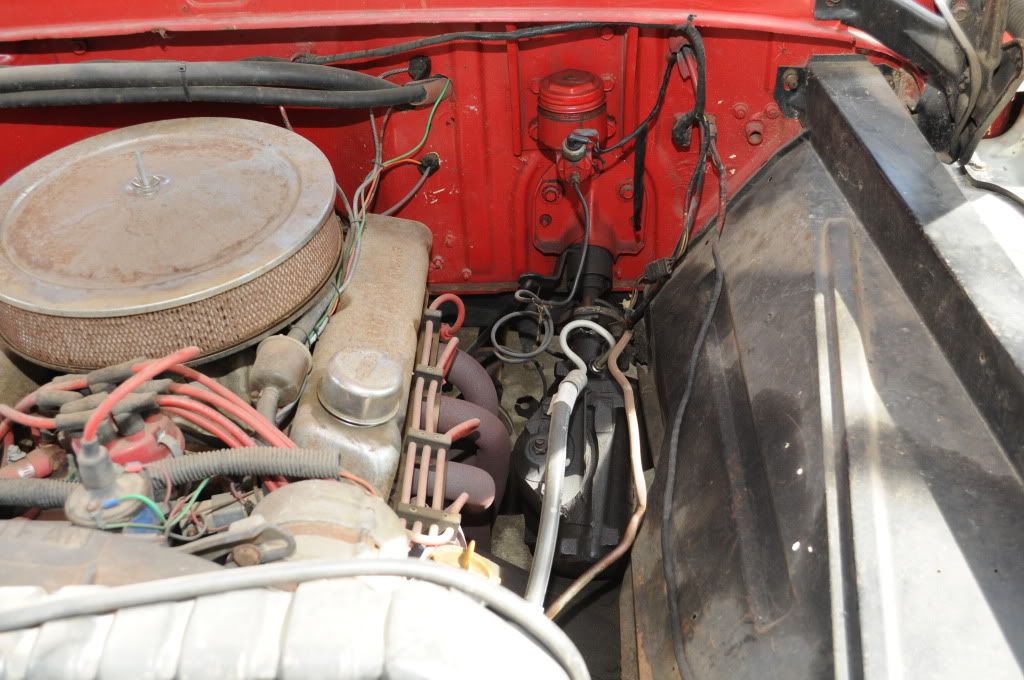
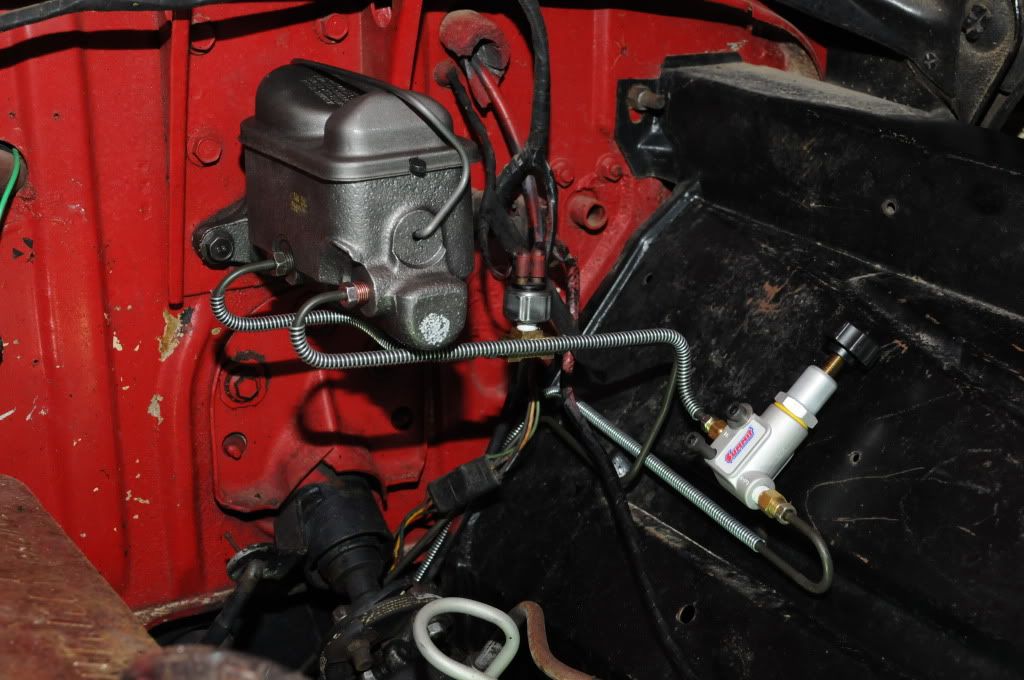
Last year, the truck was stripped completely down and the frame and the body were repainted. These photos are from back when I did the brake plumbing on it and before the rest of the truck was redone.
He brought it to me for me to plumb the hard lines between the front wheels and to install a tandem MC and to plumb it to split the front brakes from the rear.


Last year, the truck was stripped completely down and the frame and the body were repainted. These photos are from back when I did the brake plumbing on it and before the rest of the truck was redone.

Senior User
Joined: Jun 2015
Posts: 239
Likes: 3
That being said I replaced everything . . . drums, shoes, MC, wheel cylinders, hoses . . . everything after the brake pedal. Now it stops on a dime and gives you back 9 cents change. Its hard to tell how much of a role the various components played, but I did test the booster with the old drums, shoes, and wheel cylinders and it was a huge difference with just the booster, new hoses, and new lines. Now, I gently press my foot on the pedal and slow down at a light, . . . give some more gentle pressure and come to a complete stop. It wasn't like that without the booster. Also, if I slam on the brakes on dry pavement I skid to a nice straight stop.
You may as well add it. The only other thing you'll have to buy is the firewall bracket, booster, and maybe a threaded adjustable push-rod that hooks up to the pedal. I bought that in a kit with the Master Cyl., and prop. valve and had everything I needed except line and fittings. (plus the hoses, and other parts mentioned if you are replacing those as well). You can buy it all separate though.
One disadvantage to drums is that they lose effectiveness when they heat up. They'll heat up in stop and go traffic. Also, if they get wet in the rain and trap moisture they lose effectiveness. I drive my truck in the country, on sunny days so drums work very well for me. It's not a daily driver so I do not want to invest in a disc conversion right now.
If I were still in the city I would go with discs.
Good luck!
Lead Driver
Joined: Apr 2011
Posts: 6,399
Likes: 40
From: El Dorado, Arkansas
On my friend's '65 F100, I ran the lines from the MC and down in the corner of the engine compartment, where the firewall and the inner fender apron meet. They came out behind the steering gear box, just like the original line did.
If you're fabricating your own brake lines, you can route them however you want to get from point A to point B. It's just best to keep the lines as far away as possible from extreme heat sources like exhaust manifolds or headers.
If you're fabricating your own brake lines, you can route them however you want to get from point A to point B. It's just best to keep the lines as far away as possible from extreme heat sources like exhaust manifolds or headers.

Thread Starter
|
Senior User
Joined: Dec 2014
Posts: 149
Likes: 0
From: Reno, Nv
Yeah, I figured I can route them how I please. The stock lines made a bend to go between the steering box and frame to meet up at the distribution block. With the 3 port tee, I was thing of running the line around the outside of the steering box down along frame to the passenger side.
Lead Driver
Joined: Apr 2011
Posts: 6,399
Likes: 40
From: El Dorado, Arkansas
I had a manual steering gearbox in my '69 F100 but replaced it with a Saginaw PS gearbox. At any rate, both had the same 3 bolt mounting pattern. You can take the top bolt out of your steering gearbox and then just back the other two bolts off. After that, you can pull the steering gear box inward towards the engine and it will open up a gap between the box and the frame rail.
You would be able then to lay your brake line into the indented slot, between the box and the frame then, put your bolt back in and tighten the gearbox back down.
....or, you can run the line outside the gearbox. It's just up to you.
You would be able then to lay your brake line into the indented slot, between the box and the frame then, put your bolt back in and tighten the gearbox back down.
....or, you can run the line outside the gearbox. It's just up to you.
FTE Stories
Ford Trucks for Ford Truck Enthusiasts

2027 Ford Super Duty Buyer's Guide (Every Model, Engine, & Package)
Brett Foote
Top 10 Ford Truck Tragedies
Joe Kucinski
AEV FXL Super Duty - the Super Duty Raptor Ford Doesn't Make
Brett Foote
Lobo Vs Lobo: Proof the F-150 Lobo Should Be Even Lower!
Michael S. Palmer
Ford's 2001 Explorer Sportsman Concept Looks For a New Home
Verdad Gallardo
10 Best Ford Truck Engines We Miss the Most!
Joe Kucinski
2026 Shelby F-150 Off-Road: Better Than a Raptor R?
Brett Foote
2027 Super Duty Carhartt Package First Look: 12 Things You NEED to Know!
Michael S. Palmer
10 Most Surprising 2026 Ford Truck Features!
Joe Kucinski
Tuned
Joined: Jun 2015
Posts: 298
Likes: 3
I also ran them like Ultraranger described. I used the stock distribution block in the same location. The rear line ran down near it and then curved toward the rear. Btw, great write up Ultraranger, that clears up a lot for me. Come to think of it, you're probably the guy that I mentioned telling me about residual valves and newer wheel cylinders.
Markeyd, I'm definitely adding this to my list. For some reason I had decided to just stick with manual until I eventually did the disc upgrade, but why not go power drums? Everything else is already new, so it can only help.
Markeyd, I'm definitely adding this to my list. For some reason I had decided to just stick with manual until I eventually did the disc upgrade, but why not go power drums? Everything else is already new, so it can only help.
Tuned
Joined: Jun 2015
Posts: 298
Likes: 3
Looks like this would be all I'd need: http://m.ebay.com/itm/321937747242
I think that MC has a spot for the brake light switch too. Shane, you might want to consider something like this too if you're already doing the work to swap the MC.
I think that MC has a spot for the brake light switch too. Shane, you might want to consider something like this too if you're already doing the work to swap the MC.
Lead Driver
Joined: Apr 2011
Posts: 6,399
Likes: 40
From: El Dorado, Arkansas
I had previously mentioned that my '69 F100 came with manual 4-wheel drums and that I had later changed over to power front disc brakes. What I didn't mention was that in between this, I had the power brake booster I have now with a conventional cast iron 1.00" bore MC and all-wheel drums. --I figured the brakes would be sensitive with this configuration and I was right.
This was in 2012 when I installed the '75 F350 booster but still had drums all the way around.
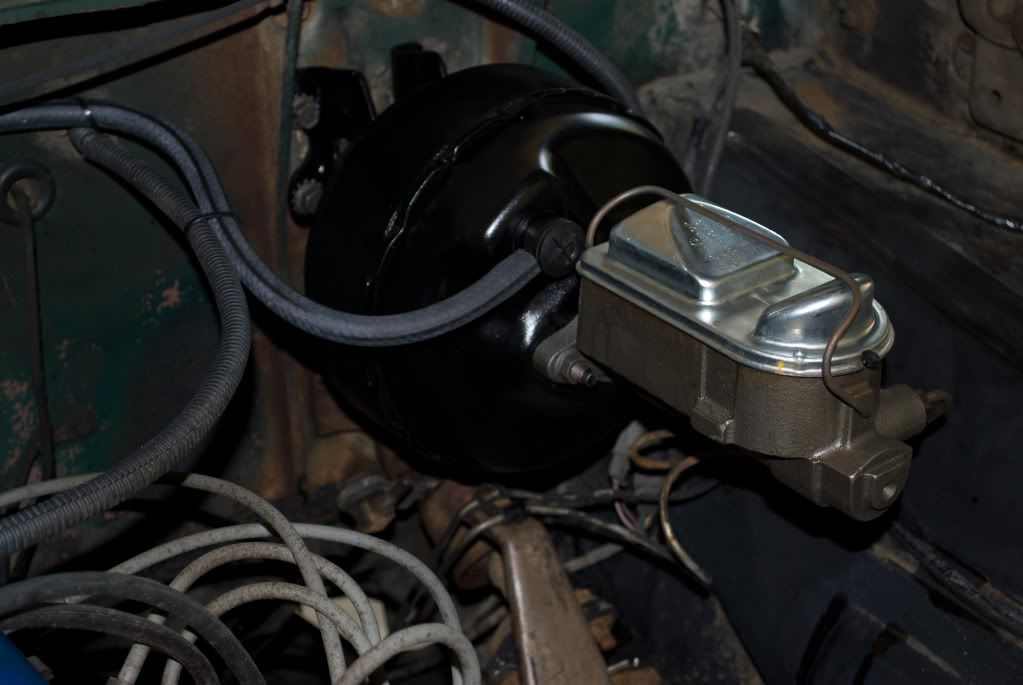
Manual brakes generally have around a 6:1 pedal ratio (mechanical advantage) while a typical power brake setup would be around 4:1. The pedal ratio didn't change (reduce) when I went from manual brakes to power brakes. The booster input rod was a straight, direct connection to my stock '69 brake pedal.
'67 and earlier F100s had 11" x 2" front drums and 11" x 1-3/4" rear drums. In '68, Ford upped the front brakes to 11" x 3" and the rears to 11" x 2-1/4". This was a lot more surface area and with the dual diaphragm booster and the 1.00" bore MC and no change in the pedal ratio, the brakes were pretty sensitive.
When I went to discs, I knew if the pedal ratio couldn't be changed (move the connection point of the booster input rod lower on the brake pedal, further away from the brake pedal's pivot), the only other way around this was to go up in MC bore diameter so, I installed a 'modern' 1-1/16" bore MC. A smaller bore MC will produce more output pressure, for the same amount of force applied to the brake pedal, than a larger bore MC. Going up 1/16th of an inch in MC bore diameter (above a 1.00" bore MC) equals a 6% reduction in output force to the brakes. But, with the powerful dual diaphragm booster behind it, the balance on my truck's brakes are just right.
Now, the brakes respond really well and brake modulation (linear application of brake force) is excellent. This is where drum brakes don't 'shine.' Modulation isn't good with drums because of their duo-servo, self-energizing nature.
This was in 2012 when I installed the '75 F350 booster but still had drums all the way around.

Manual brakes generally have around a 6:1 pedal ratio (mechanical advantage) while a typical power brake setup would be around 4:1. The pedal ratio didn't change (reduce) when I went from manual brakes to power brakes. The booster input rod was a straight, direct connection to my stock '69 brake pedal.
'67 and earlier F100s had 11" x 2" front drums and 11" x 1-3/4" rear drums. In '68, Ford upped the front brakes to 11" x 3" and the rears to 11" x 2-1/4". This was a lot more surface area and with the dual diaphragm booster and the 1.00" bore MC and no change in the pedal ratio, the brakes were pretty sensitive.
When I went to discs, I knew if the pedal ratio couldn't be changed (move the connection point of the booster input rod lower on the brake pedal, further away from the brake pedal's pivot), the only other way around this was to go up in MC bore diameter so, I installed a 'modern' 1-1/16" bore MC. A smaller bore MC will produce more output pressure, for the same amount of force applied to the brake pedal, than a larger bore MC. Going up 1/16th of an inch in MC bore diameter (above a 1.00" bore MC) equals a 6% reduction in output force to the brakes. But, with the powerful dual diaphragm booster behind it, the balance on my truck's brakes are just right.
Now, the brakes respond really well and brake modulation (linear application of brake force) is excellent. This is where drum brakes don't 'shine.' Modulation isn't good with drums because of their duo-servo, self-energizing nature.
Lead Driver
Joined: Apr 2011
Posts: 6,399
Likes: 40
From: El Dorado, Arkansas
Looks like this would be all I'd need: 1957 1972 Ford F100 8" Brake Booster 1 1 8" Bore Master Cylinder w Brackets | eBay
I think that MC has a spot for the brake light switch too. Shane, you might want to consider something like this too if you're already doing the work to swap the MC.
I think that MC has a spot for the brake light switch too. Shane, you might want to consider something like this too if you're already doing the work to swap the MC.
A 1-1/8" bore MC would have nearly a 13% reduction in output pressure for the same amount of force applied to a brake pedal with a 1.00" bore MC.
--personal opinion here but, I'm not keen on the Corvette MCs used in those kits.
Lead Driver
Joined: Apr 2011
Posts: 6,399
Likes: 40
From: El Dorado, Arkansas
It's been my observation that RARILY does an aftermarket brake booster perform as well as an actual OEM Bendix brake booster, even if it's a rebuilt unit like the Bendix booster I have. There were also single diaphragm Bendix boosters for Ford trucks.
Here's a couple on the left and one on the far right (the two in between are dual diaphragm units). Left to right: ' 68 F250 single, '74 F100 single, '74 F350 dual, '74 F350 dual, '78 F150 single.

Hard to say what the outcome would be with the aftermarket booster and the 1.00" bore MC. That's just the nature of 'engineering' a brake system (or anything automotive). Sometimes it works out fine, sometimes it doesn't. That's when you have to spend the time (and the money) to swap parts around until you get something that works to your satisfaction of being acceptable in what you expect out of it.