When you click on links to various merchants on this site and make a purchase, this can result in this site earning a commission. Affiliate programs and affiliations include, but are not limited to, the eBay Partner Network.
Does anyone have advice on how to tell what clutch is in a bone stock 1969 F-100 240 three on the tree. The only extra on this truck is heavy duty brake system. But I see there is a ten inch and an eleven inch clutch available at one parts dealer. At another the choice is standard lever type or diaphragm type. However this place does not list a 240 six under the clutch choices like the previous place does. I wanted to get the parts before I take it apart so I have minimum down time.
Thanks to both of you!! I definitely have the standard lever type. I do want to get a kit for simplicity! I certainly will be replacing the pilot bushing!! Most kits I have seen include the bushing. Thanks again!
Also don't buy a rebuilt pressure plate kit. I've seen many bent where guys had to pry out bolt mounting tab to line up the bolts holes. Those are heavy and get thrown around like paper plates and when they hit wrong something will get bent.
I have had my own set rebuilt with custom springs over standard ones a couple of time back in the 70's when living in So. Cal.
Orich
The original clutches had the old 'long style' pressure plate --3 long fingers radiating towards the center of the pressure plate. The newer diaphragm style pressure plate will have multiple fingers.
The diaphragm style clutch will have more holding force and it will be easier to push the clutch in than with the old long style and, it will have a smoother engagement.
The bigger the clutch, the more holding force it will have. However, without taking your clutch out to measure the actual clutch disc diameter, I don't know how you would know what's currently in it.
....you had mentioned having "heavy duty brakes" on your '69 F100. To my knowledge, there was only one type of drum brakes on the '68-'72 F100s, compared to the '67-earlier models. '68-'72 F100s got 11" x 3" front drums and 11"x 2-1/4" rear drums, compared to '67-earlier F100s that had 11" x 2" front drums and 11" x 1-3/4" rear drums.
DANG! I should have figured the difference in the pressure plates!! Same thing with my VWs but they are interchangeable. I would much rather have the diaphragm style!! AND I guess you are correct in that I will need to take it apart to see the size. I hope it is the 11 inch!! Size certialy does matter!!! I was not aware of the brake change. I do have the 3 inch front shoes. I guess I called it that because of getting the wrong shoes at the parts place. I took them back and mentioned that the front he gave me fit on my rear!! He looked and found that those were the rear for a '69 and gave me the correct front. He, being the parts guy, suggested that there may have been a heavy duty and regular brake. I am glad however that you set me straight on that! SO the 67 has the smaller and 68 and 69 the larger shoes! FAR OUT!
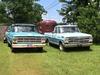
The 2nd day of ownership with my truck (1969 F100 short bed Ranger 240, C-4, --originally manual brakes, manual steering), the brakes went out on it. I rebuilt all 4 drum assemblies on it with all new parts --except the drums. They had plenty of material so, I just had them turned.
Three years later in October, 2014, I pulled the front drum brake suspension out from under the truck and installed a complete disc brake front suspension from a '77 F100. That's one of the best changes I've made on my truck.
11" x 3" Left front drum after I replaced all the old parts.
3 years later....the drum brake front suspenion....
....right before I removed all of it and replaced it with the '77 F100 disc brake front suspension.
MUCH better and well worth the effort to convert it to discs.
I did the same thing with my drums! I rebuilt entire system including new metal lines! I do want to convert to disk some day. Especially since we are pulling a two horse trailer!
The original clutches had the old 'long style' pressure plate --3 long fingers radiating towards the center of the pressure plate. The newer diaphragm style pressure plate will have multiple fingers.
The diaphragm style clutch will have more holding force and it will be easier to push the clutch in than with the old long style and, it will have a smoother engagement.
The bigger the clutch, the more holding force it will have. However, without taking your clutch out to measure the actual clutch disc diameter, I don't know how you would know what's currently in it.
....you had mentioned having "heavy duty brakes" on your '69 F100. To my knowledge, there was only one type of drum brakes on the '68-'72 F100s, compared to the '67-earlier models. '68-'72 F100s got 11" x 3" front drums and 11"x 2-1/4" rear drums, compared to '67-earlier F100s that had 11" x 2" front drums and 11" x 1-3/4" rear drums.
Pretty sure the diaphragm will actually have less holding power....not a big deal for most daily drivers.
Pretty sure the diaphragm will actually have less holding power....not a big deal for most daily drivers.
I guess I should have clarified. A regular diaphragm style clutch won't have as much clamping force as a regular long style but, a dual friction diaphragm style clutch will. The diaphragm style will also have better modulation and smoother clutch pedal action.
Center force 11" dual friction clutch in the following link. Not as cheap as a long style or regular diaphragm style but, it comes down to how much grip do you want and how much are you willing to spend for a much heavier-duty component?
^ That would have been good information to have had 2 years ago!
I was around (here) two years ago. Unfortunately, this question didn't come up for me to post the information on the Centerforce dual friction diaphragm clutch back then.
On the bright side though, if your current clutch ever gives up the ghost or, you just get a wild hair to change it out....you have the information now.
This Hennessey Takes the Expedition Tremor's Off-Roading Capability to the Next Level
Slideshow: The VelociRaptor Expedition gains a lift, upgraded suspension, Brembo brakes, and trail-ready equipment while retaining the stock 440-horsepower EcoBoost V6.
Rezvani's Latest Post-Apocalyptic Monster Is a Ford F-150 Raptor Underneath
Slideshow: Called the Fortress, the 850-horsepower pickup combines Raptor underpinnings with military-inspired features, survival equipment, and a starting price of $285,000.