


Re-curving a distributor?


Thread Starter
|
Freshman User
Joined: May 2014
Posts: 37
Likes: 0
Re-curving a distributor?
Just wondering how to go about this. And also a link to the kit would be nice. I can't seem to find it. Also, could I just buy a new distributor and not have to worry about it? Thanks for any replies.

FTE Legend


Joined: Sep 2003
Posts: 53,990
Likes: 2,398
From: NY and VA

That's old school hot rodding, to have the advance curve go x number of degrees at x RPM. Done on a distributor machine by changing weights and springs to get the desired results. Chevys could be done easily because the advance system is on the top. Ford not so easy.
What seems to be the problem? Is the vacuum advance working ok?
What seems to be the problem? Is the vacuum advance working ok?

Postmaster
Joined: Jan 2013
Posts: 3,512
Likes: 3
From: Panama City
What exactly are you working with/on? Anyone can change springs and weights but without the right tools it is hit or miss. And as far as gaining 20 hp with the way advance works it probably wont be in the power band where a truck needs it. And I am skeptical about a 20 hp gain with just advancing timing on a stock engine.
Laughing Gas


Joined: May 2006
Posts: 1,140
Likes: 13
From: Port Orchard Wa
Here you go. Duraspark_distributor_recurve_instructions_index
Some additional information to help you.
Vacuum advance- direct manifold vacuum or timed port? - Ford Muscle Forums : Ford Muscle Cars Tech Forum
And one more I found useful snipet I found useful.
"Yeah, it took me a while to fully wrap my head around manifold based timing since I'd had ported timing beat into my head for so long. Once I finally got it, it really is six or one half dozen of the other- just depends on what the end goal of the motor is. I get better economy and down low throttle response with manifold timing, but cleaner emissions and better part mid-throttle response with ported. In the end, manifold was just better for me all around.
One thing you need to really be careful about is your total advance- on a typical carbed ford head you're looking at a max of about 40*, especially in a truck.
With an EFI head it's down around 36* or so.
Over this and you can have non-audible detonation that will destroy a motor. Not catastrophically, but in the course of 10,000 miles or so.
Keep in mind, this does NOT include vacuum timing- just initial and mechanical. You can advance out to high 50*'s under low load cruise with no problem since once you load up the vacuum will go away and cut timing back.
Here's the "how to" short version.
What I like to do is advance my timing until the motor just runs perfect at idle and record what advance this is.
Then apply vacuum to the can and record what the vacuum adds.
Now subtract what the vaccum adds from your "perfect running timing". This number is now your initial timing.
Now, yank the distributor out of the truck and TOTALLY disassemble it. You'll see a rotor with two slots in it down under the advance plate. each slot will have a number followed by the letter L.
In one of these slots a little tab will be sticking up. Record the number written by both slots. Now multiply these numbers by two. These numbers are how much mechanical advance your distributor will allow.
Now, you want one of these numbers plus your initial timing (NO VACUUM) to add as close to 40 as possible without going over. Make sure the tab i referenced earlier is in this slot. if both tabs get you over 40 you have some work to do that i'm not going into right now.
While you're in there, buy a set of quick advance springs to put in. The ones I used were Mr. Gasket and cost about $7 at autozone. This will bring the mechanical advance in A LOT faster which you definitely need with manifold vacuum.
Put it all back together, set it to your new initial timing, hook the vacuum can to manifold vacuum and enjoy your newfound performance."
Some additional information to help you.
Vacuum advance- direct manifold vacuum or timed port? - Ford Muscle Forums : Ford Muscle Cars Tech Forum
And one more I found useful snipet I found useful.
"Yeah, it took me a while to fully wrap my head around manifold based timing since I'd had ported timing beat into my head for so long. Once I finally got it, it really is six or one half dozen of the other- just depends on what the end goal of the motor is. I get better economy and down low throttle response with manifold timing, but cleaner emissions and better part mid-throttle response with ported. In the end, manifold was just better for me all around.
One thing you need to really be careful about is your total advance- on a typical carbed ford head you're looking at a max of about 40*, especially in a truck.
With an EFI head it's down around 36* or so.
Over this and you can have non-audible detonation that will destroy a motor. Not catastrophically, but in the course of 10,000 miles or so.
Keep in mind, this does NOT include vacuum timing- just initial and mechanical. You can advance out to high 50*'s under low load cruise with no problem since once you load up the vacuum will go away and cut timing back.
Here's the "how to" short version.
What I like to do is advance my timing until the motor just runs perfect at idle and record what advance this is.
Then apply vacuum to the can and record what the vacuum adds.
Now subtract what the vaccum adds from your "perfect running timing". This number is now your initial timing.
Now, yank the distributor out of the truck and TOTALLY disassemble it. You'll see a rotor with two slots in it down under the advance plate. each slot will have a number followed by the letter L.
In one of these slots a little tab will be sticking up. Record the number written by both slots. Now multiply these numbers by two. These numbers are how much mechanical advance your distributor will allow.
Now, you want one of these numbers plus your initial timing (NO VACUUM) to add as close to 40 as possible without going over. Make sure the tab i referenced earlier is in this slot. if both tabs get you over 40 you have some work to do that i'm not going into right now.
While you're in there, buy a set of quick advance springs to put in. The ones I used were Mr. Gasket and cost about $7 at autozone. This will bring the mechanical advance in A LOT faster which you definitely need with manifold vacuum.
Put it all back together, set it to your new initial timing, hook the vacuum can to manifold vacuum and enjoy your newfound performance."
Senior User
Joined: Sep 2012
Posts: 372
Likes: 4
From: New Mexico
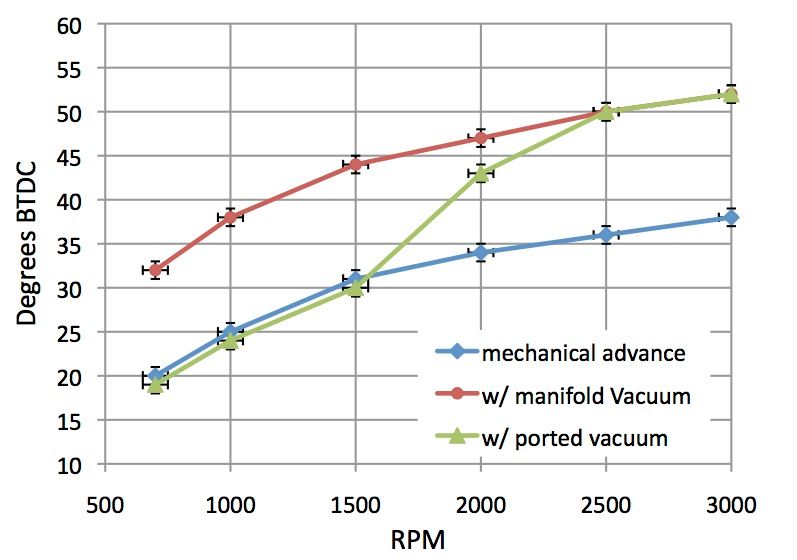
This is very useful information. Any thoughts on the shape of the curve or when (i.e. RPM) to have all the advance in? Here are some curves I measured without any engine load. Based on these I dropped the initial 10 degrees so I'm running ~20 degrees at idle right now with manifold vacuum.


Moderator & parts slinger


Joined: Feb 2007
Posts: 50,186
Likes: 5,792
From: S/W Missouri, Polk county
Copy and paste out of my info stash.
"I'd start by determining how much mechanical advance you have, then set my initial advance accordingly so you achieve 32-36 degrees total (as long as you don't experience detonation).
You can determine mechanical advance by pulling the breaker plate and seeing which advance slot the dizzy is using, the numbers will be stamped on the reluctor arms (only one advance slot is used) multiply this number by 2 and that's your mechanical advance.
Example: a 13L advance slot = 26 degrees mechanical advance, so you'd want to keep the initial advance in the 6-10 degree range to avoid spark knock.
Every vehicle/engine is different so you'll need to see what works best for your particular application, but the above numbers should get you in the ballpark, check out the link below it'll make things more clear than me trying to explain."
Duraspark_distributor_recurve_instructions_index
"I'd start by determining how much mechanical advance you have, then set my initial advance accordingly so you achieve 32-36 degrees total (as long as you don't experience detonation).
You can determine mechanical advance by pulling the breaker plate and seeing which advance slot the dizzy is using, the numbers will be stamped on the reluctor arms (only one advance slot is used) multiply this number by 2 and that's your mechanical advance.
Example: a 13L advance slot = 26 degrees mechanical advance, so you'd want to keep the initial advance in the 6-10 degree range to avoid spark knock.
Every vehicle/engine is different so you'll need to see what works best for your particular application, but the above numbers should get you in the ballpark, check out the link below it'll make things more clear than me trying to explain."
Duraspark_distributor_recurve_instructions_index

Thread
Thread Starter
Forum
Replies
Last Post
march
Big Block V8 - 385 Series (6.1/370, 7.0/429, 7.5/460)
3
Jun 3, 2013 10:29 PM
goodyear
1967 - 1972 F-100 & Larger F-Series Trucks
6
Dec 1, 2002 09:12 AM







