


reading codes


Thread Starter
|
Junior User
Joined: Feb 2013
Posts: 55
Likes: 0
reading codes
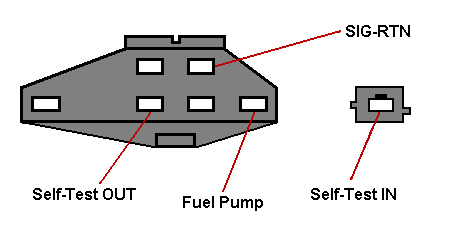
Which wires in the self diagnose conector do I jump to read my codes. I have a 1993 F150 with the 5.0 engine and e4od trans. The check engine light has been on since I bought the truck over a year ago. I put new plugs, wires, cap and rotor shortly after I bought it and it seems to run fine. Some one has bypassed the air pump and eliminated the cat. Just thought I would check for codes while I am waiting for a new gas tank assembly for the front tank. I have replaced the rear tank and decided to go ahead and do the front while I have the bed off.
Thanks, Jerry
Thanks, Jerry



Posting Guru
Joined: Sep 2008
Posts: 2,379
Likes: 2
was waiting for you or subford to reply with a nice pic...otherwise I was going to get out the crayolas.
Fleet Owner


Joined: Aug 2005
Posts: 23,667
Likes: 301
From: Easton,Ks
The Key On Engine Off and Engine Running Self-Tests detect faults that are present at the time of testing. Faults that occur only when the vehicle is operating or intermittent faults that have occurred in the last 80 warm-up cycles are detected during Continuous Self-Test, stored in the Continuous Memory and displayed during Key On Engine Off Self-Test.
As Paul pointed out above no special equipment hookup is required. STI is jumpered to SIG RTN at Self-Test Input (STI) connector and the Data Link Connector (DLC) and turn the key to the run position.
Continuous Memory Diagnostic Trouble Codes (DTC's) recorded in this step will be used for diagnosis after a PASS code 11 or 111 is received in both the Key On Engine Off and the Engine Running Self-Tests.
Start engine and run until it's at operating temperature. Turn engine off and wait 10 seconds.
DTC's will be flashed on the Malfunction Indicator Lamp (MIL).
Place ignition key in the ON position. Record all Diagnostic Trouble Codes (DTC's) displayed.
The Key On Engine Off and Engine Running Self-Tests are functional tests which only detect faults present at the time of the Self-Test. Continuous Self-Test is performed during normal vehicle operation and stores any fault information in Keep Alive Memory (KAM) for retrieval at a later time.
A single 1/2 second separator pulse is issued 6-9 seconds after the last Key On Engine Off DTC. Then, 6-9 seconds after the single 1/2 second separator pulse, the Continuous Memory DTC's will be issued.
The Self-Test is divided into three specialized tests: Key On Engine Off Self-Test, Engine Running Self-Test, and Continuous Self-Test. The Self-Test is not a conclusive test by itself, but is used as a part of the functional Quick-Test diagnostic procedure. The PCM stores the Self-Test program in its permanent memory. When activated, it checks the EEC system by testing its memory integrity and processing capability, and verifies that various sensors and actuators are connected and operating properly.

/
As Paul pointed out above no special equipment hookup is required. STI is jumpered to SIG RTN at Self-Test Input (STI) connector and the Data Link Connector (DLC) and turn the key to the run position.
Continuous Memory Diagnostic Trouble Codes (DTC's) recorded in this step will be used for diagnosis after a PASS code 11 or 111 is received in both the Key On Engine Off and the Engine Running Self-Tests.
Start engine and run until it's at operating temperature. Turn engine off and wait 10 seconds.
DTC's will be flashed on the Malfunction Indicator Lamp (MIL).
Place ignition key in the ON position. Record all Diagnostic Trouble Codes (DTC's) displayed.
The Key On Engine Off and Engine Running Self-Tests are functional tests which only detect faults present at the time of the Self-Test. Continuous Self-Test is performed during normal vehicle operation and stores any fault information in Keep Alive Memory (KAM) for retrieval at a later time.
A single 1/2 second separator pulse is issued 6-9 seconds after the last Key On Engine Off DTC. Then, 6-9 seconds after the single 1/2 second separator pulse, the Continuous Memory DTC's will be issued.
The Self-Test is divided into three specialized tests: Key On Engine Off Self-Test, Engine Running Self-Test, and Continuous Self-Test. The Self-Test is not a conclusive test by itself, but is used as a part of the functional Quick-Test diagnostic procedure. The PCM stores the Self-Test program in its permanent memory. When activated, it checks the EEC system by testing its memory integrity and processing capability, and verifies that various sensors and actuators are connected and operating properly.
/

Thread
Thread Starter
Forum
Replies
Last Post
mike L
1987 - 1996 F150 & Larger F-Series Trucks
15
Jul 13, 2006 12:08 PM
mremail1964
1987 - 1996 F150 & Larger F-Series Trucks
7
May 19, 2006 08:28 AM
broken blu oval
1980 - 1986 Bullnose F100, F150 & Larger F-Series Trucks
1
Sep 30, 2004 10:05 PM


