




Roll bar prewire recommendations?
Thread Starter
|
Postmaster
Joined: Sep 2013
Posts: 2,595
Likes: 5
From: Pasadena, Ca
Roll bar prewire recommendations?
I just got me a roll bar. Before i sand it down, paint it and bolt it in, i want to prep it for wiring.
I plan to drill a hole thru one leg bottom plate, through the bed so any wiring can be done along the frame rail and up into the engine compartment. Would the drivers side be smarter? Or passenger side? Also, i am thinking that i can run the lights in series, or not, idk.
I dont have lights picked out yet so getting into all of that is down the road.
Any ideas before i get started?
I plan to drill a hole thru one leg bottom plate, through the bed so any wiring can be done along the frame rail and up into the engine compartment. Would the drivers side be smarter? Or passenger side? Also, i am thinking that i can run the lights in series, or not, idk.
I dont have lights picked out yet so getting into all of that is down the road.
Any ideas before i get started?

Cargo Master


Joined: Oct 2010
Posts: 3,417
Likes: 32
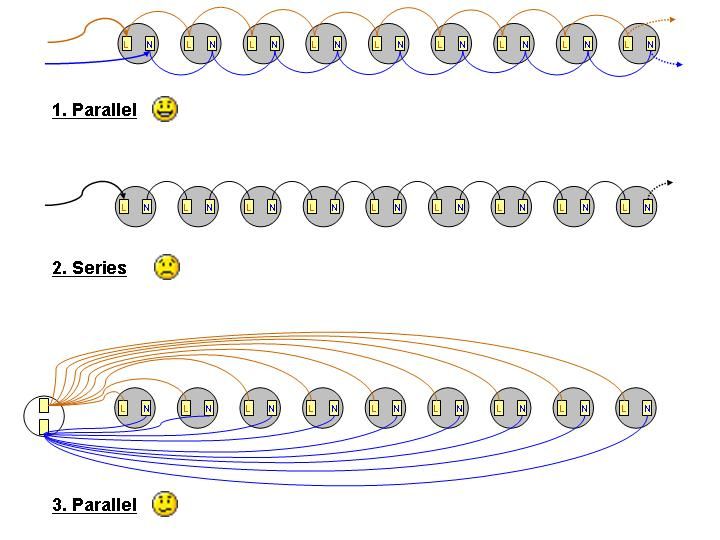
Since it's a long run, do yourself a favor and run it with at least 14ga wire. I'd even go 12ga without flinching. I would run the lights in parallel. In series if one burns out they all go out. Just like old Christmas lights.


MSEE
Joined: Apr 2004
Posts: 10,386
Likes: 35
From: Austin, TX

Never run 12-volt automotive lights in series. Not only will they act like Christmas lights as stated above, each one will be very dim because you'd be dropping 12 volts across the entire string rather than running 12 volts to each one. It also pushes the load current through the filaments which can burn out the bulbs toward the source.
Thread Starter
|
Postmaster
Joined: Sep 2013
Posts: 2,595
Likes: 5
From: Pasadena, Ca
I picked up 4 100w KC daylights off of Craigslist for $100. I am putting together my thoughts on wiring. I will run 12 gauge wiring down through the passenger side roll bar.
I am looking at a Hella H84988001 4-way mini relay box. Can i run one inline fuse to the Hella box? Would the best place to mount it be near the fuse panel? I am deciding if i should switch the roll bar and brush guard lights with the Hi Beam circuit with an additional switch.
I am looking at a Hella H84988001 4-way mini relay box. Can i run one inline fuse to the Hella box? Would the best place to mount it be near the fuse panel? I am deciding if i should switch the roll bar and brush guard lights with the Hi Beam circuit with an additional switch.

Fleet Owner
Joined: Dec 2009
Posts: 20,678
Likes: 82
From: NorCal
To determine minimum fuse and relay ratings, the basic equation is Volts x Amps = Watts
Example: 12Vdc x Amps = 100 Watts. Solve for Amps.... Amps = (100W/12Vdc) or 8.33 amps for one 100 Watt lamp.
Sizing a relay.. add up all amperage demands through the relay. Typically, one 20 Amp relay can serve two 100 Watt lamps. The "extra" capacity is a safety factor.
Minimum rating for a single circuit breaker or fuse... add up all potential amperage demands.
___________________
Given the above, here are my recommendations.
Use three switches - One for the brush guard lights, and one per pair on the roll bar (inboard and outboard).
Relays/Relay box: One relay for each light pair. Mount to right inner fender. This keeps the electrically "hot" side of the relay as short as possible as a safety measure.
Relay box power: Protect with one circuit breaker - Resettable just for the box. Alternatively, one Maxifuse to one remote power terminal for all accessories that are separate from the truck's stock systems. Get one from Jeg's or from a GM product in the salvage yard: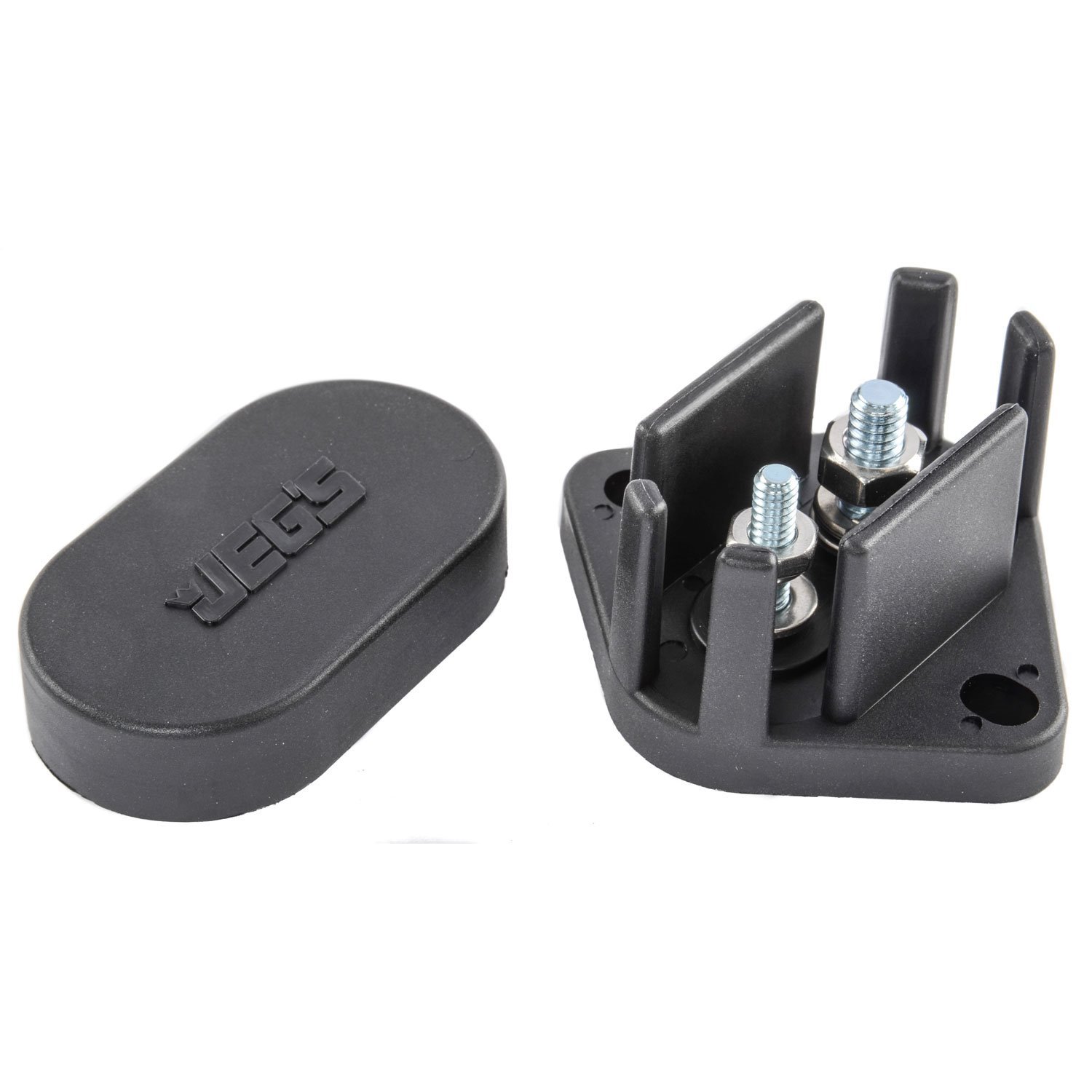
Switch power: It's only signal voltage to engage each relay. Source the power from the fuse box with one inline fuse, or three separate fuses if you choose. I would not use the high beam circuit for switch power... it limits the choice of when the driving/roll bar lights can be switched on.
Personally, I would run an auxiliary battery (mounted in a factory tray! ).
).
Example: 12Vdc x Amps = 100 Watts. Solve for Amps.... Amps = (100W/12Vdc) or 8.33 amps for one 100 Watt lamp.
Sizing a relay.. add up all amperage demands through the relay. Typically, one 20 Amp relay can serve two 100 Watt lamps. The "extra" capacity is a safety factor.
Minimum rating for a single circuit breaker or fuse... add up all potential amperage demands.
___________________
Given the above, here are my recommendations.
Use three switches - One for the brush guard lights, and one per pair on the roll bar (inboard and outboard).
Relays/Relay box: One relay for each light pair. Mount to right inner fender. This keeps the electrically "hot" side of the relay as short as possible as a safety measure.
Relay box power: Protect with one circuit breaker - Resettable just for the box. Alternatively, one Maxifuse to one remote power terminal for all accessories that are separate from the truck's stock systems. Get one from Jeg's or from a GM product in the salvage yard:
Switch power: It's only signal voltage to engage each relay. Source the power from the fuse box with one inline fuse, or three separate fuses if you choose. I would not use the high beam circuit for switch power... it limits the choice of when the driving/roll bar lights can be switched on.
Personally, I would run an auxiliary battery (mounted in a factory tray!
).
Trending Topics
Thread Starter
|
Postmaster
Joined: Sep 2013
Posts: 2,595
Likes: 5
From: Pasadena, Ca
FTE Stories
Ford Trucks for Ford Truck Enthusiasts

10 Things Every Truck Owner NEEDS (2026 Edition)
Michael S. Palmer
Rezvani's Latest Post-Apocalyptic Monster Is a Ford F-150 Raptor Underneath
Verdad Gallardo
Top 10 Most Expensive Ford Trucks Ever Sold on Bring a Trailer
Joe Kucinski
2027 Ford Super Duty Buyer's Guide (Every Model, Engine, & Package)
Brett Foote
Top 10 Ford Truck Tragedies
Joe Kucinski
AEV FXL Super Duty - the Super Duty Raptor Ford Doesn't Make
Brett Foote
Lobo Vs Lobo: Proof the F-150 Lobo Should Be Even Lower!
Michael S. Palmer
Ford's 2001 Explorer Sportsman Concept Looks For a New Home
Verdad Gallardo
10 Best Ford Truck Engines We Miss the Most!
Joe Kucinski
Fleet Owner
Joined: Dec 2009
Posts: 20,678
Likes: 82
From: NorCal
LOL.
Here's an article on a low-buck, 5-relay donor from the JY: Junkyard Builder - How to Build a Budget Junkyard Relay Board - Car Craft Magazine
Get your electrical supplies (terminals, fuse holders, wire, plugs, etc,) from Del City - Electrical Supplies & Professional Grade Wiring Products
Here's an article on a low-buck, 5-relay donor from the JY: Junkyard Builder - How to Build a Budget Junkyard Relay Board - Car Craft Magazine
Get your electrical supplies (terminals, fuse holders, wire, plugs, etc,) from Del City - Electrical Supplies & Professional Grade Wiring Products
Thread Starter
|
Postmaster
Joined: Sep 2013
Posts: 2,595
Likes: 5
From: Pasadena, Ca
Update...
I just picked up 3 sets (6@ 6" 100w each) NIB KC lights with black powder coated housing kits. $180
The kits come with the DIY wiring. The wiring is 16 gauge 21 feet, fuse, and a toggle switch. Both light's hot wire are spliced together then a single wire wire goes to the switch.
The instructions dont show any need for a relay, and the online instructions show a relay if you are connecting 2 sets together to one switch.
QUESTIONS:
1) Since these are factory instructions, should this be adequate?
2) If i add a relay, do i add it between the battery and fuse? Or between the fuse and switch?
Thanks.
Um, i found the answer to number 2...
I just picked up 3 sets (6@ 6" 100w each) NIB KC lights with black powder coated housing kits. $180
The kits come with the DIY wiring. The wiring is 16 gauge 21 feet, fuse, and a toggle switch. Both light's hot wire are spliced together then a single wire wire goes to the switch.
The instructions dont show any need for a relay, and the online instructions show a relay if you are connecting 2 sets together to one switch.
QUESTIONS:
1) Since these are factory instructions, should this be adequate?
2) If i add a relay, do i add it between the battery and fuse? Or between the fuse and switch?
Thanks.
Um, i found the answer to number 2...
Fleet Owner
Joined: Dec 2009
Posts: 20,678
Likes: 82
From: NorCal
16g wire is too lightweight for 12.33 amps. Use this table to determine the wire size to use: Amps and Wire Gauge - 12V Circuit
Personally, I'd use 10g or 12g to feed three 20 amp relays. Each relay controls two lights.
You don't want to have all that current going through the switch... that's exactly why headlight switches cycle and eventually fail. And that's why I suggest using the switch to provide the low voltage signal to energize the relay which carries the high-current to the lights. The shorter the wire and the fewer interruptions (resistance caused by splicing, connectors, etc.) the cleaner the voltage and current so the lights are that much brighter.
For the switch to provide the trigger signal... it's fuse panel (always hot)-fuse-switch-relay.
For the relay(s), it's battery-fuse-relay-light(s)... relays typically have two output terminals (Terminal 87 and 87A).
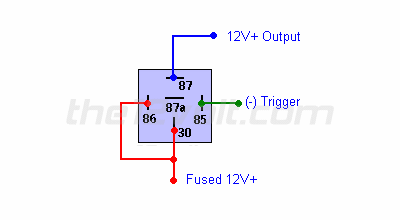
Other ways to wire relays: Relays Diagrams, Converting Polarity
Personally, I'd use 10g or 12g to feed three 20 amp relays. Each relay controls two lights.
You don't want to have all that current going through the switch... that's exactly why headlight switches cycle and eventually fail. And that's why I suggest using the switch to provide the low voltage signal to energize the relay which carries the high-current to the lights. The shorter the wire and the fewer interruptions (resistance caused by splicing, connectors, etc.) the cleaner the voltage and current so the lights are that much brighter.
For the switch to provide the trigger signal... it's fuse panel (always hot)-fuse-switch-relay.
For the relay(s), it's battery-fuse-relay-light(s)... relays typically have two output terminals (Terminal 87 and 87A).
Other ways to wire relays: Relays Diagrams, Converting Polarity
Thread Starter
|
Postmaster
Joined: Sep 2013
Posts: 2,595
Likes: 5
From: Pasadena, Ca
Right on, man.
Im jazzed right now, lol. Hopefully i can dig into this this weekend or next. I wanted black in the first place but take what comes, ya know.😁
Time to throw a good deal on 4@6" chrome KCs to someone else!
Thanks bro
Im jazzed right now, lol. Hopefully i can dig into this this weekend or next. I wanted black in the first place but take what comes, ya know.😁
Time to throw a good deal on 4@6" chrome KCs to someone else!
Thanks bro

Thread
Thread Starter
Forum
Replies
Last Post
tooldad1041
1999 - 2016 Super Duty
17
Dec 12, 2014 05:40 AM