


Duke Engines

Thread Starter
|
FTE Leadership Emeritus


Joined: Jan 2003
Posts: 161,999
Likes: 75
From: 3rd Rock

Duke Engines
Anyone heard much about this...way cool
How the Duke Engines increases the efficiency of the internal combustion engine
How the Duke Engines increases the efficiency of the internal combustion engine

Postmaster
Joined: Mar 2013
Posts: 3,066
Likes: 7
From: Over There
Interesting, many of the ideas employed there that they seem to take credit for aren't new and have been around for over a century. It is an interesting modern take on it though that combines them in a rather new unique way.
This is the Macomber Axial Engine designed in 1911, look familiar.
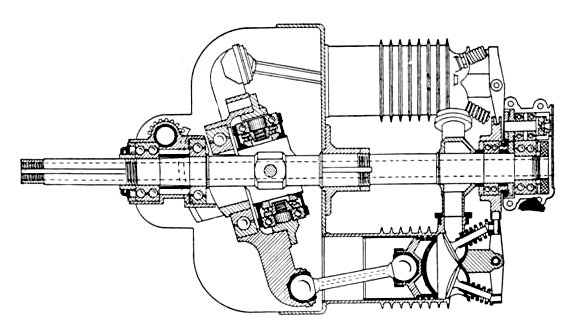
Rotary axial engines aren't new, though most that have existed in the past have used a swash plate, a kind of rotating cam not a wobble plate, what they call the "reciprocator" which isn't new tech either. In those engines though the cylinders are stationary, though an engine is really a pump and some hydraulic pumps work with the cylinders rotating like those though. This is odd and new as it moves both the crank and cylinders in opposite directions with a stationary head, that is interesting. Kind of combining an axial engine with a Wankel/Rotary engine.
I have no idea why axial rotary engines haven't caught on, I think it's a very practical design. There were some axial engines with a swash plate design and stationary cylinders used in planes back in the day. A diesel version was even tried.
My favorite design is the dyna-cam


In this particular engine I see a lot of unsolvable problems and dubious claims. Problems, almost all cause of the rotating cylinder stationary head design. Sealing, both of the combustion and coolant. It would almost have to be oil cooled and have low cylinder pressures and/or be designed to leak. Poor combustion chamber, it will have the same unsolvable problem as the rotary engine, the rotating combustion chamber and spark plug issues. The top of the combustion chamber must be flat, this means the shape will be poor, the plug can't protrude, and the plug can't seal leading to the passage of still burning gasses from one cylinder to another. Last is valving, the shape and timing is critical and fixed. This means no variable valve timing.
Claims, the 14:1 I don't buy at all, really that depends on how you measure it. But as they present it I don't buy it. 14:1 static (swept:quench) sure, 14:1 dynamic as it's implied no way.
http://www.douglas-self.com/MUSEUM/P...g/axial-IC.htm A good collection of axial history
This is the Macomber Axial Engine designed in 1911, look familiar.
Rotary axial engines aren't new, though most that have existed in the past have used a swash plate, a kind of rotating cam not a wobble plate, what they call the "reciprocator" which isn't new tech either. In those engines though the cylinders are stationary, though an engine is really a pump and some hydraulic pumps work with the cylinders rotating like those though. This is odd and new as it moves both the crank and cylinders in opposite directions with a stationary head, that is interesting. Kind of combining an axial engine with a Wankel/Rotary engine.
I have no idea why axial rotary engines haven't caught on, I think it's a very practical design. There were some axial engines with a swash plate design and stationary cylinders used in planes back in the day. A diesel version was even tried.
My favorite design is the dyna-cam
In this particular engine I see a lot of unsolvable problems and dubious claims. Problems, almost all cause of the rotating cylinder stationary head design. Sealing, both of the combustion and coolant. It would almost have to be oil cooled and have low cylinder pressures and/or be designed to leak. Poor combustion chamber, it will have the same unsolvable problem as the rotary engine, the rotating combustion chamber and spark plug issues. The top of the combustion chamber must be flat, this means the shape will be poor, the plug can't protrude, and the plug can't seal leading to the passage of still burning gasses from one cylinder to another. Last is valving, the shape and timing is critical and fixed. This means no variable valve timing.
Claims, the 14:1 I don't buy at all, really that depends on how you measure it. But as they present it I don't buy it. 14:1 static (swept:quench) sure, 14:1 dynamic as it's implied no way.
http://www.douglas-self.com/MUSEUM/P...g/axial-IC.htm A good collection of axial history

Cargo Master


Joined: Apr 2003
Posts: 3,476
Likes: 224
From: Frequently frozen MN
Nice commentary BruteFord. When I looked at the vid, I thought that there might be issues, but I don't have anything like the background to be certain.
The traditional design seems awfully tough to beat. Maybe it's just because it's been refined to such a high point.
hj
The traditional design seems awfully tough to beat. Maybe it's just because it's been refined to such a high point.
hj

Super Moderator


Joined: Apr 2004
Posts: 34,529
Likes: 2,831
Several variations it seems:
http://en.wikipedia.org/wiki/Axial_engine
More discussion, looks like the lack of money and the efforts to get money might have been as much trouble as anything:
MOVED: What ever happened to the Dyna Cam engine?
http://en.wikipedia.org/wiki/Axial_engine
More discussion, looks like the lack of money and the efforts to get money might have been as much trouble as anything:
MOVED: What ever happened to the Dyna Cam engine?

pedant
Joined: Jan 2008
Posts: 23,576
Likes: 40
From: EXTREME southwest CT

How do you keep something like this cool across a wide range of operating conditions?
I understand a torpedo engine where packaging a small cylinder makes sense, but they don't have to run very long.
Subscribed
I understand a torpedo engine where packaging a small cylinder makes sense, but they don't have to run very long.
Subscribed
Trending Topics
Super Moderator
Joined: Apr 2004
Posts: 34,529
Likes: 2,831
There is bound to be a reason beyond money. Might have a very limited rpm range for example. I'll try to research it more if I can work up an interest....
FTE Stories
Ford Trucks for Ford Truck Enthusiasts

Top 6 Best Deals Available on New Fords & Lincolns Right Now
Brett Foote
This Hennessey Takes the Expedition Tremor's Off-Roading Capability to the Next Level
Verdad Gallardo
Top 10 Fords at 2026 Carlisle Ford Nationals
Joe Kucinski
3 Best / 3 Worst Parts of Modern Ford Ownership
Brett Foote
10 Amazing Upgrades That Solve Common Ford Truck Owner Headaches
Pouria Savadkouei
Every 2026 Ford Engine Explained
Brett Foote
10 Ugly Ford Trucks That We Still Kinda Love
Joe Kucinski
10 Things Every Truck Owner NEEDS (2026 Edition)
Michael S. Palmer
Rezvani's Latest Post-Apocalyptic Monster Is a Ford F-150 Raptor Underneath
Verdad Gallardo
New User
Joined: Dec 2017
Posts: 1
Likes: 0
 These don't work
The entire DUKE engine is full of things that don't belong but the main is piston sleeves rotating ( lot of rotating mass to rob power ) counter rotating crankshaft ( there's a LOT of power lost in the void ) I get what they're trying to do but rotary valves would do better then there's the seals which gives it one of the same problems the Wankel had now a 2 stroke version of this engine might work due to the fact that only the crankshaft would be rotating but that wouldn't be aloud to be in a passenger car van or truck maybe in a Peterbilt or Mack ( not sure if they make 2 strokes for these anymore maybe outside the US ) or in an ultralight but you might want to check out the Dyna Cam engine this looks like a better solution it basically a wobbly disc that has cylinders that face the front and back of the engine with pairs of pistons joined together but this also would work better as a 2 stroke
P.S. I know this is an entire paragraph with the only punctuations being for side notes and feel free to add upon anything
P.S. I know this is an entire paragraph with the only punctuations being for side notes and feel free to add upon anything

Thread
Thread Starter
Forum
Replies
Last Post
Furyus1
1973 - 1979 F-100 & Larger F-Series Trucks
18
Jul 5, 2009 09:32 PM
Garden Spyder
Kansas Chapter
10
Feb 7, 2009 12:56 AM