Electric fuel pump wiring

Thread Starter
|
Cargo Master


Joined: May 2009
Posts: 2,587
Likes: 47
From: Eagle River, AK
Electric fuel pump wiring
I have decided to go the electric fuel pump method for the truck I am building.
I have the pump and the pre-filter and want to start getting all the wiring supplies ordered up.
I know I should have a safety switch for this pump, but I also want to be able to use the pump to "prime" the fuel system after the truck sits for extended periods of time. When the truck sits for 2-3 weeks, there is a lot of cranking required to get fuel back to the carburetor and this is what I want to resolve as well as get a more steady fuel pressure.
I believe that if I use a safety switch, It will only allow power to the pump when there is oil pressure pressent, i.e. during cranking and once the engine is running.
To use it as a priming pump as well, do I need to wire in a manual switch, or is there a way to have it "prime" once the key is turned, before start-up?
Or would it be best to use a dual trigger relay. One for the safety switch and one for the manual switch?
Or just run two relays...?
Probably over thinking it....
TIA
I have the pump and the pre-filter and want to start getting all the wiring supplies ordered up.
I know I should have a safety switch for this pump, but I also want to be able to use the pump to "prime" the fuel system after the truck sits for extended periods of time. When the truck sits for 2-3 weeks, there is a lot of cranking required to get fuel back to the carburetor and this is what I want to resolve as well as get a more steady fuel pressure.
I believe that if I use a safety switch, It will only allow power to the pump when there is oil pressure pressent, i.e. during cranking and once the engine is running.
To use it as a priming pump as well, do I need to wire in a manual switch, or is there a way to have it "prime" once the key is turned, before start-up?
Or would it be best to use a dual trigger relay. One for the safety switch and one for the manual switch?
Or just run two relays...?
Probably over thinking it....
TIA

Elder User

Joined: Jun 2012
Posts: 850
Likes: 0
From: Florida
I have been thinking about a method to power one item through two different switches and circuits, and concluded that a diode placed near the item would prevent power going back to the other switch. if that would work, then a momentary switch to press before hitting the key to start would not affect a safety switch because it is not in the same circuit..... if it works 
Thread Starter
|
Cargo Master
Joined: May 2009
Posts: 2,587
Likes: 47
From: Eagle River, AK
This was something posted in response to the same thread I started on a local forum. It was posted by one of the more senior members that is pretty well respected and it sounds pretty close to what I want to do.
"My 2 cents, I prefer to get 12 volt power from the battery or nearby source like a terminal strip or starter solenoid. Tapping into an existing circuit could overload that circuit leading to premature failure or worse.
I always fuse a power wire (lead) as close as possible to it's source , that way the whole circuit protected.
I usually use wire that is larger in size than necessary.
For a fuel pump I would use a 12 volt SPST relay.
An oil pressure switch that opens at a preset point is available from any FLAPS, they are usually employed in vehicles with idiot lights, sometimes others. This will shut off the fuel pump if oil pressure falls to a dangerous level.
I try to mount fuses and relays as close together as possible to make maintenance and trouble shooting easier.
The circuit for the fuel pump would be as follows: a switched (hot with key on) 12 volt source to a fuse, to an oil pressure switch, to post 86 on a 12 volt SPST relay The bypass priming circuit would be any 12 volt source (see above) to a fuse, to a momentary on switch to terminal 86 on your fuel pump relay.
This would allow you to press a button (or toggle) to prime the system, before cranking the engine. Then start the engine in the normal manner.
Hope this helps, if you have any questions, LMK, I try to write things like this at a basic level, so people who are mystified by electricity can learn the basics. Good luck!"
"My 2 cents, I prefer to get 12 volt power from the battery or nearby source like a terminal strip or starter solenoid. Tapping into an existing circuit could overload that circuit leading to premature failure or worse.
I always fuse a power wire (lead) as close as possible to it's source , that way the whole circuit protected.
I usually use wire that is larger in size than necessary.
For a fuel pump I would use a 12 volt SPST relay.
An oil pressure switch that opens at a preset point is available from any FLAPS, they are usually employed in vehicles with idiot lights, sometimes others. This will shut off the fuel pump if oil pressure falls to a dangerous level.
I try to mount fuses and relays as close together as possible to make maintenance and trouble shooting easier.
The circuit for the fuel pump would be as follows: a switched (hot with key on) 12 volt source to a fuse, to an oil pressure switch, to post 86 on a 12 volt SPST relay The bypass priming circuit would be any 12 volt source (see above) to a fuse, to a momentary on switch to terminal 86 on your fuel pump relay.
This would allow you to press a button (or toggle) to prime the system, before cranking the engine. Then start the engine in the normal manner.
Hope this helps, if you have any questions, LMK, I try to write things like this at a basic level, so people who are mystified by electricity can learn the basics. Good luck!"

Fleet Owner
Joined: Dec 2009
Posts: 20,678
Likes: 82
From: NorCal
I'm going EFI on my '70 and plan to install an inertia switch in case the unfortunate happens. Wouldn't want the pump keep running if injured or otherwise incapacitated. "might ooughtta consider it for your rig.
Here's a cut-away showing its operation:
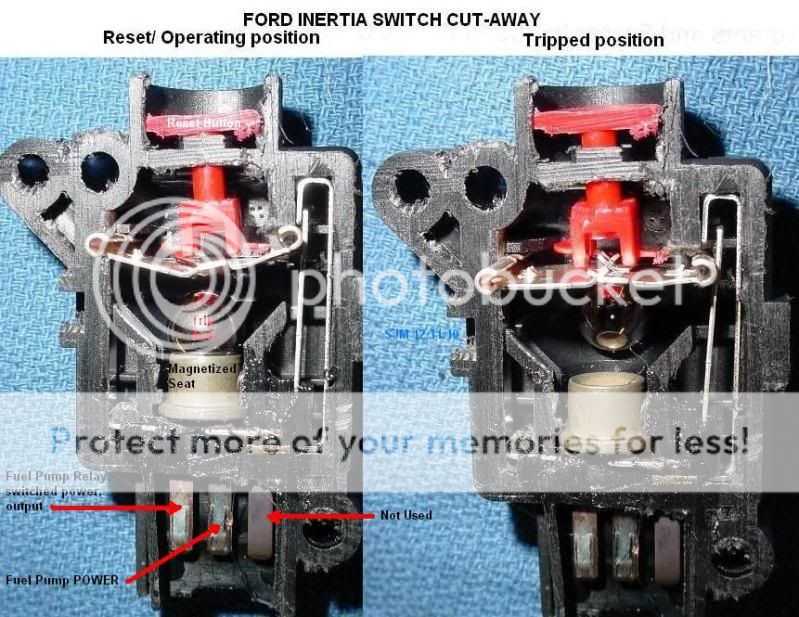
Here's a cut-away showing its operation:
Thread Starter
|
Cargo Master
Joined: May 2009
Posts: 2,587
Likes: 47
From: Eagle River, AK
It's funny you mention it, I was pricing those today. Sounds like cheap insurance to me.
I definatly plan to incorporate one in the design.
Maybe go from the oil pressure switch to the inertia switch, then to the relay.
Thanks for the pictures.
I definatly plan to incorporate one in the design.
Maybe go from the oil pressure switch to the inertia switch, then to the relay.
Thanks for the pictures.

MSEE
Joined: Apr 2004
Posts: 10,386
Likes: 35
From: Austin, TX

Most oil pressure switches or "dummy light" sending units are "ground out" switches, meaning they have one terminal, and the body itself threads into the grounded engine block. As such, the oil pressure switch would need to be the last piece in the chain.
Agreed that an inertia switch is a good idea. In fact, this is standard practice on modern EFI vehicles. You'd want to look for a 2-terminal switch, placed upstream of the oil pressure switch, which typically has to be at the "end" for the reasons described above. Therefore, the coil side of the relay would look as follows: keyed 12 volts through a fuse, through the coil of the relay, through the 2-terminal inertia switch, then finally to a ground-out oil pressure switch to ground. If you can find a 2-terminal oil pressure switch (which certainly exist), then you have more freedom as to where that goes. The contact side of the relay would look as follows: hot at all times 12 volts off the battery side of the starter solenoid, through a fuse, through the contacts of the relay, fuel pump, and then ground. The pump only comes on with the relay engaged, and the relay could only be engaged with the key on and both switches closed.
However, in the absence of any sort of "priming" mechanism as you describe, the problem you're facing would only be worse, as the engine would first have to crank to build oil pressure and turn on the fuel pump, and then prime the system. How this is solved would depend on the style of oil pressure switch used.
For the single-terminal "ground out" switch, the simplest solution would be an SPST momentary switch to ground in parallel with the oil pressure switch. You would hold it in while cranking the engine, which would "fool" the relay into thinking there is enough pressure and letting the pump run. The more complicated solution would be to implement a small electronic circuit (commonly referred to as a "one shot") to handle this automatically. The idea would be similar for a 2-terminal oil pressure switch; the connectivity would simply be different.
Since this is a fairly common application, I'd be curious if there's any sort of aftermarket module or system that's already made, with most of the work done for you. I'd check Summit or Jegs.
Agreed that an inertia switch is a good idea. In fact, this is standard practice on modern EFI vehicles. You'd want to look for a 2-terminal switch, placed upstream of the oil pressure switch, which typically has to be at the "end" for the reasons described above. Therefore, the coil side of the relay would look as follows: keyed 12 volts through a fuse, through the coil of the relay, through the 2-terminal inertia switch, then finally to a ground-out oil pressure switch to ground. If you can find a 2-terminal oil pressure switch (which certainly exist), then you have more freedom as to where that goes. The contact side of the relay would look as follows: hot at all times 12 volts off the battery side of the starter solenoid, through a fuse, through the contacts of the relay, fuel pump, and then ground. The pump only comes on with the relay engaged, and the relay could only be engaged with the key on and both switches closed.
However, in the absence of any sort of "priming" mechanism as you describe, the problem you're facing would only be worse, as the engine would first have to crank to build oil pressure and turn on the fuel pump, and then prime the system. How this is solved would depend on the style of oil pressure switch used.
For the single-terminal "ground out" switch, the simplest solution would be an SPST momentary switch to ground in parallel with the oil pressure switch. You would hold it in while cranking the engine, which would "fool" the relay into thinking there is enough pressure and letting the pump run. The more complicated solution would be to implement a small electronic circuit (commonly referred to as a "one shot") to handle this automatically. The idea would be similar for a 2-terminal oil pressure switch; the connectivity would simply be different.
Since this is a fairly common application, I'd be curious if there's any sort of aftermarket module or system that's already made, with most of the work done for you. I'd check Summit or Jegs.
Thread Starter
|
Cargo Master
Joined: May 2009
Posts: 2,587
Likes: 47
From: Eagle River, AK
Will do, thanks for the information. It seems in the world of oil pressure switches, there are many two and three terminal ones to choose from.
I will take a look and see if there is any "affordable" all in one solutions.
If possible, I would like the priming function to not have to be done while cranking. We'll se what I come up with. Once I get the system designed, I will draw it out and post it.
Thanks again for your input.
I will take a look and see if there is any "affordable" all in one solutions.
If possible, I would like the priming function to not have to be done while cranking. We'll se what I come up with. Once I get the system designed, I will draw it out and post it.
Thanks again for your input.
Trending Topics
MSEE
Joined: Apr 2004
Posts: 10,386
Likes: 35
From: Austin, TX
Sounds good. I should clarify: with either method, you'd hold the key in RUN briefly (for the time it takes to prime) prior to turning the key to START to crank the engine. In the case of the simple solution, you'd hold the momentary switch during this time to bypass the oil pressure cutoff.
FTE Stories
Ford Trucks for Ford Truck Enthusiasts

Rezvani's Latest Post-Apocalytic Monster Is a Ford F-150 Raptor Underneath
Verdad Gallardo
Top 10 Most Expensive Ford Trucks Ever Sold on Bring a Trailer
Joe Kucinski
2027 Ford Super Duty Buyer's Guide (Every Model, Engine, & Package)
Brett Foote
Top 10 Ford Truck Tragedies
Joe Kucinski
AEV FXL Super Duty - the Super Duty Raptor Ford Doesn't Make
Brett Foote
Lobo Vs Lobo: Proof the F-150 Lobo Should Be Even Lower!
Michael S. Palmer
Ford's 2001 Explorer Sportsman Concept Looks For a New Home
Verdad Gallardo
10 Best Ford Truck Engines We Miss the Most!
Joe Kucinski
2026 Shelby F-150 Off-Road: Better Than a Raptor R?
Brett Foote
Thread Starter
|
Cargo Master
Joined: May 2009
Posts: 2,587
Likes: 47
From: Eagle River, AK
Sounds good. I should clarify: with either method, you'd hold the key in RUN briefly (for the time it takes to prime) prior to turning the key to START to crank the engine. In the case of the simple solution, you'd hold the momentary switch during this time to bypass the oil pressure cutoff.
I want to be able to turn the key to the run position and only prime it if needed and then to be able to also start the truck as normal (say, if it is a restart and does not need priming) by just turning the key to start.
I know it is much simpler than I am thinking, but all these relays and switches are a little harder for me to wrap my head around.
Will wiring the momentary on switch to one input signal terminal on the relay and the safety switches to the other actually work? Or is that not the way the relays work?
Thanks again for explaining this to a "simpleton" when it comes to electronics.
*EDIT* Dang Jeff, I think it just clicked what you were saying.

Use the terminerals on the oil pressure to operate the momentary on switch. That is much simpler.
Thread Starter
|
Cargo Master
Joined: May 2009
Posts: 2,587
Likes: 47
From: Eagle River, AK
I can answer the Fuel Pump question caliRanger XLT.
The fuel pump runs continuously while the engine is running.
The fuel pump I purchased is internally regulated (with a bypass) and is a low pressure pump. I chose the Airtex E84070 Electric Fuel Pump as a starting point. I did this to hope the pump lasts longer due to the internal bypass helping to reduce dead head pressure. Wiring is also a big factor in how long a fuel pump lasts. I am wanting to make sure I do it correctly, hence the reason for this thread.
I am going to start with running in un-regulated and see how it does. As in seeing if it over powers the seats in the carb abd causes runability problems. If it does, then I will run it with a bypass style regulator so that the pump itself does not see and dead head pressure time and that the fuel in excess of the set fuel pressure is routed to a return line to the fuel tank.
A regulated bypass set-up is by far the best, but it is a more complex system and if I were to purchase a fuel pressure regulator set-up for a bypass systen, I will not buy one of the cheap ones. So if I can get the unregulated system to work well, then I will be saving some money.
On your other question, I do not know.
Fuel Pump: http://www.summitracing.com/parts/atx-e84070/overview/
Just noticed..
Oil Pressure the MFG Suggests: http://www.summitracing.com/parts/atx-os75
It is not available, but there are many three terminal oil pressure switched out there.
The fuel pump runs continuously while the engine is running.
The fuel pump I purchased is internally regulated (with a bypass) and is a low pressure pump. I chose the Airtex E84070 Electric Fuel Pump as a starting point. I did this to hope the pump lasts longer due to the internal bypass helping to reduce dead head pressure. Wiring is also a big factor in how long a fuel pump lasts. I am wanting to make sure I do it correctly, hence the reason for this thread.
I am going to start with running in un-regulated and see how it does. As in seeing if it over powers the seats in the carb abd causes runability problems. If it does, then I will run it with a bypass style regulator so that the pump itself does not see and dead head pressure time and that the fuel in excess of the set fuel pressure is routed to a return line to the fuel tank.
A regulated bypass set-up is by far the best, but it is a more complex system and if I were to purchase a fuel pressure regulator set-up for a bypass systen, I will not buy one of the cheap ones. So if I can get the unregulated system to work well, then I will be saving some money.
On your other question, I do not know.
Fuel Pump: http://www.summitracing.com/parts/atx-e84070/overview/
Just noticed..
Oil Pressure the MFG Suggests: http://www.summitracing.com/parts/atx-os75
It is not available, but there are many three terminal oil pressure switched out there.
Post Fiend
Joined: Apr 2008
Posts: 5,338
Likes: 3
From: Grants Pass, Oregon
Interesting stuff! my 76 was set up with an electric pump that crapped out shortly after i bought it that was wired directly to the relay without even a fuse! when i replaced the pump with a beefier one from Napa, i at least added an inline fuse........this truck wont see much driving in terms of mileage or speeds in excess of 45 mph, but i should wire in a safety switch of some sort........ive got a handful of the relays of the type used for driving lights, and miles of primary wire, lots of terminals and switches........Once the weather warms to the temp that makes crawling under an old truck comfortable, a project to do....
Thread Starter
|
Cargo Master
Joined: May 2009
Posts: 2,587
Likes: 47
From: Eagle River, AK
Good deal. I say go for it and add some safety. The oil pressure switch is primarily for the engine safety and the inertia switch is more to stop the pump from pumping raw fuel after an accident.
My truck is going to "look" like a nice old truck, but I want some of the modern safety features as well. I will also be inatalling a cluych safety switch so that you have to press the clutch to start the truck, but I will also have a bypass for that for in case I need to move the truck via the starter in an emergency.
My truck is going to "look" like a nice old truck, but I want some of the modern safety features as well. I will also be inatalling a cluych safety switch so that you have to press the clutch to start the truck, but I will also have a bypass for that for in case I need to move the truck via the starter in an emergency.
Thread Starter
|
Cargo Master
Joined: May 2009
Posts: 2,587
Likes: 47
From: Eagle River, AK
I have a few questions
The parts store I went to did not have the Hobbs Switch that FMC400 said he used, the crossed it to a Napa/Echlin P/N OP6617, but it does not have any identifying letters to the terminal.
Is there a way to ohm out the switch and see what terminals go to what?
In the picture below, the terminal at 10 o'clock was hooked to HOT in RUN, the terminal at 7 o'clock was hooked to HOT in START and the terminal at 5 o'clock was connected to the relay. The pump ran continuously when in the run position. Does that sound like I have the I and S terminals backwards.

Last question for now...
With the battery disconnected, is it normal for the sources I chose for the HOT in RUN and START to have continuity to ground? For some reason some of this stuff always cornfuses me .
.
The parts store I went to did not have the Hobbs Switch that FMC400 said he used, the crossed it to a Napa/Echlin P/N OP6617, but it does not have any identifying letters to the terminal.
Is there a way to ohm out the switch and see what terminals go to what?
In the picture below, the terminal at 10 o'clock was hooked to HOT in RUN, the terminal at 7 o'clock was hooked to HOT in START and the terminal at 5 o'clock was connected to the relay. The pump ran continuously when in the run position. Does that sound like I have the I and S terminals backwards.
Last question for now...
With the battery disconnected, is it normal for the sources I chose for the HOT in RUN and START to have continuity to ground? For some reason some of this stuff always cornfuses me
.