



#2 diesel

Post Fiend
Joined: Sep 2006
Posts: 7,426
Likes: 6
From: Sioux Falls, SD
Diesel #1 is the "regular" fuel. There's a whole sliding scale up here involving time of year and temperature that decides if/when you get a #1/#2 blend or straight #2. It's been -20 in the last month.
Thanks, Tom. I know the refineries here make the #2 as well, but I didn't know kerosene was in there. I suppose that makes sense. When it comes to which fuel you get, there's no choices. With that in mind, I'm trusting a refinery not to put something more corrosive into my truck. #2 is also about 60 cents more a gallon.
Thanks, Tom. I know the refineries here make the #2 as well, but I didn't know kerosene was in there. I suppose that makes sense. When it comes to which fuel you get, there's no choices. With that in mind, I'm trusting a refinery not to put something more corrosive into my truck. #2 is also about 60 cents more a gallon.

During the winter months you'll see:
Diesel#2 treated with an anti-gel,
Diesel #1 (kerosene) or
a mix/blend of the two.
When you get below -10F it's best to fill up with #1 if the truck will be parked outside. When you use an additive be sure to add it in before the fuel hits it's cloud point - For #1 diesel the winter cloud point will typically be around -30°F to -40F. # 2 diesel fuel, the winter cloud point will typically be +15°F to +20F.
You will see a drop in MPG when you run #1 for two reasons. #1 has a lower BTU rating and we tend to let the truck idle/warm up much longer during the winter.
Post Fiend
Joined: Sep 2006
Posts: 7,426
Likes: 6
From: Sioux Falls, SD
Here are a few pics so you can get an idea what happens to diesel fuel in the winter:
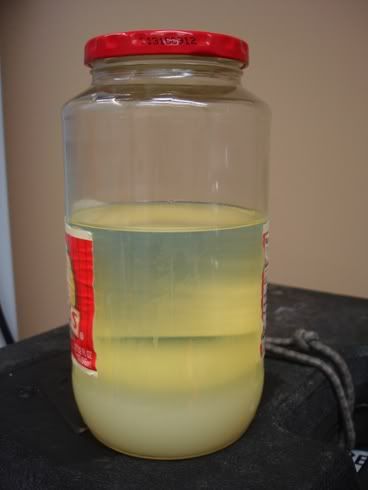
#2 Diesel when the temps dropped to -27, the paraffin wax crystals become large enough to drop out of the fuel and clog/gel your fuel.
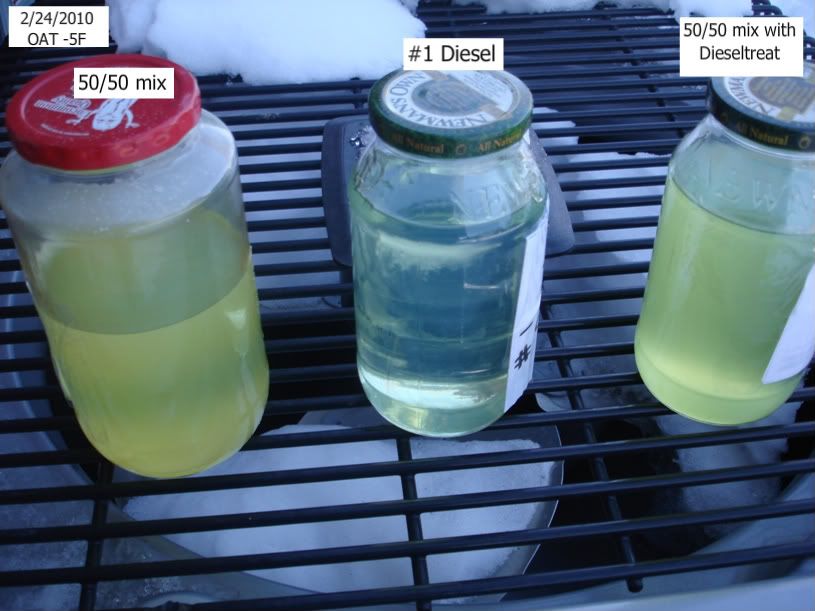
in the center of this pic is #1 diesel at -5F, not even cloudy.
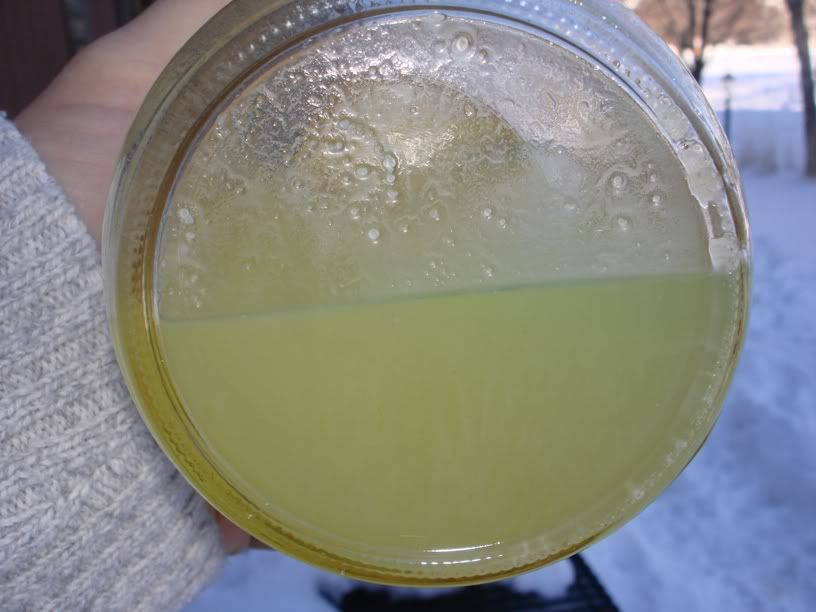
A 50/50 mix of #1 and #@ without any additive still showed som wax drop out at the bottom of the jar.......
#2 Diesel when the temps dropped to -27, the paraffin wax crystals become large enough to drop out of the fuel and clog/gel your fuel.

in the center of this pic is #1 diesel at -5F, not even cloudy.

A 50/50 mix of #1 and #@ without any additive still showed som wax drop out at the bottom of the jar.......

Post Fiend
Joined: Sep 2006
Posts: 7,426
Likes: 6
From: Sioux Falls, SD
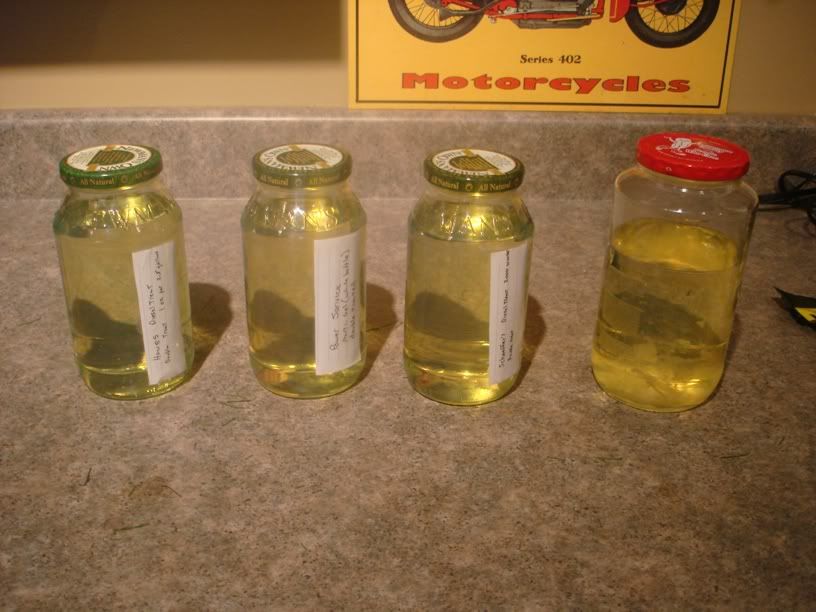
The good thing is...........if you can get your truck in a garage for a few hours the wax will eventually reabsorb into the fuel. You can still see some wax in the untreated sample on the right. The others were treated with various anti-gelling additives and seemed to recover quicker than the untreated sample.


Lead Driver


Joined: Jun 2004
Posts: 6,326
Likes: 585
From: Amarillo, TEXAS!
I was reading on a fuel company's website that the ULSD takes longer to return to normal than the old diesel did. It also said that ULSD will drop the paraffin at a higher temperature if it sits for a couple days and gets cold soaked, and if that happens the fuel needs to be warmed to a temperature quite a bit higher than the cloud point to return to normal, sometimes as high as 50F!
So the moral to the story as I see it is to treat your fuel when it's cold.
So the moral to the story as I see it is to treat your fuel when it's cold.

Cargo Master


Joined: Oct 2011
Posts: 2,878
Likes: 772
From: SoCal/Wyoming
#2 is the only option we have all year long. 71 degrees today so #1 is non-existent here . While I do add silver DK when I fill up, I do use white DK in the winter months in case I drive up to Big Bear or Tahoe.
. While I do add silver DK when I fill up, I do use white DK in the winter months in case I drive up to Big Bear or Tahoe.
Posting Guru
Joined: Oct 2007
Posts: 2,225
Likes: 1
From: Farmington, Minnesota

Humm, I never run #1, always winter blend #2 (pump says good to -30°F) usually from the same station. Rarely do I put additional additive in (MN adds 2% soy for lubricity), I have never had a problem and it was -25° here on Monday. Maybe I'm just getting lucky.

Post Fiend
Joined: Feb 2002
Posts: 10,600
Likes: 3
From: Carhenge
Still got your mixing chamber?
FTE Stories
Ford Trucks for Ford Truck Enthusiasts

Top 10 Most Expensive Ford Trucks Ever Sold on Bring a Trailer
Joe Kucinski
2027 Ford Super Duty Buyer's Guide (Every Model, Engine, & Package)
Brett Foote
Top 10 Ford Truck Tragedies
Joe Kucinski
AEV FXL Super Duty - the Super Duty Raptor Ford Doesn't Make
Brett Foote
Lobo Vs Lobo: Proof the F-150 Lobo Should Be Even Lower!
Michael S. Palmer
Ford's 2001 Explorer Sportsman Concept Looks For a New Home
Verdad Gallardo
10 Best Ford Truck Engines We Miss the Most!
Joe Kucinski
2026 Shelby F-150 Off-Road: Better Than a Raptor R?
Brett Foote
2027 Super Duty Carhartt Package First Look: 12 Things You NEED to Know!
Michael S. Palmer
Thread
Thread Starter
Forum
Replies
Last Post
Delawhere?
Bio-diesel, Propane & Alternative Diesel Engine Fuels
3
Jun 24, 2006 10:10 AM