





4x4 basics, please

Lead Driver


Joined: Jul 2013
Posts: 9,266
Likes: 149
From: In the field...
Ford recommends switching from 2x4 to 4x4HI above 5mph, and below 55mph.
To switch from 4x4HI to 4x4LO you must stop, but place the vehicle in neutral and have your foot on the brake.
According to Ford you dont have to drive in reverse to disengage the system, but they do acknowledge that is helps.
To switch from 4x4HI to 4x4LO you must stop, but place the vehicle in neutral and have your foot on the brake.
According to Ford you dont have to drive in reverse to disengage the system, but they do acknowledge that is helps.
I have to go to Neutral to come out of 4X4 LOW also.
Senior User
Joined: Feb 2011
Posts: 100
Likes: 0
Ok there are alot of things wrong with this... First off all 4x4 trucks weather solid front axle or cv shaft up front will hop on dry pavement. This is not a problem with just solid axle u-joint trucks.
Second if a t-case had a open differential. It would act like a open rear end sending power to the wheels with the least traction. Leavening you with only front or rear wheel drive.
Finally KEEP YOUR TRUCK OUT OF 4x4 UNLESS IT IS REALLY NEEDED!!! Rain, dry dirt, grass, or gravel are not a reason to use 4x4. If you don't know when to pull the lever and lock the hubs you should have bought a 1/2 ton Chevy with the auto 4x4 option
Second if a t-case had a open differential. It would act like a open rear end sending power to the wheels with the least traction. Leavening you with only front or rear wheel drive.
Finally KEEP YOUR TRUCK OUT OF 4x4 UNLESS IT IS REALLY NEEDED!!! Rain, dry dirt, grass, or gravel are not a reason to use 4x4. If you don't know when to pull the lever and lock the hubs you should have bought a 1/2 ton Chevy with the auto 4x4 option
That being said the ujoint style is also simpler and tougher then other style and I hope it lasts well. I do know what your saying though.
I didn't take the time to describe the differential they should use. My favorite is the Gleason differential, second is the Detroit locker. In both cases these units would allow for the differences in speed as well as provide for positive four wheel drive traction. I just think after almost a hundred years of four wheel drive vehicles this technology would incorporated into pickups by now. How does Subaru's 4x4 technology work for instance?
Since when is s h i f t a swear word?????
Senior User
Joined: Jan 2013
Posts: 288
Likes: 1
From: near Montreal, Canada
Last time I checked it was viscous coupling. Audis used torsen. My MDX is all electronic. I think that probably those would not work reliably on big torque and big weight vehicles. Seems like viscous already works poorly on older Superdutys for the rear diff.
Too bad. Auto AWD is very convenient on changing roads. Right now all smaller roads here are very slick ice but all major roads are dry asphalt.... Mostly
Too bad. Auto AWD is very convenient on changing roads. Right now all smaller roads here are very slick ice but all major roads are dry asphalt.... Mostly
Hotshot
Joined: Apr 2013
Posts: 10,121
Likes: 657
From: NH
The Ford manual recommends many things which may not be necessary. For example, on Super Duty's with manual hubs / manual 4x4 shift, they recommend shifting in and out of 4x4 at speeds less than 5mph. In fact, with the hubs already locked in, and the rear wheels not spinning, one can shift in and out of 4x4 High at virtually any speed. To avoid damaging anything, it is best to do this with the front wheels turned straight and your foot off the throttle. To shift into Low Range, the transmission should be in neutral and the vehicle speed should be 5 mph or less. This is the same procedure for probably any vehicle with low, electric or manual shift, or permanent 4x4 such as my Range Rover. The reason is the reduction gear, of course...you cannot 'shift on the fly' into low or the sudden reduction in the drivetrain would most likely cause damage to any number of torque-stressed components, or perhaps over-rev the engine, or cause loss of vehicle control, or all of the above.
Another 4x4 basic knowledge (as somewhat already covered here) is knowing that these Super Duty trucks have a Part-Time system. The part-time system only means that there is no method of varying speed between the axles. If we all only drove in a straight line, a part-time 4x4 is no worse for wear than a full time 4x4. You can engage your truck's 4x4 Hi or Low at any time on dry pavement without fear of damage so long as you don't turn. Of course, that is not practical, so 'Part Time' refers to only engaging 4x4 when driving on low traction surfaces, such as snow, ice, or off-road.
A brief explanation of why a part-time system cannot be used all the time, but a full-time or permanent system can:
When a vehicle steers, the wheel on the outside of the turning radius (the corner you are going around) must actually spin more times than the wheel on the inside of the turning radius. This is because the outside wheel is covering more distance. To allow this to happen, vehicle manufacturers use a differential (the pumpkin hanging down on the front and rear axles) However, when the same vehicle is steering around this same corner, there is also a difference in speed between the front and rear axles. This is because the rear wheels do not actually steer, so they 'follow' the front wheels, but not in exactly the same path. Notice when you drive your vehicle in fresh snow on a corner and then look behind you, there are not just two tire tracks...there are four. This is all totally fine on a two-wheel drive vehicle...the front and rear axles are not connected, and the axle differential will handle any difference in speed between inner / outer wheels. The problem is when 4x4 is engaged on a part-time system, the transfer case spins the drive shaft to the front and rear axles at exactly the same speed, at all times. This forces the front and rear wheels to turn at exactly the same speed. While the front and rear axle differentials will compensate for wheel speed variations on their respective axles, they cannot compensate for the fact that the rear wheels together are spinning slightly slower or faster than the front wheels, together, during a turn. Thus, by engaging 4x4 on a part-time system, you are locking the axles together. When used on a lower-traction surface, such as mud, sand, dirt, snow, etc...there is no problem...the front or rear wheels actually slip a little on their own to compensate for differing axle speeds. However, on dry pavement or other tractive surface, the wheels cannot easily slip...resulting in "hop" and driveline stress.
Now consider a vehicle with 'full-time' or 'permanent' 4x4: a third differential is included into the system, typically installed in the transfer case (center differential). This allows the front and rear driveshaft speed to vary between the axles...and the result is very smooth 4x4 operation that will never hop, even on the most high-traction surface.
Keep in mind, however, that any normal, open differential (front, center, or rear) is a double-edged sword. It makes for smooth operation, but by its very design it will always send power to the path of least resistance. This is fine for a high-traction surface, but now consider this scenario: your truck is parked on a street, facing uphill. You are in 2WD, and water running down the hill in the gutter has frozen. Your right wheels are, in fact, setting completely on ice while the left wheels are on dry pavement. You try to pull away, but only the right rear wheel spins! You go nowhere. So you engage 4x4 and try to pull away. Now, both right-side wheels in the gutter on shiny ice spin, but both left side wheels on pavement don't turn at all...and your truck goes nowhere. The reason is that power flowing through an open differential always goes to the path of least resistance...in this case it is easier for the diff to spin the wheel(s) on ice than to shove the truck forward against the traction of the dry pavement.
The vehicle with full-time 4x4 parked just up the street from you does no better. In fact, he does even worse. In his case, only his right front wheel is on ice, and the other three wheels are on dry pavement. It is true his vehicle is always in 4x4, but now there are more differentials in the equation. In this case, the center diff sends power to the path of least resistance, which is the front axle; the front axle diff then sends the power to continue along the path of least resistance which is the front right wheel, which spins uselessly on ice. So, despite being in 4x4, this vehicle can actually only spin one tire.
Of course, most vehicles with full-time or permanent 4x4 include a solution to this problem, with some sort of limited-slip or locker device on the center differential. In terms of traction, this now puts them on equals with a stock "part-time" system. Why are vehicles still made with part-time systems? Easy, a transfer case with a center diff and some additional type of locker or anti-slip mechanism costs considerably more than a simple part-time system. Additionally, a part-time system is lighter weight, and has the advantage of improving fuel economy when 4x4 is not engaged. It is also interesting to note that a vehicle with full-time / permanent 4x4 with a locked center differential will also suffer the same 'hop' and driveline stress as a part-time 4x4 vehicle with the front axle engaged.
Finally, back to the icy street scenario: at the very least, traction control will get the truck moving with the right-side wheels spinning. The ABS detects the right wheel spinning, but not the left. The ABS then pulses the brake rapidly on and off (on the spinning wheel only) which creates resistance, sending pulses of power over to the left wheel with traction. This is usually enough to get a vehicle moving and on to better traction, but the traction control itself cannot be used continuously or it will overheat the brakes and shut down. This is where a locking rear diff, or even better locking front and rear diffs, come in. Some Super Dutys have the factory rear locker...toggle it on, and the rear diff locks together, meaning both wheels are forced to turn at exactly the same speed. In this scenario, our example truck easily drives away. Once again, however, note that locking axle diffs cause even more difficulty with turning than locking transfer cases, due to not allowing any variation in speed between the inner / outer wheels. Very few vehicles offer locking front differentials as factory due to turning being almost impossible. Two vehicles that come to mind include the Jeep Wrangler Rubicon (locking front and rear diffs, part time 4x4) and the Mercedes G-wagen (locking front, center, and rear diffs, permanent 4x4).
Sorry for the long post, hope it is helpful to provide some basic understanding of 4x4 systems and differentials.
Another 4x4 basic knowledge (as somewhat already covered here) is knowing that these Super Duty trucks have a Part-Time system. The part-time system only means that there is no method of varying speed between the axles. If we all only drove in a straight line, a part-time 4x4 is no worse for wear than a full time 4x4. You can engage your truck's 4x4 Hi or Low at any time on dry pavement without fear of damage so long as you don't turn. Of course, that is not practical, so 'Part Time' refers to only engaging 4x4 when driving on low traction surfaces, such as snow, ice, or off-road.
A brief explanation of why a part-time system cannot be used all the time, but a full-time or permanent system can:
When a vehicle steers, the wheel on the outside of the turning radius (the corner you are going around) must actually spin more times than the wheel on the inside of the turning radius. This is because the outside wheel is covering more distance. To allow this to happen, vehicle manufacturers use a differential (the pumpkin hanging down on the front and rear axles) However, when the same vehicle is steering around this same corner, there is also a difference in speed between the front and rear axles. This is because the rear wheels do not actually steer, so they 'follow' the front wheels, but not in exactly the same path. Notice when you drive your vehicle in fresh snow on a corner and then look behind you, there are not just two tire tracks...there are four. This is all totally fine on a two-wheel drive vehicle...the front and rear axles are not connected, and the axle differential will handle any difference in speed between inner / outer wheels. The problem is when 4x4 is engaged on a part-time system, the transfer case spins the drive shaft to the front and rear axles at exactly the same speed, at all times. This forces the front and rear wheels to turn at exactly the same speed. While the front and rear axle differentials will compensate for wheel speed variations on their respective axles, they cannot compensate for the fact that the rear wheels together are spinning slightly slower or faster than the front wheels, together, during a turn. Thus, by engaging 4x4 on a part-time system, you are locking the axles together. When used on a lower-traction surface, such as mud, sand, dirt, snow, etc...there is no problem...the front or rear wheels actually slip a little on their own to compensate for differing axle speeds. However, on dry pavement or other tractive surface, the wheels cannot easily slip...resulting in "hop" and driveline stress.
Now consider a vehicle with 'full-time' or 'permanent' 4x4: a third differential is included into the system, typically installed in the transfer case (center differential). This allows the front and rear driveshaft speed to vary between the axles...and the result is very smooth 4x4 operation that will never hop, even on the most high-traction surface.
Keep in mind, however, that any normal, open differential (front, center, or rear) is a double-edged sword. It makes for smooth operation, but by its very design it will always send power to the path of least resistance. This is fine for a high-traction surface, but now consider this scenario: your truck is parked on a street, facing uphill. You are in 2WD, and water running down the hill in the gutter has frozen. Your right wheels are, in fact, setting completely on ice while the left wheels are on dry pavement. You try to pull away, but only the right rear wheel spins! You go nowhere. So you engage 4x4 and try to pull away. Now, both right-side wheels in the gutter on shiny ice spin, but both left side wheels on pavement don't turn at all...and your truck goes nowhere. The reason is that power flowing through an open differential always goes to the path of least resistance...in this case it is easier for the diff to spin the wheel(s) on ice than to shove the truck forward against the traction of the dry pavement.
The vehicle with full-time 4x4 parked just up the street from you does no better. In fact, he does even worse. In his case, only his right front wheel is on ice, and the other three wheels are on dry pavement. It is true his vehicle is always in 4x4, but now there are more differentials in the equation. In this case, the center diff sends power to the path of least resistance, which is the front axle; the front axle diff then sends the power to continue along the path of least resistance which is the front right wheel, which spins uselessly on ice. So, despite being in 4x4, this vehicle can actually only spin one tire.
Of course, most vehicles with full-time or permanent 4x4 include a solution to this problem, with some sort of limited-slip or locker device on the center differential. In terms of traction, this now puts them on equals with a stock "part-time" system. Why are vehicles still made with part-time systems? Easy, a transfer case with a center diff and some additional type of locker or anti-slip mechanism costs considerably more than a simple part-time system. Additionally, a part-time system is lighter weight, and has the advantage of improving fuel economy when 4x4 is not engaged. It is also interesting to note that a vehicle with full-time / permanent 4x4 with a locked center differential will also suffer the same 'hop' and driveline stress as a part-time 4x4 vehicle with the front axle engaged.
Finally, back to the icy street scenario: at the very least, traction control will get the truck moving with the right-side wheels spinning. The ABS detects the right wheel spinning, but not the left. The ABS then pulses the brake rapidly on and off (on the spinning wheel only) which creates resistance, sending pulses of power over to the left wheel with traction. This is usually enough to get a vehicle moving and on to better traction, but the traction control itself cannot be used continuously or it will overheat the brakes and shut down. This is where a locking rear diff, or even better locking front and rear diffs, come in. Some Super Dutys have the factory rear locker...toggle it on, and the rear diff locks together, meaning both wheels are forced to turn at exactly the same speed. In this scenario, our example truck easily drives away. Once again, however, note that locking axle diffs cause even more difficulty with turning than locking transfer cases, due to not allowing any variation in speed between the inner / outer wheels. Very few vehicles offer locking front differentials as factory due to turning being almost impossible. Two vehicles that come to mind include the Jeep Wrangler Rubicon (locking front and rear diffs, part time 4x4) and the Mercedes G-wagen (locking front, center, and rear diffs, permanent 4x4).
Sorry for the long post, hope it is helpful to provide some basic understanding of 4x4 systems and differentials.
Hotshot
Joined: Apr 2013
Posts: 10,121
Likes: 657
From: NH
Last time I checked it was viscous coupling. Audis used torsen. My MDX is all electronic. I think that probably those would not work reliably on big torque and big weight vehicles. Seems like viscous already works poorly on older Superdutys for the rear diff.
Too bad. Auto AWD is very convenient on changing roads. Right now all smaller roads here are very slick ice but all major roads are dry asphalt.... Mostly
Too bad. Auto AWD is very convenient on changing roads. Right now all smaller roads here are very slick ice but all major roads are dry asphalt.... Mostly
Audi does use a Torsen based center differential, and it is very effective and reliable. However, the Torsen system has limitations by design which can effectively prevent drive to any wheel if one wheel is off the ground completely, since resistance, however minor (e.g. ice), will cause it to function properly. This can be overcome through the use of traction control (very effective at making a Torsen work with a wheel in the air) but is the primary reason why Torsen center diffs are typically not used on off-road vehicles (except the gen III Range Rover). However, note that this type of diff is used very effectively in an axle differential (e.g. the front diff on the Ford Raptor)
Another common 4x4 system is the 'electronic locking multiplate clutch system' which you Acura may have some version of. Effective and smooth, yes, but could fail. It is easy to criticize the Super Duty's basic part-time system, but it is a very durable system with little to go wrong with it. I do completely agree with you about how convenient AWD / full-time / permanent 4x4 is on changing road surface conditions, though.
Senior User
Joined: Jan 2013
Posts: 288
Likes: 1
From: near Montreal, Canada
[QUOTE=troverman;13836276]Super Duty's actually have never used a viscous system. I think you are mistaking a "limited slip" rear differential for a viscous /QUOTE]
Wow. You know your stuff
So what is limited slip made from?
Wow. You know your stuff
So what is limited slip made from?
Senior User
Joined: Feb 2011
Posts: 100
Likes: 0
Nice Troverman . That covers it very well, here's a few things some of you may have observed with spinning wheels.
If the vehicle is not moving and only one wheel is spinning it will be spinning at twice the speed of normal. Why? Because as the crown gear turns it turns the carrier whitch carries the spider gears around at the same speed, but as the spider gears are being carried around they are forced to spin on the spider because they are engaged in the side gear that's linked to the axle that isn't turning because it is tied to the wheel with traction. These gears are also engaged with the side gear, axle and wheel that are spinning. The result? The spinning wheel turns exactly twice as fast. If you have a vehicle with an open differential in the transfer case also and only one wheel spins of four, guess what? That wheel spins four times as fast! Anyone that has been around tandem semis may have observed this, it's pretty wicked. Even more extreme is tri drive semis, this factor is increased to eight times. WARNING!!!!! If your playing or experimenting with this only run it for a very short period of time and light load. High speed spinning with one wheel is very hard on differentials. EXTREMLY IMPORTANT!!!! Never engage diff locks or transfer cases when wheels or axles are spinning, I've seen the results of this, one 27,000 lb rated differential carrier literally blown up into a thousand peices because of this. It must have been one big bang... If all wheels and axles are turning the same speed this is no problem and I do it all the time.
. That covers it very well, here's a few things some of you may have observed with spinning wheels. If the vehicle is not moving and only one wheel is spinning it will be spinning at twice the speed of normal. Why? Because as the crown gear turns it turns the carrier whitch carries the spider gears around at the same speed, but as the spider gears are being carried around they are forced to spin on the spider because they are engaged in the side gear that's linked to the axle that isn't turning because it is tied to the wheel with traction. These gears are also engaged with the side gear, axle and wheel that are spinning. The result? The spinning wheel turns exactly twice as fast. If you have a vehicle with an open differential in the transfer case also and only one wheel spins of four, guess what? That wheel spins four times as fast! Anyone that has been around tandem semis may have observed this, it's pretty wicked. Even more extreme is tri drive semis, this factor is increased to eight times. WARNING!!!!! If your playing or experimenting with this only run it for a very short period of time and light load. High speed spinning with one wheel is very hard on differentials. EXTREMLY IMPORTANT!!!! Never engage diff locks or transfer cases when wheels or axles are spinning, I've seen the results of this, one 27,000 lb rated differential carrier literally blown up into a thousand peices because of this. It must have been one big bang... If all wheels and axles are turning the same speed this is no problem and I do it all the time.
FTE Stories
Ford Trucks for Ford Truck Enthusiasts

Top 10 Fords at 2026 Carlisle Ford Nationals
Joe Kucinski
3 Best / 3 Worst Parts of Modern Ford Ownership
Brett Foote
10 Amazing Upgrades That Solve Common Ford Truck Owner Headaches
Pouria Savadkouei
Every 2026 Ford Engine Explained
Brett Foote
10 Ugly Ford Trucks That We Still Kinda Love
Joe Kucinski
10 Things Every Truck Owner NEEDS (2026 Edition)
Michael S. Palmer
Rezvani's Latest Post-Apocalyptic Monster Is a Ford F-150 Raptor Underneath
Verdad Gallardo
Top 10 Most Expensive Ford Trucks Ever Sold on Bring a Trailer
Joe Kucinski
2027 Ford Super Duty Buyer's Guide (Every Model, Engine, & Package)
Brett Foote
Hotshot
Joined: Apr 2013
Posts: 10,121
Likes: 657
From: NH
Ford Limited Slip rear ends use clutches which when one wheel begins to slip, force a set amount of the torque over to the other side which presumable has more traction. The downsides of these are that the clutches wear out, and when they do, the differential becomes a normal, open diff with no control of side-side wheel slip. Additionally, the clutches cannot direct very much torque away from the side which is slipping; sometimes as low as 15%...depends on how aggressive the clutches are set from the factory. On the upside, they are fully automatic, better than nothing, and can be rebuilt when they fail.
Hotshot
Joined: Apr 2013
Posts: 10,121
Likes: 657
From: NH
The Super Duty system seems to be more abrupt than some systems, but on the other hand, the rear driveline components are very strong on this vehicle. When Land Rover installed traction control on its vehicles (rear wheels in '93 and then all four starting in '99) they were forced to upgrade the axle half shafts and differentials to be able to handle the torque shock loads which were generated. Those early Rovers wouldn't limit engine power during TC events, though, and this made their system much more effective off-road than today's systems. Still, selectable lockers are superior by far, assuming the user knows proper operation.
Bleed Ford Blue

Joined: Apr 2009
Posts: 13,578
Likes: 157
From: Anchorage Alaska

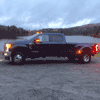
day in day out 6 months out of the year... dont mind the trailer
Senior User
Joined: Feb 2011
Posts: 100
Likes: 0
Hey Troverman or maybe another of you guys that know Fords. I have a 2010 F250 and I can't find information for the front hubs, I've put two threads up on here and searched all over the net and even talked to a few dealers. Would you or someone you know have any information on the front hubs for my truck? They don't work at all in auto and it's a bugger to get them to lock up in manual. I was hoping to get some insight into these hubs before I dismantle them. As far as I can tell 2005 through 2010 are serviced as sealed units, the main question is does this include the inner bearings, seals and such for the outer axle assembly? I was under there the other day assessing the front end and I find I can move the ujoints inside the steering yokes up and down a quarter inch, this seems loose to me. Any idea where I can get information on this? Thank you.
OP sorry for hijacking your thread
OP sorry for hijacking your thread

Elder User
Joined: Jun 2009
Posts: 663
Likes: 2
From: Elk River, MN
you apparently have never traveled on an Alaskan highway that is snow covering black ice. we dont slow down for much up here... 2wd in those conditions is just asking for trouble and i have seen it many times guy in a 4x4 pickup has it in 2wd and goes to make a pass or speeds up and looses it and goes flying in the ditch.
day in day out 6 months out of the year... dont mind the trailer
3.23.13 heading to Big Lake - YouTube
day in day out 6 months out of the year... dont mind the trailer
3.23.13 heading to Big Lake - YouTube
My 2000 excursion was the most stable vehicle I've ever driving on snowy roads.

