When you click on links to various merchants on this site and make a purchase, this can result in this site earning a commission. Affiliate programs and affiliations include, but are not limited to, the eBay Partner Network.
[7] The connecting rods should always be re-sized after new
rod bolts are installed.
[/indent][/QUOTE
Why re-size??? Is that the ARP bolts are slightly bigger and deform the big end off the connecting rods ?
you can press fit them in any ordinary press, i pressed them myself, but you have to recondition them, meaning you have to check the roundness where it bolts to the crank, any shop can do this for you... if you don't, you will have uneven wear on your rod bearings....
I finally stopped at HRD Racing Heads - they are literally right down the road. As the name suggests it's a racing head shop. The owner, Al Dicksen, has VAST racing and development experience, and it was great just to meet him and spend a few minutes visiting. While they do not do iron heads, he agreed to flow mine for a very reasonable cost. Since I don't have any "before" numbers, I won't have any real comparison for my minor porting job, but it should prove interesting anyway.
I told Al my real interest is in the closed chamber 4V heads for another build. These will be flowed before AND after I work on them. Al has worked with "Dyno Don" Nicholson and Jack Roush, many others too I'm sure, so he knows the Cleveland head. I have no illusions that my D5AE heads are going to be all that great, but it is a BRONCO engine after all! The flow numbers will at least give me an idea of what power I could ultimately expect. The closed chamber 4V heads on the other hand are already great, so I just need to clean them up and DO NO HARM!
Once this build is completed, I will get started on a more "serious" engine.
Interesting. I hope your experience with DIY porting is better then mine. I did a pair of Windsor D8OE heads and used all the resources I could find. Lots of time and effort. They looked good.
Then I took it to a local guy that competes in the Amzoil Engine Builders invitational - and does quite well. He tested mine against my stock heads, and then with a simple set of angled cuts on the exhaust valve essentially tied my exhaust flow at high lift, and beat it badly at low lift.
. Changing rod bolts can shift the rod cap sideways a few ten thousands of an inch, hence the recommendation to have it made perfectly round and the correct precision size again...
. When porting, think less about enlarging things and more in terms of how well the air will flow through the passages quickly with no obstructions, no dead ends, and no flow-blocking turbulence created... one of the weaknesses of the 4bbl. Cleveland heads is they are too big in some spots, creating energy-absorbing changes in flow velocity and/or turbulence... for most users, the fix on these heads is to actually make the ports SMALLER in those spots... many claim the 4Bbl/'4V' Cleve heads are great because they make 300+ HP, but heads with valves and ports that HUGE should be making 500+ HP! With fatter power curves!
.... many claim the 4Bbl/'4V' Cleve heads are great because they make 300+ HP, but heads with valves and ports that HUGE should be making 500+ HP! With fatter power curves!
The 4V Cleveland head is a great head! I'm sure they are on more than a few underperforming engines, but that's not the fault of the cylinder head. Shazam did it right - 799 HP with a modified factory iron head! Great head!
As far as my build, I know it will perform well, I'm just more curious than anything. What can some "moderate" port work do for the D5AE head?
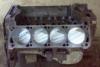
I picked up my cylinder heads from HRD Racing Heads today after test session on their Superflow 1020 flow bench. These are factory 1978 D5AE heads with some port work, Ferrea 5000 series valves 2.080” intake and 1.65” exhaust.
The results!
Intake
.100” – 64 CFM
.200” – 132 CFM
.300” – 197 CFM
.400” – 208 CFM
.500” – 212 CFM
.600” – 213 CFM
Intake Average – 171 CFM
Exhaust
.100” – 53 CFM
.200” – 92 CFM
.300” – 128 CFM
.400” – 155 CFM
.500” – 164 CFM
.600” – 167 CFM (182 CFM with pipe)
Exhaust Average – 126 CFM
These numbers are lower across the board than the previous flow test, even though I had a 30 degree back cut performed on all the valves,and did a little bit more work on the intake. The curve however is the same, and this makes me think to get much more you would have to do some short side work. I barely touched the intake short side, and didn’t really do anything to the exhaust short side. I think with serious intake short side work 235 or better would be obtainable, exhaust maybe180. Just pure speculation there, but Ido have another set I could work on…..
I am going to have the other set cleaned and flowed in STOCK form just so people know what the factory 351M/400 head flows.
When I dropped the heads off to be flowed the operator said “You might be disappointed.” To which I replied – “It’s for a Bronco!” I mean how disappointed could I be really? I would be surprised if they flowed more than 185/145 stock.
Not to hijack my own thread, but the heads for my NEXT 400 build also got flowed on the same bench. These are 1970 351C 4V heads, closed chamber of course. Their reputation is well earned – check out these numbers! As cast ports and stock valves.
Intake
.100” – 65 CFM
.200” – 122 CFM
.300” – 186 CFM
.400” – 234 CFM
.500” – 268 CFM
.600” – 283 CFM
.700” – 291 CFM
.750” – 292 CFM
Exhaust
.100” – 46 CFM
.200” – 81 CFM
.300” – 118 CFM
.400” – 143 CFM
.500” – 159 CFM
.600” – 167 CFM
.700” – 170 CFM
.750” – 170 CFM (190 CFM with pipe)
Just for the sake of comparison, the 4V heads average 22 CFM more on the intake through the lift range of my cam (.571”/.576”), but my exhaust will average 7 CFM more through the same range.
Last edited by SDDL-UP; Sep 17, 2014 at 10:48 PM.
Reason: formatting
.
. The '78 heads flowed much less than I would have expected... I guess that's from having the coolant areas intrude on the ports in the later castings... wonder what the stock '70 heads flowed like... those numbers may be around someplace...
. Wonder how the 4V heads would flow with port plates to control the turbulence and a little touch up porting...
. So far, found some flow for the heads I used on my 351W in stock condition... not too bad... exhaust looks a little weak, OK, horrible... although mine are extensively reworked...
Good work! I'm anxious to see the stock head flow numbers because I've had some discussions with some Windsor-types who have no clue how the M and W stock heads compare. In fact, I laid the stock heads side by side for one and his eyes grew quite big - almost as big as the M's ports.
I have some flow bench numbers for my W porting work, and if you don't mind I'll do a comparison chart of right-side up compared to upside-down M flow - similar to this.
I haven't taken the time to check that I did this right, nor have I checked the links Buzz sent, but please check these to see if they are right. And the "C5" in there is, I think, some small-block heads I already had loaded in.
They are actually D5AE 351M/400 heads, not the C5AE I originally posted - my bad! I am very curious as well to see how the stock head flows. Love the graphs!
Buzz,
There are people that can get upper 300's and 230 or so out of a properly ported 4V head. I'm not so sure about 200 CFM out of a stock 2V Cleveland head. I've seen that figure also, but speculate that "might" be ported. I did quite a bit of work to get to 213 on these heads and I think the intake port is the same as a 2V. The only real factory "performance" I'm aware of for the Windsor engines is the GT-40, that's a decent piece. Generally speaking the Cleveland and even lowly M heads are better than the Windsor pieces, that's why there are "Clevor" hybrids! If you like porting (and I do!), there is a lot of room for improvement! I have seen people claiming upper 200's on a ported 2V Cleveland, so maybe 200 is legit?
I have seen people claiming upper 200's on a ported 2V Cleveland, so maybe 200 is legit?
. Yes, I expected 2bbl. C and 1970 M heads to flow better than the later ones...
. Wonder what's the best my '78 M heads could flow if I ported the hell out of them... the stock 2.04/1.66 valves seem big enough as is... although I will prolly switch to one piece S.S. ones since they aren't that much... I don't want to buy anything beyond the 400 crank (for 351M), 351C pistons, and cam/lifters/springs... (plus minor stuff like overbore, bearings, rings, and gaskets)
Here are revised charts, with the first three heads being small-block and the last three being 335 Series. However, I doubt the C5AE #'s - do they really flow that well? And the stock 335 Series #'s came from this link Buzz gave.
Rezvani's Latest Post-Apocalyptic Monster Is a Ford F-150 Raptor Underneath
Slideshow: Called the Fortress, the 850-horsepower pickup combines Raptor underpinnings with military-inspired features, survival equipment, and a starting price of $285,000.