



EGR valve question

Thread Starter
|
Senior User
Joined: Sep 2011
Posts: 125
Likes: 0
EGR valve question
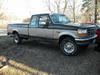
I have a 1988 F250 and it starts a idles , till it warms up and then it starts ideling real rough and shaking and blowing white smoke that smells like gas I checked injectors and fuel regulator and both are fine. The EGR looks like previous owner disconnected and plugged the EGR valve.
Any thoughts?
Any thoughts?
Logistics Pro
Joined: Mar 2005
Posts: 4,698
Likes: 47
From: Mexico, Missouri
What engine do you have? 300, 302, 351, 460...
Have you pulled codes? Is the CEL on? You can pull codes for free with a paperclip. Www.fordfuelinjection.com has plenty of info for these vintage trucks.
Problem you are describing I don't think it would be related to the EGR valve though. It sounds like when the PCM enters closed loop and starts gathering info from sensors your engine has major problems.
Have you pulled codes? Is the CEL on? You can pull codes for free with a paperclip. Www.fordfuelinjection.com has plenty of info for these vintage trucks.
Problem you are describing I don't think it would be related to the EGR valve though. It sounds like when the PCM enters closed loop and starts gathering info from sensors your engine has major problems.
Logistics Pro
Joined: Mar 2005
Posts: 4,698
Likes: 47
From: Mexico, Missouri
When you say that checked injectors and regulator, what was your fuel pressure?
Sounds like bad MAP sensor as well...these are just ideas...Try pulling codes and post back with results.
Sounds like bad MAP sensor as well...these are just ideas...Try pulling codes and post back with results.
Thread Starter
|
Senior User
Joined: Sep 2011
Posts: 125
Likes: 0
I didn't check pressure, I just made sure regulator wasn't leaking. I had someone do a leak down test and cylinders are fine. I tried to pull codes and it seems to say code 114 intake air temp sensor out of range
Thread Starter
|
Senior User
Joined: Sep 2011
Posts: 125
Likes: 0
I did and got code 114. I just find it hard to believe it needs a rebuild. Like I said it idles fine for a while the starts putting out white smoke that smells like fuel.
Trending Topics

Cargo Master


Joined: Jul 2009
Posts: 2,538
Likes: 54
From: Des Moines
If the code you got was 114: ACT out of self test range 0.3 to 3.7 volts, you REALLY need to trouble shoot the sensor itself and related circuits. Go here for more information:
Fuel Injection Technical Library » Air Charge Temperature (ACT)
If your ACT really is bad, or the circuit is having continuity/connection problems, it stands to reason that you're going to have driveability problems, particularly related to fuel.
Start with testing the ACT itself. You'll find everything you need to do so on the page I linked.
FTE Stories
Ford Trucks for Ford Truck Enthusiasts

2027 Ford Super Duty Buyer's Guide (Every Model, Engine, & Package)
Brett Foote
Top 10 Ford Truck Tragedies
Joe Kucinski
AEV FXL Super Duty - the Super Duty Raptor Ford Doesn't Make
Brett Foote
Lobo Vs Lobo: Proof the F-150 Lobo Should Be Even Lower!
Michael S. Palmer
Ford's 2001 Explorer Sportsman Concept Looks For a New Home
Verdad Gallardo
10 Best Ford Truck Engines We Miss the Most!
Joe Kucinski
2026 Shelby F-150 Off-Road: Better Than a Raptor R?
Brett Foote
2027 Super Duty Carhartt Package First Look: 12 Things You NEED to Know!
Michael S. Palmer
10 Most Surprising 2026 Ford Truck Features!
Joe Kucinski
Thread Starter
|
Senior User
Joined: Sep 2011
Posts: 125
Likes: 0
A guy that helped me replace my starter said white smoke means bad rings. Now he is a self taught mechanic and kind of struck me as just a parts replacer mechanic versus a trouble shooting mechanic.
When I look on line I get several different reasons for white smoke that smells like fuel. Most come back to running too rich. Ruled out head or head gasket as no oil in coolant or coolant in oil.
When I look on line I get several different reasons for white smoke that smells like fuel. Most come back to running too rich. Ruled out head or head gasket as no oil in coolant or coolant in oil.
Cargo Master
Joined: Jul 2009
Posts: 2,538
Likes: 54
From: Des Moines
If you're getting a strong fuel smell from the exhaust, then the engine likely is running rich. The reason for the smell is that the catalytic converter can't catalyze ALL of the fuel that's passing through it, and so you're literally blowing gasoline out of your tailpipe.  Yes, it's funny sounding, but none the less true.
This situation needs to be corrected ASAP. The longer your truck runs in a rich condition, the more unburned fuel your cat is going to try and burn, and the quicker the cat will burn out.
So again, with a code 114, test the ACT. If it passes, begin checking continuity between the sensor and the computer, and also make sure all related plugs and connectors are good and clean. I don't mean to sound like a broken record, but the point of the Diagnostic Trouble Codes is to point us in the right direction of the problem. A specific code doesn't necessarily indicate a problem with a specific sensor, but it gives you a starting point.
And right now, that starting point is testing the ACT and related wiring.
Yes, it's funny sounding, but none the less true.This situation needs to be corrected ASAP. The longer your truck runs in a rich condition, the more unburned fuel your cat is going to try and burn, and the quicker the cat will burn out.
So again, with a code 114, test the ACT. If it passes, begin checking continuity between the sensor and the computer, and also make sure all related plugs and connectors are good and clean. I don't mean to sound like a broken record, but the point of the Diagnostic Trouble Codes is to point us in the right direction of the problem. A specific code doesn't necessarily indicate a problem with a specific sensor, but it gives you a starting point.
And right now, that starting point is testing the ACT and related wiring.

Cargo Master


Joined: Apr 2003
Posts: 3,476
Likes: 224
From: Frequently frozen MN
The computer uses the Air temp info as part of the formula for how much fuel to dump in. If it knows it isn't working, then it's probably substituting a different value -- and maybe that works out to too rich -- although the O2 sensor should pick up on that.
One big clue is that you say it runs fine until it gets warm -- that's when the computer starts controlling things based on the sensors.
You can probably check the ACT with a voltmeter -- there should be a procedure in a good service manual. It's worth checking even if you're going to change it, because if the truck still acts up, you can see if the new one has any better readings (if not, you have some kind of electrical issue).
Good luck,
hj
One big clue is that you say it runs fine until it gets warm -- that's when the computer starts controlling things based on the sensors.
You can probably check the ACT with a voltmeter -- there should be a procedure in a good service manual. It's worth checking even if you're going to change it, because if the truck still acts up, you can see if the new one has any better readings (if not, you have some kind of electrical issue).
Good luck,
hj
Cargo Master
Joined: Jul 2009
Posts: 2,538
Likes: 54
From: Des Moines
And as ford2go pointed out, other sensors, like the o2 sensor, should be picking up the information the computer needs to calculate the correct fuel/air ratio. The problem is that when a sensor is bad and the computer is receiving bad data, but the remaining sensors are good (and the computer is receiving good data from them), it "doesn't compute." That doesn't mean that the computer won't work, but with conflicting data in a situation like this, the computer is going to essentially guess what the fuel/air ratio needs to be. Most of the time, the computer is going to calculate a rich fuel/air ratio because a lean mixture raises temperatures which in turn creates more NOx (nitrous oxide) emissions. But as I said before, a rich mixture means that there's more unburned fuel leaving the combustion chamber, which in turn is going to burn out the catalytic converter faster because it's trying to burn up all that fuel.
Don't worry about the questions- that's why we're here.

Cargo Master
Joined: Jul 2009
Posts: 2,538
Likes: 54
From: Des Moines
It should be located in one of the manifolds (assuming you have an upper and lower intake manifold.) It should be screwed directly into one of the air passages.
I don't know what the difference would be between an F250 (yours) and an F150 (mine) motor. I figured a 5.0 or 5.8 should be virtually the same setup for the year range.
I don't know what the difference would be between an F250 (yours) and an F150 (mine) motor. I figured a 5.0 or 5.8 should be virtually the same setup for the year range.