


Help navigating vacuum diagram (Pics)

Thread Starter
|
Elder User
Joined: Mar 2008
Posts: 509
Likes: 0
From: Central Florida
Help navigating vacuum diagram (Pics)
Okay so I think i'm ready to redo all my vacuum lines on my truck to finally get this thing running 100% again. Trouble is no matter how much I research, google parts, etc I cannot seem to navigate my engine bay according to my truck's vacuum diagram. Some things are easy to spot like the purge valves, dist etc but others I cannot for the life of me identify. I know this is alot but I feel its time to finally tame the vacuum diagram madness... and hopefully help others out in the future.
First off is my truck's vaccum diagram (1985 351w HO F150).

1st item in question; It is connected to the purge CV's and goes towards my carb. What confuses me is it doesnt seem to be on my truck's diagram at all and if it is my guess would be the FLTR before the VCV. EDIT: Okay I think this may be a "Carburetor Bowl Vent Solenoid" am I right?

2nd item in question; Is this a VCV? This is right in front of my thermostat housing, and to the left of my dist just like in the diagram, but what throws me off is the two other VCV's to the bottom right of my diagram which I cannot seem to locate on my engine. Except for the next item in question #3.

3rd item in question; This is to the right of my dist, and to my guess a VCV. But it holds only the brake booster hose, which I can't find on the diagram.

4th item in question; I know this is the air by pass valve (ignore the plugged hose as my smog pump is missing)... but where can I find this on my vaccum diagram?

Last question;
What on earth would my MAN VAC look like on my engine?

First off is my truck's vaccum diagram (1985 351w HO F150).
1st item in question; It is connected to the purge CV's and goes towards my carb. What confuses me is it doesnt seem to be on my truck's diagram at all and if it is my guess would be the FLTR before the VCV. EDIT: Okay I think this may be a "Carburetor Bowl Vent Solenoid" am I right?
2nd item in question; Is this a VCV? This is right in front of my thermostat housing, and to the left of my dist just like in the diagram, but what throws me off is the two other VCV's to the bottom right of my diagram which I cannot seem to locate on my engine. Except for the next item in question #3.
3rd item in question; This is to the right of my dist, and to my guess a VCV. But it holds only the brake booster hose, which I can't find on the diagram.
4th item in question; I know this is the air by pass valve (ignore the plugged hose as my smog pump is missing)... but where can I find this on my vaccum diagram?
Last question;
What on earth would my MAN VAC look like on my engine?
Thread Starter
|
Elder User
Joined: Mar 2008
Posts: 509
Likes: 0
From: Central Florida
5th item; Heres another one its to the right of my Carb and right above the drive side valve cover. On my truck's diagram I show either a TK, C/O HCV or MAN Vac that it could be. Odd thing is I have another one similar on the opposite side of my carb i'll show as item 6. EDIT: This is the C/O HCV aka Intake Manifold Heat Control Valve (Works to return some exhaust into the intake to warm up the fuel mixture while the engine is cold).

6th item in question; Below I posted a snip of my diagram which I would guess is the 6th item. (Guessing by the 5 line vacuum connector) EDIT: This is also a C/O HCV and works in conjunction with item 5.


7th item in question; I just want to double check that this is in fact the EXH HCV. Its connected to the driver sides exhaust manifold.


Perhaps i'm taking my diagram to literal, but if I were to follow this thing like a road map i'd be completely lost as none of the land marks are where they are shown lol.
6th item in question; Below I posted a snip of my diagram which I would guess is the 6th item. (Guessing by the 5 line vacuum connector) EDIT: This is also a C/O HCV and works in conjunction with item 5.
7th item in question; I just want to double check that this is in fact the EXH HCV. Its connected to the driver sides exhaust manifold.
Perhaps i'm taking my diagram to literal, but if I were to follow this thing like a road map i'd be completely lost as none of the land marks are where they are shown lol.

FTE Legend


Joined: Jul 2010
Posts: 32,875
Likes: 48
From: Northeast, OK
I'm not much help on the vacuum spaghetti, but I think you are right about the vent solenoid. Have you used the info in the stickies? Vacuum Diagram Acronyms
Thread Starter
|
Elder User
Joined: Mar 2008
Posts: 509
Likes: 0
From: Central Florida
I'm not much help on the vacuum spaghetti, but I think you are right about the vent solenoid. Have you used the info in the stickies? Vacuum Diagram Acronyms
I'm really thinking about tearing it all out, and redoing it all line by line.
Thread Starter
|
Elder User
Joined: Mar 2008
Posts: 509
Likes: 0
From: Central Florida
Just a quick update, think I discovered the main thing confusing me on my diagram. I've been looking for three different VCV's on my intake manifold, but what I noticed is two of them are sharing the same tree right above my thermostat housing. I'm still curious what the FLTR looks like, on both of mine they are capped off. EDIT: I'm actually missing the third VCV which went on the thermostat housing.

Also took a second look at my Curb Idle adjustment tag. Never realized it tells you to plug the VOTM, Air BPV, EGR, and Purge's...
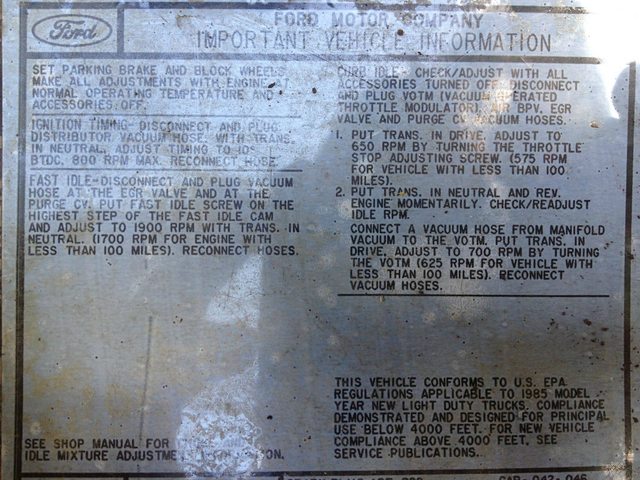
Also took a second look at my Curb Idle adjustment tag. Never realized it tells you to plug the VOTM, Air BPV, EGR, and Purge's...
FTE Legend
Joined: Jul 2010
Posts: 32,875
Likes: 48
From: Northeast, OK
Is the FLTR a filter? My guess is that the VCV is meant to kill the vacuum to things in certain situations, and that means admitting air into the system. So a filter would be used to prevent dirt from coming in. But, if that port is capped then the VCV can't do its job properly.
Trending Topics
Thread Starter
|
Elder User
Joined: Mar 2008
Posts: 509
Likes: 0
From: Central Florida
Is the FLTR a filter? My guess is that the VCV is meant to kill the vacuum to things in certain situations, and that means admitting air into the system. So a filter would be used to prevent dirt from coming in. But, if that port is capped then the VCV can't do its job properly.
FTE Stories
Ford Trucks for Ford Truck Enthusiasts

10 Things Every Truck Owner NEEDS (2026 Edition)
Michael S. Palmer
Rezvani's Latest Post-Apocalyptic Monster Is a Ford F-150 Raptor Underneath
Verdad Gallardo
Top 10 Most Expensive Ford Trucks Ever Sold on Bring a Trailer
Joe Kucinski
2027 Ford Super Duty Buyer's Guide (Every Model, Engine, & Package)
Brett Foote
Top 10 Ford Truck Tragedies
Joe Kucinski
AEV FXL Super Duty - the Super Duty Raptor Ford Doesn't Make
Brett Foote
Lobo Vs Lobo: Proof the F-150 Lobo Should Be Even Lower!
Michael S. Palmer
Ford's 2001 Explorer Sportsman Concept Looks For a New Home
Verdad Gallardo
10 Best Ford Truck Engines We Miss the Most!
Joe Kucinski
FTE Legend
Joined: Jul 2010
Posts: 32,875
Likes: 48
From: Northeast, OK
I don't think I would say it would fix the problem of a high idle. It might, or it might fix a different problem you haven't noticed. But, I don't think it is good to have them capped. On the other hand, it might fix the problem so is worth a try.
Thread Starter
|
Elder User
Joined: Mar 2008
Posts: 509
Likes: 0
From: Central Florida
Could it mean they went to the air filter?
Thread Starter
|
Elder User
Joined: Mar 2008
Posts: 509
Likes: 0
From: Central Florida


Thread Starter
|
Elder User
Joined: Mar 2008
Posts: 509
Likes: 0
From: Central Florida
Judging by the price i'm assuming its alot smaller lol. I wonder what the purpose of these were? I've never seen them on our trucks ever.
FTE Legend
Joined: Jul 2010
Posts: 32,875
Likes: 48
From: Northeast, OK
I'm pretty sure the purpose was just what it says - to filter the air that is allowed in when one of the VCV's determines that vacuum should be bled off. IOW, a vaccum bleed filter.
As for not having seen them, I don't remember them either. But, back in the day they may not have been understood and left off. My EVTM is for 1981 and I don't see any of that fancy stuff in it, so it was probably later. However, I highly recommend that you get the Electrical & Vacuum Troubleshooting Manual for your truck. It explains this so simply that even I understand. Well worth the $20 I spent. I think it would go a LOOOOOONG way to help with your understanding of what you have.
As for not having seen them, I don't remember them either. But, back in the day they may not have been understood and left off. My EVTM is for 1981 and I don't see any of that fancy stuff in it, so it was probably later. However, I highly recommend that you get the Electrical & Vacuum Troubleshooting Manual for your truck. It explains this so simply that even I understand. Well worth the $20 I spent. I think it would go a LOOOOOONG way to help with your understanding of what you have.