


A/C Compressor Won't Engage - Interior Temp sensor?

Thread Starter
|
Freshman User
Joined: May 2008
Posts: 38
Likes: 0
I do have continuity between the low side and high side switches. If I jumper the high side switch, I still don't get voltage to the compressor. On the outside chance that both switches went bad simultaneously, I'll try bypassing both and see what happens. If both switches are good....?
Is the PCM's only function here to open the relay during a WOT event, or is it more complex than that? Here is what I've been using to help track this down:
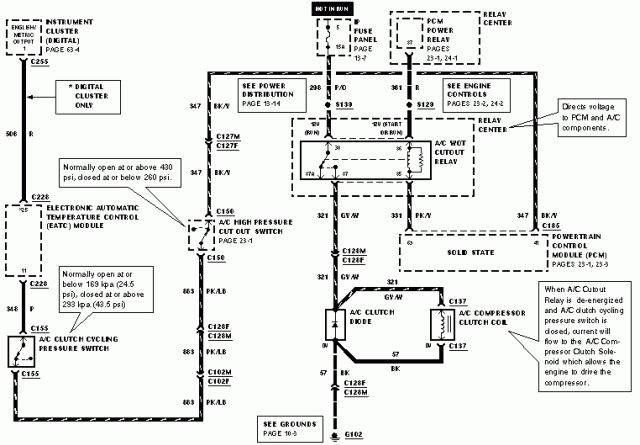
Is the PCM's only function here to open the relay during a WOT event, or is it more complex than that? Here is what I've been using to help track this down:

Thread Starter
|
Freshman User
Joined: May 2008
Posts: 38
Likes: 0
OK, this is getting even more confusing.
Also, I'm not sure if the diagram that I supplied is accurate. It appears that mine is arranged thusly:
EATC provides 12v -> Low side cyling switch -> high side switch -> terminal 30 of relay. The only thing the PCM does is operate the relay during WOT events.
All I can figure is that the normal circuitry is not providing sufficient amperage to engage the coil. I'm baffled.
- I have 12v at the low side pressure switch
- I have 12v at high side switch. Jumpering the switch produces no result
- I have continuity between high side switch and the supply terminal (30) on relay
Also, I'm not sure if the diagram that I supplied is accurate. It appears that mine is arranged thusly:
EATC provides 12v -> Low side cyling switch -> high side switch -> terminal 30 of relay. The only thing the PCM does is operate the relay during WOT events.
All I can figure is that the normal circuitry is not providing sufficient amperage to engage the coil. I'm baffled.

Fleet Mechanic
Joined: Feb 2006
Posts: 1,776
Likes: 5
From: Lorain County, Ohio

It's easy to find out. Jumper across pins 30 and 87 of the relay, the compressor should engage.
Then turn the EATC off.
-If the compressor continues to run, the diagram is correct.
-If the compressor does not run, you are correct.
BTW, do you have 12v at pin 30 on the relay? I scanned back through the thread but didn't see it mentioned.
Then turn the EATC off.
-If the compressor continues to run, the diagram is correct.
-If the compressor does not run, you are correct.
BTW, do you have 12v at pin 30 on the relay? I scanned back through the thread but didn't see it mentioned.
Thread Starter
|
Freshman User
Joined: May 2008
Posts: 38
Likes: 0
Despite having 12v at the high side switch and test light continuity to terminal 30, I do not get any voltage to terminal 30 under normal operation. However, if I supply 12v directly (from the battery) to the wire coming from the high side switch, then I get voltage at terminal 30 and the compressor will kick on.
The EATC supplies 12v at every point in the circuit except terminal 30 when powered by the EATC. When I introduce battery current anywhere along the circuit, I get voltage at terminal 30, and the compressor starts working.
Something is happening between the high side switch and terminal 30 that prevents voltage to the relay....unless that voltage is supplied directly from the battery at any point along the circuit.
The EATC supplies 12v at every point in the circuit except terminal 30 when powered by the EATC. When I introduce battery current anywhere along the circuit, I get voltage at terminal 30, and the compressor starts working.
Something is happening between the high side switch and terminal 30 that prevents voltage to the relay....unless that voltage is supplied directly from the battery at any point along the circuit.
Fleet Mechanic
Joined: Feb 2006
Posts: 1,776
Likes: 5
From: Lorain County, Ohio
Lets assume that the diagram is correct for the moment.
Can you run a jumper from the battery to pin 30 of the relay and also plug the relay in? Might be a little tricky.
I have a hunch that the system would work properly if you did that.
Can you run a jumper from the battery to pin 30 of the relay and also plug the relay in? Might be a little tricky.
I have a hunch that the system would work properly if you did that.
Thread Starter
|
Freshman User
Joined: May 2008
Posts: 38
Likes: 0
OK, I jumpered the battery to the underside of the relay panel at terminal 30 with the relay in place. As expected the compressor kicks in. It will, however, continue to run regardless of the EATC settings.
Fleet Mechanic
Joined: Feb 2006
Posts: 1,776
Likes: 5
From: Lorain County, Ohio
Hmmmm.
What color is the wire going to pin 30?
Every diagram I can find for 94-99 CV/GM all show the EATC controller sending a signal to the PCM, which closes the relay for the compressor.
projectSHO89 is looking at one that shows a series circuit from the controller out to the compressor.
Maybe that wire color will give a clue as to how it;s actually wired.
What color is the wire going to pin 30?
Every diagram I can find for 94-99 CV/GM all show the EATC controller sending a signal to the PCM, which closes the relay for the compressor.
projectSHO89 is looking at one that shows a series circuit from the controller out to the compressor.
Maybe that wire color will give a clue as to how it;s actually wired.
Thread Starter
|
Freshman User
Joined: May 2008
Posts: 38
Likes: 0
It's green with an orange stripe....which is also the color of the wire coming from the high side switch. My original guess was that it ran directly from the switch to terminal 30....but that doesn't seem to be exactly the case anymore.
FTE Stories
Ford Trucks for Ford Truck Enthusiasts

10 Things Every Truck Owner NEEDS (2026 Edition)
Michael S. Palmer
Rezvani's Latest Post-Apocalyptic Monster Is a Ford F-150 Raptor Underneath
Verdad Gallardo
Top 10 Most Expensive Ford Trucks Ever Sold on Bring a Trailer
Joe Kucinski
2027 Ford Super Duty Buyer's Guide (Every Model, Engine, & Package)
Brett Foote
Top 10 Ford Truck Tragedies
Joe Kucinski
AEV FXL Super Duty - the Super Duty Raptor Ford Doesn't Make
Brett Foote
Lobo Vs Lobo: Proof the F-150 Lobo Should Be Even Lower!
Michael S. Palmer
Ford's 2001 Explorer Sportsman Concept Looks For a New Home
Verdad Gallardo
10 Best Ford Truck Engines We Miss the Most!
Joe Kucinski
Hotshot


Joined: Jan 2004
Posts: 19,762
Likes: 1,079
From: St Louis
Been gone since early this morning.
Here's the 97 schematic: https://dl.dropboxusercontent.com/u/...s%2055-003.pdf
Here's the 97 schematic: https://dl.dropboxusercontent.com/u/...s%2055-003.pdf
Thread Starter
|
Freshman User
Joined: May 2008
Posts: 38
Likes: 0
If I check resistance (with the engine off) between the connector at the high side switch and terminal 30, I get around 1/2 ohm or so. Using a test light between these two points works as well. So, it seems that C127 would be good.
What baffles me here is that the high side switch is sending 12v down the green wire, but it doesn't make it to terminal 30. When I send battery current down the same wire, terminal 30 is energized, and the compressor kicks on.
What is S110 in the diagram?
What baffles me here is that the high side switch is sending 12v down the green wire, but it doesn't make it to terminal 30. When I send battery current down the same wire, terminal 30 is energized, and the compressor kicks on.
What is S110 in the diagram?
Hotshot
Joined: Jan 2004
Posts: 19,762
Likes: 1,079
From: St Louis
A (S)plice.
Do a resistance check from terminal 30 all the way back to the input to the low pressure switch (pink wire). Do a wiggle test while you're at it.
If that passes, disconnect C228 from the EATC. Jumper BOTH switches under the hood and inject battery power into pin 25 of C228 and see if you can get the compressor to engage. If it does, the wiring is good. Reconnect each switch, one at a time and retest including a wiggle test. If it still works, the wiring and switches are good and the EATC isn't able to provide sufficient current to energize the clutch coil.
Do a resistance check from terminal 30 all the way back to the input to the low pressure switch (pink wire). Do a wiggle test while you're at it.
If that passes, disconnect C228 from the EATC. Jumper BOTH switches under the hood and inject battery power into pin 25 of C228 and see if you can get the compressor to engage. If it does, the wiring is good. Reconnect each switch, one at a time and retest including a wiggle test. If it still works, the wiring and switches are good and the EATC isn't able to provide sufficient current to energize the clutch coil.
Thread Starter
|
Freshman User
Joined: May 2008
Posts: 38
Likes: 0
Thanks to both of you for all the help!
I'll check this as soon as I get time. I know that I have good continuity from the low pressure switch to the relay. I haven't measured yet from the EATC to the low pressure switch, but I do know that I get 12+v at the switch.
My suspicion is that the EATC just doesn't provide enough juice to engage the clutch as you mentioned. If this is the case, then either the coil has a problem and requires more current than the EATC is capable of....or the EATC is getting old and weak. Does this sound reasonable?
I guess if it comes down to it, I can just wire a toggle in the cabin to supply 12v directly to the relay when I need A/C. Of course I'd prefer to have it work like it's designed.
I'll check this as soon as I get time. I know that I have good continuity from the low pressure switch to the relay. I haven't measured yet from the EATC to the low pressure switch, but I do know that I get 12+v at the switch.
My suspicion is that the EATC just doesn't provide enough juice to engage the clutch as you mentioned. If this is the case, then either the coil has a problem and requires more current than the EATC is capable of....or the EATC is getting old and weak. Does this sound reasonable?
I guess if it comes down to it, I can just wire a toggle in the cabin to supply 12v directly to the relay when I need A/C. Of course I'd prefer to have it work like it's designed.
Fleet Mechanic
Joined: Feb 2006
Posts: 1,776
Likes: 5
From: Lorain County, Ohio
What baffles me here is that the high side switch is sending 12v down the green wire, but it doesn't make it to terminal 30. When I send battery current down the same wire, terminal 30 is energized, and the compressor kicks on.
My mistake, I thought you had determined that power was not getting from the HPS to the clutch at all.
There is a common problem I've heard about on Lincoln Town Cars. The CV/GM probably uses the same controller. A bad solder joint on a relay in the controller for the clutch circuit causes the clutch to not engage. This usually causes a 0V reading at the Low Pressure Switch, though. It's possible that there's enough current available to light the test lamp but not engage the compressor.
Apply power to the PK/LB wire at the Low Pressure switch. Does the compressor engage?
If so, the EATC controller is faulty. (The wire from the controller to the switch "could" be open but that's not high on the probability list.)
If it is the controller, it's usually an easy fix if you have some soldering skills. Here's a Tech article on how to repair the EATC controller:
Lincolns OnLine | Tech Tips and Articles
My mistake, I thought you had determined that power was not getting from the HPS to the clutch at all.
There is a common problem I've heard about on Lincoln Town Cars. The CV/GM probably uses the same controller. A bad solder joint on a relay in the controller for the clutch circuit causes the clutch to not engage. This usually causes a 0V reading at the Low Pressure Switch, though. It's possible that there's enough current available to light the test lamp but not engage the compressor.
Apply power to the PK/LB wire at the Low Pressure switch. Does the compressor engage?
If so, the EATC controller is faulty. (The wire from the controller to the switch "could" be open but that's not high on the probability list.)
If it is the controller, it's usually an easy fix if you have some soldering skills. Here's a Tech article on how to repair the EATC controller:
Lincolns OnLine | Tech Tips and Articles
Hotshot
Joined: Jan 2004
Posts: 19,762
Likes: 1,079
From: St Louis
When the voltage measurements were made at the low and high side switches, was the rest of the "downstream" circuit in place? That is, was EVERTHING (clutch coil, relay, switches, etc) connected? If not, you were just measuring an open circuit voltage from the EATC, a distinct possibility if there's a bad/cold solder joint involved in the EATC.