


Fuel Tank Vent Mod

Thread Starter
|
Posting Guru
Joined: Oct 2011
Posts: 1,647
Likes: 1
From: Exton, PA
Fuel Tank Vent Mod
I've read the sticky threads on this mod, but was not thrilled about all the JB weld involved in the process. i'm replacing my midship tank now and would like to see improved filling speed, but think I might go about the mod a little differently.
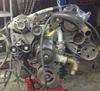
I've already gutted the spring and piston-thing that closes the stock roll-over valve (see below), and my plan is to drill out the hole in the remaining valve body cylinder (currently the pin-sized hole in the center, left of the image) as big as I can go, clean it out good, pop it back into the tank and use 1/4" ID hose up to the filler neck. i'm not convinced that 1/4" hose will allow enough air to escape while filling, but I guess we'll find out! I think i'll take her for a test run fill-up before I tied the hose into the top of the filler neck, though to make sure it works OK. i'll just tie the hose up under the frame somewhere.
i'm also thinking i'll lose the inner rubber tube in the filler neck, but keep the inner steel tube in the upper portion, as I don't really see how that causes any problems...
anyone done it this way already?
also, I was amazed at how small the air-escape hole is in the stock valve! no wonder why it doesn't work worth a darn!
also, also, i'm guessing that black gunk there is not the remnants of a gasket, but rather just old fuel gunk/algae...

I've already gutted the spring and piston-thing that closes the stock roll-over valve (see below), and my plan is to drill out the hole in the remaining valve body cylinder (currently the pin-sized hole in the center, left of the image) as big as I can go, clean it out good, pop it back into the tank and use 1/4" ID hose up to the filler neck. i'm not convinced that 1/4" hose will allow enough air to escape while filling, but I guess we'll find out! I think i'll take her for a test run fill-up before I tied the hose into the top of the filler neck, though to make sure it works OK. i'll just tie the hose up under the frame somewhere.
i'm also thinking i'll lose the inner rubber tube in the filler neck, but keep the inner steel tube in the upper portion, as I don't really see how that causes any problems...
anyone done it this way already?
also, I was amazed at how small the air-escape hole is in the stock valve! no wonder why it doesn't work worth a darn!
also, also, i'm guessing that black gunk there is not the remnants of a gasket, but rather just old fuel gunk/algae...

Post Fiend
Joined: Dec 2010
Posts: 10,121
Likes: 3
From: Orrville, Ohio
If I am thinking correctly the design of the stock filler is such that the inner plastic tube is intended to allow air to escape through the filler neck as well and the "breather" that you have pictured above is only there to augment that process. The inner tube is designed to allow the fuel to flow through it and air to escape around the outside of it and go back out the top of the filler neck. Am I misunderstanding the design? If this is the case, and you don't want to do the "big hose and JB weld" version of the mod, you might try leaving the plastic tube in there and see how it works. I think without the bigger hose, if you remove that inner tube you're not going to be happy with how it works. We shall see I guess.
Thread Starter
|
Posting Guru
Joined: Oct 2011
Posts: 1,647
Likes: 1
From: Exton, PA
Nate - I would agree that the original design is supposed to work that way. I would further add that the real issue with these tanks always clicking off the fuel pump filler may be the small inner hose collapsing down (after 15 years of life) enough to choke the flow of fuel through itself and has nothing to do with the inability for air to escape out of the tank as it fills. there is quite a gap between this inner and outer tube, and I don't see how it could ever become completely closed, making the filling problem come from not enough air escaping. I would think it more likely that the inner tube diameter is maybe just barely large enough for the flow of incoming fuel and when it starts to collapse as it gets old, some backpressure starts to happen.
so my experimental fill-up without this inner tube installed, but with the steel inner part of the filler neck still there and only 1/4" hose for air to escape elsewhere will test this theory out...
if it doesn't work, maybe i'll look for some more rigid inner tube material to put back in there.
...or i'll just deal with standing there holding the handle half-way depressed every time.
so my experimental fill-up without this inner tube installed, but with the steel inner part of the filler neck still there and only 1/4" hose for air to escape elsewhere will test this theory out...
if it doesn't work, maybe i'll look for some more rigid inner tube material to put back in there.
...or i'll just deal with standing there holding the handle half-way depressed every time.

FOREIGN GURU
Joined: Jul 2006
Posts: 7,655
Likes: 7
From: Celaya, Gto. MX


Nate - I would agree that the original design is supposed to work that way. I would further add that the real issue with these tanks always clicking off the fuel pump filler may be the small inner hose collapsing down (after 15 years of life) enough to choke the flow of fuel through itself and has nothing to do with the inability for air to escape out of the tank as it fills. there is quite a gap between this inner and outer tube, and I don't see how it could ever become completely closed, making the filling problem come from not enough air escaping. I would think it more likely that the inner tube diameter is maybe just barely large enough for the flow of incoming fuel and when it starts to collapse as it gets old, some backpressure starts to happen.
so my experimental fill-up without this inner tube installed, but with the steel inner part of the filler neck still there and only 1/4" hose for air to escape elsewhere will test this theory out...
if it doesn't work, maybe i'll look for some more rigid inner tube material to put back in there.
...or i'll just deal with standing there holding the handle half-way depressed every time.
so my experimental fill-up without this inner tube installed, but with the steel inner part of the filler neck still there and only 1/4" hose for air to escape elsewhere will test this theory out...
if it doesn't work, maybe i'll look for some more rigid inner tube material to put back in there.
...or i'll just deal with standing there holding the handle half-way depressed every time.
 But maybe you are rigth about the tube diameter tho. IDK.
Thread Starter
|
Posting Guru
Joined: Oct 2011
Posts: 1,647
Likes: 1
From: Exton, PA
stay tuned :-)
VT Chapter Ldr


Joined: Apr 2004
Posts: 96,116
Likes: 294
From: Orange, Vermont
I think they have added extra foaming agent so that when it goes thru the filling pump the meter is reading the flow of diesel and air, so we are buying more air then we used to. Just my conspiracy theory, not really helpful to the question......

Cargo Master
Joined: May 2011
Posts: 2,623
Likes: 0
From: Rockford IL

but im not one for conspiracy theory.

Thread
Thread Starter
Forum
Replies
Last Post
robandrhonda
1994.5 - 1997 7.3L Power Stroke Diesel
13
Apr 21, 2020 08:48 PM
CJ06SLT
1961 - 1966 F-100 & Larger F-Series Trucks
5
Apr 24, 2017 11:44 AM
superduty06
1980 - 1986 Bullnose F100, F150 & Larger F-Series Trucks
2
Dec 6, 2006 04:12 PM







