


EOT and ECT 30 Degree Difference

Thread Starter
|
New User
Joined: Mar 2013
Posts: 11
Likes: 0
EOT and ECT 30 Degree Difference
Hey Guys,
I'm steadily running about a 30 degree difference between my EOT and ECT with the EOT being the higher of the two. I've recently installed a Scangauge II to monitor the EOT and ECT etc. At highway speeds EOT is usually around 215 and ECT is around 185. On really hot days EOT may get to 230 and ECT at 200.
In my particular situation my truck is used for work. It's a 2005 F350 Lariat 6.0L with 182,000 km. I'm a rig welder, therefore I have at least 3,000 pounds I'm hauling all the time. I've done an EGR delete on my truck, with a recent coolant flush and changed to Chevron Delo RED ELC Coolant which meets the CAT standards.
I'm wondering if the 30 degree difference is okay because of the EGR delete and the weight I'm hauling, or if I'm going to be looking at a new oil cooler? Also, should I be driving in Tow/Haul?
I'm steadily running about a 30 degree difference between my EOT and ECT with the EOT being the higher of the two. I've recently installed a Scangauge II to monitor the EOT and ECT etc. At highway speeds EOT is usually around 215 and ECT is around 185. On really hot days EOT may get to 230 and ECT at 200.
In my particular situation my truck is used for work. It's a 2005 F350 Lariat 6.0L with 182,000 km. I'm a rig welder, therefore I have at least 3,000 pounds I'm hauling all the time. I've done an EGR delete on my truck, with a recent coolant flush and changed to Chevron Delo RED ELC Coolant which meets the CAT standards.
I'm wondering if the 30 degree difference is okay because of the EGR delete and the weight I'm hauling, or if I'm going to be looking at a new oil cooler? Also, should I be driving in Tow/Haul?

Postmaster
Joined: Jan 2005
Posts: 4,424
Likes: 12
From: BC Canada
The spec is unloaded 15 degrees, and you look loaded if your avatar is the truck. That being said, seems likely you are cooler bound, but I would try tow haul and I wonder how the ECT can be so low, do you have a water pump or thermostat issue? What gauge are you using? Also, what type of roads and hills? If you are running flat ground, no acceleration, ie steady state, how does the temps settle down and does the oil start to drop? I notice on mine, oil spikes faster than coolant sometimes, ie high boost, it goes up fast, coolant goes up after, fast, then the fan kicks in? Trying to get an idea of recovery time? Seems if it is not showing the code for delta per the latest tune? What strategy?

Mountain Pass
Joined: Jul 2009
Posts: 234
Likes: 4
From: Northern Colorado
What you want to check is that when they are at the point they should only be reading ambient temp they are close to the same. If they are then you are probably cooler bound and should either try a reverse flush or just replace the cooler.
Thread Starter
|
New User
Joined: Mar 2013
Posts: 11
Likes: 0
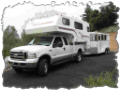
My Avatar pic is the truck I'm talking about and I'm using a Scangauge II. Both EOT and ECT tend to go up and down based on driving and road conditions, but stay really close to that 30 degree difference. ECT might go up 5 degrees and EOT will follow, then come back down after no longer accelerating or going uphill. I'm located in the prairies so the land is fairly flat.

Elder User
Joined: Apr 2012
Posts: 904
Likes: 1
Hey Guys,
I'm steadily running about a 30 degree difference between my EOT and ECT with the EOT being the higher of the two. I've recently installed a Scangauge II to monitor the EOT and ECT etc. At highway speeds EOT is usually around 215 and ECT is around 185. On really hot days EOT may get to 230 and ECT at 200.
In my particular situation my truck is used for work. It's a 2005 F350 Lariat 6.0L with 182,000 km. I'm a rig welder, therefore I have at least 3,000 pounds I'm hauling all the time. I've done an EGR delete on my truck, with a recent coolant flush and changed to Chevron Delo RED ELC Coolant which meets the CAT standards.
I'm wondering if the 30 degree difference is okay because of the EGR delete and the weight I'm hauling, or if I'm going to be looking at a new oil cooler? Also, should I be driving in Tow/Haul?
I'm steadily running about a 30 degree difference between my EOT and ECT with the EOT being the higher of the two. I've recently installed a Scangauge II to monitor the EOT and ECT etc. At highway speeds EOT is usually around 215 and ECT is around 185. On really hot days EOT may get to 230 and ECT at 200.
In my particular situation my truck is used for work. It's a 2005 F350 Lariat 6.0L with 182,000 km. I'm a rig welder, therefore I have at least 3,000 pounds I'm hauling all the time. I've done an EGR delete on my truck, with a recent coolant flush and changed to Chevron Delo RED ELC Coolant which meets the CAT standards.
I'm wondering if the 30 degree difference is okay because of the EGR delete and the weight I'm hauling, or if I'm going to be looking at a new oil cooler? Also, should I be driving in Tow/Haul?
weight you are carrying..... then the headgaskets blew.

i also had the egr cooler still in place.
i'd say it's time to fix it... unless you have a REALLY long lead
on that stinger, if that truck doesn't go down the road, you don't
make any money, correct? what's a week off of work worth to you?
i dropped the money on the BPD external oil cooler, with no regrets.
in a year, i have yet to have either coolant or oil temps reach 200 degrees.
and that is in a E-350 with rolling weight of 10,500#, including going
up grapevine from bakersfield at 65 mph.
Trending Topics
Lead Driver


Joined: Jul 2004
Posts: 6,951
Likes: 512
From: Foothills, CA

My Avatar pic is the truck I'm talking about and I'm using a Scangauge II. Both EOT and ECT tend to go up and down based on driving and road conditions, but stay really close to that 30 degree difference. ECT might go up 5 degrees and EOT will follow, then come back down after no longer accelerating or going uphill. I'm located in the prairies so the land is fairly flat.
Then when you first turn the key on or even just started, compare the two temps: EOT and ECT and see if they are near the same, which should be around ambient air temp (I think you could compare those to the intake air temp) but really you are mainly looking to be sure you don't have a "built in" difference at the get-go. And if you did we might be looking at replacing one of the temp senders before going after something more major.
Hope that helps...
FTE Stories
Ford Trucks for Ford Truck Enthusiasts

3 Best / 3 Worst Parts of Modern Ford Ownership
Brett Foote
10 Amazing Upgrades That Solve Common Ford Truck Owner Headaches
Pouria Savadkouei
Every 2026 Ford Engine Explained
Brett Foote
10 Ugly Ford Trucks That We Still Kinda Love
Joe Kucinski
10 Things Every Truck Owner NEEDS (2026 Edition)
Michael S. Palmer
Rezvani's Latest Post-Apocalyptic Monster Is a Ford F-150 Raptor Underneath
Verdad Gallardo
Top 10 Most Expensive Ford Trucks Ever Sold on Bring a Trailer
Joe Kucinski
2027 Ford Super Duty Buyer's Guide (Every Model, Engine, & Package)
Brett Foote
Top 10 Ford Truck Tragedies
Joe Kucinski
Lead Driver

Joined: Oct 2010
Posts: 5,420
Likes: 16
From: Ouray, CO
As long as your ambient temps dropped to or BELOW 62/63 overnight those temps look normal.

Mountain Pass
Joined: Jul 2009
Posts: 234
Likes: 4
From: Northern Colorado
Since you don't have your EGR cooler, then you should just try doing a good flush, and reverse-flush the oil cooler at the same time. There is a chance that you can get out all of the sludge which has build up that way, and restore your deltas to a more reasonable level. If a reverse flush doesn't do the trick, then you should consider replacing the cooler. From what I understand, the primary reason for the 15degree delta is that once the oil cooler started plugging it would starve the EGR cooler of coolant and cause it to crack and fail - and that is the best indication of plugging.
One thing to consider when flushing - reverse-flush the cooler both before and after you do VC9 - before to increase the effectiveness, and after because VC9 will likely stir a LOT of stuff up and re-plug it.
One thing to consider when flushing - reverse-flush the cooler both before and after you do VC9 - before to increase the effectiveness, and after because VC9 will likely stir a LOT of stuff up and re-plug it.

Mountain Pass
Joined: May 2012
Posts: 199
Likes: 3
I agree that if its a mechanical issue its probably the oil cooler
But..... just for drill I would like you to clear the EOT and ECT values on the ScanGauge and re-enter them in 2 different slots...
Why do I say this? From personal experience. I had strange readings on my EOT (very high delta between the ECT).
I found that I had missed one little entry on the EOT (they are a long string of numbers).
So recheck and re-enter your ECT & EOT
maybe you have just entered one or both slightly off
It may be an easy fix... wouldn't hurt to check and re-check ALL the ScanGaugue entered values.
I also had my fuel level not reading even with the correct entries. Ed from FICM repair said re-enter in a different slot... viola... worked like a charm
But..... just for drill I would like you to clear the EOT and ECT values on the ScanGauge and re-enter them in 2 different slots...
Why do I say this? From personal experience. I had strange readings on my EOT (very high delta between the ECT).
I found that I had missed one little entry on the EOT (they are a long string of numbers).
So recheck and re-enter your ECT & EOT
maybe you have just entered one or both slightly off
It may be an easy fix... wouldn't hurt to check and re-check ALL the ScanGaugue entered values.
I also had my fuel level not reading even with the correct entries. Ed from FICM repair said re-enter in a different slot... viola... worked like a charm

Tuned
Joined: Oct 2009
Posts: 425
Likes: 4
My Avatar pic is the truck I'm talking about and I'm using a Scangauge II. Both EOT and ECT tend to go up and down based on driving and road conditions, but stay really close to that 30 degree difference. ECT might go up 5 degrees and EOT will follow, then come back down after no longer accelerating or going uphill. I'm located in the prairies so the land is fairly flat.
Before going any farthure,plug in the EGR VALVE (if it's good) if it's still on the engine,if not, lay valve on top of the engine then test drive. You will need a functional EGR VALVE (doesn't have to be installed) or tunes that turn the egr off. Thanks to research by chees-it,he found the coolant fan doesn't operate correctly in absence of a valve.