





Prevent injector cup failures?

Thread Starter
|
Hotshot


Joined: Jan 2011
Posts: 18,849
Likes: 179
From: Puget Sound

Junior User
Joined: Oct 2012
Posts: 82
Likes: 0
I hade 375k on my e99 350 had replaced two injecters over that time and no glow plugs(but should have replace GP's as maintance)
A couple weeks ago had to have the heads pulled to replace bellowed GP's so replaced the cups as a preventative messure had soot and diesel smell in degas bottle after the work. I flushed system with cascade and am waiting to see if there is any other problem. Theres the catch 22 do you do the maintanace and hope its ok or do you leave it alone until there is a problem? Still stock inj and a super chip since 1999.
A couple weeks ago had to have the heads pulled to replace bellowed GP's so replaced the cups as a preventative messure had soot and diesel smell in degas bottle after the work. I flushed system with cascade and am waiting to see if there is any other problem. Theres the catch 22 do you do the maintanace and hope its ok or do you leave it alone until there is a problem? Still stock inj and a super chip since 1999.

Lead Driver
Joined: Sep 2010
Posts: 7,793
Likes: 50

Post Fiend
Joined: Mar 2007
Posts: 26,966
Likes: 50
From: Texas
We also have Chris who has 435k on stock injector cups. I think there could be a few reasons for that. First of all I am pretty sure Chris does NOT let his EGT's get out of control. I am also pretty sure he does NOT drive his truck like a punk kid !! I have seen how young guys just beat the living crap out of their trucks.
 As for beating the crap out of it, I have had to pull the bed and weld it back together when the sheet metal started to tear and some pinch welds had broken loose.
Brass is also less corrosive and won't have a reaction due to dissimilar metals or get holes in it due to lack of coolant maintenance.

Fleet Mechanic


Joined: Feb 2007
Posts: 1,852
Likes: 39

To me the most obvious candidate is thermal cycling. Brass has a temperature coefficient of expansion that is almost twice that of iron. I think the engineers used that to their advantage, causing the seal to get tighter with heat. This could explain why cups showing little sealant still did not leak; the sealant might really be more about filling voids and other small irregularities.
Picture how the cup goes in, constrained at the top and bottom by the iron head, but physically unsupported in the middle, where it is exposed to the hot coolant. I think that with every temperature cycle, that cup is "ballooning" out, which would account for the commonly-seen longitudinal cracks.
My theory is that the guys who start their trucks and drive them 100+ miles are the ones who get the high mileage out of their injector cups. The guys that drive 10 miles to work and back will have the premature failures, I think. More temperature cycles for a given amount of miles on the engine.
As far as EGTs, it doesn't seem to me that they would have much influence. The dominant thermal force on the cup is coming from the circulating coolant, and it is moving by pretty quickly. It would take a LOT of energy to get the temperature in that zone to rise much at all. EGTs down near the tip could certainly heat up that end of the cup a little more, but that is where the cup is constrained by the head, so I don't think it would result in stress cracking down there.
These are just my theories.
Picture how the cup goes in, constrained at the top and bottom by the iron head, but physically unsupported in the middle, where it is exposed to the hot coolant. I think that with every temperature cycle, that cup is "ballooning" out, which would account for the commonly-seen longitudinal cracks.
My theory is that the guys who start their trucks and drive them 100+ miles are the ones who get the high mileage out of their injector cups. The guys that drive 10 miles to work and back will have the premature failures, I think. More temperature cycles for a given amount of miles on the engine.
As far as EGTs, it doesn't seem to me that they would have much influence. The dominant thermal force on the cup is coming from the circulating coolant, and it is moving by pretty quickly. It would take a LOT of energy to get the temperature in that zone to rise much at all. EGTs down near the tip could certainly heat up that end of the cup a little more, but that is where the cup is constrained by the head, so I don't think it would result in stress cracking down there.
These are just my theories.
FTE Stories
Ford Trucks for Ford Truck Enthusiasts

Rezvani's Latest Post-Apocalytic Monster Is a Ford F-150 Raptor Underneath
Verdad Gallardo
Top 10 Most Expensive Ford Trucks Ever Sold on Bring a Trailer
Joe Kucinski
2027 Ford Super Duty Buyer's Guide (Every Model, Engine, & Package)
Brett Foote
Top 10 Ford Truck Tragedies
Joe Kucinski
AEV FXL Super Duty - the Super Duty Raptor Ford Doesn't Make
Brett Foote
Lobo Vs Lobo: Proof the F-150 Lobo Should Be Even Lower!
Michael S. Palmer
Ford's 2001 Explorer Sportsman Concept Looks For a New Home
Verdad Gallardo
10 Best Ford Truck Engines We Miss the Most!
Joe Kucinski
2026 Shelby F-150 Off-Road: Better Than a Raptor R?
Brett Foote
Thread Starter
|
Hotshot
Joined: Jan 2011
Posts: 18,849
Likes: 179
From: Puget Sound
KelVarnson and I are whistling the same tune here.
Breaking it down, the initial question was: Is there something we can/should do (maintenance-wise) to extend the life of the cup?
akaFrankCastle poetically summarized the general concensus: "just want drive truck and no break cup."
Breaking it down, the initial question was: Is there something we can/should do (maintenance-wise) to extend the life of the cup?
akaFrankCastle poetically summarized the general concensus: "just want drive truck and no break cup."

Postmaster
Joined: Jun 2010
Posts: 2,555
Likes: 9
From: Longview, TX
I'm late to the party...
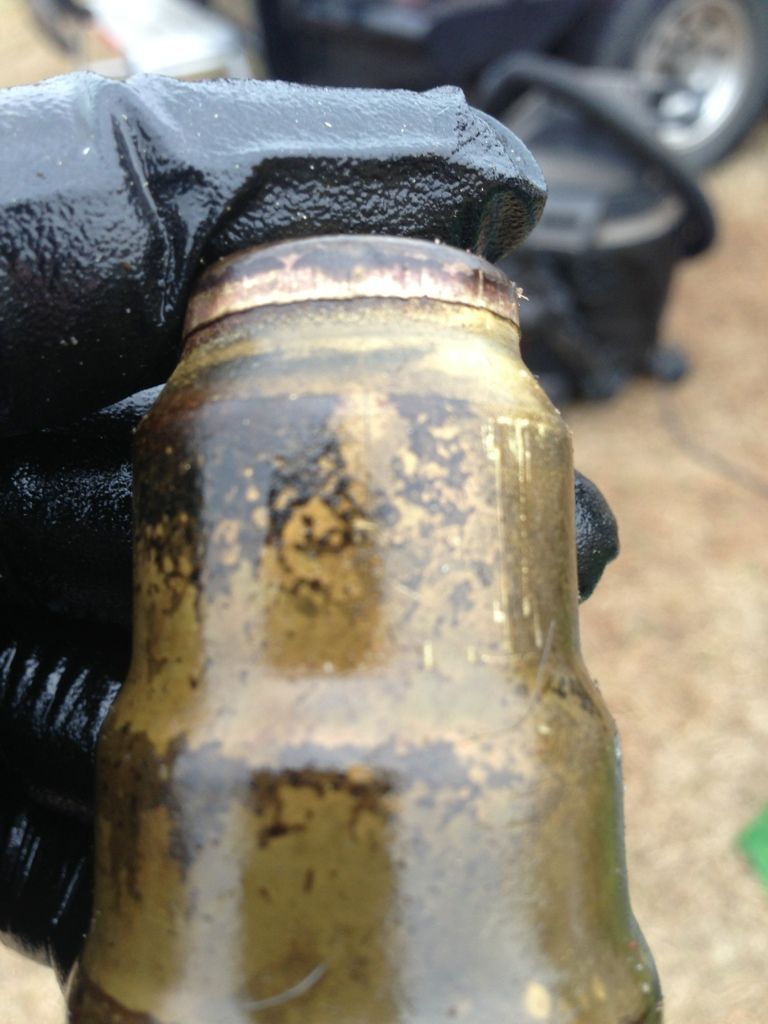
I'll add a little input though to support Kel's theory. My cup was cracked near the bottom. Also, the crack didn't extend into the area that was constrained by the head, it was in the middle that is open to coolant.
I also have a theory to bounce about why they used brass. It is a better thermal conductor than cast iron and steel. Injectors work really hard, and I'm sure they produce heat that needs to be transferred out. Brass was the ideal choice because it has adequate thermal conductivity while having ideal strength and expansion/contraction properties.
I'll add a little input though to support Kel's theory. My cup was cracked near the bottom. Also, the crack didn't extend into the area that was constrained by the head, it was in the middle that is open to coolant.
I also have a theory to bounce about why they used brass. It is a better thermal conductor than cast iron and steel. Injectors work really hard, and I'm sure they produce heat that needs to be transferred out. Brass was the ideal choice because it has adequate thermal conductivity while having ideal strength and expansion/contraction properties.

Senior User
Joined: Sep 2009
Posts: 341
Likes: 0
I am curious of the retorquing the stock sticks on trucks, did you get any amount of turn out of any of the bolts? Were some at spec and some turned a bit?
I am rebuilding an old stove right now and an interesting tid bit. The wire terminals used in ovens/stoves are nickel because any other material expands and contracts to much which eventually loosens up the connection causing a burn out.
I am rebuilding an old stove right now and an interesting tid bit. The wire terminals used in ovens/stoves are nickel because any other material expands and contracts to much which eventually loosens up the connection causing a burn out.
Jeff
Hotshot
Joined: May 2005
Posts: 13,484
Likes: 42
From: Stevens Point, WI
They used brass because much like the copper washer on the end of the injector it easily conforms to the surrounding area it is being pressed into and is supposed to seal up without much aid like a copper washer.
One other thing I wonder is how thin some parts of the cups get when being formed. Like when you try to expand any metal it gets thinner and thinner till it cracks and like I mentioned brass is very prone to cracking. The heat cycles don't help. I would imagine if simply a thicker cup was used the cracking problem would be greatly reduced. That is if there is enough room to go thicker. I am curious as well if the replacement cups are thicker than say the E99's? Possibly the E99's were thinner than the rest and no one mentioned anything about it?
One other thing I wonder is how thin some parts of the cups get when being formed. Like when you try to expand any metal it gets thinner and thinner till it cracks and like I mentioned brass is very prone to cracking. The heat cycles don't help. I would imagine if simply a thicker cup was used the cracking problem would be greatly reduced. That is if there is enough room to go thicker. I am curious as well if the replacement cups are thicker than say the E99's? Possibly the E99's were thinner than the rest and no one mentioned anything about it?
Postmaster
Joined: Jun 2010
Posts: 2,555
Likes: 9
From: Longview, TX
They used brass because much like the copper washer on the end of the injector it easily conforms to the surrounding area it is being pressed into and is supposed to seal up without much aid like a copper washer.
One other thing I wonder is how thin some parts of the cups get when being formed. Like when you try to expand any metal it gets thinner and thinner till it cracks and like I mentioned brass is very prone to cracking. The heat cycles don't help. I would imagine if simply a thicker cup was used the cracking problem would be greatly reduced. That is if there is enough room to go thicker. I am curious as well if the replacement cups are thicker than say the E99's? Possibly the E99's were thinner than the rest and no one mentioned anything about it?
One other thing I wonder is how thin some parts of the cups get when being formed. Like when you try to expand any metal it gets thinner and thinner till it cracks and like I mentioned brass is very prone to cracking. The heat cycles don't help. I would imagine if simply a thicker cup was used the cracking problem would be greatly reduced. That is if there is enough room to go thicker. I am curious as well if the replacement cups are thicker than say the E99's? Possibly the E99's were thinner than the rest and no one mentioned anything about it?