



Parking Brake Problems
Thread Starter
|
Tuned
Joined: Dec 2012
Posts: 391
Likes: 1
From: Fouke, Arkansas
Parking Brake Problems
I have a 2000 F350 4X4 with a V10 under the hood and a 5 speed manual transmission. It has a heavy western hauler bed, and a dual tired rearend. The truck has disc brakes all the way around that work great. I bought the truck used and immediately replaced all the disc brake pads as well as the seperate parking brake shoes and I had the parking brake drums turned. My problem is the parking brake shoes won't hold the truck at all and never have even when they were new. The parking brake shoes seem very small to me for a truck this size and weight. I have adjusted them as tight as I can with out causing them to drag when they are released. Is this a common problem for this type of parking brake on this type of truck? Is there something I am over looking or need to do to perhaps improve the parking brake? Would it be possible to splice some sort of "locking" valve into the brake lines going to the disc brakes to perhaps hold them engaged when I park the truck? I have a good idea how air brakes work, so I suppose this "locking" valve would work like that except basically opposite of a locking air brake valve, if that makes any sense. Thank you in advance for your input, ideas, suggestions, and thoughts.

Elder User
Joined: Oct 2001
Posts: 544
Likes: 2
From: Jersey Shore Not Seaside!
Sorry didn’t see this post earlier.
You’re right that these DIH parking brakes are marginal at 12k-13.5k, although the DRW is a little better due to its wider shoe/drum width. When we were trying to develop an aftermarket lining for this application it was challenging.
First, what you did with the drums is the worst thing you can do. In order for Ford to meet FMVSS standards to hold on a 20% grade the F-350 SRW/DRW had to have the drum surfaces grit blasted for the proper static force. I’ve never seen an aftermarket rotor that has the same surface, only turned.

Plus another problem with turning the drums is that you are enlarging the drum diameter, so if the new shoes are ground to the OE diameter, the contact area of the new shoes in the turned drum will be smaller, concentrating in the center of the shoe rather then the ends, eliminating the duo-servo action which is required for maximum hill holding and of course ground clearance is more of a concern at the axle rather then the transfer case/transmission.
Even with the OE production line product, with in-service time the lining and drum surfaces can degrade from heat and oxidation to the point of reducing it’s hill hold capability. And if the parking brake was left on (if the truck does not have auto release) it’s ability is gone within a mile. Yes that is a Superduty.

(Ignore the thermocouple.)

And adjustment is also very critical. Normally with a drum service brake you would set up for a running clearance between the shoes and drums between 0.025” and 0.030” depending on the overall diameter. With the DIH parking brake it is critical to have this at no larger then 0.015” total. The service manual states 0.030", but that is not how it's done on the production line parts! This is really hard to do by the typical “feel” when rotating adjustment method for maximum holding capability, and the problem is if you over adjust the contact between the shoe and drum is going to wipe out the grit blasting. So in order to do this in NHTSA mode, we had to use a large micrometer to make sure the linings were set to spec test to test. You ain’t got one of these.
And despite all of what I have written, there also was a requirement to burnish in the brake before the hill hold test. As per the Ford manual, one, and only one stop from 25mph with parking brake only allows enough friction material transfer onto the drum surface to attain the proper friction material to friction material static friction as an iron surface alone has too low of a coefficient of friction. From the manual:
9. Burnish the parking brake shoe and linings.
And the DIH shoe's linings are also critical. OE linings, and it doesn’t matter if its an F-350, F-150, Explorer, Corvette, etc have to have a certain amount of compliancy to compress and fit the drums the best. This however means that they don’t have the structural reinforcement to heat with heat aging, and in time they need to get replaced. With aftermarket shoes, there are NO federal or state manufacturing requirements, so all they need to do is sell a product that fits and hope it will work. And then it’s a consumers/mechanics trial and error conundrum.
So for you with a manual transmission truck about now are thinking I’m not going to be able to deal with all of this in the field. And I admit it’s difficult, but doable, even if you have to use aftermarket rotors and get them grit blasted yourself. And if it was my manual trans truck I would only get the Ford OE “Blue Box” linings, not even the Ford Motorcraft red box versions.
You were asking about setting up hydraulic line valves and yes that can be done. For certain types of tests we used to use Mico hydraulic line kits from NAPA , basically the same type of kit used in drag racing to hold the front brake on while doing burnouts. You can find these types of kits everywhere. We used to plumb the Mico Kits as a one way valve so they would hold the hydraulic pressure with just a quick apply of electric power, but you would have to reapply a higher pressure to release them from the one-way action.

You can even go simpler by plumbing in a Swaglok ball valve into the rear brake line located in the cabin by the drivers seat.
Sounds like a great solution, but there is a problem, and why Ford did not go with a integral parking brake through the disc brake caliper like it has on some passenger cars. Heavier weight vehicles can’t use an organic based friction material and need to use a semi-metallic for durability and fade resistance. The problem with this type of friction material is swell from heat, not unlike air brake linings. So while an air braked truck uses spring cans to maintain pressure as the drum linings cool, an integral caliper parking brake does not. So if you park a hot, semi-metallic material equipped truck on a hill to get lunch by the time you are ready for dessert you will be out the door running after your truck.
You can work around this if you are thoughtful about it every time you park (wouldn’t hurt to get an infrared heat gun at Harbor Freight to shoot the rotors), but Mico has come up with a solution after dealing with many lawsuits about runaway vehicles ,selling the in-line valves as hill hold devices. Its not fun being in the bucket of a utility bucket truck during a ride. They are not cheap.
http://www.awdirect.com/product_imag...ationguide.pdf
Brake Locks | MICO, Inc.
And there is another solution depending upon your degree of fabrication or mechanical skills - installing a driveshaft brake (at the axle unless you trust your U-Joints although there are ground clearance issues at both driveshaft and transmission/transfer case applications). I've not seen a direct fit application, so they would have to be fabricated to our trucks. These have become popular with hill racing folks, and there are still commercial applications that use them. Sometimes you have to apply them in motion to first clean off the debris before you park to get the best holding.
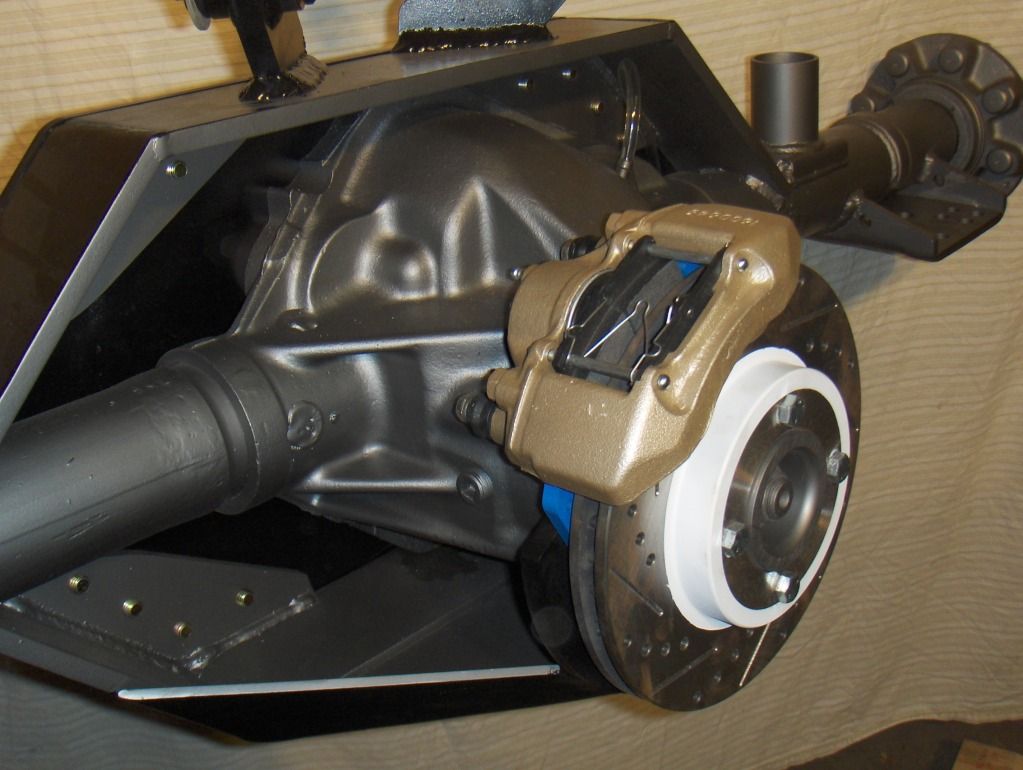
Northern Drivetrain, LLC: Driveline & Pinion Brakes
Hope it was worth the wait.
.
You’re right that these DIH parking brakes are marginal at 12k-13.5k, although the DRW is a little better due to its wider shoe/drum width. When we were trying to develop an aftermarket lining for this application it was challenging.
First, what you did with the drums is the worst thing you can do. In order for Ford to meet FMVSS standards to hold on a 20% grade the F-350 SRW/DRW had to have the drum surfaces grit blasted for the proper static force. I’ve never seen an aftermarket rotor that has the same surface, only turned.
Plus another problem with turning the drums is that you are enlarging the drum diameter, so if the new shoes are ground to the OE diameter, the contact area of the new shoes in the turned drum will be smaller, concentrating in the center of the shoe rather then the ends, eliminating the duo-servo action which is required for maximum hill holding and of course ground clearance is more of a concern at the axle rather then the transfer case/transmission.
Even with the OE production line product, with in-service time the lining and drum surfaces can degrade from heat and oxidation to the point of reducing it’s hill hold capability. And if the parking brake was left on (if the truck does not have auto release) it’s ability is gone within a mile. Yes that is a Superduty.
(Ignore the thermocouple.)
And adjustment is also very critical. Normally with a drum service brake you would set up for a running clearance between the shoes and drums between 0.025” and 0.030” depending on the overall diameter. With the DIH parking brake it is critical to have this at no larger then 0.015” total. The service manual states 0.030", but that is not how it's done on the production line parts! This is really hard to do by the typical “feel” when rotating adjustment method for maximum holding capability, and the problem is if you over adjust the contact between the shoe and drum is going to wipe out the grit blasting. So in order to do this in NHTSA mode, we had to use a large micrometer to make sure the linings were set to spec test to test. You ain’t got one of these.
And despite all of what I have written, there also was a requirement to burnish in the brake before the hill hold test. As per the Ford manual, one, and only one stop from 25mph with parking brake only allows enough friction material transfer onto the drum surface to attain the proper friction material to friction material static friction as an iron surface alone has too low of a coefficient of friction. From the manual:
9. Burnish the parking brake shoe and linings.
- Accelerate the vehicle to 40 km/h (25 mph).
- Shift the transmission to NEUTRAL.
- Slowly apply the parking brake control (2780) to approximately one-half to three-quarters of its travel.
- Allow the vehicle to come to a complete stop.
- Release the parking brake.
And the DIH shoe's linings are also critical. OE linings, and it doesn’t matter if its an F-350, F-150, Explorer, Corvette, etc have to have a certain amount of compliancy to compress and fit the drums the best. This however means that they don’t have the structural reinforcement to heat with heat aging, and in time they need to get replaced. With aftermarket shoes, there are NO federal or state manufacturing requirements, so all they need to do is sell a product that fits and hope it will work. And then it’s a consumers/mechanics trial and error conundrum.
So for you with a manual transmission truck about now are thinking I’m not going to be able to deal with all of this in the field. And I admit it’s difficult, but doable, even if you have to use aftermarket rotors and get them grit blasted yourself. And if it was my manual trans truck I would only get the Ford OE “Blue Box” linings, not even the Ford Motorcraft red box versions.
You were asking about setting up hydraulic line valves and yes that can be done. For certain types of tests we used to use Mico hydraulic line kits from NAPA , basically the same type of kit used in drag racing to hold the front brake on while doing burnouts. You can find these types of kits everywhere. We used to plumb the Mico Kits as a one way valve so they would hold the hydraulic pressure with just a quick apply of electric power, but you would have to reapply a higher pressure to release them from the one-way action.
You can even go simpler by plumbing in a Swaglok ball valve into the rear brake line located in the cabin by the drivers seat.
Sounds like a great solution, but there is a problem, and why Ford did not go with a integral parking brake through the disc brake caliper like it has on some passenger cars. Heavier weight vehicles can’t use an organic based friction material and need to use a semi-metallic for durability and fade resistance. The problem with this type of friction material is swell from heat, not unlike air brake linings. So while an air braked truck uses spring cans to maintain pressure as the drum linings cool, an integral caliper parking brake does not. So if you park a hot, semi-metallic material equipped truck on a hill to get lunch by the time you are ready for dessert you will be out the door running after your truck.
You can work around this if you are thoughtful about it every time you park (wouldn’t hurt to get an infrared heat gun at Harbor Freight to shoot the rotors), but Mico has come up with a solution after dealing with many lawsuits about runaway vehicles ,selling the in-line valves as hill hold devices. Its not fun being in the bucket of a utility bucket truck during a ride. They are not cheap.
http://www.awdirect.com/product_imag...ationguide.pdf
Brake Locks | MICO, Inc.
And there is another solution depending upon your degree of fabrication or mechanical skills - installing a driveshaft brake (at the axle unless you trust your U-Joints although there are ground clearance issues at both driveshaft and transmission/transfer case applications). I've not seen a direct fit application, so they would have to be fabricated to our trucks. These have become popular with hill racing folks, and there are still commercial applications that use them. Sometimes you have to apply them in motion to first clean off the debris before you park to get the best holding.
Northern Drivetrain, LLC: Driveline & Pinion Brakes
Hope it was worth the wait.
.
Thread Starter
|
Tuned
Joined: Dec 2012
Posts: 391
Likes: 1
From: Fouke, Arkansas
fmtrvt I can't thank you enough for your input. I really appreciate it and it has given me information I didn't have before and it has also give me something to think about. I have fairly decent fabrication and mechanical skills so with the information you have given me and my desire and enjoyment to solve problems my brain is working already to solve this problem. I will post in this thread as soon as I work it all out. Thank you again I really really appreciate your input and sharing this information with me.
Elder User
Joined: Oct 2001
Posts: 544
Likes: 2
From: Jersey Shore Not Seaside!
Your welcome. Based on your post I thought you would get inventive.
But let me go back into the discussion and say that right now I think your truck's parking is really compromised by the current rotor's drums and possibly linings. We, and Ford of course, were able to park this truck at 13,500lbs on a 20% grade. A 20% grade is no easy feat.
Getting some good quality rear rotors and having them grit blasted (36grit) doesn't appear out of your realm. And whatever linings you have, you can put them into the drum and do the "rock" test (seeing if the lining arc is tighter then the drum's arc) or as we did in the field clamp 2" from one end of the shoe to the drum and measure the lining to drum clearance on the other end. Divide by 2 and you know how much fall off there is. For DIH, 0.000" is ideal.
Once you have the original DIH brake working even close to it's capability a small supplemental parking assist could be a great project.
And the reason that I state this is using a single brake mechanism as a driveline brake (either disc or internal/external drum, yes there are those too) can be expensive to kluge together. Although the advantage of a driveline brake is that it is working though the differential so it has the leverage from the ring and pinion ratio that a wheel end brake does not. The wheel end brakes may have to static hold 13,500lbs dead weight of potential energy (+slope load) while a single driveline brake is only required at 3,619lbs with a 3.73 ratio, even less if your ratio is taller. A 9" or 10" scrub radius should hold that.
A fine example of a drum unit on a .... sigh ... Hydromatic.

From an aftermarket option though it's easier to design a unit to mount at the drive axle then the transmission/transfer case in most situations.
And here is a place you might want to check out:
http://www.highangledriveline.com/e_brake.html
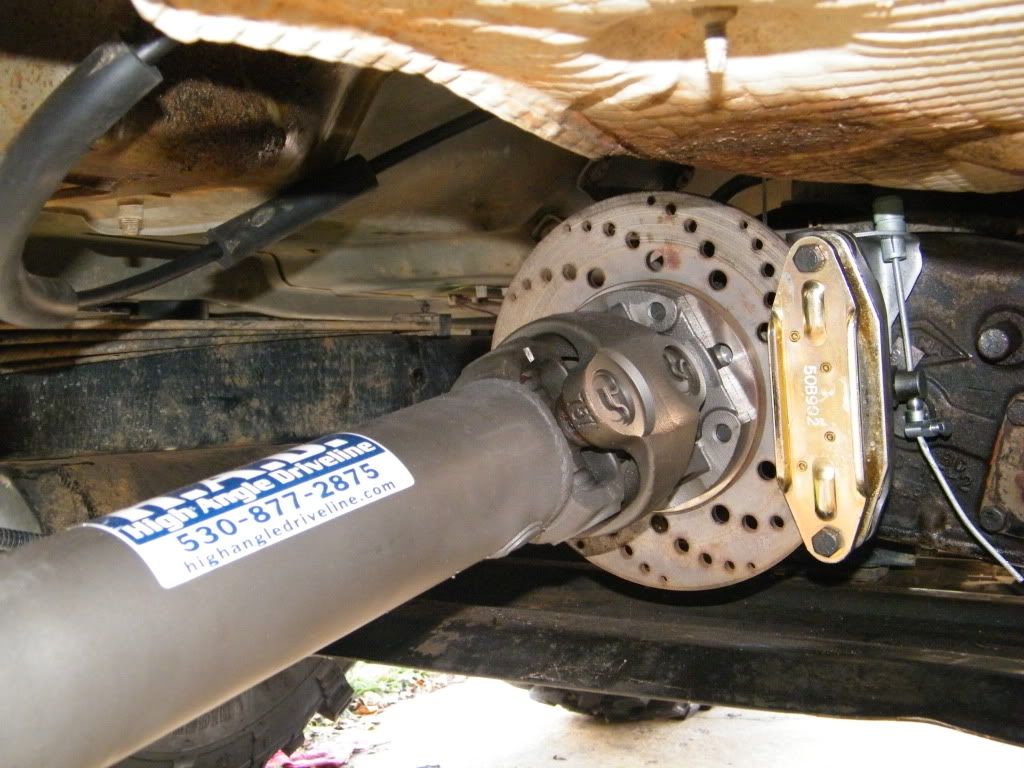
Or here:
http://www.tsmmfg.com/Pinion_Mounted_Parking_Brakes.htm

But let me go back into the discussion and say that right now I think your truck's parking is really compromised by the current rotor's drums and possibly linings. We, and Ford of course, were able to park this truck at 13,500lbs on a 20% grade. A 20% grade is no easy feat.
Getting some good quality rear rotors and having them grit blasted (36grit) doesn't appear out of your realm. And whatever linings you have, you can put them into the drum and do the "rock" test (seeing if the lining arc is tighter then the drum's arc) or as we did in the field clamp 2" from one end of the shoe to the drum and measure the lining to drum clearance on the other end. Divide by 2 and you know how much fall off there is. For DIH, 0.000" is ideal.
Once you have the original DIH brake working even close to it's capability a small supplemental parking assist could be a great project.
And the reason that I state this is using a single brake mechanism as a driveline brake (either disc or internal/external drum, yes there are those too) can be expensive to kluge together. Although the advantage of a driveline brake is that it is working though the differential so it has the leverage from the ring and pinion ratio that a wheel end brake does not. The wheel end brakes may have to static hold 13,500lbs dead weight of potential energy (+slope load) while a single driveline brake is only required at 3,619lbs with a 3.73 ratio, even less if your ratio is taller. A 9" or 10" scrub radius should hold that.
A fine example of a drum unit on a .... sigh ... Hydromatic.
From an aftermarket option though it's easier to design a unit to mount at the drive axle then the transmission/transfer case in most situations.
And here is a place you might want to check out:
http://www.highangledriveline.com/e_brake.html
Or here:
http://www.tsmmfg.com/Pinion_Mounted_Parking_Brakes.htm
Thread Starter
|
Tuned
Joined: Dec 2012
Posts: 391
Likes: 1
From: Fouke, Arkansas
fmtrvt thanks a million, I really appreciate the information.....you are a wealth of knowledge and I thank you for sharing. I once put a 4 speed manual transmission out of an old duece and a half in a 55 chevy truck. The old 4 speed transmission had an outter drum type brake on it with a band around the drum and a lever that came up through the floor board that engaged the "parking" brake", it held really good and it was kinda neat. I was kinda thinking about one of those old brakes activated by the existing parking brake cable. I was also kicking around the ideal of getting a part machined that would bolt on the pinion U joint yoke that looked like say a "donut" with several holes around the edge. Then build another part like a set of "old ice tongs" that would mount on the rearend. When you step on the parking brake pedal the "ice tongs" would engage in the holes in the "donut" edge locking the back differential. One of the down sides to this idea is getting it to release under pressure. I really appreciate your input and really you have solved my problem for me and I honestly can't thank you enough.
Elder User
Joined: Oct 2001
Posts: 544
Likes: 2
From: Jersey Shore Not Seaside!
My first “car”, a 1956 F-500 (yes, farm boy), had the same type of brake. It worked well too.
For using the OE parking cable system .... Our trucks utilize a Dura Automotive design that is a balanced tension system. The wheel end side uses a spring between the cable-backing plate attachment and application lever to supply tension from one end, and a tensioned take-up reel at the pedal assembly to supply an opposing force. Hopefully in whatever you come up with the tension reel will work with a hard, non-tensioned opposing end connection. I think that it would.
Sounds like your thinking of coming up with a setup like the parking pawl in the automatic transmission vehicles, so you might want to take a look at how those pawls and toothed wheels are designed. You are right that retraction under load is the main issue in releasing. If you are considering a pin through a holed wheel I would think that over-sized holes with a tapered pin, captured on both sides of the wheel might retract better then a straight pin. Bolting flanges for the driveshaft connections make this an easier task.
Most US roads are at a maximum of a 10% grade, but driveways and parking lots can be above this. You can do rough calculation of the forces you would need to deal with when using a driveline parking mechanism like this (-2% for tire rolling losses, etc as per NHTSA).
12,000gvw on 20% grade: 12000x.18= 2160 / axle ratio (3.73) = 579lbs. x3 for roll shock loading IMO.
If you are doing a mechanical lock design what ever you come up with what you do not want it to accidentally engage while moving.
For using the OE parking cable system .... Our trucks utilize a Dura Automotive design that is a balanced tension system. The wheel end side uses a spring between the cable-backing plate attachment and application lever to supply tension from one end, and a tensioned take-up reel at the pedal assembly to supply an opposing force. Hopefully in whatever you come up with the tension reel will work with a hard, non-tensioned opposing end connection. I think that it would.
Sounds like your thinking of coming up with a setup like the parking pawl in the automatic transmission vehicles, so you might want to take a look at how those pawls and toothed wheels are designed. You are right that retraction under load is the main issue in releasing. If you are considering a pin through a holed wheel I would think that over-sized holes with a tapered pin, captured on both sides of the wheel might retract better then a straight pin. Bolting flanges for the driveshaft connections make this an easier task.
Most US roads are at a maximum of a 10% grade, but driveways and parking lots can be above this. You can do rough calculation of the forces you would need to deal with when using a driveline parking mechanism like this (-2% for tire rolling losses, etc as per NHTSA).
12,000gvw on 20% grade: 12000x.18= 2160 / axle ratio (3.73) = 579lbs. x3 for roll shock loading IMO.
If you are doing a mechanical lock design what ever you come up with what you do not want it to accidentally engage while moving.
Trending Topics
Thread Starter
|
Tuned
Joined: Dec 2012
Posts: 391
Likes: 1
From: Fouke, Arkansas
That's very true fm, if it did engage while moving it would really cause a problem and tear up a world of stuff. I like the idea of some sort of disc brake on the pinion shaft like in the pictures you posted. I am going to compare the price of one as opposed to having a disc machined, I can get one machined very cheap say for the price of a coke LOL. I might can get a small caliper off of a car and modify it fairly easily to work on my truck. Man I really appreciate the help you have given me. The wheels in my head are really turning now and I can definately see some fun and a solution in the future, thanks to you.
FTE Stories
Ford Trucks for Ford Truck Enthusiasts

Top 10 Fords at 2026 Carlisle Ford Nationals
Joe Kucinski
3 Best / 3 Worst Parts of Modern Ford Ownership
Brett Foote
10 Amazing Upgrades That Solve Common Ford Truck Owner Headaches
Pouria Savadkouei
Every 2026 Ford Engine Explained
Brett Foote
10 Ugly Ford Trucks That We Still Kinda Love
Joe Kucinski
10 Things Every Truck Owner NEEDS (2026 Edition)
Michael S. Palmer
Rezvani's Latest Post-Apocalyptic Monster Is a Ford F-150 Raptor Underneath
Verdad Gallardo
Top 10 Most Expensive Ford Trucks Ever Sold on Bring a Trailer
Joe Kucinski
2027 Ford Super Duty Buyer's Guide (Every Model, Engine, & Package)
Brett Foote
Elder User
Joined: Oct 2001
Posts: 544
Likes: 2
From: Jersey Shore Not Seaside!
Just find a car in a salvage yard that uses an integral parking brake, like the Lincoln LS. Drain the brake fluid out, maybe rinse it out good with alcohol, then I would use some brake parts assembly fluid to fill the brake fluid chamber and cap it off. This will prevent the caliper from rusting up internally in the future.
Thread Starter
|
Tuned
Joined: Dec 2012
Posts: 391
Likes: 1
From: Fouke, Arkansas
Thanks fm that's a good idea. I have to go to the junk yard in the next few days anyway for a distributor and the ignition module and the wiring harness. Does it need to be a back brake caliper or does it matter? What year model Lincoln should I look for at the junk yard? Thanks again
Last edited by Hogtrapper; Jan 21, 2013 at 10:20 PM. Reason: Add text
Elder User
Joined: Oct 2001
Posts: 544
Likes: 2
From: Jersey Shore Not Seaside!
As I stated earlier, the integral brake is used with an organic friction material, so they are typically on lighter weight vehicles. You will find them on Asian vehicles, Fords that have Asian roots and some European variants, Lincoln LS being one.
However, its prudent to get something off the heaviest vehicle you can find, which off the top of my head might be an Isuzu Trooper from the 80's or 90's. If not at the salvage yard, you should find them at eBay for reasonable prices, just also get the hanging bracket. Think about left or right for cable routing.
However, its prudent to get something off the heaviest vehicle you can find, which off the top of my head might be an Isuzu Trooper from the 80's or 90's. If not at the salvage yard, you should find them at eBay for reasonable prices, just also get the hanging bracket. Think about left or right for cable routing.
Thread Starter
|
Tuned
Joined: Dec 2012
Posts: 391
Likes: 1
From: Fouke, Arkansas
Thank you again fm, I'm on a mission now with a good direction to head. I really appreciate your help with this, I was very ignorant about this subject till you chimed in, thank you.

New User
Joined: Jul 2014
Posts: 1
Likes: 0
Superduty-Enough Truck, Not enough Brakes
Good advice from Jack on the parking brake(1-17-13). Mine has been weak from the start. My F350 is automatic, but at the boat ramp I want a brake too.
I haul a lot and tow a lot. That's what I bought the truck for. It's a one-ton truck. There is no chrome on my hitch ball.
I have smoked the parking brakes many times because I can't tell the damn thing is on until I drive it 20 miles, get out, and whiff," What's that smell?"
The Blue Box parking brake shoes are $99 at my local dealership. I will probably get new rotors from frozenrotors.com. I will have the drum surface (parking brake) only, grit blasted, 36 grit. I think this is the key element for a brake system that was way under-sized, under-built, and otherwise poorly designed.
I was turning my front rotors every 5-10K miles, because they were warping, run-out up to .010". My mechanic asked, " Am I gonna' have to marry this bitch?"
I went to cryogenic frozen rotors for my 5th pair of fronts. They weren't cheap. But I haven't touched 'em in 3 years. Thanks Jack, good advice.
I haul a lot and tow a lot. That's what I bought the truck for. It's a one-ton truck. There is no chrome on my hitch ball.
I have smoked the parking brakes many times because I can't tell the damn thing is on until I drive it 20 miles, get out, and whiff," What's that smell?"
The Blue Box parking brake shoes are $99 at my local dealership. I will probably get new rotors from frozenrotors.com. I will have the drum surface (parking brake) only, grit blasted, 36 grit. I think this is the key element for a brake system that was way under-sized, under-built, and otherwise poorly designed.
I was turning my front rotors every 5-10K miles, because they were warping, run-out up to .010". My mechanic asked, " Am I gonna' have to marry this bitch?"
I went to cryogenic frozen rotors for my 5th pair of fronts. They weren't cheap. But I haven't touched 'em in 3 years. Thanks Jack, good advice.

New User
Joined: May 2014
Posts: 15
Likes: 0
That was a good first reply to this thread and very much confirms my supicions, That Ford did a bunch of fubar. I'm almost certain the engineers were paid to create jobs not build quality.
I remember an old Dodge or 56 Chevrolet truck with park brake in middle of floor. Pulled lever back to engage and I think it had a drum brake, external band, so they knew well back then.
I remember an old Dodge or 56 Chevrolet truck with park brake in middle of floor. Pulled lever back to engage and I think it had a drum brake, external band, so they knew well back then.


Thread
Thread Starter
Forum
Replies
Last Post