


 [/IMG]


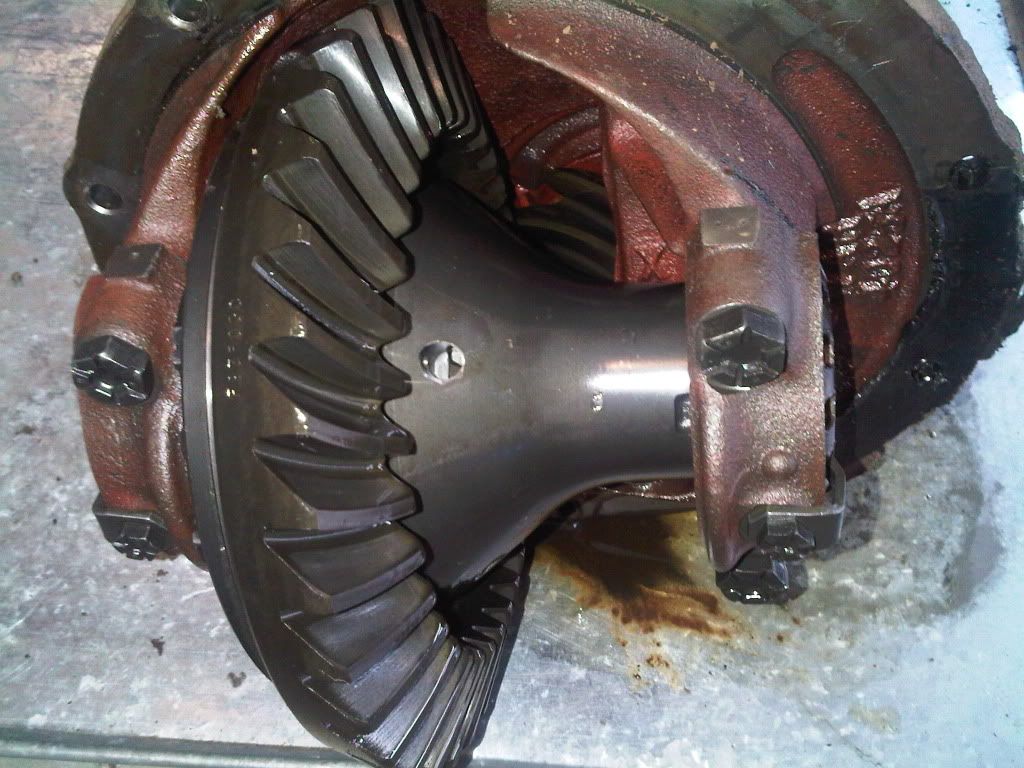
9" ford differential
Lead Driver


Joined: Sep 2003
Posts: 7,018
Likes: 210
From: SoCal

Without load, both axles of an open differential will turn together.
Look at the female splines on each side of the differential assembly. The splines on one side of a LSD are in two pieces, one inboard of the other. One of those is connected to the clutch carrier.
Here's another test: Try holding both the housing and one axle steady, and turn the other axle. If you can easily spin it and the pinion, it's either open or has really worn clutches. Ford's standard spec for the preload torque on the clutches is about 40 lbf-ft.
Look at the female splines on each side of the differential assembly. The splines on one side of a LSD are in two pieces, one inboard of the other. One of those is connected to the clutch carrier.
Here's another test: Try holding both the housing and one axle steady, and turn the other axle. If you can easily spin it and the pinion, it's either open or has really worn clutches. Ford's standard spec for the preload torque on the clutches is about 40 lbf-ft.

Cranky Old Guy
Joined: Mar 2008
Posts: 3,562
Likes: 6
From: Raphine, Virginia
Cranky Old Guy
Joined: Mar 2008
Posts: 3,562
Likes: 6
From: Raphine, Virginia
Trending Topics
Ford Parts Specialist
Joined: Nov 2006
Posts: 88,826
Likes: 790
From: Simi Valley, CA

If the AXLE code stamped on the Warranty Plate (1959 thru 1980), printed on the Certification Label (1981 thru today) begins with a letter: Limited Slip.
If the AXLE code begins with a number: no Limited Slip.
9 inch: Misc 1957/80 Passenger Cars / 1957/83 F100 / 1965/67 E100 Super Van / 1966/86 Bronco / 1969/74 E200 / 1975/86 F150 & E100/150.
Some of the above 1983/86's have the 8.8" integral, some have the 9" as it depended on the applications.
Some 1959/68 F100's have optional Dana 44's with Limited Slip. Some 1977/79 F100/150's have Dana 44's with/without Limited Slip.
Some 1963/69 F100's have optional Dana 60.2's and Dana 60.3's, both w/Limited Slip. These two Dana's are not the same as a Dana 60.
If the AXLE code begins with a number: no Limited Slip.
9 inch: Misc 1957/80 Passenger Cars / 1957/83 F100 / 1965/67 E100 Super Van / 1966/86 Bronco / 1969/74 E200 / 1975/86 F150 & E100/150.
Some of the above 1983/86's have the 8.8" integral, some have the 9" as it depended on the applications.
Some 1959/68 F100's have optional Dana 44's with Limited Slip. Some 1977/79 F100/150's have Dana 44's with/without Limited Slip.
Some 1963/69 F100's have optional Dana 60.2's and Dana 60.3's, both w/Limited Slip. These two Dana's are not the same as a Dana 60.
FTE Stories
Ford Trucks for Ford Truck Enthusiasts

Top 6 Best Deals Available on New Fords & Lincolns Right Now
Brett Foote
This Hennessey Takes the Expedition Tremor's Off-Roading Capability to the Next Level
Verdad Gallardo
Top 10 Fords at 2026 Carlisle Ford Nationals
Joe Kucinski
3 Best / 3 Worst Parts of Modern Ford Ownership
Brett Foote
10 Amazing Upgrades That Solve Common Ford Truck Owner Headaches
Pouria Savadkouei
Every 2026 Ford Engine Explained
Brett Foote
10 Ugly Ford Trucks That We Still Kinda Love
Joe Kucinski
10 Things Every Truck Owner NEEDS (2026 Edition)
Michael S. Palmer
Rezvani's Latest Post-Apocalyptic Monster Is a Ford F-150 Raptor Underneath
Verdad Gallardo
Thread Starter
|
Junior User
Joined: Jun 2002
Posts: 93
Likes: 0
This appears to be the same thing. Looks like whatever it is, not very popular.
HELP identifying a 9 inch "posi" - Ford Muscle Forums : Ford Muscle Cars Tech Forum
HELP identifying a 9 inch "posi" - Ford Muscle Forums : Ford Muscle Cars Tech Forum
 (sigh) Posi or Positraction are strictly GM terms. One would think a Ford related forum would know this.
Thread Starter
|
Junior User
Joined: Jun 2002
Posts: 93
Likes: 0
He has one post. Anyway, got it narrowed down to possibly an early auburn unit. I know now, it is not an open differential.
Ford Parts Specialist
Joined: Nov 2006
Posts: 88,826
Likes: 790
From: Simi Valley, CA
The only Auburn unit I'm aware of is this:
In 1935, Auburn introduced the two speed Columbia rear end. Auburn and Columbia were owned by Errat Lobban Cord, who also owned Lycoming and Duesenberg. The FWD Cord L-29 was available 1929/32, 'Coffin nosed' Cord 810/812 in 1936/37.
Ford offered the Columbia as an option in 1940/48 Passenger Cars. This unit is vacuum operated. hit the dash mounted switch, a screech is heard from the rear end when it changes gears.
In 1935, Auburn introduced the two speed Columbia rear end. Auburn and Columbia were owned by Errat Lobban Cord, who also owned Lycoming and Duesenberg. The FWD Cord L-29 was available 1929/32, 'Coffin nosed' Cord 810/812 in 1936/37.
Ford offered the Columbia as an option in 1940/48 Passenger Cars. This unit is vacuum operated. hit the dash mounted switch, a screech is heard from the rear end when it changes gears.
Lead Driver
Joined: Sep 2003
Posts: 7,018
Likes: 210
From: SoCal
Auburn LSDs use a cone-type clutch, so it's going to look different from Ford's Traction-Lok. I've never actually seen one apart, so I don't know what it looks like. However, I know that once its clutch wears out, it's not a simple matter of replacing clutch plates as in the Fords. I think the entire differential assembly needs to be replaced, or you have just an open differential.
And I agree with Bill; I've seen a lot of people incorrectly refer to Ford's LSDs as "Posi". Brainwashed by the mighty GM corp.
And I agree with Bill; I've seen a lot of people incorrectly refer to Ford's LSDs as "Posi". Brainwashed by the mighty GM corp.

Thread
Thread Starter
Forum
Replies
Last Post
FORDF250HDXLT
1967 - 1972 F-100 & Larger F-Series Trucks
28
Apr 8, 2024 07:23 AM
