


Bed Wood

Freshman User
Joined: Apr 2006
Posts: 37
Likes: 0
From: Springfield, MO
I just saw a technique for staining oak used on a home improvement show. They were looking for an ebony/zebra wood effect so they took some steel wool and let it sit outside in a bucket with a little bit of water in the bottom...a rusty pad with rusty water was the goal. Once the rust had developed in the steel wool/water they added vinegar. They took this mixture an wiped the oak boards liberally and voila they had a very nice looking ebony stain. I guess the combination of the oxide, the acid, and the tannins in the wood all came together to produce a very nice black stain in the oak. There have been discussions in the past about how to make oak look like ebony...hope someone finds this useful.

Hotshot


Joined: Oct 2004
Posts: 15,882
Likes: 88
From: Durham NC
Ebonizing or fuming oak dark grey to black is easily done. Build an air tight "tent" out of polyethylene plastic sheet with minimal extra volume but large enough that the wood doesn't touch the plastic. Use short lengths of pvc pipe to space the wood off the floor. Place a shallow pan of plain household ammonia from the grocery store in the tent (next to, not on top) with the wood and seal it. Leave it for several hours or overnight depending on how dark you want it. Overnight will give it a jet black color. Be a little careful handling the ammonia, the fumes can take your breath away (a small amount briefly held under the nose is "smelling salts" meant to make even an unconscious person gasp deeply) and make your eyes burn. If you spill it just leave the area until the fumes dissipate.
Hotshot
Joined: Oct 2004
Posts: 15,882
Likes: 88
From: Durham NC
Here's a very useful compilation of information:
http://www.clubfte.com/users/earl/Re...%20Information
about 1/2 way down is bed wood board dimensions and shapes.
http://www.clubfte.com/users/earl/Re...%20Information
about 1/2 way down is bed wood board dimensions and shapes.
Hotshot
Joined: Oct 2004
Posts: 15,882
Likes: 88
From: Durham NC
rhopper Not to ignore your question. I know that some have used composite decking for bed wood. Plastic (composite wood is plastic no matter what they call it) has a much higher coefficient of expansion than wood, and it expands in all directions equally (but only from temperature not moisture), so you need to leave more space and provisions for movement than for wood. One downfall of the decking material is that it gets quite hot in the sun.

Thread Starter
|
Laughing Gas
Joined: Jun 2004
Posts: 823
Likes: 4
From: Calais, Vermont
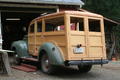
Of course, I am going to be ripping the boards to the factory width of 5 3/4". I assumed that this much was understood. My goal is pretty much to return the truck to a condition similar to that which it was in when it came off the assembly line. But, as I mentioned in an earlier post, I am pretty sure that I will stop short of painting the wood along with the rest of the body and bed. I am certain that the original boards were flatsawn. Quartersawn, while a much better cut (better behavior with moisture content changes) would be way too expensive, because fewer boards with useful widths (for my purpose, at least) are available per log. Protecting the wood (both sides) with some kind of penetrating sealer (even linseed oil) goes a long way in limiting the movement of the wood with changes in moisture content. At 5 3/4", I'm not too worried about cupping, though I will heed the advice to place the "frown down". Just a note on sealers, I would caution anyone from using Thompson Water Seal on their wood beds. It is pretty much various waxes disolved in very potent solvents. During application, those solvents can do a number to a paint job. The same caution probably applies to other sealers. And as far as clear urethanes, I understand that the first coat may do some penetrating, but subsequent applications do not. They only ride on top of the first coat. And the bond between coats is as much mechanical as it is chemical. So, subsequent applications need to be applied on the sanded surface of the coat underneath. Around here (central Vermont) it's getting hard to even kind urethane that isn't water based. I have no idea how this finish holds up outdoors, but I suspect it's not too good. So, I will probably use the linseed / turpentine mix that I had so much success with on my plywood strips bed. I know that the wood will turn grey, there will be some staining and maybe I'll get a crack or two, but it's a pretty tough truck. I think it can handle it. I intend to use it as a truck when it's back on the road. I just won't be driving it in the winter. At least not around here. The first few scartches in the body and the bed will probably break my heart, but it's a truck. I'll get over it.
Lead Driver


Joined: Jan 2005
Posts: 6,104
Likes: 138
From: Orcas Island Wa.

Great attitude. Looks like you have a good handle on the situation. So glad you aren't going to drive it in the winter there. Spent two winters remodling a house in N. Pomfret back in the 70's and my '66 scout was never the same afterwards. 

Tuned
Joined: Sep 2010
Posts: 374
Likes: 3
I thought I had a plan but after reading these posts (twice) I'm rethinking my plans. I was thinking of using some 2x12 used fir that is possibly 75 years old or more. I haven't looked at it for awhile but I'm pretty sure it has very few knots if any. I have had this lumber in my basement for about 20 yrs. I was going to plane it down to about 1 1/8" or 1 1/4" for this deck that I built.

After reading the info here I'm thinking this lumber is to wide and will probably warp.to easy. Maybe it would be better to sell it and get some 2x8 fir and use it instead. It would probably be a shame to use the 2x12s for a truck deck anyway. When I bolt the metal strips down should the bolts go through the cross members or should I use some light channel iron run across under and between the cross members to bolt the strips to and let the boards more or less float on the cross members?
After reading the info here I'm thinking this lumber is to wide and will probably warp.to easy. Maybe it would be better to sell it and get some 2x8 fir and use it instead. It would probably be a shame to use the 2x12s for a truck deck anyway. When I bolt the metal strips down should the bolts go through the cross members or should I use some light channel iron run across under and between the cross members to bolt the strips to and let the boards more or less float on the cross members?
Thread Starter
|
Laughing Gas
Joined: Jun 2004
Posts: 823
Likes: 4
From: Calais, Vermont
AX: Thanks for sharing that stuff from Earl's World. With regard to this thread: the bed wood information is going to save me a lot of time (and probably headaches), especially information on rabbet depth and width, as well as hole locations.
FTE Stories
Ford Trucks for Ford Truck Enthusiasts

10 Things Every Truck Owner NEEDS (2026 Edition)
Michael S. Palmer
Rezvani's Latest Post-Apocalyptic Monster Is a Ford F-150 Raptor Underneath
Verdad Gallardo
Top 10 Most Expensive Ford Trucks Ever Sold on Bring a Trailer
Joe Kucinski
2027 Ford Super Duty Buyer's Guide (Every Model, Engine, & Package)
Brett Foote
Top 10 Ford Truck Tragedies
Joe Kucinski
AEV FXL Super Duty - the Super Duty Raptor Ford Doesn't Make
Brett Foote
Lobo Vs Lobo: Proof the F-150 Lobo Should Be Even Lower!
Michael S. Palmer
Ford's 2001 Explorer Sportsman Concept Looks For a New Home
Verdad Gallardo
10 Best Ford Truck Engines We Miss the Most!
Joe Kucinski
Postmaster
Joined: Aug 2003
Posts: 3,222
Likes: 6
From: Houston
jvmcc, your take on the finish/sealer for the wood is good. You might want to add some varnish (you can get it with UV inhibitors) to your oil based sealer. It adds some body that will help close up the cells and stop more moisture from doing its thing (rot). Woodies used varnish, with the first several coats thinned with oils and thinner to penetrate the wood more. Some of the coach builders put as many as 6 coats on, the first several the thinned varnish, the last straight varnish. Of course they had to be recoated often to keep from getting gray.



Believe Nothing
Joined: Jun 2004
Posts: 7,514
Likes: 398
From: W. Central FL.

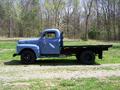
I find this thread very interesting. For giggles and laughs I'll put a couple pictures of a weathered deck board on my flatbed 1956 F-350. I seriously doubt if the pictured board is original. Perhaps axracer or some other knowledgeable wood worker can ID the wood. It is a coarse grain, fairly soft wood and shows no signs of cupping, warpage. Pictured is one of the edge boards that is bolted along the one side, and one bolt in the front and rear cross members. The other side of the board floats freely under the skid strip. Pictures that I posted earlier in this thread show the entire bed surface where various boards have broken sections, missing sections but no signs of warpage.
From experience I know that if wood decides it is going to cup or warp those metal skid strips would not prevent that.
From experience I know that if wood decides it is going to cup or warp those metal skid strips would not prevent that.
Last edited by raytasch; Mar 9, 2012 at 09:03 AM. Reason: Default date on camera
Believe Nothing
Joined: Jun 2004
Posts: 7,514
Likes: 398
From: W. Central FL.
Just throwing this into the discussion for the fact that these wide boards have no signs of warping or cupping. ??????