


Dynamat?
Thread Starter
|
Fleet Mechanic

Joined: Mar 2010
Posts: 1,342
Likes: 1
From: Jamestown, IN
Dynamat?
Okay I should be getting the cab back form the body shop next week and I would like some opinions on dynamat and other products you guys have used on for insulation. I want the quietest ride possible. I know they originally used undercoating in the cabs, but which is better? Also I am willing to cover the whole inside of the cab with dynamat or whatever it takes, but would putting it in certain areas do the same job? (hard to explain) I will also have a nice stereo system in it and I have heard dynamat is good for putting behind speakers? Also is there a cheaper knockoff brand of dynamat?
Logistics Pro

Joined: Apr 2010
Posts: 3,577
Likes: 29
From: Pekin, IL

Hi Jordan, I have read about buying a similar product at Menard's or Lowe's. It's some kind of roofing type sealer IIRC. I read it's the same stuff, but I don't really know that for sure. Others hopefully will fall in and confirm this. There was a thread on this awhile back. Not sure if I subscribed to it or not.

Senior User
Joined: Jun 2009
Posts: 105
Likes: 0
From: Cape Girardeau, Mo
I used Dynamat Extreme on my truck. I used to be in the car audio business and have been using their products since the original stuff came out. I've also used Hushmat on a recent customer build. You probably do pay a certain premium for buying a 'branded' material over a generic product from the home improvement store. The thing to compare would be the thickness of the butyl material in the two products.
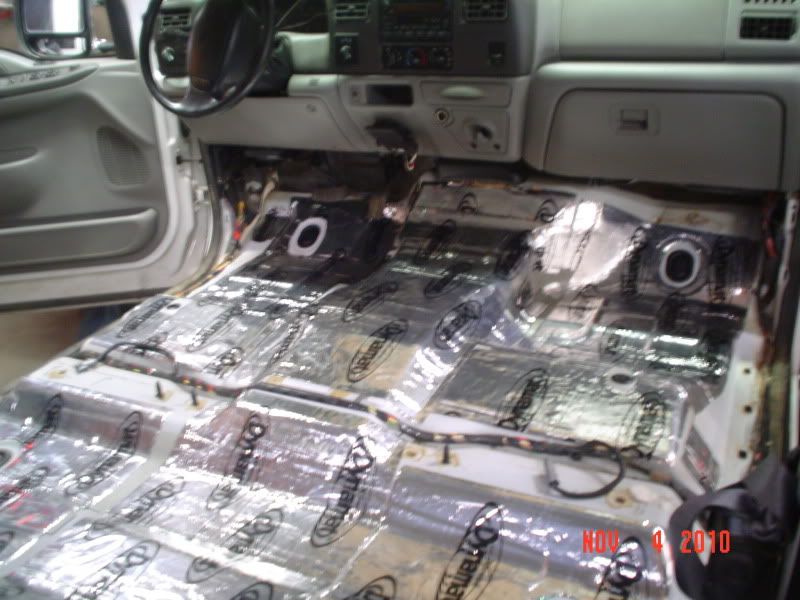
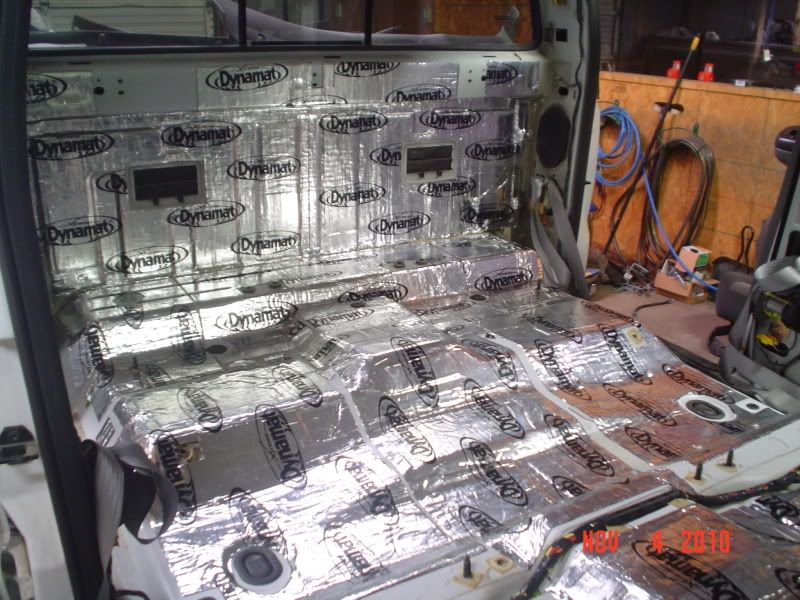
Already have the floor, back cab wall, and roof done. The doors will be done when I install the speakers. If I ever have to remove the dash or lift the cab the firewall will get done also.
Already have the floor, back cab wall, and roof done. The doors will be done when I install the speakers. If I ever have to remove the dash or lift the cab the firewall will get done also.
Refyred


Joined: Feb 2010
Posts: 2,083
Likes: 12
From: Southern Nevada
Jordan check out this outfit. I have used their product that is like Dynamat. It works very well and is cheaper! B-Quiet sound deadening material
Now B-quiet LOL
Now B-quiet LOL

Elder User
Joined: Oct 2004
Posts: 628
Likes: 1
From: Batavia Oh

Welder User
Joined: Feb 2009
Posts: 5,269
Likes: 50
From: northwest MT

Peel & Seal from Lowes......less than $20 per roll. It is the same thickness as the spendy stuff. Fatmat is good too, but way more $$$$.
I used this stuff on my floor, ceiling and behind the seat....It really does help with the noise.
I used this stuff on my floor, ceiling and behind the seat....It really does help with the noise.
Trending Topics
Logistics Pro
Joined: Apr 2010
Posts: 3,577
Likes: 29
From: Pekin, IL
I might even be able to get some...


FTE Stories
Ford Trucks for Ford Truck Enthusiasts

3 Best / 3 Worst Parts of Modern Ford Ownership
Brett Foote
10 Amazing Upgrades That Solve Common Ford Truck Owner Headaches
Pouria Savadkouei
Every 2026 Ford Engine Explained
Brett Foote
10 Ugly Ford Trucks That We Still Kinda Love
Joe Kucinski
10 Things Every Truck Owner NEEDS (2026 Edition)
Michael S. Palmer
Rezvani's Latest Post-Apocalyptic Monster Is a Ford F-150 Raptor Underneath
Verdad Gallardo
Top 10 Most Expensive Ford Trucks Ever Sold on Bring a Trailer
Joe Kucinski
2027 Ford Super Duty Buyer's Guide (Every Model, Engine, & Package)
Brett Foote
Top 10 Ford Truck Tragedies
Joe Kucinski
Cargo Master

Joined: Aug 2008
Posts: 2,661
Likes: 23
I used it in my car, it helps a lot with keeping sound out from the road and keeping your music in and louder for you (not everyone you drive by) . What I used was about 1/16" thick or so. A lot like thick aluminum foil over a backing that sticks very well... Wait that is what it is lol. Another reason to cover everything underneath is it also works like a sealer, so if your carpet gets something spilled on even if its never cleaned up it won't rust the floor boards . Carpet goes right over it, actually everything does real easy unless what you're putting over it is super thin. Can't feel it there either. I would suggest some for the headliner area too, insulates and better sound from your system. All around great stuff that's worth doing all you can in

Laughing Gas
Joined: Oct 2006
Posts: 879
Likes: 40
From: Colorado Springs /Mesa AZ
OK guys, here is another source. I think this will answer your question.
Dynamat vs.Lowes "peel and seal"
__________________________________________________
46 Ford Tudor - Street Rod
48 Ford F1 - OSC
"Happiness - 3 pedals and a 5 speed"
Dynamat vs.Lowes "peel and seal"
__________________________________________________
46 Ford Tudor - Street Rod
48 Ford F1 - OSC
"Happiness - 3 pedals and a 5 speed"
Senior User
Joined: Nov 2010
Posts: 243
Likes: 2
From: Guadalajara, Mexico
I haven't personally used this one but I thought I'd bring up the subject.
Did use a similar product (as far as I can tell by their page) for heat/corrosion insulation on the floor of a couple of projects with a friend.
LizardSkin® Spray-On Insulation : Lizardskin
Did use a similar product (as far as I can tell by their page) for heat/corrosion insulation on the floor of a couple of projects with a friend.
LizardSkin® Spray-On Insulation : Lizardskin
Lead Driver


Joined: Aug 2006
Posts: 8,094
Likes: 654
From: Brentwood, TN
Dynamat is a vibration dampner...this means that it will stop a panel from vibrating, what it doesn't mean is that it will soundproof a panel. For example, how much do you have to touch a cymbal or a tuning fork to get it to stop vibrating? A tip of the finger is usually enough to dampen the vibration. That said, how much Dynamat do you need to do the same on your cab floor, back wall, etc? Lot's of people will install 100% coverage with Dynamat...you could do the same but it is a waste of material IMO. Yeah I have heard the heat insulation aspects because the Dynamat has an aluminum backing, that is not what the backing is there for however. Dynamat is made from a 1/8 inch thick layer of soft butyl rubber, the aluminum holds the shape of the rubber...without it the rubber will ooze. Once installed the rubber bonds to the panel to which it was installed so it's not really going to go too far but installation recomendations are to use aluminum tape on the edges/seams...this isn't to ensure a tight insulation for the heat, it's to keep the butyl from coming out on your upholstery.
Don't get me wrong, I use Dynamat and as a vibration damper it works great...just don't put it in your cab and think that you are gaining much in the way of heat insulation or sound proofing.
Sound passes through panels, a vibration dampener will keep the panel from vibrating but it won't stop the sound from passing through the panel. What will stop the sound is mass-loaded vinyl (MLV). This is the material that is used extensively in professional sound studios and high-end theaters. A proper installation of the MLV consists of a layer of closed cell foam (CCF) and a layer of MLV. For instance, on my cab floor there are 2 coats of Lizardskin to isolate the heat, a layer of Dynamat (in the low areas only), a layer of 1/4 inch CCF, and a layer of MLV (1/8 inch thick). All these layers make about 3/8 inch thickness on top of the floor...not all that much for the benefit gained. AND the carpet can be laid directly on top of the MLV...no further pad is necessary. I like that part because lumpy carpet is just plain ugly in a nice truck.
On the firewall and the back wall of the cab I use the same technique but since these are vertical surfaces I must use something to adhere the CCF and MLV to them. For this I use an industrial grade Velcro...that makes it easy to install and keeps it removable just in case I need access at a later date.
Another point worth discussing is the roof and doors. How much noise comes through your roof? I never thought about it too much until I talked with a soundproofing professional...he told me that unless you are driving around and area with noise overhead, like an airport, you aren't going to get much noise through the roof. Since the roof is like a big cymbal you want to use vibration dampener on it but skip the soundproofing. There are lightweight products made for use behind headliners if you really think that you need some...I personally use Lizardskin to isolate the heat and Dynamat to dampen the vibration.
When I bought the CCF and MLV to do my truck I asked the vendor about the best way to install it in the doors...I assumed that it would go against the door skin itself. He told me that much of the noise that passes through the door area comes in through the door jambs so sound proofing the door skin itself will help but it won't be as effective as it could be. He recommended that I install the CCF and MLV in the door panels under the upholstery rather than inside the door on the skin, this covers the skin and the jambs both. Since I have yet to design/fabricate my door panels/upholstery this will be a lot easier for me. Hope this helps...
Don't get me wrong, I use Dynamat and as a vibration damper it works great...just don't put it in your cab and think that you are gaining much in the way of heat insulation or sound proofing.
Sound passes through panels, a vibration dampener will keep the panel from vibrating but it won't stop the sound from passing through the panel. What will stop the sound is mass-loaded vinyl (MLV). This is the material that is used extensively in professional sound studios and high-end theaters. A proper installation of the MLV consists of a layer of closed cell foam (CCF) and a layer of MLV. For instance, on my cab floor there are 2 coats of Lizardskin to isolate the heat, a layer of Dynamat (in the low areas only), a layer of 1/4 inch CCF, and a layer of MLV (1/8 inch thick). All these layers make about 3/8 inch thickness on top of the floor...not all that much for the benefit gained. AND the carpet can be laid directly on top of the MLV...no further pad is necessary. I like that part because lumpy carpet is just plain ugly in a nice truck.
On the firewall and the back wall of the cab I use the same technique but since these are vertical surfaces I must use something to adhere the CCF and MLV to them. For this I use an industrial grade Velcro...that makes it easy to install and keeps it removable just in case I need access at a later date.
Another point worth discussing is the roof and doors. How much noise comes through your roof? I never thought about it too much until I talked with a soundproofing professional...he told me that unless you are driving around and area with noise overhead, like an airport, you aren't going to get much noise through the roof. Since the roof is like a big cymbal you want to use vibration dampener on it but skip the soundproofing. There are lightweight products made for use behind headliners if you really think that you need some...I personally use Lizardskin to isolate the heat and Dynamat to dampen the vibration.
When I bought the CCF and MLV to do my truck I asked the vendor about the best way to install it in the doors...I assumed that it would go against the door skin itself. He told me that much of the noise that passes through the door area comes in through the door jambs so sound proofing the door skin itself will help but it won't be as effective as it could be. He recommended that I install the CCF and MLV in the door panels under the upholstery rather than inside the door on the skin, this covers the skin and the jambs both. Since I have yet to design/fabricate my door panels/upholstery this will be a lot easier for me. Hope this helps...

Laughing Gas

Joined: Jan 2004
Posts: 813
Likes: 5
From: Meade, KS
Gotta echo charlie's comments there.
This is an area I did not do so hot on when I redid my truck.
Hopefully in a couple of years I'll be tearing down my truck for some rust repair and a new paint job. When I do that I'll pull out all the old stuff and use a system similar to what Charlie's described.
There was a website that compared the benefits of different sound deadening products as well as their durability against heat/cold, etc. It was discussed on the HAMB here: Dynamat sound deadener and alternatives comparison - THE H.A.M.B.
However, the site referenced has now been converted as the guy who was searching for the best product apparently decided he could do it better and made his own product which he details here: Sound Deadener Showdown - Your Source for Sound Deadening Products and Information
This is more than just a sticky deadener, but a system much like Charlie described and what I plan to go with in the future...having some background in audio/acoustics this makes much more sense than simply slapping on the dynamat and calling it good.
Peace,
Jim
This is an area I did not do so hot on when I redid my truck.
Hopefully in a couple of years I'll be tearing down my truck for some rust repair and a new paint job. When I do that I'll pull out all the old stuff and use a system similar to what Charlie's described.
There was a website that compared the benefits of different sound deadening products as well as their durability against heat/cold, etc. It was discussed on the HAMB here: Dynamat sound deadener and alternatives comparison - THE H.A.M.B.
However, the site referenced has now been converted as the guy who was searching for the best product apparently decided he could do it better and made his own product which he details here: Sound Deadener Showdown - Your Source for Sound Deadening Products and Information
This is more than just a sticky deadener, but a system much like Charlie described and what I plan to go with in the future...having some background in audio/acoustics this makes much more sense than simply slapping on the dynamat and calling it good.
Peace,
Jim
Senior User
Joined: Sep 2007
Posts: 206
Likes: 0
From: Atwater, CA
I used Dynamat Xtreme in my '56 on the rear wall, the floor and the firewall. I was happy with the price I paid for it and buying it off Amazon, the shipping was free. I also installed the 1/4" Dynaliner over the Dynamat for help with the temperature aspect of keeping the cab cool. I have pictures of the installation in my gallery if you want to take a look. There are also some pictures of how everything turned out after the carpet was installed. I am quite pleased with the sound (or lack thereof) and the cab temp (no AC / no heater). You also might want to look at the following links to see the tech sheets for the two products.
Dynaliner
Dynamat Xtreme
Dynaliner
Dynamat Xtreme