





HELP bleeding brakes please

Thread Starter
|
Senior User
Joined: Apr 2003
Posts: 287
Likes: 0
From: Northeast OH
 HELP bleeding brakes please
I had one stuck caliper and one very leaky caliper so I replaced all 4 calipers and pads today. I have bled 2 quarts of brake fluid through the system and still have a super mushy pedal that goes almost to the floor. I bled the brakes conventionally, with a helper pushing the pedal while I bled the right rear, left real, right front, and left front brakes, in that order, twice. I don't seem to be getting any air from the bleeders but my pedal is way soft.
Am I missing something? Is there a way to bleed the ABS system? That is the only thing I'm not sure about.
My truck is out of service until I can get this resolved. Please help!
Am I missing something? Is there a way to bleed the ABS system? That is the only thing I'm not sure about.
My truck is out of service until I can get this resolved. Please help!

Super Moderator


Joined: May 2004
Posts: 29,380
Likes: 118
From: Central Coast of CA

You do NOT need to bleed the ABS system unless you replaced the 4-wheel anti-lock brake hydraulic control unit, or if you suspect air is in the HCU.
Follow this step-by-step and see if this procedure, especially the step in BOLD BLUE doesn't solve your problem.
Four Wheel Anti-Lock Brake System (4WABS) Hydraulic Control Unit (HCU)
NOTE: This procedure only needs to be performed if the 4-wheel anti-lock brake (4WABS) hydraulic control unit (HCU) has been replaced or if air is suspected in the HCU.
This following step only needs to be performed if the 4-wheel anti-lock brake (4WABS) hydraulic control unit (HCU) has been replaced or if air is suspected in the HCU.
Have an assistant pump the brake pedal (BP) (2B222) and then hold firm pressure on the brake pedal.
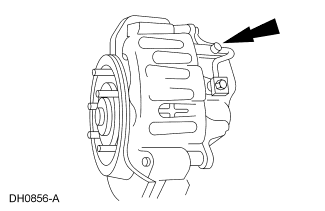
Loosen the disc brake caliper bleeder screw until a stream of brake fluid comes out. While the assistant maintains pressure on the brake pedal, tighten the disc brake caliper bleeder screw.
Repeat until clear, bubble-free fluid comes out.
Refill the brake master cylinder reservoir as necessary.
Tighten the disc brake caliper bleeder screw. Refer to Specifications.
More info: https://www.ford-trucks.com/forums/9...ml#post8534563
In the above thread, post number 16, that step I highlighted in blue solved 7475ih's problem.
Stewart
Follow this step-by-step and see if this procedure, especially the step in BOLD BLUE doesn't solve your problem.
Four Wheel Anti-Lock Brake System (4WABS) Hydraulic Control Unit (HCU)
NOTE: This procedure only needs to be performed if the 4-wheel anti-lock brake (4WABS) hydraulic control unit (HCU) has been replaced or if air is suspected in the HCU.
- Clean all dirt from and remove the brake master cylinder filler cap, and fill the brake master cylinder reservoir with the specified brake fluid.
- Connect a clear waste line to the RH rear bleeder screw and the other end in a container partially filled with recommended brake fluid.
- With the RH rear bleeder screw open, cycle the brake pedal until no more air is seen in the waste line.
- Tighten the RH rear bleeder screw, and disconnect the waste line.
- Repeat Steps 2, 3 and 4 for the LH rear bleeder screw, the RH front disc brake caliper bleeder screw, and the LH front disc brake caliper bleeder screw, in that order.
- Connect the scan tool DCL cable adapter into the vehicle data link connector (DLC) under the dash, and follow the scan tool instructions.
- Repeat the system bleed procedure as outlined in Steps 1 through 5.
- NOTE: It is not necessary to do a complete brake system bleed if only the disc brake caliper was disconnected.
Have an assistant pump the brake pedal (BP) (2B222) and then hold firm pressure on the brake pedal.
Loosen the disc brake caliper bleeder screw until a stream of brake fluid comes out. While the assistant maintains pressure on the brake pedal, tighten the disc brake caliper bleeder screw.
Repeat until clear, bubble-free fluid comes out.
Refill the brake master cylinder reservoir as necessary.
Tighten the disc brake caliper bleeder screw. Refer to Specifications.
More info: https://www.ford-trucks.com/forums/9...ml#post8534563
In the above thread, post number 16, that step I highlighted in blue solved 7475ih's problem.
Stewart
Last edited by Stewart_H; Feb 3, 2013 at 12:07 PM.
Logistics Pro

Joined: Jan 2011
Posts: 4,888
Likes: 3,435
From: Ohio
On a slightly related note, any idea how much fluid the whole system holds? I was changing the fluid last summer and it went through a couple quarts and I still wasn't 100% satisfied I was getting fresh fluid all the way to the back.
Thread Starter
|
Senior User
Joined: Apr 2003
Posts: 287
Likes: 0
From: Northeast OH
Yes, the calipers are installed correctly.
Stewart, I don't follow, are you saying I can bleed the ABS without the scan tool? I don't have a scan tool, so I may end up taking it to a shop to get bled if I can't get this figured out.
Stewart, I don't follow, are you saying I can bleed the ABS without the scan tool? I don't have a scan tool, so I may end up taking it to a shop to get bled if I can't get this figured out.

Fleet Mechanic
Joined: Sep 2002
Posts: 1,388
Likes: 2
From: Greensboro, NC
If you didn't clamp the soft lines when the calipers were replaced then you will still have air in the system. It's pretty amazing how much air can get sucked back in during the short amount of time the line is disconnected. I use a Motive Power Bleeder at the shop and have had the best results with it. When I did a complete flush on mine it took 2 quarts to get the complete color change. The color change was a result of using ATE Super Blue so you can see the blue change over from amber/clear. While the ABS pump may not have been opened it will still be a good idea to have it bled using a scan tool. It's an extremely easy operation and on my Solus Ultra it takes longer to input the vehicle type than to bleed the pump.
The Motive bleeder can be found here: Motive Products
Stacey David on Gearz has been promoting the Phoenix reverse bleeder where it pushes the fluid up from each corner. Never tried it but he sure likes it (or gets paid to like it....)
The Motive bleeder can be found here: Motive Products
Stacey David on Gearz has been promoting the Phoenix reverse bleeder where it pushes the fluid up from each corner. Never tried it but he sure likes it (or gets paid to like it....)
Trending Topics
Junior User
Joined: Dec 2011
Posts: 65
Likes: 0
From: Butler Pa
FTE Stories
Ford Trucks for Ford Truck Enthusiasts

10 Things Every Truck Owner NEEDS (2026 Edition)
Michael S. Palmer
Rezvani's Latest Post-Apocalyptic Monster Is a Ford F-150 Raptor Underneath
Verdad Gallardo
Top 10 Most Expensive Ford Trucks Ever Sold on Bring a Trailer
Joe Kucinski
2027 Ford Super Duty Buyer's Guide (Every Model, Engine, & Package)
Brett Foote
Top 10 Ford Truck Tragedies
Joe Kucinski
AEV FXL Super Duty - the Super Duty Raptor Ford Doesn't Make
Brett Foote
Lobo Vs Lobo: Proof the F-150 Lobo Should Be Even Lower!
Michael S. Palmer
Ford's 2001 Explorer Sportsman Concept Looks For a New Home
Verdad Gallardo
10 Best Ford Truck Engines We Miss the Most!
Joe Kucinski
Super Moderator
Joined: May 2004
Posts: 29,380
Likes: 118
From: Central Coast of CA
I may end up taking it to a shop to get bled if I can't get this figured out.
Here, I'll isolate it for you.
Connect a clear waste line to the RH rear bleeder screw and the other end in a container partially filled with recommended brake fluid.

- With the RH rear bleeder screw open, cycle the brake pedal until no more air is seen in the waste line.
- Tighten the RH rear bleeder screw, and disconnect the waste line.
- Repeat Steps 2, 3 and 4 for the LH rear bleeder screw, the RH front disc brake caliper bleeder screw, and the LH front disc brake caliper bleeder screw, in that order.
As I pointed out in the other brake thread I linked you too, that step is what solved another users brake issues.
Try bleeding your brakes exactly as directed in that step and see if it solves your problems, before you spend your hard earned money by having a shop solve your problem.
Stewart
Thread Starter
|
Senior User
Joined: Apr 2003
Posts: 287
Likes: 0
From: Northeast OH
Thank you for your advice. I will try this method again before I give up. This is the standard method for bleeding that I have always used, which is why I was unclear in your meaning. I am puzzled as to why this method has not succeded by now...I think I did let the MC run dry while i was swapping parts (oops) so I assumed that air would be in the system.
I am an old school guy. I finally gave up on old pre-electronic vehicles (as daily drivers) when they just became too unreliable for me, but I do have an appreciation for simplicity, which is one reason I like my X...it is relatively simple in a world of ever more complicated vehicles. Still, some aspects are foreign to me. Maybe I am making it more complicated than it is.
I am an old school guy. I finally gave up on old pre-electronic vehicles (as daily drivers) when they just became too unreliable for me, but I do have an appreciation for simplicity, which is one reason I like my X...it is relatively simple in a world of ever more complicated vehicles. Still, some aspects are foreign to me. Maybe I am making it more complicated than it is.
Fleet Mechanic
Joined: Oct 2010
Posts: 1,407
Likes: 155
From: Milwaukee, WI
Not a good sign if the master cylinder ran dry. That could really fill the system up with air. I believe it is recommended to bench bleed a master cylinder when it is goes dry. I'll let others chime in to confirm.
The trick and key point in the bleeding process is for the bleed tube to be submerged into a small container of fluid. It needs to stay submerged during the entire bleeding proces.
The trick and key point in the bleeding process is for the bleed tube to be submerged into a small container of fluid. It needs to stay submerged during the entire bleeding proces.

New User
Joined: Feb 2013
Posts: 6
Likes: 0
If you didn't clamp the soft lines when the calipers were replaced then you will still have air in the system. It's pretty amazing how much air can get sucked back in during the short amount of time the line is disconnected. I use a Motive Power Bleeder at the shop and have had the best results with it. When I did a complete flush on mine it took 2 quarts to get the complete color change. The color change was a result of using ATE Super Blue so you can see the blue change over from amber/clear. While the ABS pump may not have been opened it will still be a good idea to have it bled using a scan tool. It's an extremely easy operation and on my Solus Ultra it takes longer to input the vehicle type than to bleed the pump.
The Motive bleeder can be found here: Motive Products
Stacey David on Gearz has been promoting the Phoenix reverse bleeder where it pushes the fluid up from each corner. Never tried it but he sure likes it (or gets paid to like it....)
The Motive bleeder can be found here: Motive Products
Stacey David on Gearz has been promoting the Phoenix reverse bleeder where it pushes the fluid up from each corner. Never tried it but he sure likes it (or gets paid to like it....)
i too im having trouble with my 2000 f250 4x4 7.3
i have done all the bleeding the way you are all talking about and still nothing as far as a good brake pedal totaly lost so i got a chilton as was reading and says i need a scanner to bleed the air out of the abs my truck has RABS so i have a SOLUS PRO SCAN TOOL when bring up my truck
all it has on it is the 4wheel abs funition opition not for the rabs
what do you thing is going on there ?????????

Thread
Thread Starter
Forum
Replies
Last Post
elvis64505
1999 - 2003 7.3L Power Stroke Diesel
2
Feb 19, 2013 10:54 PM
newtattoobob
1983 - 2012 Ranger & B-Series
2
Aug 29, 2002 08:03 AM
