


Running issues

Thread Starter
|
Logistics Pro


Joined: Dec 2004
Posts: 3,920
Likes: 2
From: Carson City, NV
Running issues
82 f150, 300I six
Recently I got one step outta the way with my truck, the new bed, now I have to try and figure out why my truck is running like garbage.
After you start it up, sometimes when you go to press the gas, initially, the truck will want to stall, it will pretty much sound like it stops running for a second or two before it regains power. After this hiccup seems to work itself out, driving down the road, you can slowly feel the truck start to loose more and more power, to the point where its bucking and jerking, and eventually stalls. Then you have to crank and crank and crank and hopefully get it to kick over and rev the **** outta the thing and maybe make it back home without being stranded somewhere!
A while ago, my gas tank had rusted through and had a bunch of rusty water in the tank, my father was unaware of this as he would try and start the truck occasionally for me while I was living out of state. Do you think that perhaps the rusty water pumping through the carb during this time frame damaged it? I'm really unsure of what to do with this as I don't know much about carbs to begin with, should I look into adjusting it, rebuilding it, getting a new one?
Thoughts?
Kyle
Recently I got one step outta the way with my truck, the new bed, now I have to try and figure out why my truck is running like garbage.
After you start it up, sometimes when you go to press the gas, initially, the truck will want to stall, it will pretty much sound like it stops running for a second or two before it regains power. After this hiccup seems to work itself out, driving down the road, you can slowly feel the truck start to loose more and more power, to the point where its bucking and jerking, and eventually stalls. Then you have to crank and crank and crank and hopefully get it to kick over and rev the **** outta the thing and maybe make it back home without being stranded somewhere!
A while ago, my gas tank had rusted through and had a bunch of rusty water in the tank, my father was unaware of this as he would try and start the truck occasionally for me while I was living out of state. Do you think that perhaps the rusty water pumping through the carb during this time frame damaged it? I'm really unsure of what to do with this as I don't know much about carbs to begin with, should I look into adjusting it, rebuilding it, getting a new one?
Thoughts?
Kyle
Thread Starter
|
Logistics Pro
Joined: Dec 2004
Posts: 3,920
Likes: 2
From: Carson City, NV
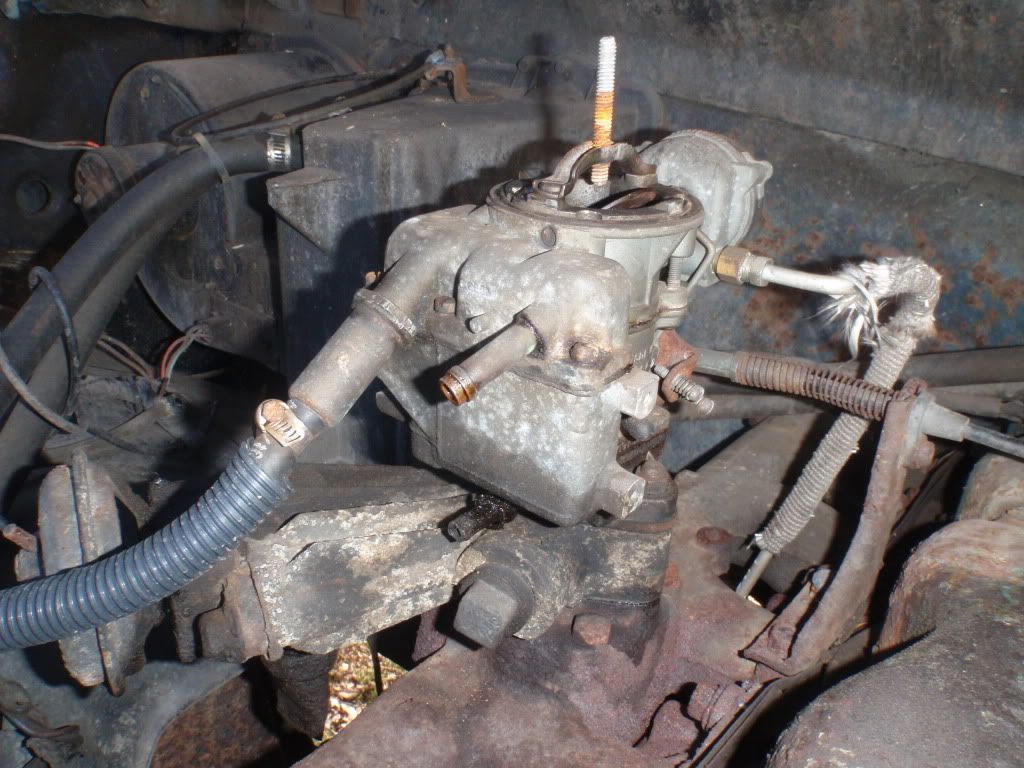
Just went out and checked it, it says manufactured for ford by carter on one side. Also, it has some lines missing, attached a picture, but I don't think that's the source of the problem.

FTE Legend


Joined: Jul 2010
Posts: 32,875
Likes: 48
From: Northeast, OK
Sounds like two separate problems. First, I agree that you have an accelerator pump problem. But, given the rust, my guess is that the check ball in the pump is stuck or that the discharge nozzles are plugged. I know that my 2150's discharge nozzles plugged from the junk in my tank.
As for the sagging during subsequent running, I'm guessing that either your fuel filter is clogged such that you are starving for fuel, or that you have so much junk in your carb that passages are getting clogged. But, if you still have water in the tank that would certainly cause problems.
I think you are going to have to rebuild the carb to get the accelerator pump working and to clean the gunk out. And, you will need to change the fuel filter as well. But, I highly recommend the use of two of the see-thru plastic filters, with one ahead of the fuel pump and one behind the pump, and do not use any of the metal screw-in filters as they only strain gnats, not the silt that comes from rust.
And, you may have to address the tank as well. Are you still running the same tank? If so, the water has to come out, and the best way is to drop the tank and pour it out. Then pour a bit of good gas in and slosh it around and pour it out, and repeat until it comes out clean. But, even then you'll have rust that'll come off in little bits and you will have to change out the filters periodically.
As for the sagging during subsequent running, I'm guessing that either your fuel filter is clogged such that you are starving for fuel, or that you have so much junk in your carb that passages are getting clogged. But, if you still have water in the tank that would certainly cause problems.
I think you are going to have to rebuild the carb to get the accelerator pump working and to clean the gunk out. And, you will need to change the fuel filter as well. But, I highly recommend the use of two of the see-thru plastic filters, with one ahead of the fuel pump and one behind the pump, and do not use any of the metal screw-in filters as they only strain gnats, not the silt that comes from rust.
And, you may have to address the tank as well. Are you still running the same tank? If so, the water has to come out, and the best way is to drop the tank and pour it out. Then pour a bit of good gas in and slosh it around and pour it out, and repeat until it comes out clean. But, even then you'll have rust that'll come off in little bits and you will have to change out the filters periodically.

Elder User
Joined: Nov 2004
Posts: 666
Likes: 5
I would rebuild the carb. Does it still have the metal tag with the ID numbers on it? I don't see it in the picture, but it could be on the other side. It is usually attached with one of the screws that hold the top of the carb to the carb body. You will need the numbers from that tag. If the tag is still there PUT IT BACK ON the carb when you rebuild it. Lots of people leave it off.
The problem with the accelerator pump on the YF/YFA is that the diaphragm does two jobs. It is the accelerator pump AND it is a vacuum diaphragm that controls the metering needle. So, there is fuel above the diaphragm and manifold vacuum below the diaphragm. When the diaphragm tears the engine sucks fuel straight out of the fuel bown into the manifold. When the engine is cold, it will run. As the engine warms up it gets richer and richer until it starts bucking and stumbling and eventual floods out.
The problem with the accelerator pump on the YF/YFA is that the diaphragm does two jobs. It is the accelerator pump AND it is a vacuum diaphragm that controls the metering needle. So, there is fuel above the diaphragm and manifold vacuum below the diaphragm. When the diaphragm tears the engine sucks fuel straight out of the fuel bown into the manifold. When the engine is cold, it will run. As the engine warms up it gets richer and richer until it starts bucking and stumbling and eventual floods out.
FTE Legend
Joined: Jul 2010
Posts: 32,875
Likes: 48
From: Northeast, OK
It is amazing what the rust/silt from a bad tank will clog in a carb. So, yours needs to be taken apart and all the passages blown out. I use either carb cleaner or brake cleaner with the little straw on them to squirt through the passages, and then blow them out w/compressed air. And, I use a Q-tip with a bit of cleaner on it to swap out the bowl of the carb and anything else that has gunk on it.
But, some of the plastic parts in some carbs don't like that cleaner, so remove and set them aside first. You can use rubbing alcohol on them.
That carb is probably the simplest carb on these engines to rebuild. There are several threads about doing so and lots of good info on the web. If you've not rebuilt one this is a good time to learn.
Trending Topics
Thread Starter
|
Logistics Pro
Joined: Dec 2004
Posts: 3,920
Likes: 2
From: Carson City, NV
Gary, Jim, thanks very much for the input! I didn't see any metal tag on the carb, but there is a sticker that says "rebuilt carburetor" on it, but that's all it says. Jim, the mixture getting progressively richer sounds spot on. One other thing I remember this truck doing when it first started to develop this issue was when I was driving on a downward slope, off roading out in the woods, even on not that steep of a grade, you could smell gas, maybe it was coming out of somewhere from that tear.
Looks like I need to yank this thing off and find the proper rebuild kit for it. How much do one of those usually cost?
Looks like I need to yank this thing off and find the proper rebuild kit for it. How much do one of those usually cost?
FTE Stories
Ford Trucks for Ford Truck Enthusiasts

10 Things Every Truck Owner NEEDS (2026 Edition)
Michael S. Palmer
Rezvani's Latest Post-Apocalyptic Monster Is a Ford F-150 Raptor Underneath
Verdad Gallardo
Top 10 Most Expensive Ford Trucks Ever Sold on Bring a Trailer
Joe Kucinski
2027 Ford Super Duty Buyer's Guide (Every Model, Engine, & Package)
Brett Foote
Top 10 Ford Truck Tragedies
Joe Kucinski
AEV FXL Super Duty - the Super Duty Raptor Ford Doesn't Make
Brett Foote
Lobo Vs Lobo: Proof the F-150 Lobo Should Be Even Lower!
Michael S. Palmer
Ford's 2001 Explorer Sportsman Concept Looks For a New Home
Verdad Gallardo
10 Best Ford Truck Engines We Miss the Most!
Joe Kucinski
Posting Guru
Joined: Oct 2010
Posts: 1,199
Likes: 1
From: Missouri
I'm not familiar with these 1bbl carbs, but the top port appears to be a vent tube and the bottom one may be a vacuum port. I would cap off both of them unless someone else says otherwise.
FTE Legend
Joined: Jul 2010
Posts: 32,875
Likes: 48
From: Northeast, OK
O'Reillys lists 4 kits, with only 2 giving prices from $13 to $19: List: Carburetor Kit - 1982 Ford F-150 | O'Reilly Auto Parts
While at first blush it would seem a problem that your carb doesn't have the tag, if whomever put the rebuilt one on got the right carb, then you are probably ok. The kits will fit a wide range of those carbs so you should have the right components in the kit. The issue might be getting the right spec's for float level and any other adjustment like the metering rod. However, someone here may have the spec's, although at least the '81 factory shop manual doesn't, instead referring you to the Truck Performance Specification Book. And, I may have one of the best libraries in captivity, so can probably come up with a bunch of spec's if need be.
Having said that, I tend to leave most adjustments alone when rebuilding, with the exception of float level. That's because many of the adjustments have been tweaked to get the vehicle to run correctly. So, if yours ran properly at some point in the recent past I would leave things like choke, unloader, and metering rod adjustments alone as you rebuild it. And, it may be that the float level spec is common across a bunch of the carbs, which you will see when you read the instructions in the kit.
So, have fun! It really is a sense of accomplishment when you rebuild your first carb.
While at first blush it would seem a problem that your carb doesn't have the tag, if whomever put the rebuilt one on got the right carb, then you are probably ok. The kits will fit a wide range of those carbs so you should have the right components in the kit. The issue might be getting the right spec's for float level and any other adjustment like the metering rod. However, someone here may have the spec's, although at least the '81 factory shop manual doesn't, instead referring you to the Truck Performance Specification Book. And, I may have one of the best libraries in captivity, so can probably come up with a bunch of spec's if need be.
Having said that, I tend to leave most adjustments alone when rebuilding, with the exception of float level. That's because many of the adjustments have been tweaked to get the vehicle to run correctly. So, if yours ran properly at some point in the recent past I would leave things like choke, unloader, and metering rod adjustments alone as you rebuild it. And, it may be that the float level spec is common across a bunch of the carbs, which you will see when you read the instructions in the kit.
So, have fun! It really is a sense of accomplishment when you rebuild your first carb.
FTE Legend
Joined: Jul 2010
Posts: 32,875
Likes: 48
From: Northeast, OK
If the bottom one is open it does need to be capped. But the top one is a vent and vents shouldn't be capped. If you do you will alter the pressure in the float bowl which will alter the fuel/air ratio.
The carb was designed to have atmospheric pressure on top of the gas and anything else changes the fuel delivery. In fact, that is the way some of the "feed-back" carbs work - the computer manipulates the pressure above the gas.
The vent was designed to go into the vapor recovery system so any gas fumes get caught by the activated charcoal while parked and then released back while driving. I leave mine open as I'm not running the vapor system and there's really no draw of air into the carb so not much gets in there. But, if you are concerned about that you could put a piece of hose on it and run it to a fuel filter hidden some place. That way nothing can get in.
The carb was designed to have atmospheric pressure on top of the gas and anything else changes the fuel delivery. In fact, that is the way some of the "feed-back" carbs work - the computer manipulates the pressure above the gas.
The vent was designed to go into the vapor recovery system so any gas fumes get caught by the activated charcoal while parked and then released back while driving. I leave mine open as I'm not running the vapor system and there's really no draw of air into the carb so not much gets in there. But, if you are concerned about that you could put a piece of hose on it and run it to a fuel filter hidden some place. That way nothing can get in.
Thread Starter
|
Logistics Pro
Joined: Dec 2004
Posts: 3,920
Likes: 2
From: Carson City, NV
Thanks gary, I'll be sure to cap that bottom hole when it gets back onto the truck. I was able to order my rebuild kit from napa, $25 bucks. We used the numbers on the carb, the 7197S to find the right kit, it'll be in tomorrow morning! And silly question, but does the rebuild kit include a new accelerator pump, or whatever t has to repair/replace it?
Elder User
Joined: Nov 2004
Posts: 666
Likes: 5
That thing at the bottom that looks like an open vacuum port is actually the end of the throttle shaft, all covered in gunk :-) The top one is the fuel bowl vent - don't plug it. It originally went to the charcoal canister under the battery. I would reconnect it if you still have the charcoal canister. If not, connect it to the air filter so it can vent the gas fumes into the engine.
If you don't have the metal tag, then I would read through the instructions in the rebuild kit and note any measurements that they want you to set. Then measure those dimensions BEFORE you rebuild it. No guarantee that they are still correct, but it is better than just guessing. You will see that the rebuild kit covers 30 or 40 sub-models and there will be tables of dimensions specific to each sum-model (based on the number from the missing tag).
If you don't have the metal tag, then I would read through the instructions in the rebuild kit and note any measurements that they want you to set. Then measure those dimensions BEFORE you rebuild it. No guarantee that they are still correct, but it is better than just guessing. You will see that the rebuild kit covers 30 or 40 sub-models and there will be tables of dimensions specific to each sum-model (based on the number from the missing tag).