Engine running hot?

Thread Starter
|
Elder User
Joined: Aug 2011
Posts: 649
Likes: 1
From: Tucson, AZ

Engine running hot?
Yet another rookie post/question...
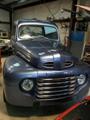
My 351W (I am pretty sure its a 351W, see my other thread on engine identification) in my 51 F-1 runs hot I THINK. I don't have a working temperature gauge, and this truck is not truly road-ready but...
I have driven it around the neighborhood for 10 or 15 minutes at a time and it sure seems hot. There is plenty of water in the radiator, but it leaks a little when driven so I check and refill it each time I drive it. So far I have not gotten steam and/or boiling water shooting out of the radiator cap, but there is general steam coming from the engine (no, not smoke). I have a small cooling system leak somewhere that only seems to leak when it has been driven and gotten hot so there is a little water coming out below the radiator. I am hopeful that is the only source of steam.
What concerns me more is when I am done driving and shut her down, I can still hear a significant clunking, chugging, noise coming from inside the engine (not like knocking and pinging from in the cylinders, the engine isn't trying to turn). It seems kinda like the coolant is boiling and there is steam and or air moving around inside the cooling system. It almost sounds like a very quite washing machine. Kind of rhythmic, slow ka-chunk...ka-chunk every second or two. There is also a quiet hissing in the back ground.
So...I am thinking back wash the cooling system (but don't know exactly how. That is why I posted on another thread about trying to find a good maintenance manual/shop manual for the 351W telling me how to back wash it) to get any old crap out of there. I believe it was done recently by the PO, but not sure now thoroughly. May need redoing. Also, thinking of changing the thermostat. Again, not sure how without a good manual.
What else should I be thinking of? The whole engine probably needs an over haul, but that is what I am trying to asses at the moment. At least partly. I don't exactly want to take it to an engine shop and ask...they'll just say "yes, it needs everything" to get my $4000. Sooooo...
Any thoughts or guidance? Oh, and the fan seems to work fine.
t
My 351W (I am pretty sure its a 351W, see my other thread on engine identification) in my 51 F-1 runs hot I THINK. I don't have a working temperature gauge, and this truck is not truly road-ready but...
I have driven it around the neighborhood for 10 or 15 minutes at a time and it sure seems hot. There is plenty of water in the radiator, but it leaks a little when driven so I check and refill it each time I drive it. So far I have not gotten steam and/or boiling water shooting out of the radiator cap, but there is general steam coming from the engine (no, not smoke). I have a small cooling system leak somewhere that only seems to leak when it has been driven and gotten hot so there is a little water coming out below the radiator. I am hopeful that is the only source of steam.
What concerns me more is when I am done driving and shut her down, I can still hear a significant clunking, chugging, noise coming from inside the engine (not like knocking and pinging from in the cylinders, the engine isn't trying to turn). It seems kinda like the coolant is boiling and there is steam and or air moving around inside the cooling system. It almost sounds like a very quite washing machine. Kind of rhythmic, slow ka-chunk...ka-chunk every second or two. There is also a quiet hissing in the back ground.
So...I am thinking back wash the cooling system (but don't know exactly how. That is why I posted on another thread about trying to find a good maintenance manual/shop manual for the 351W telling me how to back wash it) to get any old crap out of there. I believe it was done recently by the PO, but not sure now thoroughly. May need redoing. Also, thinking of changing the thermostat. Again, not sure how without a good manual.
What else should I be thinking of? The whole engine probably needs an over haul, but that is what I am trying to asses at the moment. At least partly. I don't exactly want to take it to an engine shop and ask...they'll just say "yes, it needs everything" to get my $4000. Sooooo...
Any thoughts or guidance? Oh, and the fan seems to work fine.
t
Thread Starter
|
Elder User
Joined: Aug 2011
Posts: 649
Likes: 1
From: Tucson, AZ
Obviously the radiator will need repair but I intend to replace it anyway. But i suppose it could be clogged and not allowing adequate circulation...? Would I be jumping the gun to go ahead and replace the radiator now? I assume I will be keeping this engine, but not 100% sure. I think a new nice aluminum radiator should work on any engine I go with (maybe a 302) if I go the engine replacement route. I really don't think I am gonna go there, but it is a possibility I suppose. Would a replacement radiator NOW be a reasonable step in the process toward better cooling? I know there are cheaper, simpler solutions for now, but if I am gonna do it anyway....

Senior User
Joined: May 2011
Posts: 115
Likes: 0
From: Allen, Texas
I'm sure the experts will be along shortly but I would raise the rear end a bit so that all the water and gunk will run forward. (Probably good to do this on your lawn instead of your garage floor.)
Then drain the radiator, pull the hoses off and then remove the water pump. Stick a garden hose in the coolant path and flush all the gunk out of the system, basically until the water runs clean or as clean as possible.
Then new gasket on waterpump, throw in a new thermostat, new hoses and clamps, top it up with some good coolant/water mix and test it out.
Then drain the radiator, pull the hoses off and then remove the water pump. Stick a garden hose in the coolant path and flush all the gunk out of the system, basically until the water runs clean or as clean as possible.
Then new gasket on waterpump, throw in a new thermostat, new hoses and clamps, top it up with some good coolant/water mix and test it out.
Thread Starter
|
Elder User
Joined: Aug 2011
Posts: 649
Likes: 1
From: Tucson, AZ
I'm sure the experts will be along shortly but I would raise the rear end a bit so that all the water and gunk will run forward. (Probably good to do this on your lawn instead of your garage floor.)
Then drain the radiator, pull the hoses off and then remove the water pump. Stick a garden hose in the coolant path and flush all the gunk out of the system, basically until the water runs clean or as clean as possible.
Then new gasket on waterpump, throw in a new thermostat, new hoses and clamps, top it up with some good coolant/water mix and test it out.
Then drain the radiator, pull the hoses off and then remove the water pump. Stick a garden hose in the coolant path and flush all the gunk out of the system, basically until the water runs clean or as clean as possible.
Then new gasket on waterpump, throw in a new thermostat, new hoses and clamps, top it up with some good coolant/water mix and test it out.
t
Logistics Pro
Joined: May 2010
Posts: 3,793
Likes: 19
From: Austin
Hey Tyler,
Seems like we are talking quite a bit today. Hmmm.. Taking the waterpump off is normally a major pain - It's held on by a bunch of bolts - some very long. Invariably some of them will be rusted in there...
If you do take it off of there I'd replace it - they don't cost much. (<$40
with the core of the old one).
On the radiator - I'd buy it after you are pretty sure you are going to
stay with a specific engine. You get radiators configured to match up with the in & out ports on your engine. Replacing the thermostat is usually pretty straight forward. It sits in the little place where your water
hose enters the top of the engine. (They don't cost anything & could be causing you over heating probs - <$5 to replace). Get some gasket sealer
to spread on the gasket if you replace it.
To flush an engine - You generally just put a garden hose in the top
hose outlet & open up your radiator drain plug & let it flush until it's
clear. (Most people will use radiator flush from prestone, et al as part of the process - follow directions on bottle).
Ben in Austin
Seems like we are talking quite a bit today. Hmmm.. Taking the waterpump off is normally a major pain - It's held on by a bunch of bolts - some very long. Invariably some of them will be rusted in there...
If you do take it off of there I'd replace it - they don't cost much. (<$40
with the core of the old one).
On the radiator - I'd buy it after you are pretty sure you are going to
stay with a specific engine. You get radiators configured to match up with the in & out ports on your engine. Replacing the thermostat is usually pretty straight forward. It sits in the little place where your water
hose enters the top of the engine. (They don't cost anything & could be causing you over heating probs - <$5 to replace). Get some gasket sealer
to spread on the gasket if you replace it.
To flush an engine - You generally just put a garden hose in the top
hose outlet & open up your radiator drain plug & let it flush until it's
clear. (Most people will use radiator flush from prestone, et al as part of the process - follow directions on bottle).
Ben in Austin

Senior User
Joined: May 2010
Posts: 287
Likes: 0
From: mississippi
I have a 351w in my lighting that I have been in and out of for the past 12 years so I might have a little useful info. first off, the steam your talking about coming from the engine, if it coming from the exhaust you have got problems like a head cracked, head gasket, or a cracked block. all the racket after shut down is probably air in the system and the hiss could be a small leak somewhere. look around the lower intake, heads and freeze plugs real good or it could be leaking inside the cylinders and you wouldn't see it. There is a set up somewhere where you can pressurize your cooling system with shop air regulated to the proper pressure with out the truck running and look and listen for leaks. also the water pump isn't too bad or expensive of a job to replace. You remove the belt, fan, and hoses. there are a few bolts and studs holding it to the front of the motor. I will caution you that they could be corroded and hard to turn. for gods sakes don't break them. they go thew the timing chain cover in to the block and if they brake your going to have to remove the timing cover to get them out. I've been down that road before. to really flush the block good your going to have to remove the thermostat and pump and just flush it with a hose. You might could find a radiator shop that would take yours and rod it out and clean it good for cheaper then a new one. hope this helps.
Senior User
Joined: May 2010
Posts: 287
Likes: 0
From: mississippi
buy the way you can get a nice 351w long block for under $2000.00 online. here is one with a 3 year 100,000 mile warranty for $1600.00
NEW REMAN FORD 5.8 LITER 351 WINDSOR 351W V8 LONG BLOCK ENGINE 1978-1984 | eBay
NEW REMAN FORD 5.8 LITER 351 WINDSOR 351W V8 LONG BLOCK ENGINE 1978-1984 | eBay
Trending Topics

Fleet Mechanic
Joined: Aug 2010
Posts: 1,994
Likes: 3
From: Morgan Hill, CA
I'm thinking that you may not have a really big problem....
First...the cooling leaking from somewhere when it's hot, and you keep topping off the radiator. That could be the overflow. Older vehicles don't have the expansion tank, so when the coolant gets warm, it expands, and some forces its way past the radiator cap and out of the overflow...usually there's a small tube hooked to this that runs down below the radiator and allows the excess fluid to dump on the ground.
Second....I'm with Whitey on the thermostat....if the engine was sitting around for some time, maybe the thermostat is stuck & not allowing coolant to circulate through the engine. They are cheap, and it goes into the little housing on the intake manifold where the top big radiator hose is connected (you posted a pic of that housing earlier).
Also...think about getting a cheap temp gauge...one of the direct reading bulb type....and attach it to the port where the temp sensor goes (also in the intake manifold). That would tell you if you have a problem and it wouldn't rely on any of the electrical system or other gauges to work.
Also...for the record, I replaced the engine in my OT 95 pickup this summer with a rebuilt unit from O'Reilly Auto. They charged $1300 and it has a 3 year 36k mile warranty. There weren't any freight charges since I bought it locally. I went that route because I can't rebuild it myself for that kind of money. The last V8 that I went through cost me around $2k for parts and machine work.
Dan
First...the cooling leaking from somewhere when it's hot, and you keep topping off the radiator. That could be the overflow. Older vehicles don't have the expansion tank, so when the coolant gets warm, it expands, and some forces its way past the radiator cap and out of the overflow...usually there's a small tube hooked to this that runs down below the radiator and allows the excess fluid to dump on the ground.
Second....I'm with Whitey on the thermostat....if the engine was sitting around for some time, maybe the thermostat is stuck & not allowing coolant to circulate through the engine. They are cheap, and it goes into the little housing on the intake manifold where the top big radiator hose is connected (you posted a pic of that housing earlier).
Also...think about getting a cheap temp gauge...one of the direct reading bulb type....and attach it to the port where the temp sensor goes (also in the intake manifold). That would tell you if you have a problem and it wouldn't rely on any of the electrical system or other gauges to work.
Also...for the record, I replaced the engine in my OT 95 pickup this summer with a rebuilt unit from O'Reilly Auto. They charged $1300 and it has a 3 year 36k mile warranty. There weren't any freight charges since I bought it locally. I went that route because I can't rebuild it myself for that kind of money. The last V8 that I went through cost me around $2k for parts and machine work.
Dan
FTE Stories
Ford Trucks for Ford Truck Enthusiasts

10 Ugly Ford Trucks That We Still Kinda Love
Joe Kucinski
10 Things Every Truck Owner NEEDS (2026 Edition)
Michael S. Palmer
Rezvani's Latest Post-Apocalyptic Monster Is a Ford F-150 Raptor Underneath
Verdad Gallardo
Top 10 Most Expensive Ford Trucks Ever Sold on Bring a Trailer
Joe Kucinski
2027 Ford Super Duty Buyer's Guide (Every Model, Engine, & Package)
Brett Foote
Top 10 Ford Truck Tragedies
Joe Kucinski
AEV FXL Super Duty - the Super Duty Raptor Ford Doesn't Make
Brett Foote
Lobo Vs Lobo: Proof the F-150 Lobo Should Be Even Lower!
Michael S. Palmer
Ford's 2001 Explorer Sportsman Concept Looks For a New Home
Verdad Gallardo
Thread Starter
|
Elder User
Joined: Aug 2011
Posts: 649
Likes: 1
From: Tucson, AZ
I'm thinking that you may not have a really big problem....
First...the cooling leaking from somewhere when it's hot, and you keep topping off the radiator. That could be the overflow. Older vehicles don't have the expansion tank, so when the coolant gets warm, it expands, and some forces its way past the radiator cap and out of the overflow...usually there's a small tube hooked to this that runs down below the radiator and allows the excess fluid to dump on the ground.
Second....I'm with Whitey on the thermostat....if the engine was sitting around for some time, maybe the thermostat is stuck & not allowing coolant to circulate through the engine. They are cheap, and it goes into the little housing on the intake manifold where the top big radiator hose is connected (you posted a pic of that housing earlier).
Also...think about getting a cheap temp gauge...one of the direct reading bulb type....and attach it to the port where the temp sensor goes (also in the intake manifold). That would tell you if you have a problem and it wouldn't rely on any of the electrical system or other gauges to work.
Also...for the record, I replaced the engine in my OT 95 pickup this summer with a rebuilt unit from O'Reilly Auto. They charged $1300 and it has a 3 year 36k mile warranty. There weren't any freight charges since I bought it locally. I went that route because I can't rebuild it myself for that kind of money. The last V8 that I went through cost me around $2k for parts and machine work.
Dan
First...the cooling leaking from somewhere when it's hot, and you keep topping off the radiator. That could be the overflow. Older vehicles don't have the expansion tank, so when the coolant gets warm, it expands, and some forces its way past the radiator cap and out of the overflow...usually there's a small tube hooked to this that runs down below the radiator and allows the excess fluid to dump on the ground.
Second....I'm with Whitey on the thermostat....if the engine was sitting around for some time, maybe the thermostat is stuck & not allowing coolant to circulate through the engine. They are cheap, and it goes into the little housing on the intake manifold where the top big radiator hose is connected (you posted a pic of that housing earlier).
Also...think about getting a cheap temp gauge...one of the direct reading bulb type....and attach it to the port where the temp sensor goes (also in the intake manifold). That would tell you if you have a problem and it wouldn't rely on any of the electrical system or other gauges to work.
Also...for the record, I replaced the engine in my OT 95 pickup this summer with a rebuilt unit from O'Reilly Auto. They charged $1300 and it has a 3 year 36k mile warranty. There weren't any freight charges since I bought it locally. I went that route because I can't rebuild it myself for that kind of money. The last V8 that I went through cost me around $2k for parts and machine work.
Dan
Tyler
Fleet Mechanic
Joined: Aug 2010
Posts: 1,994
Likes: 3
From: Morgan Hill, CA
Tyler,
The OT truck is a 95 Ch#*&y 3/4 ton 4x4 that I use as a tow vehicle that I use for one of my other hobbies....boating! Small block 350's are cheap and parts are well stocked. When my engine finally became too tired, I was faced with either replacing the truck or freshening up the engine. Since 3/4 ton trucks are getting pretty expensive, I opted for the rebuild.
For my 52... I also have a 351W which came out of an 89 F150....although it is looking a little different these days. It went from this:

To this:

I'm hoping to finally get it started over the Thanksgiving weekend!!
The OT truck is a 95 Ch#*&y 3/4 ton 4x4 that I use as a tow vehicle that I use for one of my other hobbies....boating! Small block 350's are cheap and parts are well stocked. When my engine finally became too tired, I was faced with either replacing the truck or freshening up the engine. Since 3/4 ton trucks are getting pretty expensive, I opted for the rebuild.
For my 52... I also have a 351W which came out of an 89 F150....although it is looking a little different these days. It went from this:
To this:
I'm hoping to finally get it started over the Thanksgiving weekend!!
Thread Starter
|
Elder User
Joined: Aug 2011
Posts: 649
Likes: 1
From: Tucson, AZ
Man that is flippin nice! That is exactly what I'd like to get mine to.
Can you explain to me the various "levels" of overhaul and what they might cost? I want to do stuff myself to the extent possible, but I'd rather sub out things requiring super precision and or very expensive equipment.
Do you start with just a bore out and move up to a bore out plus a valve job, ring job etc. or how does it work? Surely it isn't an all-or-nothing affair. I will get the whole thing done if needed, but don't want to get suckered into something I don't need either.
Peace,
t
Can you explain to me the various "levels" of overhaul and what they might cost? I want to do stuff myself to the extent possible, but I'd rather sub out things requiring super precision and or very expensive equipment.
Do you start with just a bore out and move up to a bore out plus a valve job, ring job etc. or how does it work? Surely it isn't an all-or-nothing affair. I will get the whole thing done if needed, but don't want to get suckered into something I don't need either.
Peace,
t

Laughing Gas
Joined: Jan 2008
Posts: 758
Likes: 0
From: Alabama
Tyler it depends on how worn out your engine is. Mine was completely worn out. I had a shop clean my cylinder wall up .040. We also found that it had spun a bearing on the crank and was bad enough that I wanted to replace the crank. I also wanted a better cam instead of stock. Then I didn't want to put used items back in with the new ones so everything is new except the block. I even rebuilt the heads with all new parts. But mine would not run as is. If I was you I would run the motor, check compression, and see how it was. See if it uses oil. Things like that before I made a decision to rebuild. You can always replace items on it such as plugs and wires and things that can be reused on a rebuild later.
Laughing Gas
Joined: Jan 2008
Posts: 758
Likes: 0
From: Alabama
I guess I really didn't answer your question. My complete rebuild was about $2400.00.
First you would want to make sure you have a rebuildable block. Thats where a shop would check the cylinder walls, bore or hone out any grooves, then you would have to have oversized rings on the piston to fit the new bore size. Then there are rod bearings to check. Thats the bearing between the piston rod and the crankshaft. Valve job is on the heads, there to depending on if they are worn out or burnt, broke springs, will determine if its time for a valve job. There is so much to rebuilding a motor that you have to be careful with. Make sure if you want to do this that you get a good book on rebuilding a 351W and do a lot of online research. Just torquing bolts is critical. I let the shop I used to clean the block up install my crankshaft and cam and the timing gear. I just did the easy stuff. This is in no way trying to scare you off rebuilding your on motor. Just know that there is a LOT of things that must be done for it to work correctly after rebuilding. Thats just my 2 cents worth.
First you would want to make sure you have a rebuildable block. Thats where a shop would check the cylinder walls, bore or hone out any grooves, then you would have to have oversized rings on the piston to fit the new bore size. Then there are rod bearings to check. Thats the bearing between the piston rod and the crankshaft. Valve job is on the heads, there to depending on if they are worn out or burnt, broke springs, will determine if its time for a valve job. There is so much to rebuilding a motor that you have to be careful with. Make sure if you want to do this that you get a good book on rebuilding a 351W and do a lot of online research. Just torquing bolts is critical. I let the shop I used to clean the block up install my crankshaft and cam and the timing gear. I just did the easy stuff. This is in no way trying to scare you off rebuilding your on motor. Just know that there is a LOT of things that must be done for it to work correctly after rebuilding. Thats just my 2 cents worth.