


GOODBYE SLUSH BOX!!!

Thread Starter
|
Zombie Survivalist
Joined: Feb 2009
Posts: 14,809
Likes: 3
From: Rock Springs, WY, USA
GOODBYE SLUSH BOX!!!
a couple days ago, i put my 93 explorer under the knife. its an EB and came from the factory with a 5R55 automatic. over its 18 year, 241,000 mile life, it has fully consumed and destroyed two such transmissions. well, at the price of $2400 for a new one (not counting installation), with a 100,000 mile unlimited warranty (usless if you ask me, cause thats a 5R55's average lifespan, and would pop as soon as the warranty ran out), i decided to take a trip to the junkyard. lo and behold: a 90 4x4 ranger with a 5 speed.
GOODBYE 5R55 SLUSHBOX, AND GOOD RIDDANCE!
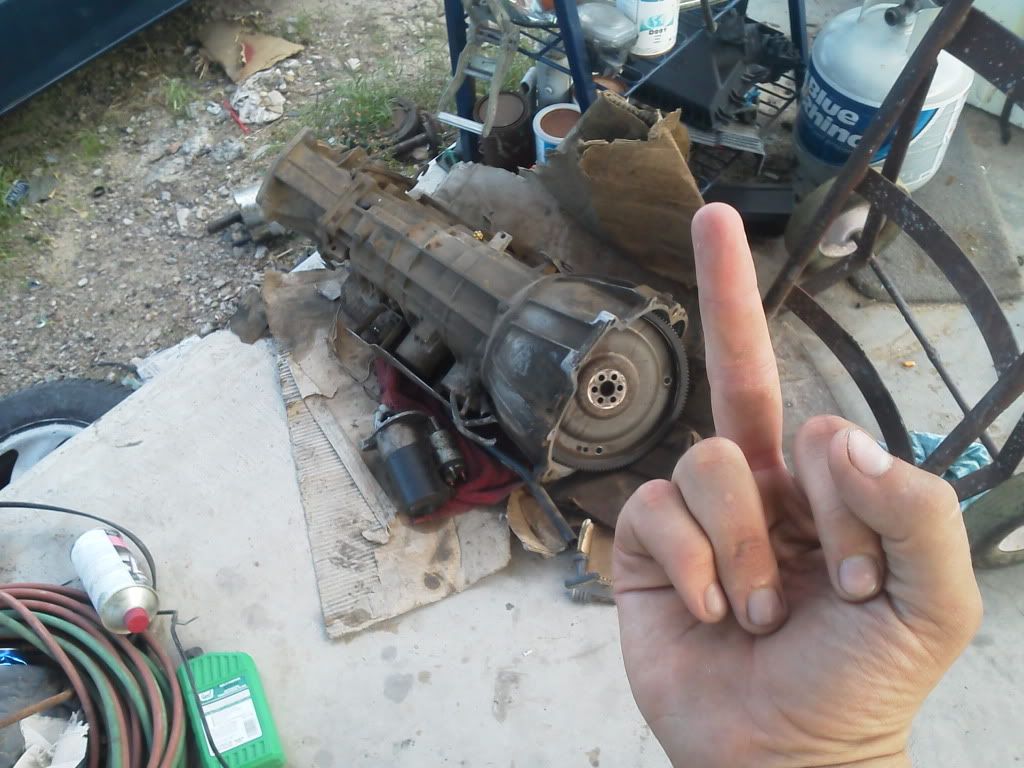
my rear main seal appears to be in perfect workin order, even after 241,000 miles! (the little bit of fluid you see is tranny fluid from where its front main puked)

the brand new flywheel and clutch, installed.

interior before:

after:

all donor parts were from the 90 ranger. i used the 5 speed, shifter, steering column, pedal assembly, and a couple steering column trim pieces with my steering wheel and key cylinder. all mounting brackets, and even the transmission cross member did not need to be swapped out. SO, the only parts my explorer didnt come from the factory with is the steering column and associated trim, transmission and shifter, and the clutch bits. took it out for a drive, and WOW! theres no doubt in my mind that that damn slushbox was robbin me of at least 20% of my power, God only knows how much economy, and it netted me a 300 rpm drop at 65 mph. it will also go 85 @4000 rpm in third gear.


oh, and the starter motor took a dump on me right as i went to start it for the first time after the swap. gotta say, it had a good run as it was the original. fortunately, all the above work was done AT my new favorite junkyard, and they grabbed another starter for me for $50. grand total: $1,565 and a few cents.
all said and done with, very, VERY pleased.
GOODBYE 5R55 SLUSHBOX, AND GOOD RIDDANCE!
my rear main seal appears to be in perfect workin order, even after 241,000 miles! (the little bit of fluid you see is tranny fluid from where its front main puked)
the brand new flywheel and clutch, installed.
interior before:
after:
all donor parts were from the 90 ranger. i used the 5 speed, shifter, steering column, pedal assembly, and a couple steering column trim pieces with my steering wheel and key cylinder. all mounting brackets, and even the transmission cross member did not need to be swapped out. SO, the only parts my explorer didnt come from the factory with is the steering column and associated trim, transmission and shifter, and the clutch bits. took it out for a drive, and WOW!
theres no doubt in my mind that that damn slushbox was robbin me of at least 20% of my power, God only knows how much economy, and it netted me a 300 rpm drop at 65 mph. it will also go 85 @4000 rpm in third gear. oh, and the starter motor took a dump on me right as i went to start it for the first time after the swap. gotta say, it had a good run as it was the original. fortunately, all the above work was done AT my new favorite junkyard, and they grabbed another starter for me for $50. grand total: $1,565 and a few cents.
all said and done with, very, VERY pleased.

Postmaster
Joined: Oct 2009
Posts: 3,432
Likes: 7
Good job on the swap, and good job on swapping from a '90, thats probably one of the last years the manual trans was still halfway descent.
However, this does go to illustrate why you should not swap automatics. It is far better to have your old one rebuilt than to get an off the shelf rebuild. With rare exception, off the shelf rebuilds are budget rebuilds, and you don't know what was replaced, upgraded, or what was wrong with it int he first place.
A properly rebuilt and upgraded and maintained 5R55e will last about 250,000 miles. Such a rebuild costs about $2800, not that much more than an improper rebuild. That price is installed too.
However, this does go to illustrate why you should not swap automatics. It is far better to have your old one rebuilt than to get an off the shelf rebuild. With rare exception, off the shelf rebuilds are budget rebuilds, and you don't know what was replaced, upgraded, or what was wrong with it int he first place.
A properly rebuilt and upgraded and maintained 5R55e will last about 250,000 miles. Such a rebuild costs about $2800, not that much more than an improper rebuild. That price is installed too.
Thread Starter
|
Zombie Survivalist
Joined: Feb 2009
Posts: 14,809
Likes: 3
From: Rock Springs, WY, USA
I do beg to differ. The first one was the factory trans, and most of the driving on it was done by my mother, who drives like a grandma, and I'd say 90+% was highway. It took a dump around 155,k. I'm not sure if we had it rebuilt or replaced, but it took a dump at 100 miles less than what it has now. I'm sure my lead foot didn't help with its longevity, but I had nothin to do with the first one droppin.
Postmaster
Joined: Oct 2009
Posts: 3,432
Likes: 7
Ok, so you mean to tell me you replaced the fluid every 30,000 miles? Neither the factory one, nor your rebuilt swap in have high friction clutches, oversized boost valves, valve body cailibrations, shift kits, etc. The factory transmission is designed to slip to makes shifts seem smoother. Every time it slips, it wears of some friction material, which gets into the fluid. Many of these particles are smaller than the filter can handle. So these microparticles remain in the fluid in circulation, only the larger particles settle out into the pan or get trapped in the filter. In small amounts, these particles won't cause any harm, but since they cannot be removed by the filter and remain in the fluid, the only way to remove them is to replace the fluid at specified intervals. Over time, these particles accumulate until they start to saturate the fluid. Once that starts, they can accumulate in valve bores, seals, etc. They will begin wearing down on surfaces, especially around moving parts. What invariably happens with the 5R55e is the servo bores take the brunt of it, particularly the pulse width modulated ones. The metal pin, which is usually steel, will wear into the soft aluminum around it. Once enough wear has occurred, it allows fluid to flow past the bore, and cause the pressure in the affected circuit to drop. This in turn causes the clutches and bands to not engage fully, and to stay in a slip stage longer. This causes more friction material, and before long, total transmission failure.
The problem with the factory one is the weak engagements, combined with the servo bores being aluminum. The properly upgraded rebuilds use brass bores. Brass is a self lubricating metal, and can absorb anything that tries to wear into it. A shift kit and valve body calibration increases the engagement pressure, which reduces the amount of slip at each shift, which decreases the heat and the amount of friction material that is lost. A properly upgraded transmission fixes all the factory shortfalls, and dramatically increases the transmissions life. However, maintenance is still an important part of the package. The fluid needs to be replaced, along with the filter, every 30,000 miles, more often if you do towing or other hard operating conditions).
You will notice a long thread about 5R55e failures, and most of those that have had the premature failures are not following proper maintenance schedules, using flush machines, and swapping transmissions with budget off the shelf rebuilds, which not only have the factory shortfalls, but have components that are no longer new and may have wear which has not been corrected. This is why most rebuilds do not last as long as the original.
My '97 Aerostar has a properly beefed up and upgraded 5R55e, and I routinely haul loads of up to 3,000 lbs with it. This is in the mountain west, so lots of hills to add to the equation. My trans shop built my transmission. Hardened planetary gears, high energy clutches and bands, valve body calibration, shift kit, brass bore sleeves, oversized boost valve, custom brazed torque converter, and a stacked plate type transmission cooler, and they are backing it with a 5 year, 80,000 mile warranty in full knowledge of what I do with it. Truth be told, it will last well beyond that period. The other transmissions they have built for some of my other vans have held up very well under the same kind of use. One of them, the van got totaled, and its transmission is going to be reused in combination with a 300 hp engine, all they are changing is the torque converter, which needs to have a different stall speed, and the bellhousing. That transmission is an A4LD.
The 5 speed manual trans used in the Rangers is known for being weak. The primary problems are the synchos. This is the primary reason that 4.0L Rangers with a manual are quite rare, the Ford engineers knew the transmission was barely adequate. Even with the 3.0L and the 2.3L setups, the transmission is known to wear quickly, and the primary symptom is difficult engagement on several gear changes. While not everyone will have problems, and the mileage you get before problems show up can vary, it is very common for the transmission you opted to use as a replacement to have engagement problems, especially when combined with the 4.0L V6.
Now on to the good stuff. First of, your old transmission is not a 5R55e. The 5R55e is a fully electronically controlled 5 speed transmission, that was not introduced until the '97 model year. A '93 has an A4LD, which was used through the '94 model year. After that, Ford opted to use the all electronically controlled equivalents. The A4LD is known to be a bit weak in its stock form, but is also well supported in terms of upgraded. The A4LD can be reliably upgraded to handle up to about 300 hp. and can be built to V8 specs. However, so can the M50D manual trans.
No don't read me wrong, I tend to be a technical person, I almost live on details. I think your swap is cool, and I rather like driving stick. Good job on tacking a swap that most would shy away from. Great job and keeping it clean and professional looking. The early M50D transmissions, like the one you choose to use, are stronger, though clunkier feeling, than the later ones. Just make sure you fill them with the proper fluid, and don't think that because its a manual that it doesn't need maintenance too. Change out the fluid every 50,000 miles with the proper fluid, which I'm pretty sure is Mercon ATF. Strange but true. Gear oil will kill those transmissions.
The problem with the factory one is the weak engagements, combined with the servo bores being aluminum. The properly upgraded rebuilds use brass bores. Brass is a self lubricating metal, and can absorb anything that tries to wear into it. A shift kit and valve body calibration increases the engagement pressure, which reduces the amount of slip at each shift, which decreases the heat and the amount of friction material that is lost. A properly upgraded transmission fixes all the factory shortfalls, and dramatically increases the transmissions life. However, maintenance is still an important part of the package. The fluid needs to be replaced, along with the filter, every 30,000 miles, more often if you do towing or other hard operating conditions).
You will notice a long thread about 5R55e failures, and most of those that have had the premature failures are not following proper maintenance schedules, using flush machines, and swapping transmissions with budget off the shelf rebuilds, which not only have the factory shortfalls, but have components that are no longer new and may have wear which has not been corrected. This is why most rebuilds do not last as long as the original.
My '97 Aerostar has a properly beefed up and upgraded 5R55e, and I routinely haul loads of up to 3,000 lbs with it. This is in the mountain west, so lots of hills to add to the equation. My trans shop built my transmission. Hardened planetary gears, high energy clutches and bands, valve body calibration, shift kit, brass bore sleeves, oversized boost valve, custom brazed torque converter, and a stacked plate type transmission cooler, and they are backing it with a 5 year, 80,000 mile warranty in full knowledge of what I do with it. Truth be told, it will last well beyond that period. The other transmissions they have built for some of my other vans have held up very well under the same kind of use. One of them, the van got totaled, and its transmission is going to be reused in combination with a 300 hp engine, all they are changing is the torque converter, which needs to have a different stall speed, and the bellhousing. That transmission is an A4LD.
The 5 speed manual trans used in the Rangers is known for being weak. The primary problems are the synchos. This is the primary reason that 4.0L Rangers with a manual are quite rare, the Ford engineers knew the transmission was barely adequate. Even with the 3.0L and the 2.3L setups, the transmission is known to wear quickly, and the primary symptom is difficult engagement on several gear changes. While not everyone will have problems, and the mileage you get before problems show up can vary, it is very common for the transmission you opted to use as a replacement to have engagement problems, especially when combined with the 4.0L V6.
Now on to the good stuff. First of, your old transmission is not a 5R55e. The 5R55e is a fully electronically controlled 5 speed transmission, that was not introduced until the '97 model year. A '93 has an A4LD, which was used through the '94 model year. After that, Ford opted to use the all electronically controlled equivalents. The A4LD is known to be a bit weak in its stock form, but is also well supported in terms of upgraded. The A4LD can be reliably upgraded to handle up to about 300 hp. and can be built to V8 specs. However, so can the M50D manual trans.
No don't read me wrong, I tend to be a technical person, I almost live on details. I think your swap is cool, and I rather like driving stick. Good job on tacking a swap that most would shy away from. Great job and keeping it clean and professional looking. The early M50D transmissions, like the one you choose to use, are stronger, though clunkier feeling, than the later ones. Just make sure you fill them with the proper fluid, and don't think that because its a manual that it doesn't need maintenance too. Change out the fluid every 50,000 miles with the proper fluid, which I'm pretty sure is Mercon ATF. Strange but true. Gear oil will kill those transmissions.
Thread Starter
|
Zombie Survivalist
Joined: Feb 2009
Posts: 14,809
Likes: 3
From: Rock Springs, WY, USA
Wow. Remind me to ask you about anything to do with my explorer in the future. Lol. I'm not sure how many miles are on my donor tranny, but it shifts smoothly and crisp. When put it in the bed of my truck, it tipped over and the seal around the shifter was bad (replaced it later) and spilled fluid all over. I topped it off with two quarts of Lucas oil stabilizer. Good or bad?
And thanks for the complement. I'm rather proud of the outcome, and hope it will last long enough to teach my kids how to drive in it someday. I plan to rebuild the 4.0 with a 4.3 stroker kit sometime soon along with a carb conversion and twin turbos (why not?). My goal is 400/400 HP/TQ. How would you recommend I beef things up?
And thanks for the complement. I'm rather proud of the outcome, and hope it will last long enough to teach my kids how to drive in it someday. I plan to rebuild the 4.0 with a 4.3 stroker kit sometime soon along with a carb conversion and twin turbos (why not?). My goal is 400/400 HP/TQ. How would you recommend I beef things up?
Postmaster
Joined: Oct 2009
Posts: 3,432
Likes: 7
I would replace all the fluid. That oil stabilizer is nothing more than a heavy mineral oil, its basically the same stuff that you don't want in there.
I would drain it out and replace it with the proper Mercon fluid. Current spec is MerconV. Use a pure MerconV, not a "multitransmission formula". This is one of the best things you can do for the M50D. There are upgrade kits, but most of those are beyond the scope of a DIYer, and should be left to someone who has experience rebuilding transmissions.
Just make sure you granny shift, don't powershift or double clutch, it puts more wear and strain on the sychros, which are the primary failure point of the M50D. The gears themselves are plenty strong enough. So long as the trans shifts smoothly, I wouldn't worry about beefing it up, if you start having difficulty getting it to go into certain gears, that may mean that its time to upgrade.
I would drain it out and replace it with the proper Mercon fluid. Current spec is MerconV. Use a pure MerconV, not a "multitransmission formula". This is one of the best things you can do for the M50D. There are upgrade kits, but most of those are beyond the scope of a DIYer, and should be left to someone who has experience rebuilding transmissions.
Just make sure you granny shift, don't powershift or double clutch, it puts more wear and strain on the sychros, which are the primary failure point of the M50D. The gears themselves are plenty strong enough. So long as the trans shifts smoothly, I wouldn't worry about beefing it up, if you start having difficulty getting it to go into certain gears, that may mean that its time to upgrade.

Mountain Pass
Joined: Jul 2003
Posts: 225
Likes: 0
From: Southwestern Ontario
Khan is right and I can relate a story to back it up.
My nephew had a 92 Explorer with a manual and thinking we were being smart we replaced the ATF in it with gear oil. Figured we were going to make it last forever with a better oil.
Well guess what, the tranny was destroyed in less than a year. It was rebuilt and the oil the shop installed was ATF. They gave the nephew a stern warning not to replace it with gear oil again.
The tranny was fine from then on.
My nephew had a 92 Explorer with a manual and thinking we were being smart we replaced the ATF in it with gear oil. Figured we were going to make it last forever with a better oil.
Well guess what, the tranny was destroyed in less than a year. It was rebuilt and the oil the shop installed was ATF. They gave the nephew a stern warning not to replace it with gear oil again.
The tranny was fine from then on.
Trending Topics

Freshman User
Joined: Feb 2006
Posts: 40
Likes: 0
Fellows: My wifes 02 Sport-Trac is getting a FORD reman 4.0L SOHC engine installed after it had the timing chain system come apart at 134K miles.
Now Im concerned about the Tansmission. Its never had its fluid changed and I dont see anything in the owners manual to do so.
Ive read the postings here about suggested fluid changes, etc and its got me wondering what to do.
Do you think its too late to fool with it as now I hate to "disturb" anything thats floating around in it. Perhaps I should just run it until it gives up.
Is there a listing of p/n of ithems that should be installed in these transmissions when they are O/H?
Khan... you posted alot of info on what you had done to yours, could you give us p/ns?
Thanks
Now Im concerned about the Tansmission. Its never had its fluid changed and I dont see anything in the owners manual to do so.
Ive read the postings here about suggested fluid changes, etc and its got me wondering what to do.
Do you think its too late to fool with it as now I hate to "disturb" anything thats floating around in it. Perhaps I should just run it until it gives up.
Is there a listing of p/n of ithems that should be installed in these transmissions when they are O/H?
Khan... you posted alot of info on what you had done to yours, could you give us p/ns?
Thanks
FTE Stories
Ford Trucks for Ford Truck Enthusiasts

Top 10 Fords at 2026 Carlisle Ford Nationals
Joe Kucinski
3 Best / 3 Worst Parts of Modern Ford Ownership
Brett Foote
10 Amazing Upgrades That Solve Common Ford Truck Owner Headaches
Pouria Savadkouei
Every 2026 Ford Engine Explained
Brett Foote
10 Ugly Ford Trucks That We Still Kinda Love
Joe Kucinski
10 Things Every Truck Owner NEEDS (2026 Edition)
Michael S. Palmer
Rezvani's Latest Post-Apocalyptic Monster Is a Ford F-150 Raptor Underneath
Verdad Gallardo
Top 10 Most Expensive Ford Trucks Ever Sold on Bring a Trailer
Joe Kucinski
2027 Ford Super Duty Buyer's Guide (Every Model, Engine, & Package)
Brett Foote
Postmaster
Joined: Oct 2009
Posts: 3,432
Likes: 7
The automatic transmissions need new fluid every 30,000 miles. The owners manual neglects to mention this. This value is determined not by how much heat the fluid can take, but by the amount of friction material it can hold in suspension before it cannot hold any more. Ford even stated that some of the newer models can go 100,000 miles without a fluid change. That is BS, and is based upon the wrong facts. 30,000 miles is the maximum the trans should be allowed to go without a fluid change.
If you have more than that right now, the best thing to do is first, drop the pan. If you have a drain plug, use that, but you still need to remove the pan. Observe what kind of material is on the pan. There should be some fine dust grit material, but you don't want to see metal, or at least not any big chunks of metal. Once you are taken note of what is on the pan, clean it with a rag and some brake parts cleaner. Next replace the transmission filter. The pan gasket is usually reusable, unless a new one is included with the filter. If the trans has been properly maintained every 30,000 miles, all you need to do is put the pan on and refill. If the trans has been neglected, it is recommend that you do a dynamic fluid exchange (not to be confused with a flush).
A dynamic fluid exchange is a process where you use the transmissions own internal pump to replace the old fluid that is still in the torque converter, valve body, and cooler lines. This is done by removing the return line at the cooler, and then turning on the engine, and allowing it to run till it pumps out some fluid. Then you add more fluid, and repeat. The process takes roughly 12 quarts, including the fluid it took to fill the trans. This process replaces over 3/4 of the old fluid, without any of the dangers associated with a flush. This method is not required if the trans gets new fluid every 30,000 miles or so.
As far as shift kits and other methods to increase the transmissions life expectancy. P/N are almost irrelevant. If you know how to do it, they you are trans professional and you have access to those parts and can order the right ones from Transgo or Sonnax for the trans you are working on. If you do not know how to do it, you need to defer it to someone who does. Shift kits and valve body calibrations should only be performed by a transmission specialist. Attempts to do it yourself will usually fail because of the lack of proper tools and knowledge.
If you have more than that right now, the best thing to do is first, drop the pan. If you have a drain plug, use that, but you still need to remove the pan. Observe what kind of material is on the pan. There should be some fine dust grit material, but you don't want to see metal, or at least not any big chunks of metal. Once you are taken note of what is on the pan, clean it with a rag and some brake parts cleaner. Next replace the transmission filter. The pan gasket is usually reusable, unless a new one is included with the filter. If the trans has been properly maintained every 30,000 miles, all you need to do is put the pan on and refill. If the trans has been neglected, it is recommend that you do a dynamic fluid exchange (not to be confused with a flush).
A dynamic fluid exchange is a process where you use the transmissions own internal pump to replace the old fluid that is still in the torque converter, valve body, and cooler lines. This is done by removing the return line at the cooler, and then turning on the engine, and allowing it to run till it pumps out some fluid. Then you add more fluid, and repeat. The process takes roughly 12 quarts, including the fluid it took to fill the trans. This process replaces over 3/4 of the old fluid, without any of the dangers associated with a flush. This method is not required if the trans gets new fluid every 30,000 miles or so.
As far as shift kits and other methods to increase the transmissions life expectancy. P/N are almost irrelevant. If you know how to do it, they you are trans professional and you have access to those parts and can order the right ones from Transgo or Sonnax for the trans you are working on. If you do not know how to do it, you need to defer it to someone who does. Shift kits and valve body calibrations should only be performed by a transmission specialist. Attempts to do it yourself will usually fail because of the lack of proper tools and knowledge.

Thread
Thread Starter
Forum
Replies
Last Post
farlight7
1983 - 2012 Ranger & B-Series
9
Apr 14, 2013 09:27 PM
turborich
Explorer, Sport Trac, Mountaineer & Aviator
5
Nov 4, 2011 10:08 PM
Taffy.C
Explorer, Sport Trac, Mountaineer & Aviator
6
Oct 31, 2007 05:23 AM
slbrunk2
1980 - 1986 Bullnose F100, F150 & Larger F-Series Trucks
11
Oct 10, 2004 09:22 PM
