


Little power mods
Senior User
Joined: Jan 2011
Posts: 374
Likes: 0
From: Connecticut
Porting, Polishing, & Gasket Matching
... The next best upgrade is head and intake porting. This is expensive work and not for the light hearted. But the gains from these mods are quite significant. The object of porting is not to enlarge the ports, the stock ports are usually already large enough. Its to get rid if the rough edges and sharp direction changes that restrict and slow the flow. You also want the ports to line up. Turbulence robs power, so the less you have the better. I'm not going to go into how porting is done, there are lots of videos and instructions on the subject that can be found, and lots of engine shops that can do it if you don't want to tackle it yourself. How much can you gain from a good porting job? Typically between 7 - 12%. So on a 4.0L OHV engine, with stock valves, the stock output at the crank is 160 hp, you can go as high as 179 hp. If you go with slightly oversize vales, you can pick up an additional 10 hp. Porting combines with other mods very nicely, so you can get more gains if you combine this with better exhaust and a tune.
Tuning is one of the best bangs for the buck. The stock tune is often cited as holding the performance back. I don't agree with that conclusion. A lot of the stock tuning has to do with protecting the engine in the event something goes wrong. However, the margin of error the factory allows for is huge, and you can use much of that to squeeze more power out of the engine...
Tuning is one of the best bangs for the buck. The stock tune is often cited as holding the performance back. I don't agree with that conclusion. A lot of the stock tuning has to do with protecting the engine in the event something goes wrong. However, the margin of error the factory allows for is huge, and you can use much of that to squeeze more power out of the engine...
Ruggles squeezed out the extra hp by gasket matching mating components and then porting and polishing things to eliminate sources of turbulance. What they did in the mid 80s was to optimize the performance of the 231 V6 by taking the extra time to improve what was already there. I recall when I was reading about the reworking of the engine that they would have the owner rotate races and by drilling smaller through holes, bump up the oil pressure needed by the higher performing engine. To expand on a point you made, the auto manufacturers have designed in some level of inefficiency because they now that the Average Joe won't change the oil religiously, thus gunking up the engine and clogging things like an oversized hole in the race. I'm sure though that 25 years later, the manufacturers have improved the engines leaps, but not completely perhaps.
Having this in mind and having read a bunch about bolt on improvements, it's clear that the biggest gains come with the investment of elbow grease and know how. I think that Dutter's dream to build an engine exercises the right kind of thinking if folks are serious about performance; mpg's or hp's. Most folks though don't have the luxury of pulling their engines, not without at least having alternate transportation. I suppose that the best time to start though is once the warrantees have expired and the itch to optimize performance needs to be scratched. I've seen engines for sale, something that could be acquired reasonably and then reworked and rebuilt with specific mods and tuned to achieve the dream. That could be a fun winter project given time, elbow grease, and some money. But what a kick if you can take a stock engine, optimize it, and enjoy improved performance for the remainder of your ownership!
Thanks for the input.
Posting Guru
Joined: Aug 2008
Posts: 1,017
Likes: 1
From: Jackson, MO
Yep that was the last mods i brought up, because my truck had good power befor the 35s, so thats why i was thinking about lower gear. Now i already have the dana 35 up front and 8.8 in the rear. But i dont know to much about gear ratios and what not but i think itll sure help. And thanks for the good info KhanTyranitar i would like to polish my heads but theres SOO much crap around my motor for smog and what not, That it would have to be a real project to get it done. BUT that would be a true HP again-er that id notice. I had a dirtbike that had that done and oohh yeah it gave it some more ***** for sure, But i will look into that.
And its sounding like headers arent the way to go, so what do you think about me getting lower gears to match the 35s i have. Because thall be like $500
And its sounding like headers arent the way to go, so what do you think about me getting lower gears to match the 35s i have. Because thall be like $500
Thread Starter
|
Elder User
Joined: Jul 2010
Posts: 716
Likes: 0
From: Paradise CA
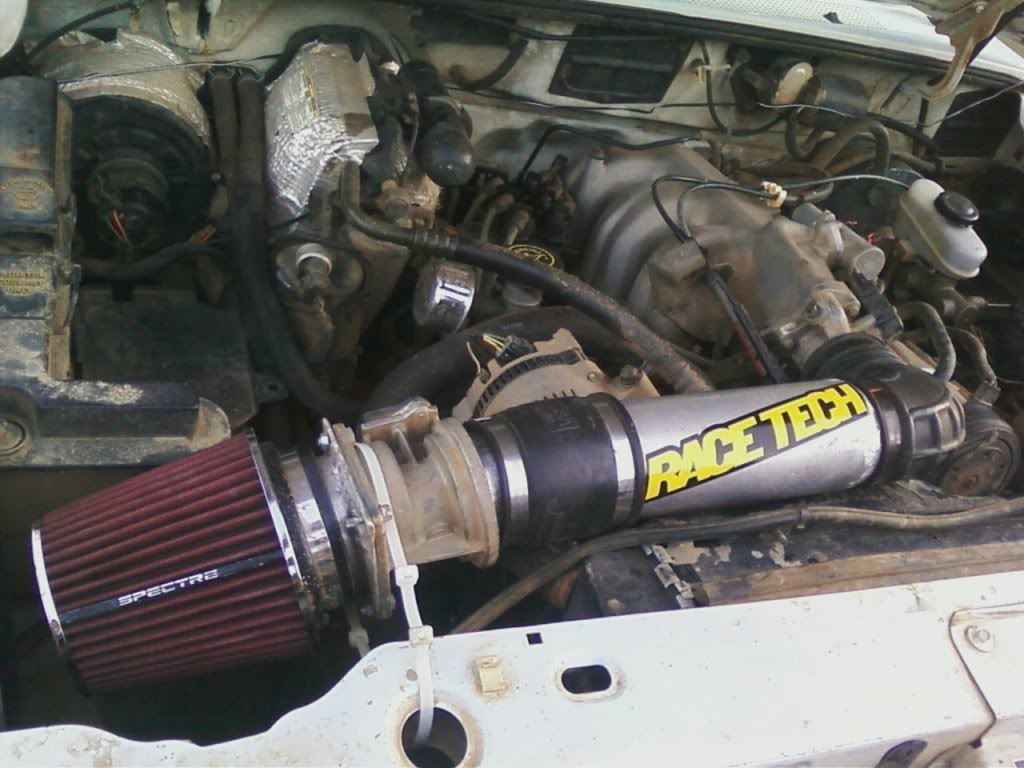
Well today i quickly fab.d up a intake like the one i had on my f150. Mainly for looks but might add .5 to 1 hp with the sticker haha. Its all rounded off and what not. And after i can my back spaced rims, i think ill polish my hole intake and heads

Postmaster
Joined: Oct 2009
Posts: 3,432
Likes: 7
Good job on that intake, it should gain you -5 to -10 hp. Notice this numbers are negative. The negative of a gain is a loss. Warm air intakes never cause power gains. Your factory intake was designed to shield the intake from engine heat, and to draw in only cold air from outside. When you run a filter with no shroud, you draw heated air from under the hood. Warmer air is less dense than cold air. This density difference results in a power difference. But its more than that. Air heats up as it gets compressed. The colder the air, the cooler the compressed mixture. The colder the compressed mixture, the more timing advance can be used, which in turn produces more power. When you draw in warm air, the computer detects the temperature difference, and will pull timing to prevent pinging, which costs additional power.
Put you stock intake back on to restore you performance back to what it should be.
You don't want to polish anything on your intake. Polished on the intake is bad.
Put you stock intake back on to restore you performance back to what it should be.
You don't want to polish anything on your intake. Polished on the intake is bad.
Thread Starter
|
Elder User
Joined: Jul 2010
Posts: 716
Likes: 0
From: Paradise CA
Well i do see what your saying, Bit iv tried the stock and the hot airs and i didnt feela big difference in eather. BUT on the f150 i have i put the filter with the MAI right to the part were in gos off the throttle body to a single tube, and i did feel a difference. But ill take it for a test ride to day and see.
And how its it bad, lots of ppl do it
And how its it bad, lots of ppl do it
Senior User
Joined: Jan 2011
Posts: 374
Likes: 0
From: Connecticut
Unregulated
Dutter,
I work in a regulated industry where making false claims on performance is a felony. Fortunately, most industries are unregulated however, the down side is that making false claims is in general, not a felony...just bad practice. Unless there is a class action suit of some kind, the most manufacturers get is a slap on the hand.
There is huge money to be made at the expense of the consumer. Buyer beware. No doubt many of us have dropped our guards and been dupped by a salesperson - probably more than once. Before I got engaged here at FTE, I might have not had the benefit of expanded information to make a more informed buying decision around my Ranger. Now, a quick Search and a series of questions generally introduces enough input to make a better decision. As a result of reading here, Cold Air Intakes are out: don't work as advertised. K&N filters are out: don't work as advertised and the consumer runs the risk of messing up their MAF sensor. Exhaust systems seem to be an OK investment, but probably maximized by proper tuning. I'm still not convinced on that one and for now, my original exhaust is hanging on. So I have more time to gather input (data and opinion).
Hopefully your CAI didn't cost you much, but I'm with Khan - go stock if you are looking for modest power gains and in this case, minimizing the losses.
Kevin
I work in a regulated industry where making false claims on performance is a felony. Fortunately, most industries are unregulated however, the down side is that making false claims is in general, not a felony...just bad practice. Unless there is a class action suit of some kind, the most manufacturers get is a slap on the hand.
There is huge money to be made at the expense of the consumer. Buyer beware. No doubt many of us have dropped our guards and been dupped by a salesperson - probably more than once. Before I got engaged here at FTE, I might have not had the benefit of expanded information to make a more informed buying decision around my Ranger. Now, a quick Search and a series of questions generally introduces enough input to make a better decision. As a result of reading here, Cold Air Intakes are out: don't work as advertised. K&N filters are out: don't work as advertised and the consumer runs the risk of messing up their MAF sensor. Exhaust systems seem to be an OK investment, but probably maximized by proper tuning. I'm still not convinced on that one and for now, my original exhaust is hanging on. So I have more time to gather input (data and opinion).
Hopefully your CAI didn't cost you much, but I'm with Khan - go stock if you are looking for modest power gains and in this case, minimizing the losses.
Kevin
FTE Stories
Ford Trucks for Ford Truck Enthusiasts

Rezvani's Latest Post-Apocalytic Monster Is a Ford F-150 Raptor Underneath
Verdad Gallardo
Top 10 Most Expensive Ford Trucks Ever Sold on Bring a Trailer
Joe Kucinski
2027 Ford Super Duty Buyer's Guide (Every Model, Engine, & Package)
Brett Foote
Top 10 Ford Truck Tragedies
Joe Kucinski
AEV FXL Super Duty - the Super Duty Raptor Ford Doesn't Make
Brett Foote
Lobo Vs Lobo: Proof the F-150 Lobo Should Be Even Lower!
Michael S. Palmer
Ford's 2001 Explorer Sportsman Concept Looks For a New Home
Verdad Gallardo
10 Best Ford Truck Engines We Miss the Most!
Joe Kucinski
2026 Shelby F-150 Off-Road: Better Than a Raptor R?
Brett Foote
Hotshot
Joined: Dec 2003
Posts: 18,423
Likes: 9
From: iowa
Polishing intakes with Carbs was bad because you wanted the turbulance to keep the fuel atomized in the mixture, BUT with fuel injection the fuel isn't introduced into the air stream until right before the valve. So polishing the intake actually can increase the air flow rates and since no fuel is mixed doesn't hurt like it used to. The mustang guys learned this 20yrs ago.
NOW with that said, on a ranger polishing the intake probably won't do you much good unless your running flat out all the time. It's pretty much a race only or full throttle gain only. Won't hurt ya, but won't make a noticeable difference.
Senior User
Joined: Jan 2011
Posts: 374
Likes: 0
From: Connecticut
That's actually old school thinking (sorry I like carbs to and I am big time old school)
Polishing intakes with Carbs was bad because you wanted the turbulance to keep the fuel atomized in the mixture, BUT with fuel injection the fuel isn't introduced into the air stream until right before the valve. So polishing the intake actually can increase the air flow rates and since no fuel is mixed doesn't hurt like it used to. The mustang guys learned this 20yrs ago.
NOW with that said, on a ranger polishing the intake probably won't do you much good unless your running flat out all the time. It's pretty much a race only or full throttle gain only. Won't hurt ya, but won't make a noticeable difference.
Polishing intakes with Carbs was bad because you wanted the turbulance to keep the fuel atomized in the mixture, BUT with fuel injection the fuel isn't introduced into the air stream until right before the valve. So polishing the intake actually can increase the air flow rates and since no fuel is mixed doesn't hurt like it used to. The mustang guys learned this 20yrs ago.
NOW with that said, on a ranger polishing the intake probably won't do you much good unless your running flat out all the time. It's pretty much a race only or full throttle gain only. Won't hurt ya, but won't make a noticeable difference.
Kevin
Thread Starter
|
Elder User
Joined: Jul 2010
Posts: 716
Likes: 0
From: Paradise CA
Alright well im going to work on my truck getting more cold air for the filter. Ill just make like a block off thingy. And now will polishing my intake affect smog, I dont think so but i want to be sure.
Hotshot
Joined: Dec 2003
Posts: 18,423
Likes: 9
From: iowa
No it wont.
That filter would be more likely to affect smog. Mainly because that is an oiled filter and the oil will get sucked off and contaminate your MAF wire and require cleaning or replacing soon. Honestly, get rid of that filter, even if you go with the same size and shape paper filter, those oiled filters are a race only filter or should be. And they are death on your sensors.
That filter would be more likely to affect smog. Mainly because that is an oiled filter and the oil will get sucked off and contaminate your MAF wire and require cleaning or replacing soon. Honestly, get rid of that filter, even if you go with the same size and shape paper filter, those oiled filters are a race only filter or should be. And they are death on your sensors.
Hotshot
Joined: Dec 2003
Posts: 18,423
Likes: 9
From: iowa
Oh and just want to correct on minor thing from one of your earlier posts, the 3.8 is a buick engine and not the 350 with 2 cylinders cut off. The 4.3 is the one that is based on the 350 minus a couple cylinders (the math shows this, a 3.8 x 1.33 equals 5L but 4.3 x 1.33 = 5.7 or 350cid) Sorry used to work for a Chev dealer back in the early 90s very familar with all of those LOL
Postmaster
Joined: Oct 2009
Posts: 3,432
Likes: 7
That's actually old school thinking (sorry I like carbs to and I am big time old school)
Polishing intakes with Carbs was bad because you wanted the turbulance to keep the fuel atomized in the mixture, BUT with fuel injection the fuel isn't introduced into the air stream until right before the valve. So polishing the intake actually can increase the air flow rates and since no fuel is mixed doesn't hurt like it used to. The mustang guys learned this 20yrs ago.
NOW with that said, on a ranger polishing the intake probably won't do you much good unless your running flat out all the time. It's pretty much a race only or full throttle gain only. Won't hurt ya, but won't make a noticeable difference.
Polishing intakes with Carbs was bad because you wanted the turbulance to keep the fuel atomized in the mixture, BUT with fuel injection the fuel isn't introduced into the air stream until right before the valve. So polishing the intake actually can increase the air flow rates and since no fuel is mixed doesn't hurt like it used to. The mustang guys learned this 20yrs ago.
NOW with that said, on a ranger polishing the intake probably won't do you much good unless your running flat out all the time. It's pretty much a race only or full throttle gain only. Won't hurt ya, but won't make a noticeable difference.
Porting is not the same as polishing. I have done several porting jobs, and know several people who do that kind of work for a living. Trust me, on a dyno you can tell the difference between a ported intake and a polished intake. Most of the rough yet ported intakes would average about 4% more power than a comparable polished finish. The difference is in airflow, which can be verified with a flow bench. The slightly rougher finish flows better.