


Propane powered 66???
Thread Starter
|
Fleet Mechanic


Joined: Feb 2009
Posts: 1,662
Likes: 36
From: Las Vegas NV

Propane powered 66???
Hello folk my uncle has a 66 with a flat bed and I recently asked him if he would be interested in selling it.
He said maybe he would sell it one day,but then he hit me with the fact that it is powered by propane.
I had seen the 2 tanks on the truck but I never thought it would be the fuel tanks.
the engine is a v8 but dont know more than that.
Is this conversion popular????
thanks for the info.
Seth
He said maybe he would sell it one day,but then he hit me with the fact that it is powered by propane.
I had seen the 2 tanks on the truck but I never thought it would be the fuel tanks.
the engine is a v8 but dont know more than that.
Is this conversion popular????
thanks for the info.
Seth

Elder User
Joined: Oct 2010
Posts: 838
Likes: 0
From: 50 miles west of Chicago
Depends on what you mean by popular. There are a lot of this type of conversion out there on pickups. Some say because the motor runs so much cleaner that they do it for fleet trucks as they last longer. Some do for the cost of fuel difference. Some do it just to be more green.
As with anything there are pros and cons. Goggle propane conversions and I am sure you will find alot. Also be aware that the conversion is not cheap.
jim

As with anything there are pros and cons. Goggle propane conversions and I am sure you will find alot. Also be aware that the conversion is not cheap.
jim

Senior User
Joined: Apr 2006
Posts: 154
Likes: 2
From: Fort Erie, ON
Does its popularity really matter? I think that something unique would be a lot more interesting at car shows and cruises. Running a low cost, clean burning, high octane (104) fuel has got to be another benefit.
As for being expensive, depending upon how much you drive, fuel can be the most expensive cost of driving a vehicle. Gasoline is already over $4/gallon many places in the US, premium is even more. If your truck gets 20 mpg, your driving cost is $0.20/mile with $4/gallon gasoline. If you drive 20,000 miles/year, gasoline will cost you $4000.
If you were to convert to propane, you can expect your propane mileage to be 75-80% of your gasoline mileage. With the more conservative 75% estimate, your propane economy will be around 15 mpg. Without too much trouble, you should be able to find $2.50/gallon propane. For 20,000 miles/year, you can expect to buy 1333 gallons of propane at a cost of $3333. If you had locked in your price last summer in Buffalo, NY with a propane supplier (Ferrell Gas), you could be paying $2.2135/gallon right now at a cost of $2951/year. With the higher (and more likely) estimate of 80%, you would instead require 1250 gallons of propane at a cost of $2767.
With a propane account, your fuel savings work out to $1233/year with 20 mpg and 20,000 miles per year. If you drive more and/or your truck is less fuel efficient, your savings are even greater. If you do the math, converting to propane could easily be much cheaper than sticking with gasoline.
As for being expensive, depending upon how much you drive, fuel can be the most expensive cost of driving a vehicle. Gasoline is already over $4/gallon many places in the US, premium is even more. If your truck gets 20 mpg, your driving cost is $0.20/mile with $4/gallon gasoline. If you drive 20,000 miles/year, gasoline will cost you $4000.
If you were to convert to propane, you can expect your propane mileage to be 75-80% of your gasoline mileage. With the more conservative 75% estimate, your propane economy will be around 15 mpg. Without too much trouble, you should be able to find $2.50/gallon propane. For 20,000 miles/year, you can expect to buy 1333 gallons of propane at a cost of $3333. If you had locked in your price last summer in Buffalo, NY with a propane supplier (Ferrell Gas), you could be paying $2.2135/gallon right now at a cost of $2951/year. With the higher (and more likely) estimate of 80%, you would instead require 1250 gallons of propane at a cost of $2767.
With a propane account, your fuel savings work out to $1233/year with 20 mpg and 20,000 miles per year. If you drive more and/or your truck is less fuel efficient, your savings are even greater. If you do the math, converting to propane could easily be much cheaper than sticking with gasoline.

Laughing Gas
Joined: Jul 2010
Posts: 1,133
Likes: 127
From: Chico, Ca.
I knew a guy some 20 years ago who had a beat up Oldsmobile that ran on propane. There was a switch to change from propane to gas in the engine bay. The engine had over 250,000 miles, and purred like a kitten. Presumeably, the propane burns so much cleaner that you don't have the carbon buildup that you would with gas. I don't know if this makes them cost effective. It's been a long time since I've seen a conversion, so I suspect your uncle converted his slick in the distant past.
Kurt
Kurt

Fleet Mechanic
Joined: Jul 2006
Posts: 1,346
Likes: 4
From: Rapid City, SoDak
 But the good news is when you flip the switch to real gas it feels like you just injected it with nitrous!
 I managed a lawncare company that ran 3 converted trucks, they're not terribly underpowered just cruising around but if you have a load on it's really noticeable. Also check on the tank size, fraso is right about the mileage and if your tanks aren't very big you won't get very far. We filled those trucks every single morning and they were nearly empty in the evening. And one more thing, there's a number of things with a converted truck that a normal mechanic won't touch, so it takes a special mechanic. In Tulsa, OK where we were at the time there was one guy in town that worked on them and there was a long waiting list and he charged whatever he wanted to. I don't mean to be Debbie Downer but my experience turned me off of the whole idea.
Trending Topics

Posting Guru
Joined: Jan 2011
Posts: 2,315
Likes: 0
From: Rossmoor at Seal Beach
I used to do propane conversions for Cal Gas which later became Amerigas. As for Mileage differences, they were negligable, there is a very slight power loss, but the engine does run much smoother. I would not recommend it if you live in a cold climate as the propane is hard to get to vaporize in colder temps, making for hard starts... the upside is you can do oil changes about every 15,000 miles as the oil stays very clean. if it is set up as a dual fuel, using both Propane and gasoline... pass on that! the dual fuel will never run well on either fuel as it is a compromise... if you get it dialed in on Propane then it will run poorly on gasoline, and vice versa! Replacement parts are hard to come by now for the Impco Propane carb/fuel injection units. If it is a working system, it should last a long time, and they are pretty easy to fix! the big advantage is the cost of the fuel. Some states do not charge highway fuel tax surcharges on propane making it a very desirable fuel choice. yes it is very clean burning, hence the reason it is used in warehouse vehicles. It is a personal choice, if I had access to a conversion kit, i would do it in a heartbeat, but California does not allow propane conversions anymore, only dual fuel or LNG. LPG is much cleaner then LNG, and easier to use as a fuel.
FTE Stories
Ford Trucks for Ford Truck Enthusiasts

Top 10 Fords at 2026 Carlisle Ford Nationals
Joe Kucinski
3 Best / 3 Worst Parts of Modern Ford Ownership
Brett Foote
10 Amazing Upgrades That Solve Common Ford Truck Owner Headaches
Pouria Savadkouei
Every 2026 Ford Engine Explained
Brett Foote
10 Ugly Ford Trucks That We Still Kinda Love
Joe Kucinski
10 Things Every Truck Owner NEEDS (2026 Edition)
Michael S. Palmer
Rezvani's Latest Post-Apocalyptic Monster Is a Ford F-150 Raptor Underneath
Verdad Gallardo
Top 10 Most Expensive Ford Trucks Ever Sold on Bring a Trailer
Joe Kucinski
2027 Ford Super Duty Buyer's Guide (Every Model, Engine, & Package)
Brett Foote
Thread Starter
|
Fleet Mechanic
Joined: Feb 2009
Posts: 1,662
Likes: 36
From: Las Vegas NV
Wow thanks for the excellent information I will post pictures tomorrow.
The truck was very complete til a-holes broke windows and started taking parts from the engine.my father in law has a 66 that was his dads and he is thinking of selling it too.
and he has a 66 maybe a 55 big truck.
The truck was very complete til a-holes broke windows and started taking parts from the engine.my father in law has a 66 that was his dads and he is thinking of selling it too.
and he has a 66 maybe a 55 big truck.
Senior User
Joined: Apr 2006
Posts: 154
Likes: 2
From: Fort Erie, ON
If your power output is noticeably lower on propane, it could be because:
- the carburetor is undersized
- the fuel mixture is incorrect
- the advance curve is incorrect
You can easily increase the compression ratio (10:1 is good) to take advantage of propane's 104 octane rating, which will help to make up for the loss in VE.
Posting Guru
Joined: Jan 2011
Posts: 2,315
Likes: 0
From: Rossmoor at Seal Beach
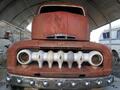
That is an old Impco 300 series propane system (really reliable), and judging from the truck, it was at one time a propane company tank setting service truck, we used to call them Boom trucks! I would figure that it is not dual fuel, strictly Propane, which makes it run much better. Judging from the truck colors it was probably either a Petrolane Gas truck at one time or Suburban gas. That Y block looks real tired but a quick overhaul and you could be good to go. That propane system, is easy to get parts for, but you would need to get the fuel tanks re-certified aka Hydro-tested! My guess is that it probably has 4-5 hundred thousand on it, as that is how long we used to run our trucks before selling them. Even with that kind of mileage they were usually running pretty well. The boom looks like an autocrane 3005 or 4005 or their abouts, those are not to hard to find parts for too. That could be a really cool restore! but it would be a lot of work. let us know what you decide to do!
Posting Guru
Joined: Jan 2011
Posts: 2,315
Likes: 0
From: Rossmoor at Seal Beach
here is a link to a modern boom truck. The suspension on most of them is set up to handle up to 5000 lbs. the approximate weight of one 500gal tank at 87 percent full, which is considered a full tank.
Google Image Result for http://www.cranenetwork.com/watermark.php?src=equipment-pics%2Fcranes%2FAuto+Crane%2FvGMTfTkcMEqLrTDMW8447--4.JPG
Google Image Result for http://www.cranenetwork.com/watermark.php?src=equipment-pics%2Fcranes%2FAuto+Crane%2FvGMTfTkcMEqLrTDMW8447--4.JPG