









Boost leak detector - PICS!

Thread Starter
|
Hotshot
Joined: Jul 2008
Posts: 12,782
Likes: 2,142
From: N.GA Mountains

Boost leak detector - PICS!
This is sooooo cheap and simple I cannot believe I've not done it until now...
3" PVC cap tapped for a schrader valve:
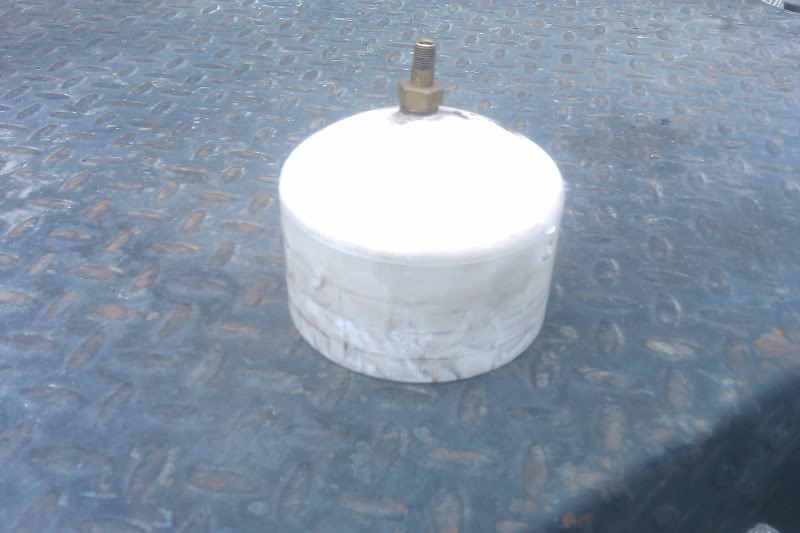
You could get all fancy and tap a pressure gauge in there too - but its totally not necessary. The CCV, VC's, etc are gonna leak some and bleed the pressure down, so we just blow up the intake tubing until it looks uncomfortably inflated and start sprayin' soapy water and listening...
Remove airbox (or in my case 6637) and clamp PVC in place, then blow compressed air in and spray all boots, etc with soapy water:
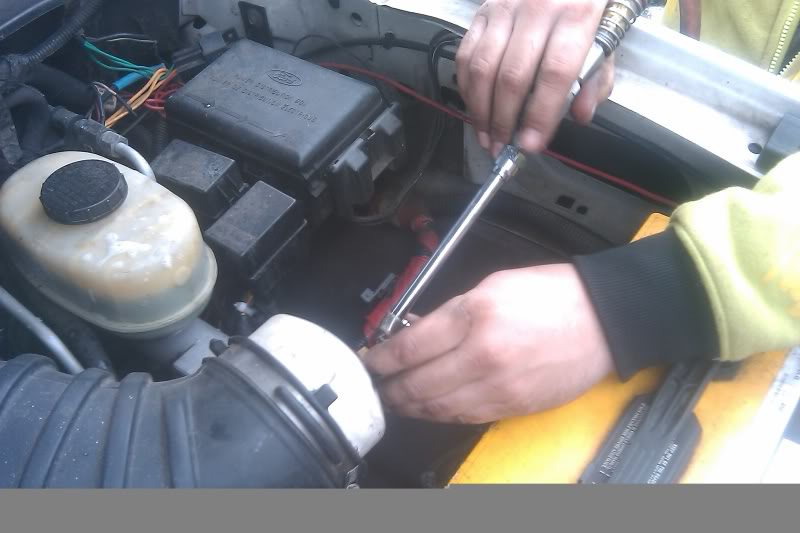
I'm willing to bet more people have leaks than think they do... Most of that 'dirty engine' syndrome can be mitigated by eliminating leaks found with this EASY test.
Thanks to Jim (rat49F6) for loaning me this tool and all the other help he's been to me since I've been in NJ!!!
3" PVC cap tapped for a schrader valve:
You could get all fancy and tap a pressure gauge in there too - but its totally not necessary. The CCV, VC's, etc are gonna leak some and bleed the pressure down, so we just blow up the intake tubing until it looks uncomfortably inflated and start sprayin' soapy water and listening...
Remove airbox (or in my case 6637) and clamp PVC in place, then blow compressed air in and spray all boots, etc with soapy water:
I'm willing to bet more people have leaks than think they do... Most of that 'dirty engine' syndrome can be mitigated by eliminating leaks found with this EASY test.
Thanks to Jim (rat49F6) for loaning me this tool and all the other help he's been to me since I've been in NJ!!!

Cargo Master

Joined: Oct 2007
Posts: 2,712
Likes: 107
From: BoCoMo
This is sooooo cheap and simple I cannot believe I've not done it until now...
3" PVC cap tapped for a schrader valve:

You could get all fancy and tap a pressure gauge in there too - but its totally not necessary. The CCV, VC's, etc are gonna leak some and bleed the pressure down, so we just blow up the intake tubing until it looks uncomfortably inflated and start sprayin' soapy water and listening...
Remove airbox (or in my case 6637) and clamp PVC in place, then blow compressed air in and spray all boots, etc with soapy water:
I'm willing to bet more people have leaks than think they do... Most of that 'dirty engine' syndrome can be mitigated by eliminating leaks found with this EASY test.
Thanks to Jim (rat49F6) for loaning me this tool and all the other help he's been to me since I've been in NJ!!!
3" PVC cap tapped for a schrader valve:
You could get all fancy and tap a pressure gauge in there too - but its totally not necessary. The CCV, VC's, etc are gonna leak some and bleed the pressure down, so we just blow up the intake tubing until it looks uncomfortably inflated and start sprayin' soapy water and listening...
Remove airbox (or in my case 6637) and clamp PVC in place, then blow compressed air in and spray all boots, etc with soapy water:
I'm willing to bet more people have leaks than think they do... Most of that 'dirty engine' syndrome can be mitigated by eliminating leaks found with this EASY test.
Thanks to Jim (rat49F6) for loaning me this tool and all the other help he's been to me since I've been in NJ!!!
Keep your psi low or you will have 'leaks' everywhere

Thread Starter
|
Hotshot
Joined: Jul 2008
Posts: 12,782
Likes: 2,142
From: N.GA Mountains
Good advice Les. Not sure how many psi I was putting in there, but guessing not more than 20-25... We just puffed up the intake tube a little and looked for leaks until it got soft again - then added more air (2-3 secs).
I'm surprised we haven't gotten any comments about the lovely hand model we used for this shoot!
I'm surprised we haven't gotten any comments about the lovely hand model we used for this shoot!
Cargo Master
Joined: Oct 2007
Posts: 2,712
Likes: 107
From: BoCoMo
Good advice Les. Not sure how many psi I was putting in there, but guessing not more than 20-25... We just puffed up the intake tube a little and looked for leaks until it got soft again - then added more air (2-3 secs).
I'm surprised we haven't gotten any comments about the lovely hand model we used for this shoot!
I'm surprised we haven't gotten any comments about the lovely hand model we used for this shoot!
'I need to make me one of those... I have the stuff laying around.

Post Fiend


Joined: Jun 2006
Posts: 9,714
Likes: 2
From: White Mnt's,New Hampshire
Trending Topics

Senior User
Joined: Jan 2010
Posts: 161
Likes: 0
From: Seattle
Went ahead and made one of these today (thanks for the easy directions) and I'm afraid to ask about the results - why would air be coming out of the dipstick? I only pressured it up to about 20 psi and couldn't find any other "leaks."
FTE Stories
Ford Trucks for Ford Truck Enthusiasts

Rezvani's Latest Post-Apocalytic Monster Is a Ford F-150 Raptor Underneath
Verdad Gallardo
Top 10 Most Expensive Ford Trucks Ever Sold on Bring a Trailer
Joe Kucinski
2027 Ford Super Duty Buyer's Guide (Every Model, Engine, & Package)
Brett Foote
Top 10 Ford Truck Tragedies
Joe Kucinski
AEV FXL Super Duty - the Super Duty Raptor Ford Doesn't Make
Brett Foote
Lobo Vs Lobo: Proof the F-150 Lobo Should Be Even Lower!
Michael S. Palmer
Ford's 2001 Explorer Sportsman Concept Looks For a New Home
Verdad Gallardo
10 Best Ford Truck Engines We Miss the Most!
Joe Kucinski
2026 Shelby F-150 Off-Road: Better Than a Raptor R?
Brett Foote
Senior User
Joined: Jan 2010
Posts: 161
Likes: 0
From: Seattle
Turns out I made the mistake of hooking it up to the CCV coupler just like this. I'll try again later with the detector hooked up to the correct boot.
Postmaster
Joined: Sep 2007
Posts: 4,005
Likes: 3
From: Mcafee, NJ

schrader valve came from my B.A. local Hardware store
u would like those beat up hands
lets make a high class new tester like rons
Good advice Les. Not sure how many psi I was putting in there, but guessing not more than 20-25... We just puffed up the intake tube a little and looked for leaks until it got soft again - then added more air (2-3 secs).
I'm surprised we haven't gotten any comments about the lovely hand model we used for this shoot!
I'm surprised we haven't gotten any comments about the lovely hand model we used for this shoot!
lets make a high class new tester like rons




Posting Guru
Joined: May 2007
Posts: 1,141
Likes: 0
I would say if you put enough pressure on it with the valves open it will bypass the piston ring's, the reason for CCV. Seems like if you wanted to check for leaks take the intercooler tube off at the cold side at the spider and plug with cap also.
Thread Starter
|
Hotshot
Joined: Jul 2008
Posts: 12,782
Likes: 2,142
From: N.GA Mountains
 We don't need it to 'hold' pressure to check for leaks - just have some pressure in there so we see bubbles in our soapy solution. Anyway, the thing you are suggesting we disconnect is the most likely suspect for a leak... Besides, at least one intake valve is always open, right?
The intake tube goes directly into CCV - unlike gassers, there is no PCV - so air blown in the way I describe is pressurizing crankcase via valve cover. This would be a good reason to keep pressure low. You could plug CCV in intake tube and put as much pressure as ya wanted (until ya broke CAC) - but again, I think its totally unnecessary!
K.I.S.S.
and not needed, but thanks anyway Joe!!!!