


clamp on wheels why??

Hotshot
Joined: Feb 2004
Posts: 11,697
Likes: 3
From: Marengo, Iowa
How would you know?
Everything you said was wrong too, except for fords having five and six lugs.
FYI ....From your post above..
"Early Budds were also of split design, known as widowmakers... Later came the split ring,"
Wrong, split ring 2 and 3 piece wheels came before the widowmaker (firestone rh5degree)
"then the Budd of today, which is a one piece unit."
Wrong...There are one piece, two piece and three piece, Budd wheels today.
The one piece being tubless, the two and three piece are both tube type split rims.
"However, the Daytons are universal across the different manufacturers"
Wrong...Daytons come in many different widths and sizes, and in one piece, two piece, and three piece wheels.
"Nowadays, everything is the same 10 lug design for the most part",
Wrong... there's six lug, five lug, eight lug, ten lug
all different widths, offsets, one piece two piece three piece etc...
"The widowmakers are 6 lug design"
The widowmakers came in five and six lug.
Hope this helps.
Greg
Everything you said was wrong too, except for fords having five and six lugs.
FYI ....From your post above..
"Early Budds were also of split design, known as widowmakers... Later came the split ring,"
Wrong, split ring 2 and 3 piece wheels came before the widowmaker (firestone rh5degree)
"then the Budd of today, which is a one piece unit."
Wrong...There are one piece, two piece and three piece, Budd wheels today.
The one piece being tubless, the two and three piece are both tube type split rims.
"However, the Daytons are universal across the different manufacturers"
Wrong...Daytons come in many different widths and sizes, and in one piece, two piece, and three piece wheels.
"Nowadays, everything is the same 10 lug design for the most part",
Wrong... there's six lug, five lug, eight lug, ten lug
all different widths, offsets, one piece two piece three piece etc...
"The widowmakers are 6 lug design"
The widowmakers came in five and six lug.
Hope this helps.
Greg
On the Daytons, you are too literal, as it should be obvious that you don't mix sizes, or are you too obnoxious to realize that? I waas merely stating that the same size will mount on any manufacturer, like the Chevy parts truck that my uncle wrecked with 9.00-20's will mount on the Ford that I recently picked up with daytons 9.00-20's will swap rims. Only an idiot would think you could mix different sizes...
While there are variant,s most rims on the heavies are 10 bolt, too literal again. Medium duty trucks are where the most variants come from.
If I am wrong, simply present your info in a helpful, meaningful way, rather than coming across the way you just did, you were way out of line in your first post, and just seem to like to keep it going. So I go my timelines wrong, but I have worked with this stuff for a long time too, so whatever.

Senior User
Joined: Nov 2008
Posts: 411
Likes: 5
From: Cle Elum WA
Stu, I did my fronts and on My Truck, it was as simple as getting some stud pilot nuts and bolting the stud pilot lockring type wheels on.
The thing I had to watch out for was to make sure that the wheel studs were threaded down towards the hub far enough for the wheel to get tight.
These wheels were off a forklift, I have since changed them again and put some wheels on with round handholes ...they look better.
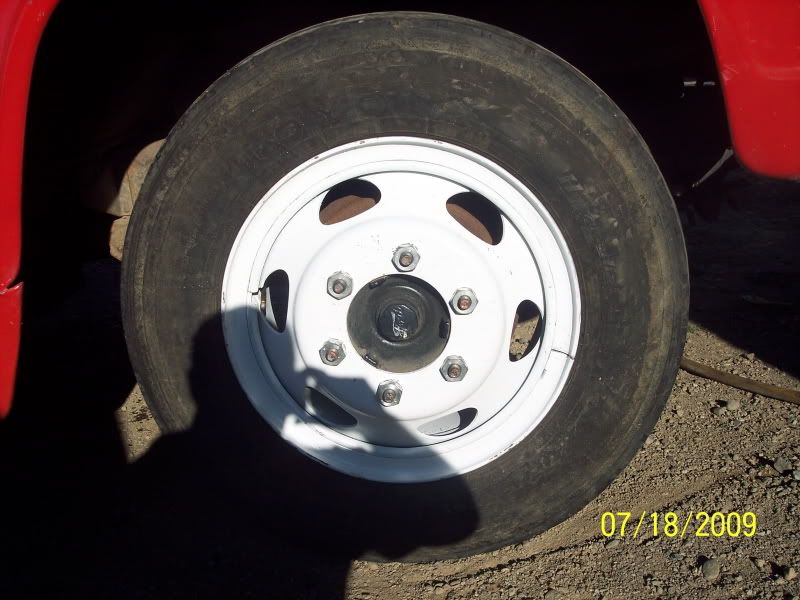
DISCLAIMER......I AM SIMPLY TELLING WHAT WORKED ON MY TRUCK, AND I AM IN NO WAY SAYING IT WILL WORK ON ANYONE ELSES TRUCK, NOR AM I ENCOURAGING THEM DO DO WHAT I HAVE DONE.
ANY WORK LIKE THIS SHOULD BE DONE BY A TRAINED PROFESSIONAL .
On my rears the studs were to long and bottomed in the inner nut, so I got out my cutoff wheel and shortened one up then discovered that where the studs come through the hub..the unthreaded shoulder part of the stud, is to long, and the inner wheel won't quite get tight.
I need to get different studs, or shorten these up and thread them down farther.
I still haven't done it..Maybe this summer.
I don't think it will be a big deal.
Greg
The thing I had to watch out for was to make sure that the wheel studs were threaded down towards the hub far enough for the wheel to get tight.
These wheels were off a forklift, I have since changed them again and put some wheels on with round handholes ...they look better.
DISCLAIMER......I AM SIMPLY TELLING WHAT WORKED ON MY TRUCK, AND I AM IN NO WAY SAYING IT WILL WORK ON ANYONE ELSES TRUCK, NOR AM I ENCOURAGING THEM DO DO WHAT I HAVE DONE.
ANY WORK LIKE THIS SHOULD BE DONE BY A TRAINED PROFESSIONAL .
On my rears the studs were to long and bottomed in the inner nut, so I got out my cutoff wheel and shortened one up then discovered that where the studs come through the hub..the unthreaded shoulder part of the stud, is to long, and the inner wheel won't quite get tight.
I need to get different studs, or shorten these up and thread them down farther.
I still haven't done it..Maybe this summer.
I don't think it will be a big deal.
Greg
Marmon-Herrington Man


Joined: Jul 2005
Posts: 11,986
Likes: 446
From: Central Illinois

Yeah, the hub piloted studs aren't threaded fully to the base to allow the inner cap nut to seat. Replacement studs should deal with that, but I can see too that there might be some machine work needed on hubs to accommodate the swap. Now I'll butt out of you guys' p'ing contest. Stu

Post Fiend
Joined: Feb 2007
Posts: 7,191
Likes: 4
From: Blairsville,Ga
.
I don't know who the member was, but there was at least one old thread devoted to the conversion of a truck from a hub piloted to stud piloted mounting. If anybody has successfully done that I'd like to hear more about it. I know in theory what machine work would be required on the hubs to do it, but that's not the same as actually having done it. Stu
I don't know who the member was, but there was at least one old thread devoted to the conversion of a truck from a hub piloted to stud piloted mounting. If anybody has successfully done that I'd like to hear more about it. I know in theory what machine work would be required on the hubs to do it, but that's not the same as actually having done it. Stu
Marmon-Herrington Man
Joined: Jul 2005
Posts: 11,986
Likes: 446
From: Central Illinois
I think I've seen diagrams in one of the books that show a recessed stud shank in some applications. Wondered if on a case-by-case basis there might be hub mods needed to pull off the change. Agree that it only works going hub piloted to stud piloted because of the generaly larger center bore of a stud piloted wheel. Stu

Thread Starter
|
Senior User
Joined: Dec 2009
Posts: 171
Likes: 0
looks like i opened a can of worms. I have a 1984 f700 it has the dayton wheels. someone must have replaced it with one piece because only one wheel up front has the split ring "widow maker" i have a wobble from the rear. How does one propery install a dayton wheel to get it lines up and all???

New User
Joined: Feb 2011
Posts: 4
Likes: 0
Proper method to true a dayton wheel:
Make sure hub and wheel surface are clean(wire brush)
Finger tighten nut/clamp assembly evenly in a criss/cross
Put a tall spray can next to tire and spin to check true
As you spin the tire you will see the wobble tighten the nut at the point the tire is closest to can.
once the tire is running true tighten in a criss/cross evenly
LOL this will make sense once you do it for yourself.
Make sure hub and wheel surface are clean(wire brush)
Finger tighten nut/clamp assembly evenly in a criss/cross
Put a tall spray can next to tire and spin to check true
As you spin the tire you will see the wobble tighten the nut at the point the tire is closest to can.
once the tire is running true tighten in a criss/cross evenly
LOL this will make sense once you do it for yourself.
Last edited by MotorHedd; Mar 8, 2011 at 03:14 PM. Reason: Safety concern raised by truckdog62563
FTE Stories
Ford Trucks for Ford Truck Enthusiasts

Top 6 Best Deals Available on New Fords & Lincolns Right Now
Brett Foote
This Hennessey Takes the Expedition Tremor's Off-Roading Capability to the Next Level
Verdad Gallardo
Top 10 Fords at 2026 Carlisle Ford Nationals
Joe Kucinski
3 Best / 3 Worst Parts of Modern Ford Ownership
Brett Foote
10 Amazing Upgrades That Solve Common Ford Truck Owner Headaches
Pouria Savadkouei
Every 2026 Ford Engine Explained
Brett Foote
10 Ugly Ford Trucks That We Still Kinda Love
Joe Kucinski
10 Things Every Truck Owner NEEDS (2026 Edition)
Michael S. Palmer
Rezvani's Latest Post-Apocalyptic Monster Is a Ford F-150 Raptor Underneath
Verdad Gallardo
Marmon-Herrington Man
Joined: Jul 2005
Posts: 11,986
Likes: 446
From: Central Illinois
First, I'll welcome you to the group. Glad to have you. Next, I'll disagree with you on the above statement. This below article in Fleet Owner magazine explains why use of neverseize is a bad idea. Stu
Debunking a myth
Debunking a myth
New User
Joined: Feb 2011
Posts: 4
Likes: 0
thanx for the welcome truckdog...this is a great forum.I agree with you...with a caveat.Here is the original...
{The age-old practice of using anti-seize compounds as wheel system lubricants has never been approved or endorsed by a wheel, hub or fastener manufacturer. It hails back to the day of stud-piloted or Budd wheel systems when the inner and outer cap nuts were constantly “freezing” together during the removal process.}
For the dayton style wheel it has been an acceptable practice.But lets be real here who knows about dayton wheels except old farts like us LOL.Love your garage...a lil jealous here.I am going to edit that post tho and remove the never seize part.
MH
{The age-old practice of using anti-seize compounds as wheel system lubricants has never been approved or endorsed by a wheel, hub or fastener manufacturer. It hails back to the day of stud-piloted or Budd wheel systems when the inner and outer cap nuts were constantly “freezing” together during the removal process.}
For the dayton style wheel it has been an acceptable practice.But lets be real here who knows about dayton wheels except old farts like us LOL.Love your garage...a lil jealous here.I am going to edit that post tho and remove the never seize part.
MH
Senior User
Joined: Jul 2007
Posts: 410
Likes: 6
From: SE / NWL MI
Stu~
Thanks for posting the link to the article on anti-sieze. I bookmarked it for future reference when I get going again on the project. Still haven't got up to the scrapyard to check on the 22.5 5x8 wheels yet. We keep getting hit with snow, and I'm still waiting for a truck.
Thanks for posting the link to the article on anti-sieze. I bookmarked it for future reference when I get going again on the project. Still haven't got up to the scrapyard to check on the 22.5 5x8 wheels yet. We keep getting hit with snow, and I'm still waiting for a truck.
Marmon-Herrington Man
Joined: Jul 2005
Posts: 11,986
Likes: 446
From: Central Illinois
Since my posting the same topic has come up over on the HAMB. Boy, talk about strong differences of opinion. One guy even linked in two discussion threads from engineering forums debating the subject. Good reading. Here are those threads. Stu
Thoughts on using anti-seize on lug studs - THE H.A.M.B.
Use of Anti Seize on Vehicle Lug Nuts
Mechanical engineering other topics - Use of Anti Seize on vehicle lug nuts
Thoughts on using anti-seize on lug studs - THE H.A.M.B.
Use of Anti Seize on Vehicle Lug Nuts
Mechanical engineering other topics - Use of Anti Seize on vehicle lug nuts

Thread
Thread Starter
Forum
Replies
Last Post
theservicegroup777
6.0L Power Stroke Diesel
2
May 10, 2017 06:48 AM
woodtrucker
1994.5 - 1997 7.3L Power Stroke Diesel
7
Dec 24, 2013 04:44 AM
