Alternator advice?

Laughing Gas


Joined: Jan 2010
Posts: 854
Likes: 17
From: Florida
I have a lot of gadgets with little amp draw (alarm, Insight, GPS, kids' DSi's, phone charger) but also a train horn compressor that sucks 18A when on, so I have been thinking about an upgrade as well.
If I went with the same alt as HighBinder do I have to upgrade cables? If so, which cables? I'm quite a bit less mechanically experienced than you guys, but I would want to do it right.
I recently put on the OEM block heater cord (it was quite a pain), and I know that that cable to the starter is well buried and nearly impossible to get to. Thanks for the advice.
If I went with the same alt as HighBinder do I have to upgrade cables? If so, which cables? I'm quite a bit less mechanically experienced than you guys, but I would want to do it right.
I recently put on the OEM block heater cord (it was quite a pain), and I know that that cable to the starter is well buried and nearly impossible to get to. Thanks for the advice.

Post Fiend
Joined: Jul 2005
Posts: 6,127
Likes: 6
See what gauge cable is on there in the factory cable.
Then double up (with new one running right beside it).
YOU MUST HAVE A FUSIBLE LINK.
The combined amp ratings of the 2 fusible links (one on factory cable plus new one) must be below the amp rating of the alternator.
If you want to play safe, go 10% below.
-------------
Alternative: run one new cable long / thick enough to take the amp load / and run it to one fuse at or below rated output of alternator.
Be sure you protect the cable with the plastic cable protector wrap.
If the insulation / dielectric fails, you want that 2nd cable protector as a backup.
Be sure it is tightly and snugly attached to the vehicle.
These cables are pushing 400amp on starting... not fun to mess with.
For a reference:
I upgraded to a 145 a from 110 a factory.
I did not upgrade cable.
Leave that job to when I get complete new cables.
But if you are going 180 amp (70amp more than stock, or over 60% more....) I would.
Then double up (with new one running right beside it).
YOU MUST HAVE A FUSIBLE LINK.
The combined amp ratings of the 2 fusible links (one on factory cable plus new one) must be below the amp rating of the alternator.
If you want to play safe, go 10% below.
-------------
Alternative: run one new cable long / thick enough to take the amp load / and run it to one fuse at or below rated output of alternator.
Be sure you protect the cable with the plastic cable protector wrap.
If the insulation / dielectric fails, you want that 2nd cable protector as a backup.
Be sure it is tightly and snugly attached to the vehicle.
These cables are pushing 400amp on starting... not fun to mess with.
For a reference:
I upgraded to a 145 a from 110 a factory.
I did not upgrade cable.
Leave that job to when I get complete new cables.
But if you are going 180 amp (70amp more than stock, or over 60% more....) I would.
Laughing Gas
Joined: Jan 2010
Posts: 854
Likes: 17
From: Florida
Gearloose, forgive my ignorance - which cable are we talking about and do the cables come with a fusible link installed (if I add a second OEM cable) or is that another part to hunt down?
How'd you do it Bismic?
How'd you do it Bismic?

Freshman User
Joined: May 2010
Posts: 35
Likes: 0
Check this guy out. I talked to him and he has been in the automotive electrical business since 1968. High Output Alternator, 200-250-300-350 Amp Alternators, high output alternators, Delco Remy,Ford Truck Alternators They use 8 70 amp diodes on their 200 amp alt. compared to 6 75 amp diodes used by DC power. Also they use a copper heat sink and an 8mm copper battery lead post compared to a 6mm. They sell them in 140, 160, 200, and 250 amp models. I also talked to DC Power and was just about to buy his 190 amp but this guy at alt. parts sold me. I'm by no means saying that DC Power doesn't have a great product but its worth a look around to see what else is out there. 200A High Output F-Series Diesel Truck Alternator This site has power cables that are fused with a 200amp inline fuse. They also can make to your specifications to length and with what size term. ends you need ground cables for a heavy up for your return path. The power cables are #4 stranded copper. They recommend a #4 for the return path ground as well. The guy at alt.parts.com said that the best way to heavy up the ground path is right from the back of the alt. to the negative battery term. The 200 amp inline fuse I mentioned above is the recommended size buy the manufacturer of the fuse kit which is a company called Little Fuse. They say not to increase or decrease the size.

Fleet Owner


Joined: Nov 2003
Posts: 27,924
Likes: 3,644

Check this guy out. I talked to him and he has been in the automotive electrical business since 1968. High Output Alternator, 200-250-300-350 Amp Alternators, high output alternators, Delco Remy,Ford Truck Alternators They use 8 70 amp diodes on their 200 amp alt. compared to 6 75 amp diodes used by DC power. Also they use a copper heat sink and an 8mm copper battery lead post compared to a 6mm. They sell them in 140, 160, 200, and 250 amp models. I also talked to DC Power and was just about to buy his 190 amp but this guy at alt. parts sold me. I'm by no means saying that DC Power doesn't have a great product but its worth a look around to see what else is out there. 200A High Output F-Series Diesel Truck Alternator This site has power cables that are fused with a 200amp inline fuse. They also can make to your specifications to length and with what size term. ends you need ground cables for a heavy up for your return path. The power cables are #4 stranded copper. They recommend a #4 for the return path ground as well. The guy at alt.parts.com said that the best way to heavy up the ground path is right from the back of the alt. to the negative battery term. The 200 amp inline fuse I mentioned above is the recommended size buy the manufacturer of the fuse kit which is a company called Little Fuse. They say not to increase or decrease the size.
Freshman User
Joined: May 2010
Posts: 35
Likes: 0
Did you look at the site ? Like I said I know DC Power is a quality product, but I talked to the guy at alternator parts and he spent a significant amount of time talking to me about all the parts that go into building his product. This was the guy that builds them not just a sales rep. I did a lot of research and talked to numerous people before making my decision because that kind of money I don't take lightly
Laughing Gas
Joined: Jan 2010
Posts: 854
Likes: 17
From: Florida
That's very doable - thanks!!
FTE Stories
Ford Trucks for Ford Truck Enthusiasts

Top 10 Fords at 2026 Carlisle Ford Nationals
Joe Kucinski
3 Best / 3 Worst Parts of Modern Ford Ownership
Brett Foote
10 Amazing Upgrades That Solve Common Ford Truck Owner Headaches
Pouria Savadkouei
Every 2026 Ford Engine Explained
Brett Foote
10 Ugly Ford Trucks That We Still Kinda Love
Joe Kucinski
10 Things Every Truck Owner NEEDS (2026 Edition)
Michael S. Palmer
Rezvani's Latest Post-Apocalyptic Monster Is a Ford F-150 Raptor Underneath
Verdad Gallardo
Top 10 Most Expensive Ford Trucks Ever Sold on Bring a Trailer
Joe Kucinski
2027 Ford Super Duty Buyer's Guide (Every Model, Engine, & Package)
Brett Foote
Fleet Owner
Joined: Nov 2003
Posts: 27,924
Likes: 3,644
There is much more to building a reliable alternator than just the rectifier. 90% of the time the diodes are enough for the application under normal operating conditions.
You need to take a look at why your alt keeps going out and what is failing. Most common causes of alt failure are regulators going out, doides burning up, insulation on the windings thermally breaking down, and bearings.
Regulators - They go out usually to a heavy duty cycle. Having to go full field or close to it for long periods of time. This is caused by several things..
1. Low output at idle
2. Weak or bad batteries.
3. Too much current draw in relation to amount of alt current available from the alt.
Rectifiers - They go out usually due to duty cycle just like regulators.
1. Too much output current in relation to diode capacity. Need more diode capacity.
2. Bad connections between the alt and batteries/load... positive or ground.
3. Too much current draw for long periods of time. Again, duty cycle
Winding Insulation - It goes for the following...
1. Putting out close to max current for long periods of time.
2. Bad connections at the rectifier.
3. Poor stator construction. not enough varnish on the wire, wires loose..
Alternators have a duty cycle just like anything else. Most would think.. "I got a 350 amp alternator why cant it do 350 all the time". Well... same as a car engine. You can say I have a 400 hp motor that can turn 8000 rpm. What do you think would happen if you turned 8000 rpm on a 4 hour road trip? You would have a blown motor. Same with alternators. Will your engine wear out sooner if your pulling a trailer all the time.. Of course it will. Your alt will go out sooner too if your pullling an excessive amount of current for too long a periods of time.
Now if your alt is failing for bad diodes you have multiple scenarios. Is your electrical system in good shape? Batteries good/charged, connections good, etc. Building a bullet proof alternator is great but it doesnt mean you can blame an alternator for failing when you have multiple problems contributing to its demise.
As gearloose preaches, so much of it is about duty cycle, especially at underhood operating conditions. Since we just don't get the technical design and construction details it is almost 100% based on users and their feedback. Looking at the stereo community and what alternators they use for their high amp applications (based on reliability and longevity) I quickly concluded DCPower is the way to go. No doubt many folks could conclude differently.
There are many people on the various 6.0L forums that have bought the alternatorparts units and are happy with them. Who knows about longevity, but no doubt they are fine also.
You need to take a look at why your alt keeps going out and what is failing. Most common causes of alt failure are regulators going out, doides burning up, insulation on the windings thermally breaking down, and bearings.
Regulators - They go out usually to a heavy duty cycle. Having to go full field or close to it for long periods of time. This is caused by several things..
1. Low output at idle
2. Weak or bad batteries.
3. Too much current draw in relation to amount of alt current available from the alt.
Rectifiers - They go out usually due to duty cycle just like regulators.
1. Too much output current in relation to diode capacity. Need more diode capacity.
2. Bad connections between the alt and batteries/load... positive or ground.
3. Too much current draw for long periods of time. Again, duty cycle
Winding Insulation - It goes for the following...
1. Putting out close to max current for long periods of time.
2. Bad connections at the rectifier.
3. Poor stator construction. not enough varnish on the wire, wires loose..
Alternators have a duty cycle just like anything else. Most would think.. "I got a 350 amp alternator why cant it do 350 all the time". Well... same as a car engine. You can say I have a 400 hp motor that can turn 8000 rpm. What do you think would happen if you turned 8000 rpm on a 4 hour road trip? You would have a blown motor. Same with alternators. Will your engine wear out sooner if your pulling a trailer all the time.. Of course it will. Your alt will go out sooner too if your pullling an excessive amount of current for too long a periods of time.
Now if your alt is failing for bad diodes you have multiple scenarios. Is your electrical system in good shape? Batteries good/charged, connections good, etc. Building a bullet proof alternator is great but it doesnt mean you can blame an alternator for failing when you have multiple problems contributing to its demise.
As gearloose preaches, so much of it is about duty cycle, especially at underhood operating conditions. Since we just don't get the technical design and construction details it is almost 100% based on users and their feedback. Looking at the stereo community and what alternators they use for their high amp applications (based on reliability and longevity) I quickly concluded DCPower is the way to go. No doubt many folks could conclude differently.
There are many people on the various 6.0L forums that have bought the alternatorparts units and are happy with them. Who knows about longevity, but no doubt they are fine also.
Posting Guru
Joined: Apr 2008
Posts: 2,424
Likes: 2
From: Albemarle, NC
I just ran a 2/0 cable along side my existing alt. cable to pass side battery as the factory is only like 10ga. Eventually (when it warms up) I might run another cable to the drivers side battery. The existing cable taht links the batteries together is prtty decent size so Im not in a huge hurry to get it done, but its on the list.
Post Fiend
Joined: Jul 2005
Posts: 6,127
Likes: 6
Sulli
The factory cable has a fusible link in between somewhere.
If you keep factory cable and just double up, you need to fuse the other cable.
Or, do as Mark did, replace it with one cable for a neater installation.
In any case, it must be fused.
Mark
Normally, in most parts of USA, especially the south, the greatest enemy of alternators is heat on the electronics (rectifier / diodes / and the regulator / control module).
It is not just the parts, but the solder that fails on the board.
Take the electronics away, and whatever cooling capacity that is left is better used to cool the windings, bearings, and other parts.
The electronics is located to a cooler part of the vehicle, preferably with its own supply of clean, dry, and cool air.
The best solution I have seen to this issue --- that basically get you "free" extra capacity is to put the electronics outboard.
Quicktifier Remote Bridge Rectifier Alternator System
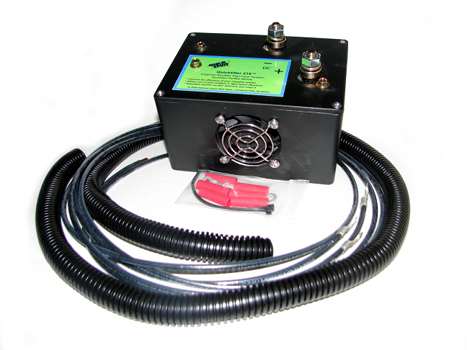
The alternatives, like dual rectifiers on the Mitsubishi, are better for people who want a "one box" solution.
General observation:
All alternators for car apps are rated "cold" as well as "hot"
You will always see drastically lower output as it heats up.
If you must ask: I do not believe it is possible for a 250amp rated alternator to put out 250 honest amps hot in a modern truck with typical summer underhood tempertures on a continuous basis --- no matter who makes it.
I believe the thermal limits are tripped well before that.
The only alternator that comes close to 200 amps continuous --- it is ONLY rated at 215amp --- is this one:
http://store.alternatorparts.com/par...erno12075.aspx
To me, anything above 200 amp that is serious about it is oil / liquid cooled.
The factory cable has a fusible link in between somewhere.
If you keep factory cable and just double up, you need to fuse the other cable.
Or, do as Mark did, replace it with one cable for a neater installation.
In any case, it must be fused.
Mark
Normally, in most parts of USA, especially the south, the greatest enemy of alternators is heat on the electronics (rectifier / diodes / and the regulator / control module).
It is not just the parts, but the solder that fails on the board.
Take the electronics away, and whatever cooling capacity that is left is better used to cool the windings, bearings, and other parts.
The electronics is located to a cooler part of the vehicle, preferably with its own supply of clean, dry, and cool air.
The best solution I have seen to this issue --- that basically get you "free" extra capacity is to put the electronics outboard.
Quicktifier Remote Bridge Rectifier Alternator System
The alternatives, like dual rectifiers on the Mitsubishi, are better for people who want a "one box" solution.
General observation:
All alternators for car apps are rated "cold" as well as "hot"
You will always see drastically lower output as it heats up.
If you must ask: I do not believe it is possible for a 250amp rated alternator to put out 250 honest amps hot in a modern truck with typical summer underhood tempertures on a continuous basis --- no matter who makes it.
I believe the thermal limits are tripped well before that.
The only alternator that comes close to 200 amps continuous --- it is ONLY rated at 215amp --- is this one:
http://store.alternatorparts.com/par...erno12075.aspx
To me, anything above 200 amp that is serious about it is oil / liquid cooled.
Post Fiend
Joined: Jul 2005
Posts: 6,127
Likes: 6
Check this guy out. I talked to him and he has been in the automotive electrical business since 1968. High Output Alternator, 200-250-300-350 Amp Alternators, high output alternators, Delco Remy,Ford Truck Alternators They use 8 70 amp diodes on their 200 amp alt. compared to 6 75 amp diodes used by DC power. Also they use a copper heat sink and an 8mm copper battery lead post compared to a 6mm. They sell them in 140, 160, 200, and 250 amp models. I also talked to DC Power and was just about to buy his 190 amp but this guy at alt. parts sold me. I'm by no means saying that DC Power doesn't have a great product but its worth a look around to see what else is out there. 200A High Output F-Series Diesel Truck Alternator This site has power cables that are fused with a 200amp inline fuse. They also can make to your specifications to length and with what size term. ends you need ground cables for a heavy up for your return path. The power cables are #4 stranded copper. They recommend a #4 for the return path ground as well. The guy at alt.parts.com said that the best way to heavy up the ground path is right from the back of the alt. to the negative battery term. The 200 amp inline fuse I mentioned above is the recommended size buy the manufacturer of the fuse kit which is a company called Little Fuse. They say not to increase or decrease the size.
That happens to be one of my more recommended vendors.
They are the supplier of the remote rectifier that I highly recommend to hop up auto grade alternators for a modest price.
Quicktifier Remote Rectifier HHO High Output Alternator High Voltage
The dedicated ground wire is a real good idea --- I have found plenty of ground fault issues --- that tripped up regular alternators.
In the case of mine (E van), the batteries are so far away (under middle of vehicle) that I am toying with a cable set that is much beefier than standard.
Working the numbers on resistance, diameter etc. now.
Also toying with the idea of a high amp circuit breaker if such can be found at a moderate price rather than a fusible link.
You got great ideas and are on the right track.