


Ignition Module recommendations


Thread Starter
|
Freshman User
Joined: Nov 2010
Posts: 39
Likes: 0
From: Ypsilanti, MI
Ignition Module recommendations
I have an 86 F150 with the I-6 4.9L in it. Was having problems with rough running at times all of a sudden. Seemed like a carb. problem so I rebuilt it only to find out it was the ignition module. Replace the IM and it took right off and ran good the last few times I drove it. Took it out tonight and got about 15 miles down the road and it started again. It will run OK for a while then it starts acting like it is getting too much fuel. It coughs, back fires and runs very rough. It seems to happen more when letting up on the gas, but will happen at normal RPMs also.
I'm thinking maybe I got a bad module. Anyone had similar issues with a new module? Anyone know of a good reliable brand to use? I got the last one at O'Reily's what ever they stock. Other suspects on my list are:
- Computer
- O2 sensor
- Bad spark plug(s)
Ignition seems best suspect, any opinions? Thanks
I'm thinking maybe I got a bad module. Anyone had similar issues with a new module? Anyone know of a good reliable brand to use? I got the last one at O'Reily's what ever they stock. Other suspects on my list are:
- Computer
- O2 sensor
- Bad spark plug(s)
Ignition seems best suspect, any opinions? Thanks

Posting Guru
Joined: Oct 2010
Posts: 1,199
Likes: 1
From: Missouri
If your o2 sensor is old you might as well replace it just to be sure, although it does sound like the module.
Did it happen to be wet outside when it started running rough? My ignition module was cracked and the wetness finished it off. Although my truck has the Duraspark II system.
Did it happen to be wet outside when it started running rough? My ignition module was cracked and the wetness finished it off. Although my truck has the Duraspark II system.

Cargo Master

Joined: Dec 2004
Posts: 3,362
Likes: 21
From: Florence, SC
Motorcraft makes the best, most reliable ignition modules. The aftermarket modules are notoriously unreliable. I personally wouldn't buy another brand.
When you replace your ignition module, make sure you apply a film of di-electric grease to the back of the module before you bolt it back up to your distributor. This is how the factory did it and it is essential in keeping the module cool, as heat is what kills these ignition modules.
When you replace your ignition module, make sure you apply a film of di-electric grease to the back of the module before you bolt it back up to your distributor. This is how the factory did it and it is essential in keeping the module cool, as heat is what kills these ignition modules.


Elder User
Joined: Jun 2010
Posts: 509
Likes: 3
From: Casper, Wyoming
I have an 86 F150 with the I-6 4.9L in it. Was having problems with rough running at times all of a sudden. Seemed like a carb. problem so I rebuilt it only to find out it was the ignition module. Replace the IM and it took right off and ran good the last few times I drove it. Took it out tonight and got about 15 miles down the road and it started again. It will run OK for a while then it starts acting like it is getting too much fuel. It coughs, back fires and runs very rough. It seems to happen more when letting up on the gas, but will happen at normal RPMs also.
I'm thinking maybe I got a bad module. Anyone had similar issues with a new module? Anyone know of a good reliable brand to use? I got the last one at O'Reily's what ever they stock. Other suspects on my list are:
- Computer
- O2 sensor
- Bad spark plug(s)
Ignition seems best suspect, any opinions? Thanks
I'm thinking maybe I got a bad module. Anyone had similar issues with a new module? Anyone know of a good reliable brand to use? I got the last one at O'Reily's what ever they stock. Other suspects on my list are:
- Computer
- O2 sensor
- Bad spark plug(s)
Ignition seems best suspect, any opinions? Thanks

Post Fiend
Joined: Dec 2007
Posts: 8,521
Likes: 16
From: Lost
Motorcraft makes the best, most reliable ignition modules. The aftermarket modules are notoriously unreliable. I personally wouldn't buy another brand.
When you replace your ignition module, make sure you apply a film of di-electric grease to the back of the module before you bolt it back up to your distributor. This is how the factory did it and it is essential in keeping the module cool, as heat is what kills these ignition modules.
When you replace your ignition module, make sure you apply a film of di-electric grease to the back of the module before you bolt it back up to your distributor. This is how the factory did it and it is essential in keeping the module cool, as heat is what kills these ignition modules.
Call me **** if ya want, but when I replace any type of module that uses a thermal transfer paste, I break out the Artic Silver. Computer nerds will know exactly what I'm talking about.....
Cargo Master
Joined: Dec 2004
Posts: 3,362
Likes: 21
From: Florence, SC
Originally Posted by Wyowanderer
Why not pull the codes? It's easy, and you might be surprised what the computer will tell you. Drive it over to AutoZone and they'll pull them for you. That way you're not wasting money on parts that aren't bad.
Originally Posted by Rogue_Wulff
I thought that stuff was supoosed to be thermal paste, not dielectric grease.
Call me **** if ya want, but when I replace any type of module that uses a thermal transfer paste, I break out the Artic Silver. Computer nerds will know exactly what I'm talking about.....
Call me **** if ya want, but when I replace any type of module that uses a thermal transfer paste, I break out the Artic Silver. Computer nerds will know exactly what I'm talking about.....
Trending Topics
Elder User
Joined: Jun 2010
Posts: 509
Likes: 3
From: Casper, Wyoming
The original poster is driving a 1986 model F150. Most auto parts stores are gonna laugh at you for bringing in something that old to "pull codes." Every one that I have been to (before I converted mine to DSII) couldn't pull codes on anything older than 1996. You will probably going to have to take it to Ford, or find some independent garage that has a code reader that old.
Swaping parts before pulling codes is just lazy and a waste of time, unless it's your only option, and it isn't in this case. At a minimum the OP ought to have the individual components checked before he replaces them; AutoZone can do that as well.
Concerning the dielectric grease, Rogue is correct. All the manuals in the world might suggest it, but FoMoCo says use thermal paste, not dielectric grease. That's good enough for me. Now using Arctic Silver- now THAT'S ****.

Post Fiend
Joined: Dec 2007
Posts: 8,521
Likes: 16
From: Lost
The reason I dislike the dielectric grease is easy to sum up.
See pic below, and look at the far strut tower. You'll see 3 GM HEI modules:
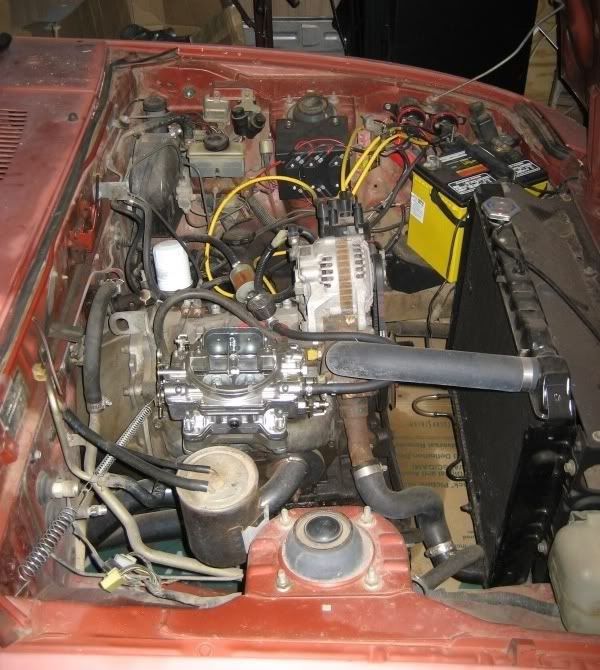
All 3 were installed using the supplied clear paste, and all 3 burned up in short order. I replaced them, and broke out the AS5. That was over 2 years ago, the originals lasted 2 weeks...
After the engine has been running for quite a while, Touching the plate can be rather uncomfortable, but the modules are just warm. I'm gonna add a fan to the backside of the plate by again borrowing from my selection of extra PC parts. PC fans are 12v DC, how cool.
See pic below, and look at the far strut tower. You'll see 3 GM HEI modules:
All 3 were installed using the supplied clear paste, and all 3 burned up in short order. I replaced them, and broke out the AS5. That was over 2 years ago, the originals lasted 2 weeks...
After the engine has been running for quite a while, Touching the plate can be rather uncomfortable, but the modules are just warm. I'm gonna add a fan to the backside of the plate by again borrowing from my selection of extra PC parts. PC fans are 12v DC, how cool.

Moderator


Joined: Nov 2007
Posts: 22,415
Likes: 92
From: Denver Metro Area, CO

I would think that some sort of heat sinks would be more effective than fans especially
given the air currents already existing under there from the radiator fan & forward motion of
the truck.
Something like this:
<img src="http://www.net-audio.co.uk/jpgs/303heatsink.jpg" height=300>
given the air currents already existing under there from the radiator fan & forward motion of
the truck.
Something like this:
<img src="http://www.net-audio.co.uk/jpgs/303heatsink.jpg" height=300>
Post Fiend
Joined: Dec 2007
Posts: 8,521
Likes: 16
From: Lost

If I can find a decent size heat sink, I'll add it and a fan, as extra insurance......

Junior User
Joined: Oct 2006
Posts: 55
Likes: 0
From: Las Vegas
Look around online for a conversion wire that takes the Module off the base of the distributor and lets you put it onto a ford heat sink. Getting into about the 1990 and up ford's will have the remote mounted modules.
Aerostars with a 3.0 usually have them on the left side near the hood iirc when you open it. a 93 F150 has it located near the brake booster underneath the cruise control electronics as yet another example.
I ran into a bronco II owner once who wired up the TFI/Ignition module to the later gen heat sink, taking it off the distributor in the back of his engine (2.9 V6, hell to get it out for repairs) and sticking it directly in front of his radiator so air was always going over it.
As for starting issues, have you looked into the PIP Sensor at the base of your distributor?
A 93 F150 here that I have given the name "Crate Of Tears" had this very parasitic start issue. Sometimes it would even just die when driving, then you had to wait for a hour or more to have it turn over again.
Turned out to be the PIP Sensor. For about $60, I found a new distributor from rockauto.com, a quality motorcraft one. Starts up like a new truck for the most part, timing is still a little off but needs to be set.
If you want to test this, use a hair dryer and blast it at the base of the distributor (careful, heat may finish it off) where you see the 2-3 wires coming out. That's the sensor.
I suspect my test finished off the PIP sensor, but it most definitely told me the issue. Surrounded it with a bunch of ice blocks then used a cool setting on the hair dryer, then it fired up!
Aerostars with a 3.0 usually have them on the left side near the hood iirc when you open it. a 93 F150 has it located near the brake booster underneath the cruise control electronics as yet another example.
I ran into a bronco II owner once who wired up the TFI/Ignition module to the later gen heat sink, taking it off the distributor in the back of his engine (2.9 V6, hell to get it out for repairs) and sticking it directly in front of his radiator so air was always going over it.
As for starting issues, have you looked into the PIP Sensor at the base of your distributor?
A 93 F150 here that I have given the name "Crate Of Tears" had this very parasitic start issue. Sometimes it would even just die when driving, then you had to wait for a hour or more to have it turn over again.
Turned out to be the PIP Sensor. For about $60, I found a new distributor from rockauto.com, a quality motorcraft one. Starts up like a new truck for the most part, timing is still a little off but needs to be set.
If you want to test this, use a hair dryer and blast it at the base of the distributor (careful, heat may finish it off) where you see the 2-3 wires coming out. That's the sensor.
I suspect my test finished off the PIP sensor, but it most definitely told me the issue. Surrounded it with a bunch of ice blocks then used a cool setting on the hair dryer, then it fired up!
Posting Guru
Joined: Oct 2010
Posts: 1,199
Likes: 1
From: Missouri
I thought that stuff was supoosed to be thermal paste, not dielectric grease.
Call me **** if ya want, but when I replace any type of module that uses a thermal transfer paste, I break out the Artic Silver. Computer nerds will know exactly what I'm talking about.....
Call me **** if ya want, but when I replace any type of module that uses a thermal transfer paste, I break out the Artic Silver. Computer nerds will know exactly what I'm talking about.....

Cargo Master
Joined: Dec 2004
Posts: 3,362
Likes: 21
From: Florence, SC
Originally Posted by Wyowanderer
The AutoZone near my house can, that's why I suggested it; and if anyone I was going to buy parts laughed at me, I'd take my business elsewhere. And IF they can't you can still do it yourself with t a 9v battery alligator clips and a test light; if you have thirty bucks you can buy a code reader pre-made.
Swaping parts before pulling codes is just lazy and a waste of time, unless it's your only option, and it isn't in this case. At a minimum the OP ought to have the individual components checked before he replaces them; AutoZone can do that as well.
Swaping parts before pulling codes is just lazy and a waste of time, unless it's your only option, and it isn't in this case. At a minimum the OP ought to have the individual components checked before he replaces them; AutoZone can do that as well.

Most people that work at AutoZone have no idea what a "feedback" carburetor even is and will look at you funny when you tell them you have a computer and a carburetor on the same vehicle. I have actually went in before to get windshield wipers for my Jeep Wrangler and the salesperson behind the counter asked me if my vehicle was 2wd or 4wd.

The first mistake you are making is buying your parts from AutoZone. Do a search in here and it is riddled with people having failures with their el cheapo parts, and the same goes for Advance Auto and any other "McParts" store out there. Cheap store replacement ignition modules and electronics components are notoriously UNRELIABLE. They will sell you on a "Lifetime Warranty" and, to their credit, will usually honor it. But anyone who has has to replace an in-tank fuel pump more than once is going to tell you it is not worth it. In fact, there are numerous garages around here that clearly have signs that state that they will NOT use customer-supplied parts. I went in to ask them why, and was told the failure rate was too high because customers would bring in the cheap aftermarket parts (ie: AutoZone, Advance Auto, etc.) and then come back when the parts they supplied failed prematurely and try to hold the garage responsible. I asked what parts they used, and I was told they would honor OEM dealer parts or parts from NAPA or CarQuest.
Originally Posted by Wyowanderer
Concerning the dielectric grease, Rogue is correct. All the manuals in the world might suggest it, but FoMoCo says use thermal paste, not dielectric grease. That's good enough for me. Now using Arctic Silver- now THAT'S ****.
