BRAKE HELP NEEDED
Thread Starter
|
Lead Driver


Joined: Mar 2008
Posts: 7,184
Likes: 383
From: Near Los Angeles
No idea of the psi. Normally the fronts would lock up first, but with a p/u, most of the vehicle weight is on the front braking system when the truck is not loaded.
I called Willwood, and the first thing they said was that I probably needed to drop from 1 1/4" mstr bore, to 1 1/8". Maybe I will install the 78 F350 mstr. and booster. The mstr. has a 1 1/16" bore, with the booster 1/2" diameter larger dual diaphams.
I called Willwood, and the first thing they said was that I probably needed to drop from 1 1/4" mstr bore, to 1 1/8". Maybe I will install the 78 F350 mstr. and booster. The mstr. has a 1 1/16" bore, with the booster 1/2" diameter larger dual diaphams.
Senior User
Joined: Oct 2010
Posts: 333
Likes: 0
From: Lawton, OK
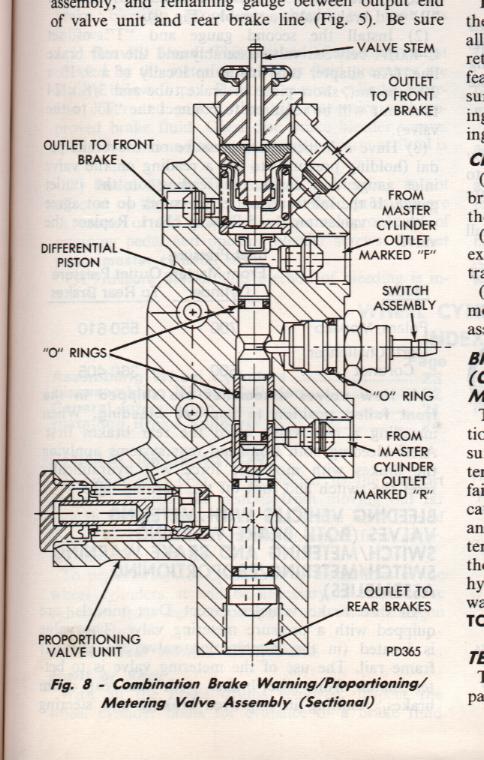
A simple Google search on prop valves will clear it up for the non believers. If it is working right you need to pump the brakes fast in a panic situation to get it to trip, thats why you should always pump the brakes slow when bleeding so you don't end up tripping the valve.
Now, if the prop valves on these trucks worked like you suggest, then whenever wheel cylinders fail, the appropriate reservoir in the master cylinder shouldn't drain until it's empty, but it does. But if it did, it wouldn't be a "proportioning valve" then would it? What you're referring to is a check valve, and while I can't say they don't exist on other cars or trucks, after having to deal with many wheel cylinder failures and the resulting cleanup, it's safe to say that such hardware doesn't exist on 70's Ford F-series trucks, which is what we are discussing here.
Senior User
Joined: Jun 2008
Posts: 264
Likes: 0
From: Bozeman, MT
Firstly, a check valve actually only allows fluid to flow in one direction, by definition. Secondly, I have the same problems with the brakes on my pickup. I have new hardware all the way around but my brakes still suck. Also, when I set up the rears, they lock up good the first time or two that I hit the pedal and then go back to where they were before I adjusted them. Is this all to do with the automatic adjusting. Is this maybe why I don't seem to have as good of brakes as I think I should. Sorry to hijack but this might be a solution for both of us.
Senior User
Joined: Oct 2010
Posts: 333
Likes: 0
From: Lawton, OK
Firstly, a check valve actually only allows fluid to flow in one direction, by definition. Secondly, I have the same problems with the brakes on my pickup. I have new hardware all the way around but my brakes still suck. Also, when I set up the rears, they lock up good the first time or two that I hit the pedal and then go back to where they were before I adjusted them. Is this all to do with the automatic adjusting. Is this maybe why I don't seem to have as good of brakes as I think I should. Sorry to hijack but this might be a solution for both of us.
Thread Starter
|
Lead Driver
Joined: Mar 2008
Posts: 7,184
Likes: 383
From: Near Los Angeles
I don't know what version of Google you're using, but the one I used came up with these: HowStuffWorks "How Master Cylinders and Combination Valves Work" and Automobile Brakes - A Short Course on How They Work among many others that stated nothing about shutting down a part of the brake system.
Now, if the prop valves on these trucks worked like you suggest, then whenever wheel cylinders fail, the appropriate reservoir in the master cylinder shouldn't drain until it's empty, but it does. But if it did, it wouldn't be a "proportioning valve" then would it? What you're referring to is a check valve, and while I can't say they don't exist on other cars or trucks, after having to deal with many wheel cylinder failures and the resulting cleanup, it's safe to say that such hardware doesn't exist on 70's Ford F-series trucks, which is what we are discussing here.
Now, if the prop valves on these trucks worked like you suggest, then whenever wheel cylinders fail, the appropriate reservoir in the master cylinder shouldn't drain until it's empty, but it does. But if it did, it wouldn't be a "proportioning valve" then would it? What you're referring to is a check valve, and while I can't say they don't exist on other cars or trucks, after having to deal with many wheel cylinder failures and the resulting cleanup, it's safe to say that such hardware doesn't exist on 70's Ford F-series trucks, which is what we are discussing here.
I have to say that I am severely disappointed with the Caddy calipers. Although the ebrake seems to clamp when I turn wheel with it up on jack, rolling down the driveway it does nothing!! It won't even stop the truck from idling forward in gear. Now I see first hand why most people go for the supior stopping power of the chevy front caliper. If the ebrake does nothing, why not sell these Caddy calipers on ebay, and go with the chevy ones for $18 ea.

Elder User
Joined: Apr 2009
Posts: 735
Likes: 1
Thread Starter
|
Lead Driver
Joined: Mar 2008
Posts: 7,184
Likes: 383
From: Near Los Angeles
FTE Stories
Ford Trucks for Ford Truck Enthusiasts

10 Things Every Truck Owner NEEDS (2026 Edition)
Michael S. Palmer
Rezvani's Latest Post-Apocalyptic Monster Is a Ford F-150 Raptor Underneath
Verdad Gallardo
Top 10 Most Expensive Ford Trucks Ever Sold on Bring a Trailer
Joe Kucinski
2027 Ford Super Duty Buyer's Guide (Every Model, Engine, & Package)
Brett Foote
Top 10 Ford Truck Tragedies
Joe Kucinski
AEV FXL Super Duty - the Super Duty Raptor Ford Doesn't Make
Brett Foote
Lobo Vs Lobo: Proof the F-150 Lobo Should Be Even Lower!
Michael S. Palmer
Ford's 2001 Explorer Sportsman Concept Looks For a New Home
Verdad Gallardo
10 Best Ford Truck Engines We Miss the Most!
Joe Kucinski
Thread Starter
|
Lead Driver
Joined: Mar 2008
Posts: 7,184
Likes: 383
From: Near Los Angeles
Anyone looking to do the dana 60 conversion, who wants to have an ebrake, is familiar with the 76-78 Caddy caliper. Most of the kits that have an ebrake use this caliper.
If you do a search on adjusting el dorado calipers you'll find all sorts of info. Classicbroncos.com has a great tech article regarding this caliper. I know there have been many guys who have had problems with them, but I thought I could rebuild my own and make sure they were done correctly, and maintain an ebrake.
Search this forum for ebrake with disc conversion, and you'll read everything I went through...the complete rebuild with photos.
<a href="http://s659.photobucket.com/albums/uu316/bobbyrogue/?action=view¤t=P1010395.jpg" target="_blank"><img src="http://i659.photobucket.com/albums/uu316/bobbyrogue/P1010395.jpg" border="0" alt="Photobucket"></a>
<a href="http://s659.photobucket.com/albums/uu316/bobbyrogue/?action=view¤t=P1010441.jpg" target="_blank"><img src="http://i659.photobucket.com/albums/uu316/bobbyrogue/P1010441.jpg" border="0" alt="Photobucket"></a>
If you do a search on adjusting el dorado calipers you'll find all sorts of info. Classicbroncos.com has a great tech article regarding this caliper. I know there have been many guys who have had problems with them, but I thought I could rebuild my own and make sure they were done correctly, and maintain an ebrake.
Search this forum for ebrake with disc conversion, and you'll read everything I went through...the complete rebuild with photos.
<a href="http://s659.photobucket.com/albums/uu316/bobbyrogue/?action=view¤t=P1010395.jpg" target="_blank"><img src="http://i659.photobucket.com/albums/uu316/bobbyrogue/P1010395.jpg" border="0" alt="Photobucket"></a>
<a href="http://s659.photobucket.com/albums/uu316/bobbyrogue/?action=view¤t=P1010441.jpg" target="_blank"><img src="http://i659.photobucket.com/albums/uu316/bobbyrogue/P1010441.jpg" border="0" alt="Photobucket"></a>
Senior User
Joined: Sep 2005
Posts: 286
Likes: 1
From: Medford, Oregon
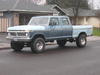
I put the booster from my 76 F-250 4x4 crew cab into my dad's 79 F-250 4x4 reg cab after his developed a leak and the thing will stand up on it's nose now! About throws me through the windshield! I had to use the pushrod from my crew, but it bolted right up no problems.
I took the vacuum booster out of the crew to install hydroboost, and now the crew will easily lock all four thirty fives.
I took the vacuum booster out of the crew to install hydroboost, and now the crew will easily lock all four thirty fives.

Lead Driver

Joined: Mar 2004
Posts: 8,922
Likes: 153
I don't know what version of Google you're using, but the one I used came up with these: HowStuffWorks "How Master Cylinders and Combination Valves Work" and Automobile Brakes - A Short Course on How They Work among many others that stated nothing about shutting down a part of the brake system.
Now, if the prop valves on these trucks worked like you suggest, then whenever wheel cylinders fail, the appropriate reservoir in the master cylinder shouldn't drain until it's empty, but it does. But if it did, it wouldn't be a "proportioning valve" then would it? What you're referring to is a check valve, and while I can't say they don't exist on other cars or trucks, after having to deal with many wheel cylinder failures and the resulting cleanup, it's safe to say that such hardware doesn't exist on 70's Ford F-series trucks, which is what we are discussing here.
Now, if the prop valves on these trucks worked like you suggest, then whenever wheel cylinders fail, the appropriate reservoir in the master cylinder shouldn't drain until it's empty, but it does. But if it did, it wouldn't be a "proportioning valve" then would it? What you're referring to is a check valve, and while I can't say they don't exist on other cars or trucks, after having to deal with many wheel cylinder failures and the resulting cleanup, it's safe to say that such hardware doesn't exist on 70's Ford F-series trucks, which is what we are discussing here.
Senior User
Joined: Oct 2010
Posts: 333
Likes: 0
From: Lawton, OK
As I understand it, the safety valve was mandated way back in the 1960's or early 1970's. All vehicles made in the USA had to have them after that. If you can't get your brakes to bleed after a problem check the pin sticking out of the front of the valve it will be sticking out, push it back in and pump slowly. All Dentsides came from the factory with them there are no exceptions.
The "pin" that you're talking about doesn't work as you describe. It's a metering valve, not a safety valve.