When you click on links to various merchants on this site and make a purchase, this can result in this site earning a commission. Affiliate programs and affiliations include, but are not limited to, the eBay Partner Network.
I am guessing now that anything with exc. chassis cab, means excluding chassis cab. yay or nay.
Or "Except Chassis Cab". Equally appropriate is "excluding". As an example, some rear receiver hitches will fit all 99-16 Super Duty applications except Chassis Cabs."
The reason why some frame mounted accessories like towing equipment that fits pick up frames but does not fit Chassis Cab frames is due in part to the difference in width between the frame rails. Pickup frames are more or less 37" apart at the vertical web, while Chassis Cabs conform to the common NTEA standard of 34" width between the vertical webs of the frame rails. The 34" spacing is common to most brands of commercial truck chassis frames, from Peterbilt to KW to Hino to Isuzu to International to Freightliner to the F-650/750 and the F-450/550.
Ford makes two versions of F-350 without a pickup bed. The first version is called a "box delete", and while it may look like a chassis cab because it doesn't have a bed, it actually has the same frame as the pickup, otherwise referred to as a "wide frame". And this is where it could get confusing, because Ford also makes an F-350 without a pickup bed in a "narrow frame" version, and this would be considered a true "chassis cab", with a frame designed to accept universal vocational bodies that could be equally fitted to a variety of truck brands.
The universal fit is possible due to the National Truck Equipment Association's efforts many years ago to encourage chassis manufacturers to abide by certain common measurements to enable vocational body manufacturers to build one type of service body, dump body, flat bed, fire apparatus body, etc that could be mounted to a variety of truck brands with relatively equal ease of fitment.
Pickup frames typically have an arching hump over the rear axle, which helps increase the range of suspension travel between empty and loaded, as there is expected to be a greater day to day variability in owner operation between empty and loaded states, and, pickup buyers place a higher value on ride comfort in either state.
Chassis cab frames typically have flat straight frame rails, for ease of vocational body equipment mounting. But there are more differences than just the shape and width of the frame rails. There is also a commonized cab to axle distance in Chassis Cabs that differs from pickups. For example, the F-350 "box delete" option that only looks like a chassis cab, but isn't... uses a wide frame that will have a 56" cab to axle distance. By contrast, the true and genuine F-350 "Chassis Cab" will have a 60" cab to axle distance (or an 84" CA, depending on the number of doors in the cab).
All of this matters when it comes to buying shock absorbers, which was your original quest and reason for the question. The F-350 pickup, and the F-350 box delete wide frame, both use the same humped frame with only a midship fuel tank and a rear frame mounted spare tire aft of axle. These frames also have staggered shock absorbers in the rear, where the driver's side shock angles rearward, and the passenger side shock angles forward.
By contrast, the rear shock arrangement of the narrow frame chassis cab has BOTH shocks angling forward, as there is an aft axle fuel tank on the narrow frame that isn't available on the wide frame. There are also spring rate differences, drive shaft differences (ie single vs double cardan joints, etc) and suspension travel differences that when considered in combination may warrant a different shock valving. But the most tangible difference that you can actually see is the shock mounting differentiation between pickup frames vs chassis cab frames.
If your F-350 has or had a pickup bed, then it is a wide frame, and therefore anything listed for an F-350, except or excluding chassis cabs, should fit fine for you.
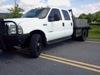
Good (old) post. I have one of those cab chassis F350’s. They also have a higher GVWR, but as you can see below - are capable of much heavier loads than that. The truck is sitting at over 15k lbs in first pic. Don’t try this with your ‘regular’ F350!
If you’re considering a cab chassis truck, know you’ll need a ‘commercial’ insurance policy and it will be a ‘stated value’ policy because commercial vehicles are not listed in blue book, etc.
This truck has 460k miles on it now and I’ve had it since 2003.
@Brandonpdx , how do you like that "airless" "air" hitch?
Do you hot shot from Oregon to Indiana without a sleeper?
How do you deal with HOS?
It has some finicky adjustments that took a little fine tuning but it does a pretty good job. Would I buy it again considering the price over a more standard unit? Probably not. The cushion cells do work though. I have always left all 5 of them in there but you can remove 1 or 2 of them to tune the cushy-ness for lighter pin weights. Has a 4,000 lb vertical capacity and 18,000 drawbar so that is well above anything I pull.
I dont run over the road right now but I was last summer back and forth between WA and IN. Right now I just run local doing factory pickups...nothing more than 40 miles in any direction. Over the road I had to fill out a logbook sheet and follow the time rules. I slept in the truck. It’s a hoot during the warmer months.
Eventually I’m going to get one of these roll off trailers similar to this guy’s. That’s around 15-16,000 lbs. he pulls it with a 5.9 common rail Ram dually.
I seem to recall you ‘could’ possibly use the standard wide DRW on a cab chassis if you moved perches, etc but a cab chassis axle on standard F350 the tires would hit the leafs if you moved the perches out.
Curious. What brings up the need for a new axle? Original one getting worn out? Would it be hard to get an axle out of a totaled 6.7 F450 and bolt it in?