





7.3 oil question.......

Post Fiend
Joined: Sep 2006
Posts: 7,426
Likes: 6
From: Sioux Falls, SD
If your UOA lab admits to measurement accuracies this bad then I'd stop using that lab! First of all measurement accuracy should be specified as a "percentage" of the "target value" being measured ...so for example a 10 ppm Iron target value and a +/-10% measurement accuracy yields a measurement error of +/-1 ppm!
Sorrry for the handwritten comparison on my grocery pad!


Junior User
Joined: Apr 2008
Posts: 91
Likes: 0
From: Vashon, WA
I beleive that is 10,000 kilometers (6000 miles) under normal duty and 5000 kilometers (3000 miles) under severe dury appilcations.

Postmaster
Joined: Jun 2006
Posts: 2,647
Likes: 0
From: Fulltime RVer


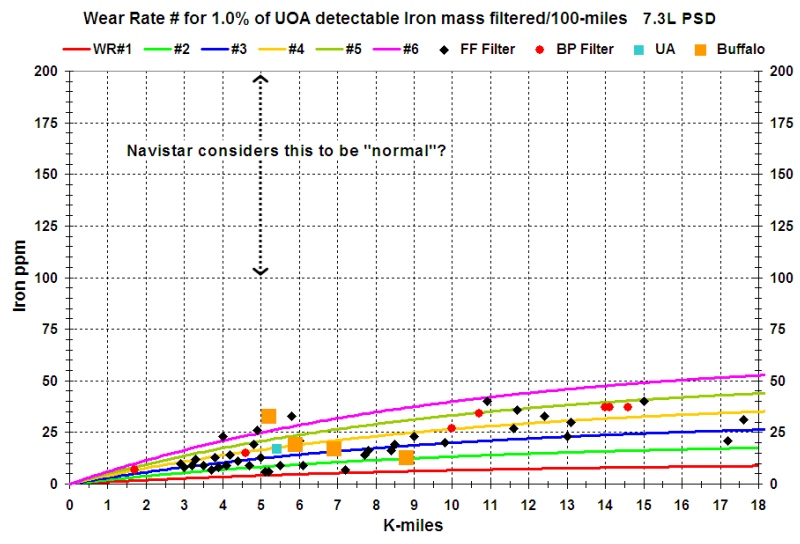
...where now only the "normal-wear" phase is being considered and it now consists of an "undulating" curve which reflects the varying application dependent wear conditions from one OCI to the next that are indicated by the various WR#'s on the curve.
It appears to me that your "33 ppm Iron reading at 5.2K-miles" which ranks above a "WR#6" and included some "drag racing" and "dyno runs" ...when compared to your "13 ppm Iron reading at 8.8K-miles" which only ranks a "WR#2" and included some "towing" and "running empty" ...suggests that some "drag racing" and "dyno runs" cause much higher wear rates than some "towing" and "running empty" ...and that's why I claim the "correct OCI" for "minimizing" engine wear depends "only" on how hard your engine has been run and on how efficiently your oil filter removes "abrasive particles" from the oil supply ...because fresher oil is cleaner oil and clean oil causes less wear than dirty oil!
..."After almost 60 UOA's comparing/contrasting data logged for UOAs and bypass systems, I can tell you that there is precious little difference in actual performance when looking at UOA results."...
..."Pretty pleased with this sample. I removed my oilguard bypass and just ran a Fleetguard Stratapore ...the 15W40 dino performed just as well as the 5W40 Delo Syn I used to run for 1/2 the cost"...
1999 7.3L Ford Powerstroke - Delo 400 15W40 6281km - Bob Is The Oil Guy
...so my current strategy for minimizing wear on my C7 is to stick with dino and do a 6K-mile OCI ...which is roughly equivalent to a (16/28)(6)=3.4K-mile OCI for a 7.3L PSD ...and I also plug-in my coolant/oil heater before each overnight start!
Is it possible that your elevated 33 ppm Iron reading after doing some "drag racing" and "dyno runs" might in part be due to diverting 10% or more of the LOP flow to feed your by-pass filter? There "might" be some "OEM margin" for "LOP flow" when the LOP is "new" and the engine remains "stock" ...but when a "modified engine" is under a "maximum load" I'm pretty sure that all of the LOP flow and then some is needed to supply the HPOP and to lubricate critical engine parts and to cool the pistons!
The table below shows how I came up with my estimate that a single 728 u-lbm "Iron BB" typically produces 5,257,000,000 individual particles in the 1 to 5 micron range...

...and to estimate the "number vs diameter" distribution shown in my table I used some "ISO-Count" data like is shown below but the data was from a 7.3L PSD UOA report.
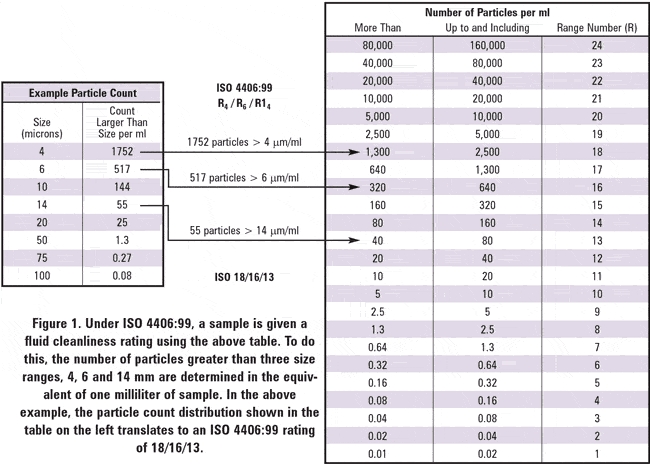

When you send the "same raw oil sample" to "3 different labs" it gets "diluted" by "3 different techs" and depending on how careful the techs are and on how often they calibrate their spectrometers you might get a slightly different Iron ppm reading from different labs ...which is why it's best to pick a known good lab and stick with it ...and that's why I'm no longer using CAT labs because CAT uses "regional" labs that don't give their reports in the same format or even talk to one another! Also even if you shake-up the "same raw oil sample" and pour it into "3 different bottles" there's no assurance that the "3 different bottles" actually contain equal concentrations of wear metals to an accuracy of 1 ppm or less!

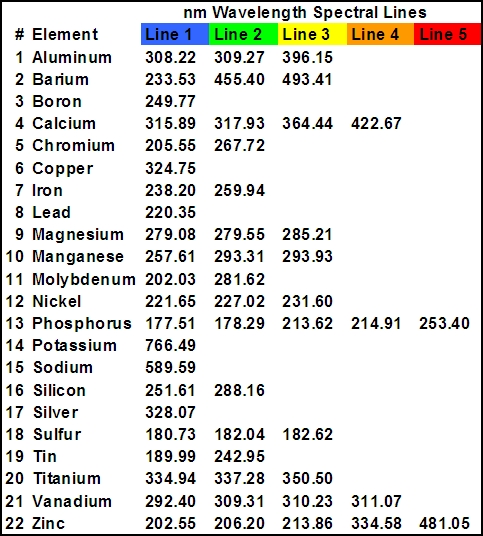
...some of the spectral lines from different wear metals are close enough to partially overlap due to "Doppler broadening" and this means the measurement accuracy for some wear metals is lower than for others ...but fortunately for my wear-rate analysis Iron ppm can be measured with an accuracy of less than +/-10% of the "actual value"!
In any case establishing a "trend" can only at best partially compensate for "inaccurate data" if the "parameter of interest" that's being "trended" is known in advance to have the same "actual value" from one measurement to the next and this doesn't apply to Iron ppm which as your own data shows varies considerably from one measurement to the next depending on how hard the engine was run!

Post Fiend

Joined: Feb 2002
Posts: 10,600
Likes: 3
From: Carhenge
The Owner's manual for our 2000 International 4700 with a T444E calls for an OCI of 10,000 miles, 6 month, or 350 engine hours, whichever comes first.
Postmaster
Joined: Jun 2006
Posts: 2,647
Likes: 0
From: Fulltime RVer
That's why everyone should at least follow the OCI recommended by Ford ...which is a 3K to 5K-mile maximum OCI depending on the number of miles spent towing ...and better yet follow my recommendation that the "correct OCI" for "minimizing" engine wear depends "only" on how hard your engine has been run and on how efficiently your oil filter removes "abrasive particles" from the oil supply ...because fresher oil is cleaner oil and clean oil causes less wear than dirty oil ...and this means you need to do some UOAs for your particular applications and then consult my wear-rate graph using the Iron ppm readings and adjust your OCIs accordingly!
For what it's worth I don't even agree with the 10K-mile OCI quoted above for the T444E engine in a MDT application because this "inflated number" resulted from an "advertising war" with Cummins to see which OEM could "advertise" the longest OCI to potential customers! The same thing happened at Cat for the 3126/c7 engines where the "engineers" were forced to "kowtow" to the "sales managers" who claimed their sales to motorhome builders would suffer if the 3126/c7 engines couldn't claim a OCI at least as long as the one being offered by Cummins ...which of course doesn't use an "oil cleanliness sensitive" HEUI system like is used by Cat and International!
http://bellaphotographics.com/FordSu...%20Cummins.pdf
"One of our competitors in the mid range diesel engine business is telling tall tales? Yes, it's hard to believe, but they're distorting the facts to make their product look better than ours. We thought you and your customers would want to know the real picture.
Cummins Engine Company is circulating printed material that draws comparisons between the new ISB family and the Internationalâ T444E engine in the areas of durability, maintenance cost, rebuild cost, and fuel economy. Let's look at each of their claims in detail."
TheDieselStop.Com Forums: 10,000 mile T444E oil changes
"From the International site: the change interval on the T444E has been recently increased from the 8000 miles that Cummins discussed to 10000 miles. This revision was based on oil-condition analysis in our four years of experience with this engine."
"From International: The two main factors in determining proper oil change interval are fuel consumed and oil capacity."
"99.5 Powerstroke = 15 guart oil pan.
T444E = 18 quart oil pan."
"The T444E is governed at 2500 RPM:"
"One difference that has yet to be brought up regarding possible differences in oil change intervals is the power ratings of the medium duty engines. Here are the horsepower and torque ratings of the three available T444E powerplants: 175 Hp 430 Lb.Ft., 190 Hp 485 Lb.Ft., 210 Hp 485 Lb.Ft."
"It would be interesting to see the temperatures the oil hits in a pick-up vs bus. I know my bus had a nice sized cooler for the allison, and I think it had another one stuffed up front as well. The other thing is if the ford pick-ups have a different size turbo running at a different rpm, it might slightly change the intervals. And even though you have a pick-up, your front end does not provide anywhere near the air flow my bus front end provides for the coolers when moving."
Post Fiend
Joined: Sep 2006
Posts: 7,426
Likes: 6
From: Sioux Falls, SD
Thank you for taking the time post the info ernesteugene. Just one more question for you. I understand you concerns about using a bypass system and oil flow. But wouldn't this be reflected in a loss of oil pressure or a slower rate of oil pressure build up like some had experienced with the older BMK-16 Amsoil dual bypass filter?
FYI - 100 ppm Iron is considered normal for the 7.3L at 5,000 miles. Navistar considers 200 ppm Normal for the 7.3L in the PSD pick-up aplication. Blackstone is the only UOA company that I know of that post a universal average, which is only based on thier in house samples IIRC. Like you mentioned above, it all depends on the vehicles average use and condition. All 7.3L engines should not be compared as equals when looking at UOA reports since they vehicles average use can vary greatly. It's acceptable by the labs to compare fleet vehicles that run under similiar conditions but it's best not to compare apples to oranges.
FYI - 100 ppm Iron is considered normal for the 7.3L at 5,000 miles. Navistar considers 200 ppm Normal for the 7.3L in the PSD pick-up aplication. Blackstone is the only UOA company that I know of that post a universal average, which is only based on thier in house samples IIRC. Like you mentioned above, it all depends on the vehicles average use and condition. All 7.3L engines should not be compared as equals when looking at UOA reports since they vehicles average use can vary greatly. It's acceptable by the labs to compare fleet vehicles that run under similiar conditions but it's best not to compare apples to oranges.
FTE Stories
Ford Trucks for Ford Truck Enthusiasts

AEV FXL Super Duty - the Super Duty Raptor Ford Doesn't Make
Brett Foote
Lobo Vs Lobo: Proof the F-150 Lobo Should Be Even Lower!
Michael S. Palmer
Ford's 2001 Explorer Sportsman Concept Looks For a New Home
Verdad Gallardo
10 Best Ford Truck Engines We Miss the Most!
Joe Kucinski
2026 Shelby F-150 Off-Road: Better Than a Raptor R?
Brett Foote
2027 Super Duty Carhartt Package First Look: 12 Things You NEED to Know!
Michael S. Palmer
10 Most Surprising 2026 Ford Truck Features!
Joe Kucinski
Top 10 Ford Trucks Coming to Mecum Indy 2026
Brett Foote
5 Best / 5 Worst Ford Truck Wheels of All Time
Joe Kucinski
Post Fiend
Joined: Feb 2002
Posts: 10,600
Likes: 3
From: Carhenge
I hope everyone is aware that comparing the OEM recommended OCI for an International T444E engine in a MDT application ...which is governed at a lower RPM, has a lower HP/TQ rating, and a larger capacity oil pan ...to a Ford 7.3L PSD engine in a "street racing" and "dyno testing" pick-up truck application is like comparing a grape to a watermelon!
Postmaster
Joined: Jun 2006
Posts: 2,647
Likes: 0
From: Fulltime RVer
A "UOA Iron ppm" reading equals the "UOA detectable Iron mass" divided by the "engine's oil mass" ...and since the "mass density" of oil is 1.75 lbm/qt the 16 quarts of "engine oil" in a 7.3L PSD have an "oil mass" of (16 qts)(1.75 lbm/qt)=28 lbm. Therefore a "UOA Iron ppm" reading of 200 ppm means there's a "UOA detectable Iron mass" of (200x10^-6)(28 lbm)=0.0056 lbm in the engine's oil supply and as can be seen below...
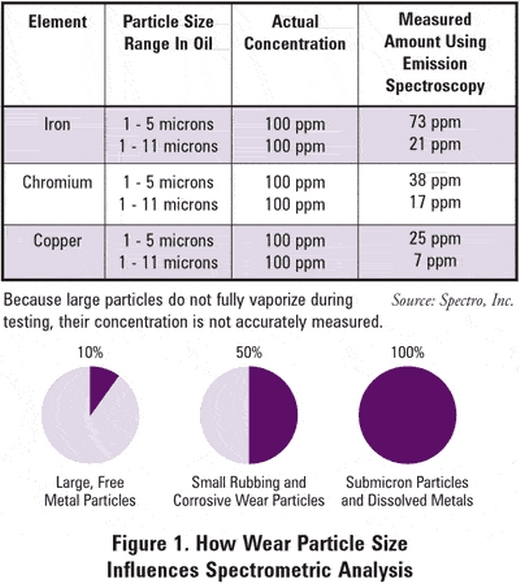
...for "1 to 5 micron" size particles which are the sizes generated by "normal wear mechanisms" the amount of "Iron mass" that's "detectable" by a "UOA spectrometer" is only 73% of the "actual Iron mass" in the oil sample and this means the "actual Iron mass" in the engine's oil supply is (0.0056 lbm)/(0.73)=0.0077 lbm ...and since a single "Iron BB" contains an "Iron mass" of 0.000728 lbm there's a (0.0077)/(0.000728)="10.6 Iron BBs" worth of "actual Iron mass" in the engine's oil supply for 5K-miles traveled ...and that's 1.6 more than the "9 Iron BBs" shown below!

So if the "9 Iron BBs" shown above are ground-up into (9)(5.257)=47.3 billion Iron particles ranging in size from "1 to 5 microns" and are mixed into the 16 quarts of "engine oil" the "UOA Iron ppm" reading would be {(9)/(10.6)}(200)=170 ppm which is 30 ppm lower than the 200 ppm Iron reading that Navistar considers "normal" for the 7.3L at 5,000 miles???
How can an engine that's wearing "normally" possibly wear away "9 Iron BBs" worth of Iron mass in 5K-miles? Where could this much Iron mass come from? For example as indicated below if "all" of the wear occurred in the cylinder Bores over 20% of the Stroke then "1 Iron BB" worth of Iron mass for 25K-miles traveled (which is only "1/5 Iron BB" worth of Iron mass for 5K-miles traveled) is equivalent to a 0.001 inch Bore increase over 20% of the Stroke for 400K-miles traveled ...and this means "9 Iron BBs" worth of Iron mass for 5K-miles traveled is equivalent to a (9)(5)(0.001)=0.045 inch Bore increase over 20% of the Stroke for 400K-miles traveled ...yet when high-mileage engines are torn down only a modest amount of cylinder wear is reported!

The above picture depicts what I consider to be "normal" cylinder wear and I haven't completed my estimates of how much total Iron mass can be worn away from cam lobes, lifters, valve stems and guides, etc before an engine becomes so loose that it can't run well ...but I claim that a wear rate of more than about "1 Iron BB" worth of Iron mass in 5K-miles is "excessive" and you say that Navistar considers a wear rate of "9 Iron BBs" worth of Iron mass in 5K-miles as being "normal"??? To perhaps put this in better perspective consider the graph below which compares the "Navistar claim" to "my claim"!
If you recall my post about "Death by a thousand cuts" ...if a 7.3L PSD engine lasts for its B90 life expectancy of 440K-miles which is a 95 year equivalent human age then the engine's crankshaft completes 1 billion revolutions and the human's heart completes 3.5 billion beats!
Well here's some additional ways to think about engine aging and death. That Navistar claim above works out to be a grand total of (9)(440/5)="792 Iron BBs" worth of Iron mass for a 440K-mile B90 life expectancy and my claim works out to be a grand total of (1)(440/5)="88 Iron BBs" worth of Iron mass for a 440K-mile B90 life expectancy ...and I think by the time a 7.3L PSD engine wears away more than about "100 Iron BBs" worth of Iron mass it's nearing end of life!
Postmaster
Joined: Jun 2006
Posts: 2,647
Likes: 0
From: Fulltime RVer
...Just one more question for you. I understand you concerns about using a bypass system and oil flow. But wouldn't this be reflected in a loss of oil pressure or a slower rate of oil pressure build up like some had experienced with the older BMK-16 Amsoil dual bypass filter?...
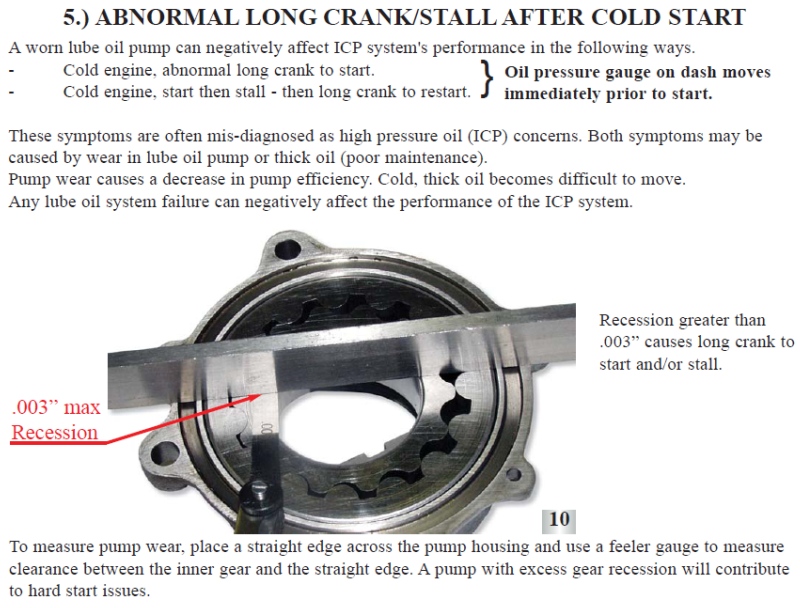
However try as I might I haven't found any specs on LOP flow rate vs RPM for either my c7 or for a 7.3L PSD ...but I have found "minimum engine oil pressure specifications" like the ones shown below for a 7.3L PSD...
.."The minimum engine oil pressure specifications are 82.7 kPa (12 psi) at 700 rpm, 165.5 kPa (24 psi) at 1,200 rpm and 310.3 kPa (45 psi) at 1,800 rpm with the engine at operating temperature."...
At a given RPM the LOP produces a constant "volume flow" and the "up-stream pressure" increases as required to force this constant "volume flow" through the oil galleries and into the various bearings and feed the other components such as cam lobes and oil jets in the pistons.
At a given RPM the "oil pressure" that's required to force the above constant "volume flow" depends primarily on the oil's temperature dependent viscosity ...so due to its dependence on temperature and RPM if you just monitor the "oil pressure" it might be difficult to determine if say 10% of this constant "volume flow" is being diverted through a by-pass oil filter ...but nonetheless only 90% of the constant "volume flow" would be going to the critical engine parts no matter what the reading was for the "oil pressure"!
Postmaster
Joined: Jun 2006
Posts: 2,647
Likes: 0
From: Fulltime RVer
Below is a quote from this thread regarding OCI and HEUI injectors...
...and below is a quote from this thread... https://www.ford-trucks.com/forums/9...tock-7-3l.html ...regarding OCI and HEUI injectors...
...and below is a picture of a HEUI injector along with some good advice from Ford regarding the importance of maintaining their recommended OCI!
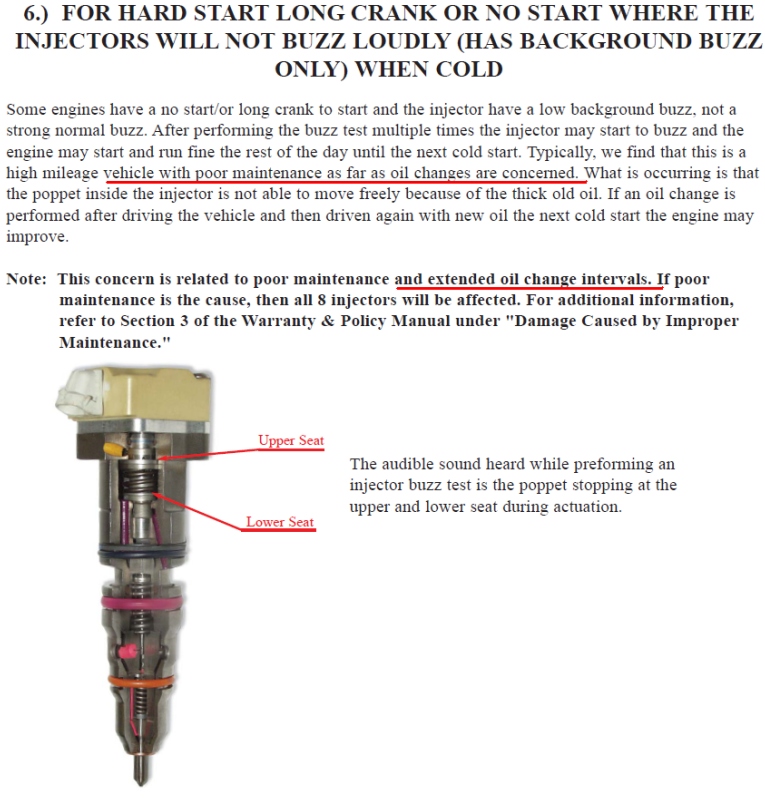
...For what it's worth I don't even agree with the 10K-mile OCI quoted above for the T444E engine in a MDT application because this "inflated number" resulted from an "advertising war" with Cummins to see which OEM could "advertise" the longest OCI to potential customers! The same thing happened at Cat for the 3126/c7 engines where the "engineers" were forced to "kowtow" to the "sales managers" who claimed their sales to motorhome builders would suffer if the 3126/c7 engines couldn't claim a OCI at least as long as the one being offered by Cummins ...which of course doesn't use an "oil cleanliness sensitive" HEUI system like is used by Cat and International! That's why everyone should follow the OCI recommended by Ford ...which is a 3K to 5K-mile maximum OCI depending on the number of miles spent towing...
...This is a "rhetorical question" ...but if one of my threads lacked some "controversy" ...would the thread really exist? ...so here comes some "controversy"! The 7.3L Power Stroke doesn't have the human equivalent of DNA repair mechanisms so the best approach for countering the effects of "tribology" is to adopt the "healthy lifestyle" of clean air, clean oil, and clean fuel!
Power Stroke engines pump "unfiltered" oil directly from the sump to the high-pressure oil pump and then on to the HEUI injectors ...and this means that not changing the "oil" and the "oil filter" at the "mileage intervals" recommended by "Ford" for the "type of service" the engine is subjected to ...or doing anything else that contributes to an accumulation of "dirt particles" in the "engine oil" ...such as sucking additional "dirt particles" into the engine by using an "inferior" third party "air filter" ...will subject the injectors to "extra wear" and "potential damage" as the "dirt particles" suspended in the oil get forced through the injectors.
Since the stock FL-1995 "oil filter" allows some particles smaller than 20 microns to accumulate in the oil ...and since particles less than 20 microns are responsible for most of the wear on the HEUI injectors ...and on the cylinder wall, piston skirt, and piston rings, and on the rest of the engine's components as well ...the best way to extend the life of an engine is to change the "oil" and the "oil filter" on a frequent basis ...and this is why "extend oil drains" based on "oil analysis" ...which seem to be so popular on this forum ...are "bad news" for engine life!
I won't even use a "10-ft pole" to further touch my comment about an "inferior" third party "air filter" ...but I will give this quote from my thread... "Air filters and oil filters... how well do they filter?" ..."The oil filter equivalent of an AIS air filter is the Fleetguard LF-3974 (Stratapore) filter which I switched to soon after it was introduced because it provides a higher filtration efficiency of small particles less than 20 microns but still has the same flow restriction of a stock FL-1995."...
I'm pretty sure that for a stock Power Stroke engine ...if every extra $ being spent on "oil analysis" and "synthetic oils" was instead used for more frequent changes of "dino oil" and "oil filters" the engine would live longer! I've already done a post on why the coolant heater should be plugged in for an hour before starting on even mildly cool nights to reduce the effects of "tribology" ...and I still can't find the reference I talked about there where each cold start causes more wear then X miles of highway driving!
The lower sections of the HEUI injectors are lubricated by the fuel ...so dirty fuel also causes injector wear ...and it's definitely worth while to upgrade the stock fuel filter by adding a 2 micron filter on the high pressure side of the fuel pump ...and due to restriction constraints a 30 micron filter is about the finest rating that should be used on the suction side of the pump. I also think a double dose of a quality fuel additive in every tank of fuel is a good practice!...
Power Stroke engines pump "unfiltered" oil directly from the sump to the high-pressure oil pump and then on to the HEUI injectors ...and this means that not changing the "oil" and the "oil filter" at the "mileage intervals" recommended by "Ford" for the "type of service" the engine is subjected to ...or doing anything else that contributes to an accumulation of "dirt particles" in the "engine oil" ...such as sucking additional "dirt particles" into the engine by using an "inferior" third party "air filter" ...will subject the injectors to "extra wear" and "potential damage" as the "dirt particles" suspended in the oil get forced through the injectors.
Since the stock FL-1995 "oil filter" allows some particles smaller than 20 microns to accumulate in the oil ...and since particles less than 20 microns are responsible for most of the wear on the HEUI injectors ...and on the cylinder wall, piston skirt, and piston rings, and on the rest of the engine's components as well ...the best way to extend the life of an engine is to change the "oil" and the "oil filter" on a frequent basis ...and this is why "extend oil drains" based on "oil analysis" ...which seem to be so popular on this forum ...are "bad news" for engine life!
I won't even use a "10-ft pole" to further touch my comment about an "inferior" third party "air filter" ...but I will give this quote from my thread... "Air filters and oil filters... how well do they filter?" ..."The oil filter equivalent of an AIS air filter is the Fleetguard LF-3974 (Stratapore) filter which I switched to soon after it was introduced because it provides a higher filtration efficiency of small particles less than 20 microns but still has the same flow restriction of a stock FL-1995."...
I'm pretty sure that for a stock Power Stroke engine ...if every extra $ being spent on "oil analysis" and "synthetic oils" was instead used for more frequent changes of "dino oil" and "oil filters" the engine would live longer! I've already done a post on why the coolant heater should be plugged in for an hour before starting on even mildly cool nights to reduce the effects of "tribology" ...and I still can't find the reference I talked about there where each cold start causes more wear then X miles of highway driving!
The lower sections of the HEUI injectors are lubricated by the fuel ...so dirty fuel also causes injector wear ...and it's definitely worth while to upgrade the stock fuel filter by adding a 2 micron filter on the high pressure side of the fuel pump ...and due to restriction constraints a 30 micron filter is about the finest rating that should be used on the suction side of the pump. I also think a double dose of a quality fuel additive in every tank of fuel is a good practice!...
Post Fiend
Joined: Sep 2006
Posts: 7,426
Likes: 6
From: Sioux Falls, SD
Well, fortunately I have not experienced any of these symptoms and we've had some record low temps this past winter (-27F OAT). It would also seem that any abnormal wear would be reflected in the wear metals on a UOA report and since switching to the oilguard bypass and Schaeffer's 7000 some 80,000 miles ago I have had my best UOA reports (wear metals, viscosity stability, and oil oxidation).
Given that the pressure is maintained in a relatively closed system and the lines to and from the bypass are on either side of the full flow filter isn't it true that the oil deverted through the bypass is being reintroduced back into the system before reaching the critical engine parts with the addded benefit of filtering the bypasses oil down to the 1-2 micron level?
At a given RPM the "oil pressure" that's required to force the above constant "volume flow" depends primarily on the oil's temperature dependent viscosity ...so due to its dependence on temperature and RPM if you just monitor the "oil pressure" it might be difficult to determine if say 10% of this constant "volume flow" is being diverted through a by-pass oil filter ...but nonetheless only 90% of the constant "volume flow" would be going to the critical engine parts no matter what the reading was for the "oil pressure"!
Post Fiend
Joined: Sep 2006
Posts: 7,426
Likes: 6
From: Sioux Falls, SD
Well, it's been almost 5 years since the last post - I'm ready to get my latest sample pulled and sent into the lab. I'm ready if you are Eugene to plot my Iron wear #'s on the graph.......I hope you are well and still enjoying your RV time!
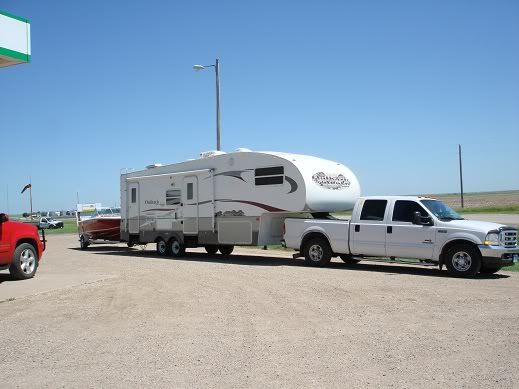
Same setup as in 2010, same injectors, the only thing different is that I pulled the VC's off to replace the glow plugs & torque down the injector hold down bolts.
Still using Schaeffer's 15W-40 series 7000 oil and running the Oilguard Bypass system. Still yanking the Outback 5th wheel around with it.........
Same setup as in 2010, same injectors, the only thing different is that I pulled the VC's off to replace the glow plugs & torque down the injector hold down bolts.
Still using Schaeffer's 15W-40 series 7000 oil and running the Oilguard Bypass system. Still yanking the Outback 5th wheel around with it.........

