When you click on links to various merchants on this site and make a purchase, this can result in this site earning a commission. Affiliate programs and affiliations include, but are not limited to, the eBay Partner Network.
Hi everyone. I'm a long time listener here (6 months anyway) and I love getting on here every morning before work and looking at everyone's builds. It's one of the highlights of my day. The amount of knowledge in this forum is amazing and I'm glad to have it as source of information. I've learned so much from you all. So thanks!
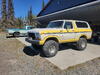
I purchased my 75 f100 back in June of 2025 and immediately started work. I initially started with a goal of just a decent reliable truck to do truck things with. But that has ballooned into something else, not quite a restoration, but in between. I thought I'd share some of build here with you all as a way to introduce myself and make friends in this awesome community.
First off I was blessed with an amazing Dad. He was a Ford mechanic for 40 years and has forgotten more than I will ever know about these trucks. I have the truck in his garage and he has helped me every step of the way. He can't turn wrenches like he used to could, but that's where I come in.
So starting out the truck was really rough but not rusty, it did run, but not good. I started off rebuilding the front axle, redid the axle u joints, new hubs, ball joints and brakes. Moved to the back and and pulled the 3rd member, new fluid, pinion seal and did rear axle bearings and seals along with brakes.
Next was the driveshafts u joints front and back and center support bearing. Dropped the transfer case and tranny. Interestingly enough, the transfer case is a Dana 21 with the Np 435 tranny. Rebuilt both of them with new bearings and seals.
Next we pulled the 360 and rebuilt it. It was in great shape except for one cylinder had to be sleeved because of a wrist pin keeper that came loose and cat a deep groove. We went with new bearings, rings and had some head work done.
I had also been cleaning and painting the frame and under cab/bed. Once we got the motor back in and running I started in the interior with new floor pans and then realizing the main wiring harness was melted. So we pulled it and soldered and spliced in New wires as needed.
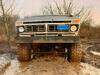
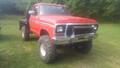
Just realized I need to attach some pics How she started In Dads garage Dana 21 Nasty interior when I bought it, Fresh installed motor Rear end complete with paint New floor pans I love this color
I'm currently doing body work which I'm not a fan of. I've never done it before and am already tired of it and am not even half way done yet.
I started off with the fenders with the passenger side being crunched. The PO must have tried painting it with bedliner or something, but I'm having to take it down to bare metal regardless. I have found a few rust spots, nothing bad tho. Learning to cut them out and patch them in with the welder was not fun. I am getting decent at pulling dents using a nail, welder and homemade slide hammer/vice grips. Had to put a door skin on the passenger side and the one I ordered from CJ pony parts worked, but had a big dent in it. New door skin arrived dented, but I used it anyway
Next I started working on the doors by stripping them bare. Got them prepped and primed along with the fenders. Not bad but far from perfect Door primered with the dented door skin I repaired.
I just finished prepping and pruning the can this weekend.
I'm slowly gathering parts and pieces to complete the build, bumper, mirrors etc. I'm having a terrible time finding a tailgate. The one that is on it is in horrible shape. I've looked at new reproduction ones but man they are expensive.
I just got my 15x6 steel wheels and am now looking at tires. Any recommendations?
I apologize for this being such a long first post, but at least now I am currently caught up.
There are at least 1800 other things I have already done to this truck that I did not mention. The list is long.
Last edited by jamiedrchiro; Feb 15, 2026 at 06:56 PM.
For not being good at body work, you are good at body work!
Ha. I think anything would look decent with flat white paint on it. There are flaws under there. I promise.
Bodyshop guys earn every $$ they get. Just wish I had the $$ to pay them to do mine.
Nice rig and awesome work! Gonna be a nice driver when you’re done.
I just got some Bridgestone All Terrain K03s on my Ranger, and they’re great for adverse conditions or off road. Not sure if they’re offered in a 15”….
The 78 has some (Cooper) Dean Tires Back Country Touring H/Ts that aren’t bad. They do like picking up rocks.
Nice rig and awesome work! Gonna be a nice driver when you’re done.
I just got some Bridgestone All Terrain K03s on my Ranger, and they’re great for adverse conditions or off road. Not sure if they’re offered in a 15”….
The 78 has some (Cooper) Dean Tires Back Country Touring H/Ts that aren’t bad. They do like picking up rocks.
I appreciate the encouragement. I've looked at the KO3s and like how they look. I'm curious with my wheels being 15x6, if I can get 31 inch tires to go on them. Some people say that with a 6 inch wide wheel, that will limit me to something like a 235/75/15. Others say you can run 31x10x15.
If anyone here has 15x6 wheels, I'd appreciate your opinion.
Stuck a wheel on to see how it looked. Hub sticking way out
This weekend I got the cab sanded and another coat of primer put on the cab, door and fenders. It was way too cold to be doing much else.
It's supposed to be warmer next weekend. We will see how much progress I can make
Jamie,
Your doing a great job on your rebuild. Its going to be a nice truck! Thanks for the posts and pictures! That helps us understand your progress!
Regards,
Chris and Cheryl
Well it's been a heck of a weekend. Started off with an ER visit for my Dad. Turns out he was having a mini stroke. Thankfully it wasn't a big one, his Dad, my Grandpa died from a massive stroke. This was an eye opener for him, even though he will recover completely, he is having to walk with a walker. The Lord is still blessing me by letting me keep my Dad a little while longer.
I did get to work on my truck. I had plans to paint the cab this weekend. That didn't happen, but I did get my front fenders and doors painted. I'm quite pleased with how they turned out. Def some orange peel but I feel for my first time painting, it looks good and honestly a lot better than I was expecting. I wasn't sure if I needed to spray the white or blue first to do the 2 tone I'm going after. So I sprayed the blue first. The next day taped off the line and wet sanded with 400 where the blue over spray was. I'm happy with how it turned out. Not bad for tractor paint... It's definitely not perfect, and I'm kicking myself because I noticed a very big ding that I missed when doing the bodywork.
Glad to hear your Dad is ok. The truck is looking good, looking real good for doing your own body and paint work. As a free body work tip when you think you are done with the body work on a area, or part. Get a different set of eyes and hands to look and feel it over...like your dad. That way he is still involved in the truck build.
If any one say "ha I see orange peel in the paint", tell them to not look that hard and move along. Or tell them that is a custom texture that you wanted, now beat it.
Orange peel in car paint is a bumpy, uneven texture resembling an orange's skin caused by paint drying too quickly or improper application techniques. It occurs when paint droplets don't flow and level out properly before curing, often due to low air pressure, incorrect spray gun distance, or improper temperature/reducer usage.
Common Causes of Orange Peel:
Rapid Drying (Flash-off): Using a fast-drying reducer/thinner, or painting in high heat/low humidity causes paint to dry before leveling.
Incorrect Viscosity: Paint that is too thick (high viscosity) does not flow properly.
Improper Gun Setup: Using a fluid tip that is too small or incorrect gun settings.
Application Issues: Applying too much paint (which leads to solvent pop and uneven curing) or applying a second coat before the first has properly settled.
Improper Spray Technique: Spraying too far from the panel, or using a gun angle that is not perpendicular.
Incorrect Air Pressure: Too low air pressure causes the paint to "dry" before it hits the surface (dry spray)
.
How to Fix It:
Wet Sanding: Using fine-grit wet sandpaper (e.g., 2000-3000 grit) to smooth the clear coat.
Repainting: In severe cases, sanding down to the base coat and reapplying the clear coat with proper techniques.
Even worse is Fish Eye, so run a moisture filter on your compressor and drain the tank daily.
Fish eye is generally worse than orange peel because it is a contamination issue (silicone/oil) that causes the paint to repel, making it impossible to fix without stripping, cleaning, and repainting. Orange peel is a texture issue caused by poor spraying technique (wrong pressure/speed) that can usually be sanded and polished flat.
Key Differences:
Fish Eye (Worse): Appears as small crater-like holes. It is caused by contaminants (oil, grease, silicone, or water in the air lines) that prevent proper bonding. It cannot be fixed by buffing.
Orange Peel: Results in a bumpy, textured surface resembling the skin of an orange. It is usually caused by paint being too thick or sprayed with improper atomization. It is repairable via sanding and buffing.
Correction Methods:
Fish Eye: Requires sanding down to the primer, thorough cleaning with solvent (like naphtha), and respraying the area.
Orange Peel: Can be corrected by wet sanding with fine-grit paper and buffing the clear coat.
Looking good. I may have missed it, but what color is that?
Sorry Im just now seeing this.
Im using rustoleum paint. The blue is Spa Blue with an added enamel hardener The white is just rustoleum tractor and implement "White" with the hardener added as well.