When you click on links to various merchants on this site and make a purchase, this can result in this site earning a commission. Affiliate programs and affiliations include, but are not limited to, the eBay Partner Network.
Conical washers and a hex or cap head might be ideal, but conical washers in the size required are tricky to find oddly enough.
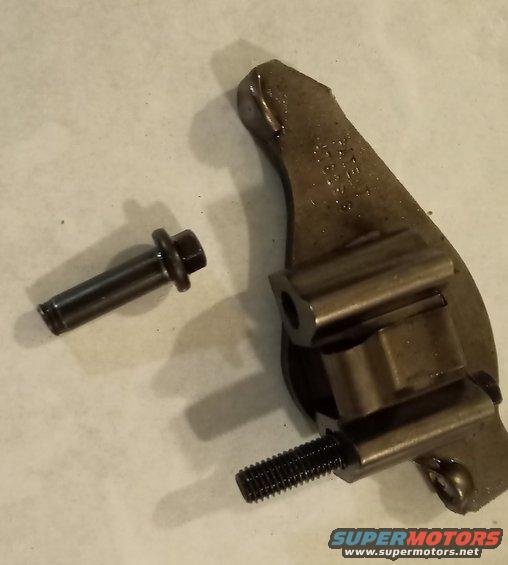
Flat top bolt on the left is a 10.9, other flat top is a 12.9. I think the 12.9 one, with the longer non threaded section, will work for both but need a head in front of me to know. To get the shoulder I was thinking of using 6mm ID 8mm OD steel tubing cut to length with a 90° chamfer on one side.
The diameter of the conical heads is a little larger than the stock bolts but it still seats on the injector collar fine. Will have to do some tests to see if the flat head is beefy enough to take the torque.
New ones are grade 8.8 so we still end up with bent bolts/bolts that stretch over time.
If these bolts were external I'd agree about the allen head, but they're going to be in an oil mist environment where they have some protection from corrosion.
Iirc with 12.9 M6x1 you need nine threads engaged to hit the torque.
Bigger issue is that the heads can't take the clamping pressure:
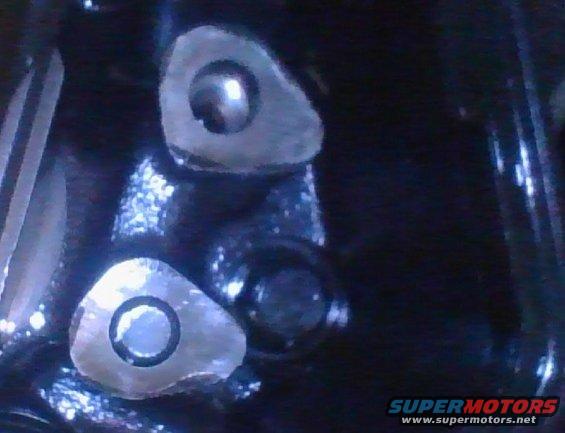
The injector collar doesn't have a very good counter sink so you end up with only a few points of contact on the edges, and at 150 in-lb you get deformation (even with the stock bolt, though less so).
The right way to do this is to take some steel alloy rod, drill a 6.1mm hole in the center, 90 degree chamfer on the end, diameter to 12mm and thickness at 4mm. then you can use 12.9 12pt screws with a flange that will push down on the entirety of the washer, preventing deformation.
I'm agreeing with @FinnishStroker about the issues with the exceedingly small hex in a FHCS....not corrosion.
I mean, I guess a person could make some bolts out of some material and have them heat treated (if required) to the proper spec to achieve the goal. The mfg'd version is probably going to have cut threads rather rolled...with rolled being stronger.
There was discussion a while back about using an off the shelf bolt, but having a custom conical washer made.
Iirc with 12.9 M6x1 you need nine threads engaged to hit the torque.
Bigger issue is that the heads can't take the clamping pressure:
The injector collar doesn't have a very good counter sink so you end up with only a few points of contact on the edges, and at 150 in-lb you get deformation (even with the stock bolt, though less so).
The right way to do this is to take some steel alloy rod, drill a 6.1mm hole in the center, 90 degree chamfer on the end, diameter to 12mm and thickness at 4mm. then you can use 12.9 12pt screws with a flange that will push down on the entirety of the washer, preventing deformation.
If only I had a lathe!
pm me a sketch of what you're thinking...I happen to know a guy with a cnc lathe. 😆
ps...the oem bolt looks to have a radius, not an angle....which makes sense... I think.
The only bolt I've personally had fail under the valve covers was a rocker arm bolt, thinking those are 12.9. I'm sure it was all me that caused it to fail and I'm still confused as to why it took over 4 years to give up.
It did scare me out of my beehives and I went back to comp 910s shimmed I think 120ish? There was likely no reason for switching the springs other than my personal feelings.
If the bent to the injector bolts is an indication of that much side load, softer may be the better. But the rocker bolts do take 20 ftlbs.
ps...the oem bolt looks to have a radius, not an angle....which makes sense... I think.
Cant seem to attach images to PMs so will just post it here
It's hard to tell profile on used bolts due to the metal deforming but looking at several closely, and where they fit in the injector collar, I'm 99% they are 90 degree conical.
I've looked through a ton of flanged bolts and the only ones I've found in the right size with the correct flange diameter are ARP. Other flanged bolts have either too small or too large a diameter of flange. The 11.6mm diameter of the washer is the same as the ARP bolt's flange so should be plenty strong.
Easiest way to cut these washers would be to take a long partially threaded 12.9 M12 bolt , part the threaded end and head off, drill hole in center, dimension the diameter, chamfer edge, part off. Then move in, chamfer edge, part off, etc etc.
Originally Posted by Kwikkordead
What's the point of this exercise? Are the bolts famous as a failure point? Never heard of a need like this before.
Not so much a failure point as an annoyance point. Plenty of stories about these bolts "loosening" up over time. Re torquing always poses the risk of breaking them off.
Every shoulder bolt I've examined after tearing apart several heads has been bent. Either over time, from the initial torque or subsequent tightenings. There's a lot of vibration put upon those bolts and it'd be nice to have a solution that won't stretch over time or require re-tightening down the road.
What's the point of this exercise? Are the bolts famous as a failure point? Never heard of a need like this before.
Reinvention of the wheel is my guess. Most everything else has been scienced-out and folks are looking for solutions to problems that don't exist for 99% of us.
I'd probably recommend 4140 in a prehard condition....which makes it about 30 R/C.
That'd probably be fine. Like I said I was thinking that using the unthreaded portion of a M12 bolt would be the economical solution, but 4140 would work too. 16 bolts... I'd say 20 washers would be ideal.
Rezvani's Latest Post-Apocalyptic Monster Is a Ford F-150 Raptor Underneath
Slideshow: Called the Fortress, the 850-horsepower pickup combines Raptor underpinnings with military-inspired features, survival equipment, and a starting price of $285,000.