



Explain how it works

Thread Starter
|
Fleet Mechanic
Joined: Mar 2007
Posts: 1,808
Likes: 0
From: Meigs County Ohio
Explain how it works
The **** for my transfer case says
Lock
LO
Lock
HI
thats all and I assume somone can tell me hot it works. It has a odd patern to it, and its new to me so help would be appreciated.
Lock
LO
Lock
HI
thats all and I assume somone can tell me hot it works. It has a odd patern to it, and its new to me so help would be appreciated.
Post Fiend
Joined: Jul 2006
Posts: 6,948
Likes: 44
you have a Np 203 full time transfer case. Notice the lack of 2wd. You do not have a true 2wd, and your truck is always in 4wd. Undoubtedly, you also do not have manual locking front hubs. You more than likely have drive slugs, with no way to disengage.
Ok, so your first detent or selection from the top is LOC, this is low range with a locker center differential. Your 203 has a center differential which allows the front and rear axles to turn at different rates during a turn on dry pavement or high traction surfaces.
Ok so in lo LOC, you ar ein low range with the front and rear outputs locked together.
Next is simply LO, this is low range without the locked center diff. You can drive on any surface this way, but you will be in low range.
next is HI Loc, and this is the same as above, only in high range, or 1:1.
Final is HI, this is your standard drive around the world range. It uses the normal 1:1 ratio (high range) and opens the differential (center) so that you can drive normally on the highway without any binding.
If you select any of the LOC selections you will find that the truck will bind and will be difficult to turn on regular paved roads. it is suggested that LOC is only used for low traction conditions.
Ok, so your first detent or selection from the top is LOC, this is low range with a locker center differential. Your 203 has a center differential which allows the front and rear axles to turn at different rates during a turn on dry pavement or high traction surfaces.
Ok so in lo LOC, you ar ein low range with the front and rear outputs locked together.
Next is simply LO, this is low range without the locked center diff. You can drive on any surface this way, but you will be in low range.
next is HI Loc, and this is the same as above, only in high range, or 1:1.
Final is HI, this is your standard drive around the world range. It uses the normal 1:1 ratio (high range) and opens the differential (center) so that you can drive normally on the highway without any binding.
If you select any of the LOC selections you will find that the truck will bind and will be difficult to turn on regular paved roads. it is suggested that LOC is only used for low traction conditions.

Post Fiend
Joined: Apr 2008
Posts: 8,261
Likes: 15
From: Big Sky Country
Someone has installed a part-time conversion kit.
Trending Topics
Posting Guru
Joined: Dec 2009
Posts: 2,134
Likes: 1
From: Mississippi
If it has locking hubs, you should read up about the conversion, something about putting it in 4wd occasionally to lubricate the t case.
FTE Stories
Ford Trucks for Ford Truck Enthusiasts

3 Best / 3 Worst Parts of Modern Ford Ownership
Brett Foote
10 Amazing Upgrades That Solve Common Ford Truck Owner Headaches
Pouria Savadkouei
Every 2026 Ford Engine Explained
Brett Foote
10 Ugly Ford Trucks That We Still Kinda Love
Joe Kucinski
10 Things Every Truck Owner NEEDS (2026 Edition)
Michael S. Palmer
Rezvani's Latest Post-Apocalyptic Monster Is a Ford F-150 Raptor Underneath
Verdad Gallardo
Top 10 Most Expensive Ford Trucks Ever Sold on Bring a Trailer
Joe Kucinski
2027 Ford Super Duty Buyer's Guide (Every Model, Engine, & Package)
Brett Foote
Top 10 Ford Truck Tragedies
Joe Kucinski
Senior User
Joined: Mar 2010
Posts: 381
Likes: 0
ok so i just went outside and looked at my transfer case and messed with the shifter and it only has 3 positions that it will go in...
form the midle position there is a long throw up (going to front of truck)
and a short throw down (going back to the seat)
im starting to think my truck has the wrong **** on the shifter...
can anyone explain to me whats going on? if its the wrong **** or what
form the midle position there is a long throw up (going to front of truck)
and a short throw down (going back to the seat)
im starting to think my truck has the wrong **** on the shifter...
can anyone explain to me whats going on? if its the wrong **** or what
Thread Starter
|
Fleet Mechanic
Joined: Mar 2007
Posts: 1,808
Likes: 0
From: Meigs County Ohio
I noticed mine as a long throw to but brint it back towards the seat then swing it towards the passanger side, then push it forward and it should only move forward a little. Then take it back head towards the front and do it again. Thats what mine will do.
Post Fiend
Joined: Jul 2006
Posts: 6,948
Likes: 44
Ah ha! Since you said the magic word,,,,"Swing" indicates that the shifter can move from side to side and not just in a straight line. This, combined with the locking hubs indicates that the t-case has been converted to part time.
This also means that anything typed above is bogus, and does not apply. What I mean is whatever I typed has not merit. Actually it does, but not in this case.
Now that you have an idea that you have a converted t-case, you will have to throw out the shift ****, or at least, black out the letters.
Identify the gear selections by placing or engaging the t-case in any position. Note what happens when you depress the gas pedal. A dirt or gravel road is good for this.
I usually lock in the front hubs for this.
Select any position, and stomp tha gas. Note what happens to the front and rear tires.
if the rear tires break free and spin, then you have found 2wd.
If they do not, and the front tries to spin as well, then you may have found 4 hi. Pay attention to the vehicle and accelerate. If you can tell that you are in a very low gear, then you may be in 4LO.
Note where the shift lever is and then make another selection.
Try to spin up the tires again, and determine what happens. The same rules as above apply, and since there are only four selections you can easily determine where you are at.
Note that you will also have a Neutral, so if nothing happens, you have found neutral. Stop the engine so you dont grind the gears away, and select something, anything, and start the engine again.
With some patience and trial, you will get to know the pastern of this converted t-case.
Oh yeah, if you do have a converted t-case, it is a good idea to engage the front output so that you can lube the rear output.
This case has a small reservoir above the rear output bearing and in an un modified case it is lubed by the rotation of the chain. Once modified the chain no longer turns unless the front driveshaft can rotate, and eventually the bearing will go dry.
The fix is to lock the hubs or engage 4wd every couple of hundred miles or so. it wont take long to fill the reservoir, so a few miles every two hundred or so will suffice.
Also note that gear oil is too heavy for the 203, and ATF is too thin. regular old 50W is recommended, but it is difficult to find. 40W or eve 30W is a decent alternative.
This also means that anything typed above is bogus, and does not apply. What I mean is whatever I typed has not merit. Actually it does, but not in this case.
Now that you have an idea that you have a converted t-case, you will have to throw out the shift ****, or at least, black out the letters.
Identify the gear selections by placing or engaging the t-case in any position. Note what happens when you depress the gas pedal. A dirt or gravel road is good for this.
I usually lock in the front hubs for this.
Select any position, and stomp tha gas. Note what happens to the front and rear tires.
if the rear tires break free and spin, then you have found 2wd.
If they do not, and the front tries to spin as well, then you may have found 4 hi. Pay attention to the vehicle and accelerate. If you can tell that you are in a very low gear, then you may be in 4LO.
Note where the shift lever is and then make another selection.
Try to spin up the tires again, and determine what happens. The same rules as above apply, and since there are only four selections you can easily determine where you are at.
Note that you will also have a Neutral, so if nothing happens, you have found neutral. Stop the engine so you dont grind the gears away, and select something, anything, and start the engine again.
With some patience and trial, you will get to know the pastern of this converted t-case.
Oh yeah, if you do have a converted t-case, it is a good idea to engage the front output so that you can lube the rear output.
This case has a small reservoir above the rear output bearing and in an un modified case it is lubed by the rotation of the chain. Once modified the chain no longer turns unless the front driveshaft can rotate, and eventually the bearing will go dry.
The fix is to lock the hubs or engage 4wd every couple of hundred miles or so. it wont take long to fill the reservoir, so a few miles every two hundred or so will suffice.
Also note that gear oil is too heavy for the 203, and ATF is too thin. regular old 50W is recommended, but it is difficult to find. 40W or eve 30W is a decent alternative.
Post Fiend
Joined: Jul 2006
Posts: 6,948
Likes: 44
Not necessarily. Some kits used the same shifter as the original one, and others used a different shifter..
Kits varied over the years, so there is no single answer to this.
Some folks have actually installed lock outs and removed the front driveshaft only to have to drive around in HILOC all of the time.
I never understood this, but anything is a possibility.
If you have locking hubs and a 203, just shift the lever around and try to turn the front diveshaft when the front hubs are unlocked.
It will only turn by hand when the t-case is in neutral, or 2wd. If it only turns by hand in neutral, and no other positions, then we can assume that the case has not been converted.
Take a look at your t-case, and look to see if you have this giant output housing.
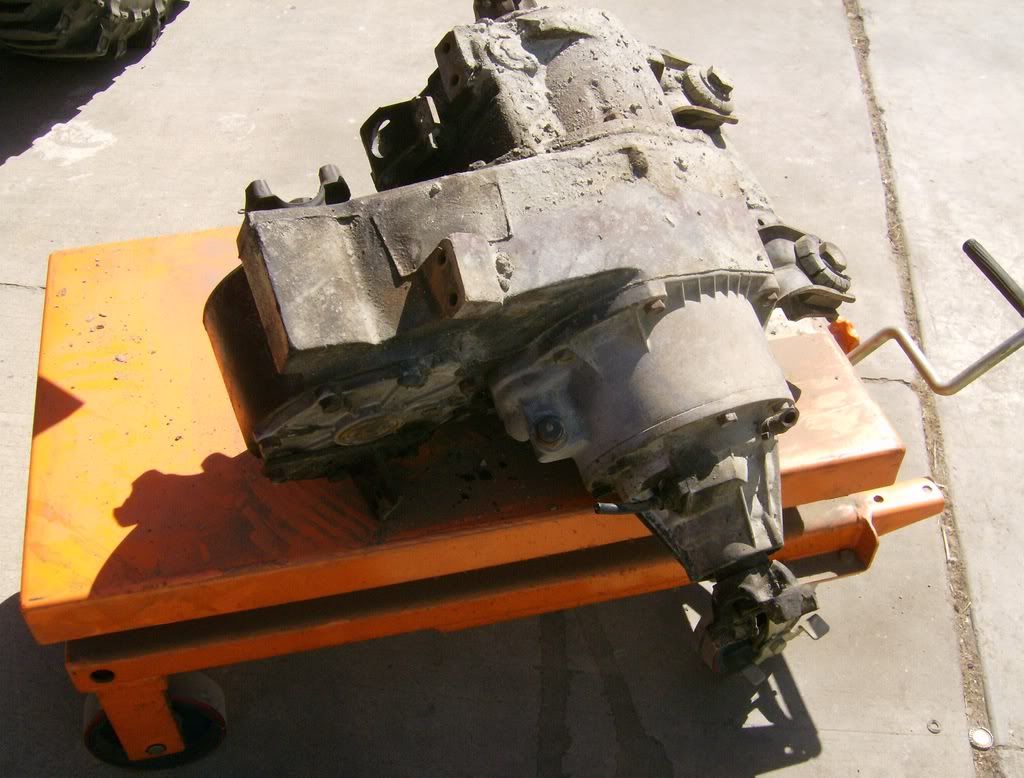
Thats a 203.
The smaller case is a 205. Notice the lack of giant output housing.

Kits varied over the years, so there is no single answer to this.
Some folks have actually installed lock outs and removed the front driveshaft only to have to drive around in HILOC all of the time.
I never understood this, but anything is a possibility.
If you have locking hubs and a 203, just shift the lever around and try to turn the front diveshaft when the front hubs are unlocked.
It will only turn by hand when the t-case is in neutral, or 2wd. If it only turns by hand in neutral, and no other positions, then we can assume that the case has not been converted.
Take a look at your t-case, and look to see if you have this giant output housing.
Thats a 203.
The smaller case is a 205. Notice the lack of giant output housing.
