


Bearings
Thread Starter
|
Junior User
Joined: Aug 2008
Posts: 73
Likes: 0
From: Vienna, VA
Bearings
This might be a silly question, but I was having some issues with the rear end and with the weather finally warming up around the DC area was able to determine bad bearings. It looks like the passanger side was rebuilt not that long ago and had good bearings in it, however the drivers side is currently missing about 6 bearings. As in completely unaccounted for. Replacing them isn't an issue, however, do i have to worry about the missing bearings getting caught up in my differential? I don't really have time to tear it appart and try to find them right now, so is it something i can just go with for now and open that can of worms at a different time or do i need to do it ASAP?

Freshman User
Joined: Mar 2007
Posts: 48
Likes: 0
Yes you should clean and inspect the gears and housing. Even if the bearings are ground up or just laying in the bottom of the case, your fluid is full of metal fragments that are going to quickly ruin all the other bearings, seals, and gears. I would replace both axle bearings and seals and flush everything. The ring gear will usually be grooved, teeth thin, or scored if bad. If it doesn't sound like a fire truck is behind you all the time, you may have caught it in time. Check the pinion support bearing side clearance too. They usually blow the seals out when they get loose, so if it is leaking you are probably looking at a ring and pinion rebuild. There are two schools of thought: one fix the bad axle bearings and just button it back up; or, if one bearing is bad all the bearings are getting bad so just rebuild it all now. If you wait it will chew itself up.

Postmaster
Joined: Apr 2002
Posts: 3,613
Likes: 6
From: Coal country
I think it might be useful to establish which rear axle you have.
Is it a Ford 9"?
A Dana series axle?
To tell the difference look at the back side of the rear axle. If there are bolts holding a backing plate on, you have a Dana. This one is easy to drain and inspect, just remove the plate.
If there is nothing on the back side of the axle, but there are 13 nuts on the front side of the axle, you have a Ford 9", and the removal process is a bit more complicated, but not hard.
Post back with your truck model, and the rear axle type. It may be helpful to post the entire Warranty Plate information as well.
Please do not remove anything yet, so as to avoid complicating what may yet be a non-issue.
Is it a Ford 9"?
A Dana series axle?
To tell the difference look at the back side of the rear axle. If there are bolts holding a backing plate on, you have a Dana. This one is easy to drain and inspect, just remove the plate.
If there is nothing on the back side of the axle, but there are 13 nuts on the front side of the axle, you have a Ford 9", and the removal process is a bit more complicated, but not hard.
Post back with your truck model, and the rear axle type. It may be helpful to post the entire Warranty Plate information as well.
Please do not remove anything yet, so as to avoid complicating what may yet be a non-issue.
Thread Starter
|
Junior User
Joined: Aug 2008
Posts: 73
Likes: 0
From: Vienna, VA
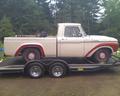
The truck is a '63 F-100 Custom with 292, 2wd. It looks like i have a Ford 9" rear on it. At this point i have only removed the rear axles and that is it. I was trying to find a knock in rear when moving. It would harmonize at high speeds, but at low, a hard 'clunk' at a steady pace. So far, it looks like I am lucky with the bearings. I am missing about six individual bearings out of the unit, however the race looks fine, as does the axle itself. However, to be honest, I am not familiar with anything to do with the differential outside of telling you where it is located and what hooks to it.
While driving, outside of the clunk, there was no abnormal noise or handling issues. when raised the passanger side rolls fine the drivers side does not at all. I can stop the passanger tire from spinning with one hand, and the drivers side will try to spin but seems hesitant. This is a limited slip right?
Only other thing i have noticed is that with either tire, when raised, i can roll either direction when in gear or neutral, and when i change direction i can hear a knock in the differential. I get no noise from the differential when i spin in one direction, only when i change the direction.
While driving, outside of the clunk, there was no abnormal noise or handling issues. when raised the passanger side rolls fine the drivers side does not at all. I can stop the passanger tire from spinning with one hand, and the drivers side will try to spin but seems hesitant. This is a limited slip right?
Only other thing i have noticed is that with either tire, when raised, i can roll either direction when in gear or neutral, and when i change direction i can hear a knock in the differential. I get no noise from the differential when i spin in one direction, only when i change the direction.
Thread Starter
|
Junior User
Joined: Aug 2008
Posts: 73
Likes: 0
From: Vienna, VA
Also what is the best way to clean out the axle housing to make sure the bearings are not in there? I am also wondering, i noticed that the seal inside of the bearing race is not damaged at all, so is there a possiblity that they were just chewed up in the bearing itself or was could it have gotten passed the seal without damaging it or the axle shaft?
Postmaster
Joined: Apr 2002
Posts: 3,613
Likes: 6
From: Coal country
The truck is a '63 F-100 Custom with 292, 2wd. It looks like i have a Ford 9" rear on it. At this point i have only removed the rear axles and that is it. I was trying to find a knock in rear when moving. It would harmonize at high speeds, but at low, a hard 'clunk' at a steady pace. So far, it looks like I am lucky with the bearings. I am missing about six individual bearings out of the unit, however the race looks fine, as does the axle itself. However, to be honest, I am not familiar with anything to do with the differential outside of telling you where it is located and what hooks to it.
While driving, outside of the clunk, there was no abnormal noise or handling issues. when raised the passanger side rolls fine the drivers side does not at all. I can stop the passanger tire from spinning with one hand, and the drivers side will try to spin but seems hesitant. This is a limited slip right?
Only other thing i have noticed is that with either tire, when raised, i can roll either direction when in gear or neutral, and when i change direction i can hear a knock in the differential. I get no noise from the differential when i spin in one direction, only when i change the direction.
Since you have done much of the work already, it would be well worth it I think, to remove the center section, called the 3rd member, chunk or hogshead. This will get you access to the center housing, allow you to confirm (if you so wish) that no bearing pieces are in there, and to change the fluid.
1. Remove the driveshaft; be sure to tape up the U-joint caps - maybe change U-joints??
2. Remove the 13 nuts around the center section. DO NOT remove any other nuts/bolts, unless you want to pay someone to realign the differential gears. Also, do not lose the copper washers, as you will re-use them.
3. Break the seal and allow most of the fluid to drain.
4. Slide the 3rd member off the studs - be careful, it is heavy.
5. Clean out the axle housing by hand; lift out any crud from the bottom.
6. Reassembly is the reverse; use RTV instead of a paper gasket to seal the 3rd member.
7. Refill with 80-90W gear oil after re-installing the axle shafts.
Freshman User
Joined: Mar 2007
Posts: 48
Likes: 0
A nine inch will not have a separate rear cover over the gears common on other rear axles. It will have a removeable center section on the forward facing side of the axle housing. If the axles are out a couple of inches, just unbolt the ujoint, center section and pull center section out. Have a drain pan handy, stinky gear oil will come out. Don't lose all those little washers. That center is heavy (70lbs). Put it on your bench and inspect. Clean the crud out of the bottom of the axle housing with putty knife, towels, solvent.
If it is a Dana rear axle, pull the access/inspection cover, remove the crude from the bottom of the housing, and inspect components.
Check the pinion support bearings, carrier bearings and spider gears. Take a look at the ring gear all the way around. Count the splines on your axles and the teeth on your gears and write them down on something for future reference. Check the carrier to see if it is open or limited slip. You can feel the notch in the middle of the carrier spline with your fingers on limited slips. Look at the fluid and what is in the bottom of the axle housing for clues. Look at the teeth individually and how they mesh together.
Marvel at Ford engineering. These axles are popular because of the low angle the pinion comes in at allowing for a large surface area on the usually diminutive pinion gear. The pinion gear also has a support bearing past the ring gear which prevents deflection between the gears. This creates a very strong compact rear axle quite popular in the automotive community.
This is not a very difficult or time consuming endeavor. If you have pulled the axles and inspected them you can definitely pull this off and you are halfway there.
I suggest servicing axle bearings in pairs.
Nine inch limited slips can stick if you try to move the tires independently. Both tires will sometimes try to move together if they are both off the ground. They should both spin easily if the truck is elevated and in neutral (block front wheels, use jackstands). The splines on one (1) side of the carrier will have a separation. You can push the axle in on that side and you will feel it catch the first set of splines on the carrier and then rotate it a hair and it will drop into the second set of splines on the spider. These carriers can twist the splines on the axle. I do not believe the limited slip was offered with the nine inch this early, but it could be changed by a later owner.
Ford 9 Inch Rebuild/Gear Setup
John
If it is a Dana rear axle, pull the access/inspection cover, remove the crude from the bottom of the housing, and inspect components.
Check the pinion support bearings, carrier bearings and spider gears. Take a look at the ring gear all the way around. Count the splines on your axles and the teeth on your gears and write them down on something for future reference. Check the carrier to see if it is open or limited slip. You can feel the notch in the middle of the carrier spline with your fingers on limited slips. Look at the fluid and what is in the bottom of the axle housing for clues. Look at the teeth individually and how they mesh together.
Marvel at Ford engineering. These axles are popular because of the low angle the pinion comes in at allowing for a large surface area on the usually diminutive pinion gear. The pinion gear also has a support bearing past the ring gear which prevents deflection between the gears. This creates a very strong compact rear axle quite popular in the automotive community.
This is not a very difficult or time consuming endeavor. If you have pulled the axles and inspected them you can definitely pull this off and you are halfway there.
I suggest servicing axle bearings in pairs.
Nine inch limited slips can stick if you try to move the tires independently. Both tires will sometimes try to move together if they are both off the ground. They should both spin easily if the truck is elevated and in neutral (block front wheels, use jackstands). The splines on one (1) side of the carrier will have a separation. You can push the axle in on that side and you will feel it catch the first set of splines on the carrier and then rotate it a hair and it will drop into the second set of splines on the spider. These carriers can twist the splines on the axle. I do not believe the limited slip was offered with the nine inch this early, but it could be changed by a later owner.
Ford 9 Inch Rebuild/Gear Setup
John
Trending Topics
Thread Starter
|
Junior User
Joined: Aug 2008
Posts: 73
Likes: 0
From: Vienna, VA
Gentlemen, thank you. That is more information than I even thought to ask. Definately not as complex as I thought it was. I will be accomplishing this within the next few days and will keep y'all up to date on what I find.
Cheers!
Cheers!
FTE Stories
Ford Trucks for Ford Truck Enthusiasts

3 Best / 3 Worst Parts of Modern Ford Ownership
Brett Foote
10 Amazing Upgrades That Solve Common Ford Truck Owner Headaches
Pouria Savadkouei
Every 2026 Ford Engine Explained
Brett Foote
10 Ugly Ford Trucks That We Still Kinda Love
Joe Kucinski
10 Things Every Truck Owner NEEDS (2026 Edition)
Michael S. Palmer
Rezvani's Latest Post-Apocalyptic Monster Is a Ford F-150 Raptor Underneath
Verdad Gallardo
Top 10 Most Expensive Ford Trucks Ever Sold on Bring a Trailer
Joe Kucinski
2027 Ford Super Duty Buyer's Guide (Every Model, Engine, & Package)
Brett Foote
Top 10 Ford Truck Tragedies
Joe Kucinski
Elder User
Joined: May 2005
Posts: 581
Likes: 1
From: Montana
another thought, look down the shaft with a flashlight and see if the bearings are still in the tube. if so you may be able to get them out with a magnet. if not i agree with rest of these folks, pull your pumpkin and clean and change the oil. the shavings will eventually take out the third member and Murphy says it'll happen going down the freeway. LOL Dutch
Thread Starter
|
Junior User
Joined: Aug 2008
Posts: 73
Likes: 0
From: Vienna, VA
Well, finally got into it, last night. fount two bearings in the axle housing, and one in the differential. Thanks for the insight, as well as helping me realize that pulling apart the 3rd member and cleaning it weren't as difficult as the books make it seem.

Thread
Thread Starter
Forum
Replies
Last Post
WatsonR
6.0L Power Stroke Diesel
4
Sep 8, 2014 08:22 PM
1975FordF250
FE & FT Big Block V8 (332, 352, 360, 390, 406, 410, 427, 428)
4
Apr 19, 2014 09:34 AM
jstutz101
Explorer, Sport Trac, Mountaineer & Aviator
5
Jul 23, 2008 06:58 AM
monsterbaby
1999 - 2016 Super Duty
1
May 14, 2005 09:05 PM