



Choke problems and bed questions

Thread Starter
|
Logistics Pro


Joined: Dec 2004
Posts: 3,920
Likes: 2
From: Carson City, NV
Choke problems and bed questions
82 F150, 4.9L, 4x4, 4 speed, shortbed stepside
Ok, I was wondering since I don't know much about carburetors at all, does my truck have a manual or electronic choke? It can't start up unless I pour gas down the carb a few times first. I know my old 79, to set the choke I just pushed the gas pedal to the floor then let go of it and fired it up and to release it I'd just hit the gas again.
Also, anyone know of any place that makes replacement stepside bed panels? I haven't seen them anywhere! My panels are in ok shape, I could restore them, they are not that far gone yet but it would still be a major PITA. Also saw a rust free regular shortbed on craigslist but I would much rather keep it a stepside.
Keyul
Ok, I was wondering since I don't know much about carburetors at all, does my truck have a manual or electronic choke? It can't start up unless I pour gas down the carb a few times first. I know my old 79, to set the choke I just pushed the gas pedal to the floor then let go of it and fired it up and to release it I'd just hit the gas again.
Also, anyone know of any place that makes replacement stepside bed panels? I haven't seen them anywhere! My panels are in ok shape, I could restore them, they are not that far gone yet but it would still be a major PITA. Also saw a rust free regular shortbed on craigslist but I would much rather keep it a stepside.
Keyul

Post Fiend
Joined: Dec 2007
Posts: 8,521
Likes: 16
From: Lost
Does the starting problem happen if the truck sits for a few hours, or does it only occur if it has sat for several days? If it only occurs after sitting for several days, but starts fine after sitting overnight, the fuel pump could be loosing it's prime.
Thread Starter
|
Logistics Pro
Joined: Dec 2004
Posts: 3,920
Likes: 2
From: Carson City, NV
Alright cool, I looked on it and didn't see anywhere to hook a connector onto it but it's pretty dark out now. I do have a single wire connector coming from the back of the alternator that is just hanging in the engine compartment that I haven't been able to figure out where it goes.
Trending Topics
Post Fiend
Joined: Dec 2007
Posts: 8,521
Likes: 16
From: Lost
Normally, the choke wire comes from the back of the alt. It's possible that someone has changed the carb or choke thermostat to an earlier non-electric version.
FTE Stories
Ford Trucks for Ford Truck Enthusiasts

3 Best / Worst Features Of The 2025+ Ford Expedition
Brett Foote
10 Ways Ford is LOSING to the Competition
Joe Kucinski
Top 6 Best Deals Available on New Fords & Lincolns Right Now
Brett Foote
This Hennessey Takes the Expedition Tremor's Off-Roading Capability to the Next Level
Verdad Gallardo
Top 10 Fords at 2026 Carlisle Ford Nationals
Joe Kucinski
3 Best / 3 Worst Parts of Modern Ford Ownership
Brett Foote
10 Amazing Upgrades That Solve Common Ford Truck Owner Headaches
Pouria Savadkouei
Every 2026 Ford Engine Explained
Brett Foote
10 Ugly Ford Trucks That We Still Kinda Love
Joe Kucinski
Post Fiend

Joined: Jan 2000
Posts: 5,330
Likes: 17
From: Dryden, ON, Canada
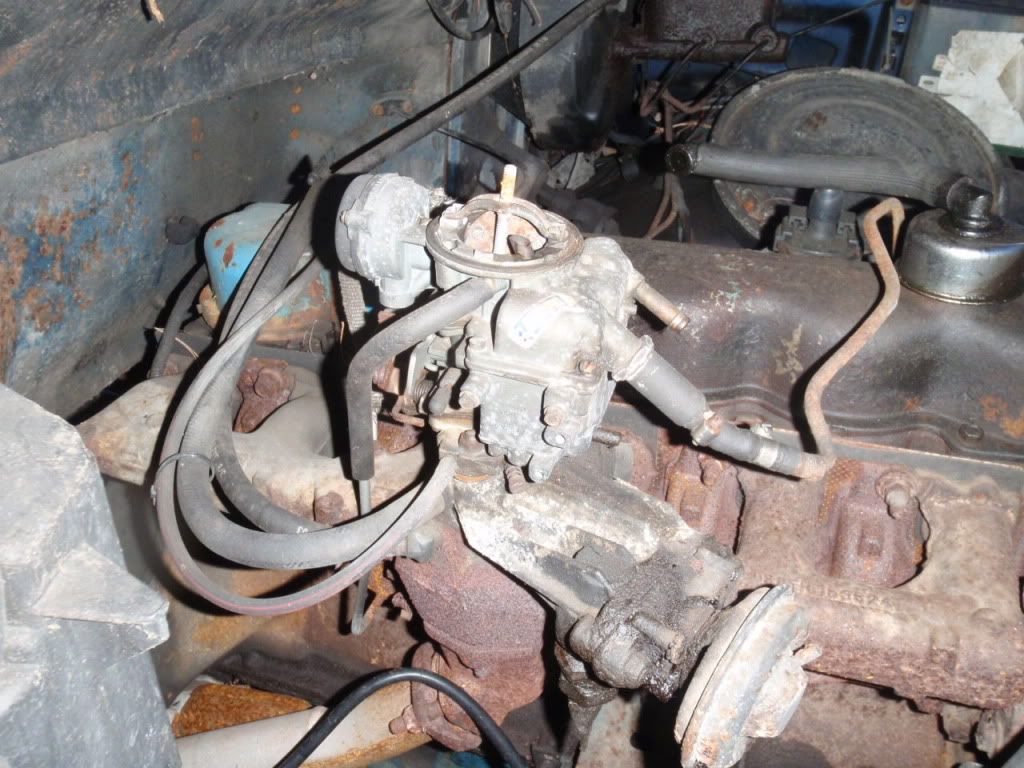
That's definitely a thermatic(non electric) choke.
With the engine dead cold, if you open the throttle and close it, there should be just enough tension on the spring in the choke cap(black piece) to close the choke blade(the butterfly in the top of the carb.)
There should be three screws and retainers on the black cap, which you need to loosen off a bit, and then you can turn the cap to adjust the tension on it.
With the engine dead cold, if you open the throttle and close it, there should be just enough tension on the spring in the choke cap(black piece) to close the choke blade(the butterfly in the top of the carb.)
There should be three screws and retainers on the black cap, which you need to loosen off a bit, and then you can turn the cap to adjust the tension on it.
Thread Starter
|
Logistics Pro
Joined: Dec 2004
Posts: 3,920
Likes: 2
From: Carson City, NV
That's definitely a thermatic(non electric) choke.
With the engine dead cold, if you open the throttle and close it, there should be just enough tension on the spring in the choke cap(black piece) to close the choke blade(the butterfly in the top of the carb.)
There should be three screws and retainers on the black cap, which you need to loosen off a bit, and then you can turn the cap to adjust the tension on it.
With the engine dead cold, if you open the throttle and close it, there should be just enough tension on the spring in the choke cap(black piece) to close the choke blade(the butterfly in the top of the carb.)
There should be three screws and retainers on the black cap, which you need to loosen off a bit, and then you can turn the cap to adjust the tension on it.
Elder User
Joined: May 2008
Posts: 508
Likes: 0
From: Wasilla, AK
The choke is non-electric. It has a bi-metal coil inside under the black cap. When the engines cold just hit the throttle once are twice and turn it over, it should start at hi idle (around 750-850 rpm). As the engine warms up the heat rises thru that pipe that's connected to it (the one with the asbestos sleeve around it) and the bi-metal coil expands. Once you see the temp rise on the instrument gauge just tap the gas pedal and the hi idle should kick off and drop the rpm's to around a 650 idle speed.

Cargo Master
Joined: Dec 2004
Posts: 3,362
Likes: 22
From: Florence, SC
Originally Posted by keyul
usually only start the truck once a month right now. It's still in the process of getting ready for the road.
Your truck has a "hot air" choke. The pipe with the insulation on it that is screwed onto the choke cap is what operates your choke. If you follow that tube, it should be connected to the exhaust manifold. There is second metal tube that goes from the exhaust manifold back up to your carburetor. That is the "fresh air" tube for your "hot air" choke. It is connected to your carburetor by a rubber hose; you can see it in the second picture. Fresh air is pulled from your air cleaner, travels through the "fresh air" tube down to the exhaust manifold where it is heated up, and then the hot air goes up through the "hot air" tube to the choke cap where it opens up the choke as the engine warms up.
The "hot air" choke is actually a better, more accurate choke system than the fully automatic chokes because it is thermostatic, meaning that the choke opens/closes in relation to your engine temperature. On fully automatic chokes, only a timer is used which sometimes comes off too soon or comes on again when the engine doesn't need it.
Originally Posted by keyul
I do have a single wire connector coming from the back of the alternator that is just hanging in the engine compartment that I haven't been able to figure out where it goes.
I think the "electric assist" was mainly for emission purposes, and your choke should operate just fine with only the "hot air" choke properly working.
Thread Starter
|
Logistics Pro
Joined: Dec 2004
Posts: 3,920
Likes: 2
From: Carson City, NV
Hey, everyone, thanks for all the help and info! It turned out that It was just the fuel bowls going dry like stated earlier. I got the truck running this morning then tried running it again in the afternoon. It fired right up and the choke was on! I am so used to efi, glad I got to learn a bit about carburetors. On a side note, I picked of an offenhauser 4bbl aluminum intake manifold yesterday for $30 bucks! Just gotta spend a few minutes cleaning it up and it should look brand new!
Keyul
Keyul
Cargo Master
Joined: Dec 2004
Posts: 3,362
Likes: 22
From: Florence, SC
Glad to help. 
Properly set up and tuned, you will find that a carbureted vehicle will run just as good as any electronic fuel injected vehicle. You just have to remember to drive it once in a while.
Keep your choke and stock thermostatic air cleaner assembly hooked up, and you should enjoy trouble-free operation of your truck no matter how cold it gets.
Thanks to the many helpful members on this site, my carbureted 1985 Lariat will now start right up with one single pump of the accelerator every single time, no matter how cold it may get. Unless of course, I let it sit for over a week without starting it. It runs so smooth in fact, that most people actually assume I have EFI when they ride with me.
Properly set up and tuned, you will find that a carbureted vehicle will run just as good as any electronic fuel injected vehicle. You just have to remember to drive it once in a while.
Keep your choke and stock thermostatic air cleaner assembly hooked up, and you should enjoy trouble-free operation of your truck no matter how cold it gets.
Thanks to the many helpful members on this site, my carbureted 1985 Lariat will now start right up with one single pump of the accelerator every single time, no matter how cold it may get. Unless of course, I let it sit for over a week without starting it. It runs so smooth in fact, that most people actually assume I have EFI when they ride with me.