


Truck making me nuts
Thread Starter
|
Fleet Mechanic


Joined: Mar 2007
Posts: 1,532
Likes: 29
From: northeast Ga
Truck making me nuts
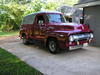
Have you ever had a problem with your truck that you can't solve?My 54 panel e-brake will not hold on any kind of incline.If you pull the brake on and leave it in neutral it will roll backward every time.Cabeles are both new,brakes are new,hold downs are new drums are new,and adjusters are new.I even went so far as cutting panels out of the face of the old drums so I could put them back on and see what was happening inside the drums when using the brakes.I then had the wife work the brakes.First the foot brake and these came out aganist the shoes as they should.Then the hand brake,again they came out aganst the drum,The drums will not turn,until you put the tires on and park on a incline { 6 inch ramps that go up to my lift } I also made a lever between the front and rear cables to increase the leverage and it gives more pressure on brake to drum.I also checked to see if the springs on the end of cables iside of drums where to long and binding when brakes where used.I use my panel to pull my boat and really don't like bakind down a ramp with out a e-brake.I have a old micro lock.That will be my next step if I can"t figuer this out.ANYONE HAVE ANY IDEALS?

Post Fiend
Joined: May 2008
Posts: 7,641
Likes: 21
From: Poway, Ca.
I have the same problem with mine from time to time. It seems to be a matter of adjusting the back shoes in very close, and adjusting the cables equally close as well.
As my brakes wear, it will tend to creep on hills. But odd thing is, it only creeps backwards, not forward!
Did they trim the shoes to match the curvature of the drums when you got them?
As my brakes wear, it will tend to creep on hills. But odd thing is, it only creeps backwards, not forward!
Did they trim the shoes to match the curvature of the drums when you got them?

Laughing Gas
Joined: Nov 2008
Posts: 914
Likes: 51
From: SW Missouri
Are you sure you have the shoes in the correct position? If here is a primary and secondary shoe and if they are reversed they will not hold well in reverse.
Short shoe on the front if my senile old brain is remembering correctly.
If the shoe arc if not the same as the drum arc it will cause the same thing. It sounds like your not getting full shoe contact to the drum.
Short shoe on the front if my senile old brain is remembering correctly.
If the shoe arc if not the same as the drum arc it will cause the same thing. It sounds like your not getting full shoe contact to the drum.

Fleet Owner


Joined: Jul 2004
Posts: 27,294
Likes: 1,055
From: NM
As Julie said, adjustment has to be right with both brakes off (e-brake and hydraulic.) There should be light drag with the drums cold, usually once per rev they'll hang up a little. As you adjust, hit and release the foot brake to re-center them, keep going until it won't turn, then back off a click or two.
After you do that, then adjust the main e-brake cable to where two or three clicks sets the brakes hard, but when released there is no drag (in addition to what it had after adjusting the shoes).
If you haven't, oil the bellcrank on the e-brake (where the three cables come together) liberally. Mine appeared to be fine, but after a good squirt, it started moving completely differently! One of the pivot holes is slotted and the bellcrank needs to slide in the slot. Made a big difference, it equalizes the pull on the two cables to the drums.
After you do that, then adjust the main e-brake cable to where two or three clicks sets the brakes hard, but when released there is no drag (in addition to what it had after adjusting the shoes).
If you haven't, oil the bellcrank on the e-brake (where the three cables come together) liberally. Mine appeared to be fine, but after a good squirt, it started moving completely differently! One of the pivot holes is slotted and the bellcrank needs to slide in the slot. Made a big difference, it equalizes the pull on the two cables to the drums.
Thread Starter
|
Fleet Mechanic
Joined: Mar 2007
Posts: 1,532
Likes: 29
From: northeast Ga
I have the short shoes on the front.I even turnd them around to see if it made a difference.I have adjusted the shoes so they drag,and still no go.I have adjusted the e-brake up to the point,that I can't pullit more than 3 clicks.I have pulled the handel so hard it bent,and had to be taken off to be straightened out.With my cut out drum I can see the shoes contacting the drum.Every thing appears to be working right they just don't hold.We used to cut groves in our dirt bike brakes to make them work better.Could this help?
Laughing Gas
Joined: Nov 2008
Posts: 914
Likes: 51
From: SW Missouri
I am still thinking they are not the same arc.
I would try to cover the shoes with something (talc power perhaps or something that would stick to the shoes) put the drums back on and turn drum and apply parking brakes and see how much of the shoes are touching the drum.
They have to be not centering and not enough shoe surface touching the drum. They, even when new, did not hold as well in reverse as they did in froward.
Good luck
Larry
I would try to cover the shoes with something (talc power perhaps or something that would stick to the shoes) put the drums back on and turn drum and apply parking brakes and see how much of the shoes are touching the drum.
They have to be not centering and not enough shoe surface touching the drum. They, even when new, did not hold as well in reverse as they did in froward.
Good luck
Larry
Thread Starter
|
Fleet Mechanic
Joined: Mar 2007
Posts: 1,532
Likes: 29
From: northeast Ga
Trending Topics
Roast em' if you got 'em
Joined: Mar 2005
Posts: 22,000
Likes: 9,890
From: Rio Rancho, NM

I wonder if it would help to replace the shorter front brake shoe with a longer (rear) shoe? Every drum brake emergency/parking brake I've ever had has always worked better in a forward direction. Its very typicall to be able to back out of the driveway and then not be able to go forward only to realise that you forgot the release the brake.
The brake shoes basically float on a single pivot on the backing plate. When you step on the brakes the shoes push out and contact the drum. The rotation of the drum tries to rotate the brake shoe assy thereby forcing the rear shoe (the longer one) into the drum with more force than just that of the wheel cylinder give it. Thats why the difference in shoe lengths. Perhaps if you replace the front shoe with one like the longer rear shoe it might give you some more effective braking surface area. Its just a thought.
Another idea that might help with your being able to leave the truck for short periods of time on the boat ramp is a "line lock" or "anti roll" solenoid. Lots of drag racers use them as well as rock crawlers. You can get them in either electric or mechanical. Basically its a solenoid that installs in the brake line and holds pressure when activated. You wouldn't want to use this as parking brake for long periods but for the short term while launching a boat, etc it would probably work great.
Bobby
The brake shoes basically float on a single pivot on the backing plate. When you step on the brakes the shoes push out and contact the drum. The rotation of the drum tries to rotate the brake shoe assy thereby forcing the rear shoe (the longer one) into the drum with more force than just that of the wheel cylinder give it. Thats why the difference in shoe lengths. Perhaps if you replace the front shoe with one like the longer rear shoe it might give you some more effective braking surface area. Its just a thought.
Another idea that might help with your being able to leave the truck for short periods of time on the boat ramp is a "line lock" or "anti roll" solenoid. Lots of drag racers use them as well as rock crawlers. You can get them in either electric or mechanical. Basically its a solenoid that installs in the brake line and holds pressure when activated. You wouldn't want to use this as parking brake for long periods but for the short term while launching a boat, etc it would probably work great.
Bobby
FTE Stories
Ford Trucks for Ford Truck Enthusiasts

10 Things Every Truck Owner NEEDS (2026 Edition)
Michael S. Palmer
Rezvani's Latest Post-Apocalyptic Monster Is a Ford F-150 Raptor Underneath
Verdad Gallardo
Top 10 Most Expensive Ford Trucks Ever Sold on Bring a Trailer
Joe Kucinski
2027 Ford Super Duty Buyer's Guide (Every Model, Engine, & Package)
Brett Foote
Top 10 Ford Truck Tragedies
Joe Kucinski
AEV FXL Super Duty - the Super Duty Raptor Ford Doesn't Make
Brett Foote
Lobo Vs Lobo: Proof the F-150 Lobo Should Be Even Lower!
Michael S. Palmer
Ford's 2001 Explorer Sportsman Concept Looks For a New Home
Verdad Gallardo
10 Best Ford Truck Engines We Miss the Most!
Joe Kucinski
Fleet Owner
Joined: Jul 2004
Posts: 27,294
Likes: 1,055
From: NM
I wonder if it would help to replace the shorter front brake shoe with a longer (rear) shoe? Every drum brake emergency/parking brake I've ever had has always worked better in a forward direction. Its very typicall to be able to back out of the driveway and then not be able to go forward only to realise that you forgot the release the brake.....Bobby

Cargo Master
Joined: Jun 2001
Posts: 2,571
Likes: 22
From: Oxford, Indiana

As Julie said they seem to work forward but not backward.
BRAKE LOCK-LINE LOCK-PARK LOCK ,Great for Cars & Trucks : eBay Motors (item 230436257282 end time Mar-13-10 11:25:52 PST)

Elder User
Joined: May 2006
Posts: 907
Likes: 1
From: Kansas City, Mo
Reading the thread. I see Julie's question of grinding the shoes to match the drum was not answered. This makes a big difference. Sounds like a lot of swapping shoes. Were the original new shoes re-installed after all the testing. chuck
Laughing Gas
Joined: Nov 2008
Posts: 914
Likes: 51
From: SW Missouri
The brakes will not hold unless the shoes are in full contact with the drums. Years ago when you turned the drums and installed new shoes you had the shoes "arced” to match the new drums circle. When you make the drum larger the factory shoes no longer "fit" the diameter of the drum. With aftermarket shoes and all the other things that happen over 40 years I doubt if you’re getting full contact. As I said earlier I drove these when they were new and the parking brake was not great in reverse back then, but would hold the truck when everything was correct. The parking brake has a different leverage point to expand the shoes than the wheel cylinder does. So the regular brakes will hold when the parking brake does not. When you consider the shoe material is a couple inches wide and 8 or so inches long on each shoe in contact with the drum, we are lucky they stop at all.
I am sure I have, in the shop, a service bulletin issued in early 50's about the parking brake not holding in reverse. I will try to look it up tomorrow.
I am pretty sure one of the cures was arcing the shoes to drum clearances as well as oiling pivot points as some others have mentioned
The not holding in reverse was not an uncommon complaint in the 50's
Larry
I am sure I have, in the shop, a service bulletin issued in early 50's about the parking brake not holding in reverse. I will try to look it up tomorrow.
I am pretty sure one of the cures was arcing the shoes to drum clearances as well as oiling pivot points as some others have mentioned
The not holding in reverse was not an uncommon complaint in the 50's
Larry

Hotshot
Joined: Oct 2004
Posts: 15,882
Likes: 88
From: Durham NC
In the fifties you were taught that when parking on a hill, park headed downhill and/or turn your wheels into the curb (almost all parking back then was parallel along a curb).
Unlike today's mechanical setting brake called a "parking" brake, and almost a joke should you use it to try to stop a car with failed brakes (ask Toyota drivers who had the gas pedal stick!!!) The hand brake back then was called an EMERGENCY brake and was supposed to stop a moving vehicle with failed brakes (a fairly common occurance with single circuit brakes), and was the reason the handle was made so hefty. No one in their right mind parked ther vehicle in neutral back then unless they chocked the wheels with the blocks everyone carried under the seat or in the trunk for changing a flat tire. I argued my way out of a failed equipment ticket with my 57 Dodge SW. It had a band around a small drum on the back of the transmission for an auxilliary brake. The cop that pulled me because he first thought it was strange that a teen was driving a SW, noticed the jacked up stance and traction bars on the rear springs (it had a "warmed over" Hemi and stick tranny, a sleeper at the midnight drags) and decided he was going to find a reason to give me a ticket. After checking the exhaust system, lights, horn and wipers he finally asked me to set the "emergency" brake and pull ahead until the engine stalled while he watched the taillights for brake lights. I had changed the band and lining a few weeks before, but the new lining started dragging and smelling, so I backed off the adjuster. I knew the brake would not hold so I tried to fake it by popping the clutch at an idle. Hecaught onto that real quick and told me to rev the engine and do it again. I couldn't fake it so the car pulled ahead.
He pulled out his citation book to start writing me a ticket. I stopped him and explained how it worked differently from other cars and that Chrysler did not designate that brake as an emergency brake, but only as a parking brake and it was not expected to hold against the engine power. I told him I was a licensed state safety inspector (I was)and knew this for a fact and would fight the ticket if he wrote it. He stood there looking confused for a few minutes, and finally said "I'm not sure if you are right or not, (I wasn't, it was BS) but you might be so I'll let you go this time" handed me back my license and registration and walked away.
The organic asbestos linings used in the 50's were also much softer than today's metalic or semi-metalic linings, so they held better at a stand still. I agree that a line lock would be the solution for your boat launching needs, ...or a couple of wheel chocks.
Unlike today's mechanical setting brake called a "parking" brake, and almost a joke should you use it to try to stop a car with failed brakes (ask Toyota drivers who had the gas pedal stick!!!) The hand brake back then was called an EMERGENCY brake and was supposed to stop a moving vehicle with failed brakes (a fairly common occurance with single circuit brakes), and was the reason the handle was made so hefty. No one in their right mind parked ther vehicle in neutral back then unless they chocked the wheels with the blocks everyone carried under the seat or in the trunk for changing a flat tire. I argued my way out of a failed equipment ticket with my 57 Dodge SW. It had a band around a small drum on the back of the transmission for an auxilliary brake. The cop that pulled me because he first thought it was strange that a teen was driving a SW, noticed the jacked up stance and traction bars on the rear springs (it had a "warmed over" Hemi and stick tranny, a sleeper at the midnight drags) and decided he was going to find a reason to give me a ticket. After checking the exhaust system, lights, horn and wipers he finally asked me to set the "emergency" brake and pull ahead until the engine stalled while he watched the taillights for brake lights. I had changed the band and lining a few weeks before, but the new lining started dragging and smelling, so I backed off the adjuster. I knew the brake would not hold so I tried to fake it by popping the clutch at an idle. Hecaught onto that real quick and told me to rev the engine and do it again. I couldn't fake it so the car pulled ahead.
He pulled out his citation book to start writing me a ticket. I stopped him and explained how it worked differently from other cars and that Chrysler did not designate that brake as an emergency brake, but only as a parking brake and it was not expected to hold against the engine power. I told him I was a licensed state safety inspector (I was)and knew this for a fact and would fight the ticket if he wrote it. He stood there looking confused for a few minutes, and finally said "I'm not sure if you are right or not, (I wasn't, it was BS) but you might be so I'll let you go this time" handed me back my license and registration and walked away.
The organic asbestos linings used in the 50's were also much softer than today's metalic or semi-metalic linings, so they held better at a stand still. I agree that a line lock would be the solution for your boat launching needs, ...or a couple of wheel chocks.

Fleet Owner


Joined: Dec 2000
Posts: 25,378
Likes: 5,387
From: Central PA
The trucks I drove at the lumber yard (Ford F-600's and Internationals of the same size) when I was in college (early to mid 70's) had a brake line lock on them. It mounted just under the dash and had a lever to flip up to lock the brakes when you stepped on the brakes. It was quite useful as the emergency brakes would not hold a big truck with a full load of lumber or dry wall, etc. It was especially valuable when we used the high lift truck to lift a load of shingles to the roof edge or dry wall to a second floor. I can't remember the name brand but it was something like Saf-T-Lok.
Anyone else have experience with these type of brake locks?
Anyone else have experience with these type of brake locks?