



Found a cowl induction hood
Post Fiend
Joined: Jul 2006
Posts: 6,948
Likes: 44
Here is a direct link: 1979 FORD F150 "COWL INDUCTION" HOOD:eBay Motors (item 130354803539 end time Jan-02-10 15:55:09 PST)
Kind of a ton of money for a hood that ended up looking like that.
Appears that two hoods were used to make one.
Without making the cowl functional, and cutting the center section out, it leaves way too much area for water to collect. I'm confident that the area where the steel was welded together under the raised section wil rust in no time.
Does look like quite a bit of work has gone into this though.
Kind of a ton of money for a hood that ended up looking like that.
Appears that two hoods were used to make one.
Without making the cowl functional, and cutting the center section out, it leaves way too much area for water to collect. I'm confident that the area where the steel was welded together under the raised section wil rust in no time.
Does look like quite a bit of work has gone into this though.
Thread Starter
|
Laughing Gas


Joined: Feb 2002
Posts: 1,067
Likes: 13
From: Kincardine, ON
I agree it's a bucket of money for something that doesn't actually work the way it's supposed to. Interesting to see what pops up from time to time though. Thanks for the direct link!
Save the old ones

Joined: Dec 2002
Posts: 666
Likes: 4
From: Boyne Mich

But the '79 (& 78 I think) has holes on the front edge for the FORD letters emblems, While the '73-'77 have the FORD letters on the Grill. BUt I know you knew that.
Yep, The bottom of that hood looks like a stock one. I don't think you're going to fit any bigger induction system under that.
Laughing Gas
Joined: Mar 2004
Posts: 1,243
Likes: 0
From: Maple Ridge B.C. Canada
i think if a hood has a scoop on it, or a raised cowl... it should be functional. thats just my opinion.
Trending Topics
Save the old ones
Joined: Dec 2002
Posts: 666
Likes: 4
From: Boyne Mich
Yeah, I'm a little nervous
FTE Stories
Ford Trucks for Ford Truck Enthusiasts

10 Ugly Ford Trucks That We Still Kinda Love
Joe Kucinski
10 Things Every Truck Owner NEEDS (2026 Edition)
Michael S. Palmer
Rezvani's Latest Post-Apocalyptic Monster Is a Ford F-150 Raptor Underneath
Verdad Gallardo
Top 10 Most Expensive Ford Trucks Ever Sold on Bring a Trailer
Joe Kucinski
2027 Ford Super Duty Buyer's Guide (Every Model, Engine, & Package)
Brett Foote
Top 10 Ford Truck Tragedies
Joe Kucinski
AEV FXL Super Duty - the Super Duty Raptor Ford Doesn't Make
Brett Foote
Lobo Vs Lobo: Proof the F-150 Lobo Should Be Even Lower!
Michael S. Palmer
Ford's 2001 Explorer Sportsman Concept Looks For a New Home
Verdad Gallardo
Elder User
Joined: Jun 2008
Posts: 572
Likes: 0
From: Duncan B.C.
If we're being technical, there are differences. The older ones ('73-'77 I think), have a different support stamping. The underside of the hood looks different. And then there's the "hood satabilizer" that locates the rear of the hood to the cowl on all of my '78-'79 Bronco hoods. I have read, (on this site, I think), that these can also be found on trucks that were ordered with a Factory Bed Cap ( canopy). I have yet to hear a satisfactory explaination as to why these are only on Broncos and canopied trucks. One was that this kept the hood from going through the windshield in the event of a head on collision. But that doesn't make sense to me. Why would a canopy (or removeable fiberglass roof, in the case of a Bronco), make the hood more likely to go through the windshield? I have only ever seen these on Broncos, so I thought maybe there were some structural differences that made the hood stabilizer necessary, although I don't know what these differences might be. But if, as I've read, the stabilizer is also found on canopied trucks, that blows that theory. I assume the only difference in the hood itself is the mounting holes and bracket for the stabilizer. A small difference, I admit, but a difference none the less. Anybody know for sure? ( I hope this isn't considered a highjacking, and appologize if it is.)

Cargo Master


Joined: Jan 2008
Posts: 2,219
Likes: 190
From: Colorado Springs
If we're being technical, there are differences. The older ones ('73-'77 I think), have a different support stamping. The underside of the hood looks different. And then there's the "hood satabilizer" that locates the rear of the hood to the cowl on all of my '78-'79 Bronco hoods. I have read, (on this site, I think), that these can also be found on trucks that were ordered with a Factory Bed Cap ( canopy). I have yet to hear a satisfactory explaination as to why these are only on Broncos and canopied trucks. One was that this kept the hood from going through the windshield in the event of a head on collision. But that doesn't make sense to me. Why would a canopy (or removeable fiberglass roof, in the case of a Bronco), make the hood more likely to go through the windshield? I have only ever seen these on Broncos, so I thought maybe there were some structural differences that made the hood stabilizer necessary, although I don't know what these differences might be. But if, as I've read, the stabilizer is also found on canopied trucks, that blows that theory. I assume the only difference in the hood itself is the mounting holes and bracket for the stabilizer. A small difference, I admit, but a difference none the less. Anybody know for sure? ( I hope this isn't considered a highjacking, and appologize if it is.)
Ford Parts Specialist
Joined: Nov 2006
Posts: 88,826
Likes: 787
From: Simi Valley, CA

If we're being technical, there are differences. The older ones ('73-'77 I think), have a different support stamping. The underside of the hood looks different. And then there's the "hood satabilizer" that locates the rear of the hood to the cowl on all of my '78-'79 Bronco hoods. I have read, (on this site, I think), that these can also be found on trucks that were ordered with a Factory Bed Cap ( canopy). I have yet to hear a satisfactory explaination as to why these are only on Broncos and canopied trucks. One was that this kept the hood from going through the windshield in the event of a head on collision. But that doesn't make sense to me. Why would a canopy (or removeable fiberglass roof, in the case of a Bronco), make the hood more likely to go through the windshield? I have only ever seen these on Broncos, so I thought maybe there were some structural differences that made the hood stabilizer necessary, although I don't know what these differences might be. But if, as I've read, the stabilizer is also found on canopied trucks, that blows that theory. I assume the only difference in the hood itself is the mounting holes and bracket for the stabilizer. A small difference, I admit, but a difference none the less. Anybody know for sure? ( I hope this isn't considered a highjacking, and appologize if it is.)
Fits: 1973/79 F100/350 & 1978/79 Bronco.

Senior User
Joined: Jul 2009
Posts: 240
Likes: 1
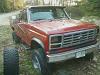
600 is alot to pay for a hood especially one that dosen't really look all that good. I like the way mine turned out because it almost looks factory. Mine is not functional but that is on my to-do list while I am rebuilding the truck.

Freshman User
Joined: May 2011
Posts: 39
Likes: 0
From: Northern New Hampshire
uh ohhhh
i have been looking for one of these for EVER, can never find one though... and fiberglass would be nice, but i like the steel for the woods.... steel doesnt crack when you mow down a tree 
Here is a direct link: 1979 FORD F150 "COWL INDUCTION" HOOD:eBay Motors (item 130354803539 end time Jan-02-10 15:55:09 PST)
Kind of a ton of money for a hood that ended up looking like that.
Appears that two hoods were used to make one.
Without making the cowl functional, and cutting the center section out, it leaves way too much area for water to collect. I'm confident that the area where the steel was welded together under the raised section wil rust in no time.
Does look like quite a bit of work has gone into this though.
Kind of a ton of money for a hood that ended up looking like that.
Appears that two hoods were used to make one.
Without making the cowl functional, and cutting the center section out, it leaves way too much area for water to collect. I'm confident that the area where the steel was welded together under the raised section wil rust in no time.
Does look like quite a bit of work has gone into this though.

Logistics Pro
Joined: May 2003
Posts: 4,238
Likes: 21
From: Northern Illinois
They are made to poke the cowl in an accident not allowing the hood to pop up over the cowl and thru the windsheild. I have no idea why Bronco's only got those.