


Carb spacers

FE "Freakin Expensive"
Joined: Dec 2003
Posts: 6,461
Likes: 4
From: Smith Mountain Lake, VA

All a T-stat is good for is cold weather starts !! and and useing a higher temp one will make sure you have heat quicker to the heater coil... They do nothing...to keep the motor running cooler ! and engine has a operating temp built in at the factory..with the size of radiator it runs and the size of its coolant lines.. Generally around 180* to 190* is about what the FE's run stock..During the summer ! If there running hotter than that you have a cooling system problem..
As far as the heat cross over... Its only needed in colder climates....for cold weather starts....and the Phenolic spacer will help a little with a cooler fuel charge and a 1" thick spcaer and above will help with a little top end..and depending on the build have been shown to also give some bottom end also.. Generally speaking the Four hole spacer helps with bottom end and the open hole spacer with some to in HP improvement's.. JMO
I just have to laugh at guys with cooling problems and they install a 160* T-stat and think thats going to fix there problems... Once the T-stat is open its al on the cooling system..and nothing else...
When i did alot of Skiing (snow) out in SoCal and was driving old vehicles...During the winter for cold starts I ran a 160* Stat for quicker warm-ups, and during the spring ,summer and fall I didnt run any T-stat to keep them as cool as I could..
As far as the heat cross over... Its only needed in colder climates....for cold weather starts....and the Phenolic spacer will help a little with a cooler fuel charge and a 1" thick spcaer and above will help with a little top end..and depending on the build have been shown to also give some bottom end also.. Generally speaking the Four hole spacer helps with bottom end and the open hole spacer with some to in HP improvement's.. JMO
I just have to laugh at guys with cooling problems and they install a 160* T-stat and think thats going to fix there problems... Once the T-stat is open its al on the cooling system..and nothing else...
When i did alot of Skiing (snow) out in SoCal and was driving old vehicles...During the winter for cold starts I ran a 160* Stat for quicker warm-ups, and during the spring ,summer and fall I didnt run any T-stat to keep them as cool as I could..

Post Fiend
Joined: Mar 2004
Posts: 6,056
Likes: 8
From: Union, Washington
All a T-stat is good for is cold weather starts !! and and useing a higher temp one will make sure you have heat quicker to the heater coil... They do nothing...to keep the motor running cooler ! and engine has a operating temp built in at the factory..with the size of radiator it runs and the size of its coolant lines.. Generally around 180* to 190* is about what the FE's run stock..During the summer ! If there running hotter than that you have a cooling system problem..
As far as the heat cross over... Its only needed in colder climates....for cold weather starts....and the Phenolic spacer will help a little with a cooler fuel charge and a 1" thick spcaer and above will help with a little top end..and depending on the build have been shown to also give some bottom end also.. Generally speaking the Four hole spacer helps with bottom end and the open hole spacer with some to in HP improvement's.. JMO
I just have to laugh at guys with cooling problems and they install a 160* T-stat and think thats going to fix there problems... Once the T-stat is open its al on the cooling system..and nothing else...
When i did alot of Skiing (snow) out in SoCal and was driving old vehicles...During the winter for cold starts I ran a 160* Stat for quicker warm-ups, and during the spring ,summer and fall I didnt run any T-stat to keep them as cool as I could..
As far as the heat cross over... Its only needed in colder climates....for cold weather starts....and the Phenolic spacer will help a little with a cooler fuel charge and a 1" thick spcaer and above will help with a little top end..and depending on the build have been shown to also give some bottom end also.. Generally speaking the Four hole spacer helps with bottom end and the open hole spacer with some to in HP improvement's.. JMO
I just have to laugh at guys with cooling problems and they install a 160* T-stat and think thats going to fix there problems... Once the T-stat is open its al on the cooling system..and nothing else...
When i did alot of Skiing (snow) out in SoCal and was driving old vehicles...During the winter for cold starts I ran a 160* Stat for quicker warm-ups, and during the spring ,summer and fall I didnt run any T-stat to keep them as cool as I could..
First, the T-stat does control how hot the engine will run at, if it does not then you have an inadequate cooling system, mainly not enough radiator or air /water flow thru said radiator.
Second, a space makes the intake runner "longer" there by helping low end not WOT, especially the 4 hole type spacer. If the intake is poorly designed then the space may straighten out the air flow and help top end, but a properly designed intake would be a better way to go.
Third, a 160° T-stat will not make or let an engine reach 160° fast than say a 190° T-stat. The hotter T-stat just lets the engine warm up an extra 30° in the end but of course that takes longer.
Fourth, if your T-stat does not cycle while at operating temp, then you have a problem. If the water circulates all the time it will not stay in the radiator long enough to be cooled. When I was drag racing, we tried the no T-state thing and the engines would over heat. Knock the valve portion out of the T-stat, causing a restriction and no over hearing and it took longer for the engine to reach operating temp, which was desired for producing extra power
I do agree with your contention that changing to a 160° T-stat will not solve and overheat problem.
FE "Freakin Expensive"
Joined: Dec 2003
Posts: 6,461
Likes: 4
From: Smith Mountain Lake, VA
I disagree on a couple of items.
First, the T-stat does control how hot the engine will run at, if it does not then you have an inadequate cooling system, mainly not enough radiator or air /water flow thru said radiator.
Second, a space makes the intake runner "longer" there by helping low end not WOT, especially the 4 hole type spacer. If the intake is poorly designed then the space may straighten out the air flow and help top end, but a properly designed intake would be a better way to go.
Third, a 160° T-stat will not make or let an engine reach 160° fast than say a 190° T-stat. The hotter T-stat just lets the engine warm up an extra 30° in the end but of course that takes longer.
Fourth, if your T-stat does not cycle while at operating temp, then you have a problem. If the water circulates all the time it will not stay in the radiator long enough to be cooled. When I was drag racing, we tried the no T-state thing and the engines would over heat. Knock the valve portion out of the T-stat, causing a restriction and no over hearing and it took longer for the engine to reach operating temp, which was desired for producing extra power
I do agree with your contention that changing to a 160° T-stat will not solve and overheat problem.
First, the T-stat does control how hot the engine will run at, if it does not then you have an inadequate cooling system, mainly not enough radiator or air /water flow thru said radiator.
Second, a space makes the intake runner "longer" there by helping low end not WOT, especially the 4 hole type spacer. If the intake is poorly designed then the space may straighten out the air flow and help top end, but a properly designed intake would be a better way to go.
Third, a 160° T-stat will not make or let an engine reach 160° fast than say a 190° T-stat. The hotter T-stat just lets the engine warm up an extra 30° in the end but of course that takes longer.
Fourth, if your T-stat does not cycle while at operating temp, then you have a problem. If the water circulates all the time it will not stay in the radiator long enough to be cooled. When I was drag racing, we tried the no T-state thing and the engines would over heat. Knock the valve portion out of the T-stat, causing a restriction and no over hearing and it took longer for the engine to reach operating temp, which was desired for producing extra power
I do agree with your contention that changing to a 160° T-stat will not solve and overheat problem.
And as far as the spacers go..its been shown on the dyno that the 4 hole spacers make more Tq and the open spacer makes more HP..and I dont meen dyno tests posted out of some Rag mag either.. But this isnt a pissing match..Just opinions..
With your semi restricted T-Stat with the valve portion gone and you hotrod over heated doesnt make sence to me ? But that was your ride.. You must have gone back yo back rounds then... I ran hard block up to the water pump holes without a T-stat and never had any over heating problems.. But that was one of my hotrods.. As a matter of fact that same car after the track..the slicks came off and the street rubber went on it..I drove home in L.A. traffic and it never over heated then either.. ?

But whatever worked for you... No worries... You know what you have gone thru as do I...

Moderator


Joined: Aug 2002
Posts: 6,099
Likes: 380
From: Southern California

OMG.....
While increasing the height will help slightly the temp item, a real heat sheild placed between the carb & manifold does exactly what it is suppose to do...shield the carb from convected heat.
Spacers work but to increase tunnel length and change velocities (turbulence) to promote low end tq or high end flow by using either one with holes or an open design-
very old school engine building basics.................................
While increasing the height will help slightly the temp item, a real heat sheild placed between the carb & manifold does exactly what it is suppose to do...shield the carb from convected heat.
Spacers work but to increase tunnel length and change velocities (turbulence) to promote low end tq or high end flow by using either one with holes or an open design-
very old school engine building basics.................................

Senior User
Joined: Dec 2008
Posts: 124
Likes: 0
From: Mississippi
All a T-stat is good for is cold weather starts !! and and useing a higher temp one will make sure you have heat quicker to the heater coil... They do nothing...to keep the motor running cooler ! and engine has a operating temp built in at the factory..with the size of radiator it runs and the size of its coolant lines.. Generally around 180* to 190* is about what the FE's run stock..During the summer ! If there running hotter than that you have a cooling system problem..
As far as the heat cross over... Its only needed in colder climates....for cold weather starts....and the Phenolic spacer will help a little with a cooler fuel charge and a 1" thick spcaer and above will help with a little top end..and depending on the build have been shown to also give some bottom end also.. Generally speaking the Four hole spacer helps with bottom end and the open hole spacer with some to in HP improvement's.. JMO
I just have to laugh at guys with cooling problems and they install a 160* T-stat and think thats going to fix there problems... Once the T-stat is open its al on the cooling system..and nothing else...
When i did a lot of Skiing (snow) out in SoCal and was driving old vehicles...During the winter for cold starts I ran a 160* Stat for quicker warm-ups, and during the spring ,summer and fall I didnt run any T-stat to keep them as cool as I could..
As far as the heat cross over... Its only needed in colder climates....for cold weather starts....and the Phenolic spacer will help a little with a cooler fuel charge and a 1" thick spcaer and above will help with a little top end..and depending on the build have been shown to also give some bottom end also.. Generally speaking the Four hole spacer helps with bottom end and the open hole spacer with some to in HP improvement's.. JMO
I just have to laugh at guys with cooling problems and they install a 160* T-stat and think thats going to fix there problems... Once the T-stat is open its al on the cooling system..and nothing else...
When i did a lot of Skiing (snow) out in SoCal and was driving old vehicles...During the winter for cold starts I ran a 160* Stat for quicker warm-ups, and during the spring ,summer and fall I didnt run any T-stat to keep them as cool as I could..

Elder User
Joined: Jun 2009
Posts: 511
Likes: 1
I know there is more to cooling than the T-stat. Put it this way my 390 runs 150-160 deg.f in the winter and 160-180 in the summer, the 180 deg is only when I'm running it real hard. No cooling problems here, wrong assumption or I didn't explain well? All of my other components must be working fine with temperatures I'm running. What do you think? Thanks Bear 45/70 for the 160-190 deg f. explanation and about the 30 deg extra time.
Post Fiend
Joined: Mar 2004
Posts: 6,056
Likes: 8
From: Union, Washington
It sounds like a cold engine. Could affect mileage and drivability. Even if you live south a engine freshly started is still a cold engine. Cold engines build sludge. Not that I know anything but street engines suffer from removing device's desinged to improve everyday driveability. My FE doesn't run good until it gets to 190. But I still have my manifold stove, dialed in choke, correct T/stat, original air cleaner. Just 2 cents I'm sure someone else will disput.
If the cold engine at start up thing worries you there are block heaters that you can use (it is not required that the outside temp be sub-freezing). We run block heater on our fire trucks and they live in a heated building.
Elder User
Joined: Jun 2009
Posts: 511
Likes: 1
Most engine wear happens at start up before oil is circulating properly. If it concerns you there are pre-oiler kits available so you will have oil pressure before you crank the engine.
If the cold engine at start up thing worries you there are block heaters that you can use (it is not required that the outside temp be sub-freezing). We run block heater on our fire trucks and they live in a heated building.
If the cold engine at start up thing worries you there are block heaters that you can use (it is not required that the outside temp be sub-freezing). We run block heater on our fire trucks and they live in a heated building.
FTE Stories
Ford Trucks for Ford Truck Enthusiasts

AEV FXL Super Duty - the Super Duty Raptor Ford Doesn't Make
Brett Foote
Lobo Vs Lobo: Proof the F-150 Lobo Should Be Even Lower!
Michael S. Palmer
Ford's 2001 Explorer Sportsman Concept Looks For a New Home
Verdad Gallardo
10 Best Ford Truck Engines We Miss the Most!
Joe Kucinski
2026 Shelby F-150 Off-Road: Better Than a Raptor R?
Brett Foote
2027 Super Duty Carhartt Package First Look: 12 Things You NEED to Know!
Michael S. Palmer
10 Most Surprising 2026 Ford Truck Features!
Joe Kucinski
Top 10 Ford Trucks Coming to Mecum Indy 2026
Brett Foote
5 Best / 5 Worst Ford Truck Wheels of All Time
Joe Kucinski
Post Fiend
Joined: Mar 2004
Posts: 6,056
Likes: 8
From: Union, Washington
And my second comment addresses that issue.
Post Fiend
Joined: Mar 2004
Posts: 6,056
Likes: 8
From: Union, Washington
The Hood Canal has ice all the way across it for the first time since the mid 1960s and before that the 1920s. Some Global warming.
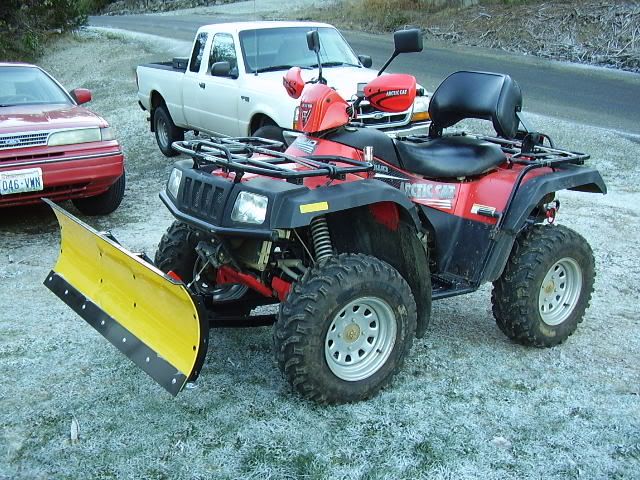
 I bought a snow plow earlier this week for my quad. probably means it will snow everywhere in the state except in Union.
Senior User
Joined: Dec 2008
Posts: 124
Likes: 0
From: Mississippi
OMG.....
While increasing the height will help slightly the temp item, a real heat sheild placed between the carb & manifold does exactly what it is suppose to do...shield the carb from convected heat.
Spacers work but to increase tunnel length and change velocities (turbulence) to promote low end tq or high end flow by using either one with holes or an open design-
very old school engine building basics.................................
While increasing the height will help slightly the temp item, a real heat sheild placed between the carb & manifold does exactly what it is suppose to do...shield the carb from convected heat.
Spacers work but to increase tunnel length and change velocities (turbulence) to promote low end tq or high end flow by using either one with holes or an open design-
very old school engine building basics.................................
Senior User
Joined: Dec 2008
Posts: 124
Likes: 0
From: Mississippi
It sounds like a cold engine. Could affect mileage and drivability. Even if you live south a engine freshly started is still a cold engine. Cold engines build sludge. Not that I know anything but street engines suffer from removing device's desinged to improve everyday driveability. My FE doesn't run good until it gets to 190. But I still have my manifold stove, dialed in choke, correct T/stat, original air cleaner. Just 2 cents I'm sure someone else will disput.
Moderator
Joined: Aug 2002
Posts: 6,099
Likes: 380
From: Southern California
beechkid I agree a spacer between the carb will help shield the convecting heat from the engine\ intake, if you are having a problem. A lot of the 4 hole spacers, open spacers, height of spacer, deck height of intake,etc.,depends on the intake factory deck height and design, not all designs from the different companys need spacers. Engineers have spent a lot of time and money, data, testing, etc. Including: Flow rates, port angles, materials, port dimensions, for a wide range of applications. Go to the source: Holley, Edelbrock, Weiand, Blue thunder, etc. and different styles in their produce line are for a wide range of different applications. Sometimes a 4 hole spacer will work, creating more atomization and turbulance than a open spacer.Sometimes a open spacer works better. The higher you raise your carb from your intake, 1",2",3' spacer will affect the power range and design of the intake and designed rpm range of the intake.
Elder User
Joined: Jun 2009
Posts: 511
Likes: 1
kennewick, oil just doesn't build sludge from running a low engine temp. I disagree, poor quality oils produce sludge. I didn't know Castrol, Mobil, Shell, Pennzoil, Royal Purple, etc. even suggest a temperature range of engines to keep sludge from forming? Oil break down produces sludge. You run what you are comfortable with. Just my two cents, zrxlover. I have no driveability issues, pulled many valve covers off using quality oils and no sludge. Mileage, plugs look like I just put them in about six months ago, a little carbon,white to light tan insulators but plug chart says normal. Do you know what octane is? It is just a anti-knock index. the lower the temp and pressure the lower octane you need to fully burn gas.You can use higher compression pistons and lower engine temp and use a lower octane gas. The more temp( operating temp) and pressure in the cylinder, you will need a higher octane gas to stop pre-ignition. you want to run the lowest octane allowable without detonation or pre-ignition for complete combustion.