


Hi Guys
Thread Starter
|
Hotshot


Joined: Oct 2009
Posts: 16,192
Likes: 4,800
From: Burbank, WA
Hi Guys
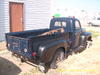
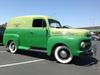
Occasional lurker just turned member. I recently rescued from the depths of a barn a 1952 Mercury M-1 flatbed truck. I believe it is a factory half-ton flatbed, as it has the short runningboards and is missing the third bracket, with no scarring of it ever having had one. The wood (what's left of it) fits too good and the square nuts on everything scream original. It's a very solid truck and I'm looking forward to it being a very enjoyable project for me. I'm no stranger to the early effies, as I've been playing with them, off and on, for about 35 years. But this is my first Merc, and I'm excited to have it. There's a small pic of it in my avatar.
Here's what I'm hoping you folks can help me with. While there's plenty of information about US built trucks, finding accurate information pertaining to Canadian vehicles has been a little more difficult. The tags and codes don't seem to be the same. The M-1 has a tag at the top of the firewall/cowl, with codes that read; TRIM 13 COLOR 88 MODEL M-1 and shows on a second line SERIAL MDA81BHP-23694.
There's a second tag, near the right side hood hinge that says;
STYLE C2C-81B
BODY NO. 14553
FBBP-706
88
Would anyone here know anything more about these codes? And did Ford Canada stamp VIN numbers on the frame rail, as they did in the US? If so, where would they be? I haven't found any, yet.
Thanks for any assistance you may be able to provide.
Also, as I take this apart, is there any need for patterns for the flatbed wood structure?
Wayne.
Here's what I'm hoping you folks can help me with. While there's plenty of information about US built trucks, finding accurate information pertaining to Canadian vehicles has been a little more difficult. The tags and codes don't seem to be the same. The M-1 has a tag at the top of the firewall/cowl, with codes that read; TRIM 13 COLOR 88 MODEL M-1 and shows on a second line SERIAL MDA81BHP-23694.
There's a second tag, near the right side hood hinge that says;
STYLE C2C-81B
BODY NO. 14553
FBBP-706
88
Would anyone here know anything more about these codes? And did Ford Canada stamp VIN numbers on the frame rail, as they did in the US? If so, where would they be? I haven't found any, yet.
Thanks for any assistance you may be able to provide.
Also, as I take this apart, is there any need for patterns for the flatbed wood structure?
Wayne.

Fleet Owner


Joined: Jul 2004
Posts: 27,299
Likes: 1,059
From: NM
Welcome !
About all I can help with is:
C2C = Canadian 1952 1/2 ton conventional cab
I'd guess 81B might mean flatbed, but the "pros" at decoding will be along shortly!
So, I've never been clear on this; did Merc trucks have 255 c.i. engines?
About all I can help with is:
C2C = Canadian 1952 1/2 ton conventional cab
I'd guess 81B might mean flatbed, but the "pros" at decoding will be along shortly!
So, I've never been clear on this; did Merc trucks have 255 c.i. engines?

Post Fiend
Joined: May 2008
Posts: 7,641
Likes: 21
From: Poway, Ca.
Hello and Welcome!
Here is the link to a sight that might help out as a start:
Welcome to MercuryPickup.com
Here is the link to a sight that might help out as a start:
Welcome to MercuryPickup.com
Roast em' if you got 'em
Joined: Mar 2005
Posts: 22,017
Likes: 9,975
From: Rio Rancho, NM

Welcome to the board!
Your truck sounds very intersting. If you haven't noticed, we like pics around here. Once you get settled in a bit try your hand at creating a gallery so we can check out your Merc.
The folks here on this board have a huge knowledge base and are more than happy to share it with you.
Enjoy the ride
Bobby
Your truck sounds very intersting. If you haven't noticed, we like pics around here. Once you get settled in a bit try your hand at creating a gallery so we can check out your Merc.
The folks here on this board have a huge knowledge base and are more than happy to share it with you.
Enjoy the ride
Bobby
Senior User
Joined: Jul 2009
Posts: 343
Likes: 1
From: Pincher Creek Alberta
52 merc,i have a 50 merc m-68,yes ford canada did stamp the frames.i found my vin on the top of drivers side rail just behind the axle.
ross,the merc flattie is a 255.the crank has a 4" stroke.
ross,the merc flattie is a 255.the crank has a 4" stroke.
Thread Starter
|
Hotshot
Joined: Oct 2009
Posts: 16,192
Likes: 4,800
From: Burbank, WA
Thanks, everyone. I'll look on the drivers frame rail for the stamped numbers. I looked pretty close on the other side, where it is stamped on my 52 F-1 Richmond built parts truck, but there was nothing there.
Thanks for the link, Julie! It's nice to see women hanging out and participating in what is traditionally a "man's world". You are appreciated!
Near as I could tell, so far, 81 is code for closed cab, and the B part designates DeLuxe, and it is a 5 star, deluxe trim truck. I've seen conflicting information about 81 being cab/chassis, or pickup. But as I mentioned, it looks mighty original to me. I'll post some pix soon. The people I bought it from uploaded photos to a flickr account, and the avatar is one of them. I'll figure out how to share them, and take some others, as well.
Again, I appreciate your welcome and wisdom. Keep it coming. I'll do my best to contribute to others, too.
Thanks for the link, Julie! It's nice to see women hanging out and participating in what is traditionally a "man's world". You are appreciated!
Near as I could tell, so far, 81 is code for closed cab, and the B part designates DeLuxe, and it is a 5 star, deluxe trim truck. I've seen conflicting information about 81 being cab/chassis, or pickup. But as I mentioned, it looks mighty original to me. I'll post some pix soon. The people I bought it from uploaded photos to a flickr account, and the avatar is one of them. I'll figure out how to share them, and take some others, as well.
Again, I appreciate your welcome and wisdom. Keep it coming. I'll do my best to contribute to others, too.
Trending Topics
Thread Starter
|
Hotshot
Joined: Oct 2009
Posts: 16,192
Likes: 4,800
From: Burbank, WA
Here's some pictures of the Merc. I hope I haven't gone overboard and over posted here. I hate making rookie faux pas.  Enjoy.


Enjoy.
FTE Stories
Ford Trucks for Ford Truck Enthusiasts

Top 10 Fords at 2026 Carlisle Ford Nationals
Joe Kucinski
3 Best / 3 Worst Parts of Modern Ford Ownership
Brett Foote
10 Amazing Upgrades That Solve Common Ford Truck Owner Headaches
Pouria Savadkouei
Every 2026 Ford Engine Explained
Brett Foote
10 Ugly Ford Trucks That We Still Kinda Love
Joe Kucinski
10 Things Every Truck Owner NEEDS (2026 Edition)
Michael S. Palmer
Rezvani's Latest Post-Apocalyptic Monster Is a Ford F-150 Raptor Underneath
Verdad Gallardo
Top 10 Most Expensive Ford Trucks Ever Sold on Bring a Trailer
Joe Kucinski
2027 Ford Super Duty Buyer's Guide (Every Model, Engine, & Package)
Brett Foote
Logistics Pro


Joined: Jul 2004
Posts: 4,364
Likes: 84
From: Utah
Welcome to the FTE.
I don't know any specifics concerning the Mercury trucks but I love your truck, looks pretty straight to. I never realized the 1/2 tons ever came with a flatbed? I wonder if it was original ?
There's no such thing as going overboard here! Post away.
also if you get tired of this truck you could always drop it off over at my dads place in West Richland
Cheers
Josh
I don't know any specifics concerning the Mercury trucks but I love your truck, looks pretty straight to. I never realized the 1/2 tons ever came with a flatbed? I wonder if it was original ?
There's no such thing as going overboard here! Post away.
also if you get tired of this truck you could always drop it off over at my dads place in West Richland
Cheers
Josh
Fleet Owner
Joined: Jul 2004
Posts: 27,299
Likes: 1,059
From: NM
I've never been clear if the 4"-crank flatties came in Merc trucks, or just in the cars. I suspect only the cars, since it was a "deluxe" upscale engine. The Canadian flathead parts I've gotten were all 8RT except for (aluminum) intake manifolds, which were cast as "C8RT".
Thread Starter
|
Hotshot
Joined: Oct 2009
Posts: 16,192
Likes: 4,800
From: Burbank, WA
Ford 1952 Truck Salesman Presentation Easel Album RARE - eBay (item 380123672953 end time Nov-07-09 14:38:08 PST)

You'll notice my truck has the short running boards, just as shown, here.
Senior User
Joined: Jul 2009
Posts: 343
Likes: 1
From: Pincher Creek Alberta
this is the only way i could get this here,sorry its so big.
<table border="0" cellpadding="3" height="672" width="860"><tbody><tr><td colspan="2" align="center" bgcolor="#0000ff" height="49" valign="middle" width="848">
</td> </tr> <tr> <td colspan="2" height="22" width="848">Late 90-125hp V8: 1949 to 1953
</td> </tr> <tr> <td align="left" height="21" valign="top" width="261">
The Strato-Star EAB V8 for 1953
(shown above)
</td> <td height="21" width="577">Major changes occurred to the mid size flathead V8 in 1948 for the new Ford trucks and in 1949 for new Ford and Mercury cars. The new engine incorporated several changes, some obvious and some not. The heads are now bolted to the blocks with 24 bolts (rather than studs and nuts) and the water outlet fittings are moved up to the front corner of the head (rather than the middle of the head). Another major change was the use of the new "Load-A-Matic" distributor, which was driven off the front of the engine, but through a shaft mounted vertically at right angle to the axis of the engine. With this new engine, Ford stopped casting the bell housing integral to the cylinder block, and provided it as a separate component which was bolted on. Internal changes include using a straight stem valve with one-piece valve guide. The belts and pulleys for 1948/49 stayed with the 5/8" wide of previous years, but changed from 1950 on to the narrow belts. In general, the latter year flatheads were commonly referred to as the "8BA" type for Ford and "8CM" for Mercury. The truck version was identified as an "8RT". Later 1952 and '53 Fords and Mercurys were known as "EAB" and "EAC" respectively. These markings are generally cast into the cylinder heads. The truck versions often had different oil pans to accommodate the different suspensions, and some truck V8's were factory "relieved". The EAB's and EAC's did not have the hardened valve seat inserts like the earlier engines.</td> </tr> <tr> <td colspan="2" height="296" valign="top" width="848"> <center> <table border="2" cellpadding="2" width="100%"> <tbody><tr> <td align="center" bgcolor="#0000ff" width="16%">[***************]Year[/COLOR]</td> <td align="center" bgcolor="#0000ff" width="15%">[***************]Displacement
(Cubic Inches)[/COLOR]</td> <td align="center" bgcolor="#0000ff" width="19%">[***************]Bore & Stroke
(Inches)[/COLOR]</td> <td align="center" bgcolor="#0000ff" width="12%">[***************]Maximum
Brake HP[/COLOR]</td> <td align="center" bgcolor="#0000ff" width="14%">[***************]Compression Ratio[/COLOR]</td> <td align="center" bgcolor="#0000ff" width="9%">[***************]Head Bolts[/COLOR]</td> <td align="center" bgcolor="#0000ff" width="15%">[***************]Notes[/COLOR]</td> </tr> <tr> <td width="16%">1949 Ford</td> <td align="center" width="15%">239</td> <td align="center" width="19%">3.1875 x 3.750</td> <td align="center" width="12%">100</td> <td align="center" width="14%">6.80:1</td> <td align="center" width="9%">24</td> <td width="15%">2</td> </tr> <tr> <td width="16%">1949 Mercury</td> <td align="center" width="15%">255</td> <td align="center" width="19%">3.1875 x 4.000</td> <td align="center" width="12%">110</td> <td align="center" width="14%">6.80:1</td> <td align="center" width="9%">24</td> <td width="15%">3,1</td> </tr> <tr> <td width="16%">1950 Ford</td> <td align="center" width="15%">239</td> <td align="center" width="19%">3.1875 x 3.750</td> <td align="center" width="12%">100</td> <td align="center" width="14%">6.80:1</td> <td align="center" width="9%">24</td> <td width="15%">2</td> </tr> <tr> <td width="16%">1950 Mercury</td> <td align="center" width="15%">255</td> <td align="center" width="19%">3.1875 x 4.000</td> <td align="center" width="12%">110</td> <td align="center" width="14%">6.80:1</td> <td align="center" width="9%">24</td> <td width="15%">1,3</td> </tr> <tr> <td width="16%">1951 Ford</td> <td align="center" width="15%">239</td> <td align="center" width="19%">3.1875 x 3.750</td> <td align="center" width="12%">100</td> <td align="center" width="14%">6.80:1</td> <td align="center" width="9%">24</td> <td width="15%">2</td> </tr> <tr> <td width="16%">1951 Mercury</td> <td align="center" width="15%">255</td> <td align="center" width="19%">3.1875 x 4.000</td> <td align="center" width="12%">112</td> <td align="center" width="14%">6.80:1</td> <td align="center" width="9%">24</td> <td width="15%">1,3</td> </tr> <tr> <td width="16%">1952 Ford</td> <td align="center" width="15%">239</td> <td align="center" width="19%">3.1875 x 3.750</td> <td align="center" width="12%">110</td> <td align="center" width="14%">7.20:1</td> <td align="center" width="9%">24</td> <td width="15%">2</td> </tr> <tr> <td width="16%">1952 Mercury</td> <td align="center" width="15%">255</td> <td align="center" width="19%">3.1875 x 4.000</td> <td align="center" width="12%">125</td> <td align="center" width="14%">7.20:1</td> <td align="center" width="9%">24</td> <td width="15%">1,4</td> </tr> <tr> <td width="16%">1953 Ford</td> <td align="center" width="15%">239</td> <td align="center" width="19%">3.1875 x 3.750</td> <td align="center" width="12%">110</td> <td align="center" width="14%">7.20:1</td> <td align="center" width="9%">24</td> <td width="15%">2</td> </tr> <tr> <td width="16%">1953 Mercury</td> <td align="center" width="15%">255</td> <td align="center" width="19%">3.1875 x 4.000</td> <td align="center" width="12%">125</td> <td align="center" width="14%">7.20:1</td> <td align="center" width="9%">24</td> <td width="15%">1,4</td> </tr> </tbody></table> </center>
Notes:
1) Mercury engines of these years had the 4" stroke crankshaft.
2) Used the Ford-Holley two barrel carburetor.
3) Used the Ford-Holley split float, dual downdraft carburetor.
4) Used the Holley Centri-Flo concentric dual carburetor.
Engine Colors:
Ford engines were generally dark blue in 1949 and changed to bronze in late '49 production through 1951. For 1952 and 1953 the Ford engine was either tangerine red or green. The Ford truck engines were red from 1948 through 1951, and then changed to green for 1952-53.
Mercury engines were green in color from 1949 through 1951. From 1952 to 1953 they were either green or tangerine.
For complete crankshaft bearing specs CLICK HERE.
Keep in mind that there were exceptions to these guidelines. Also, remanufactured engines and rebuilt engines of another color could have been installed in your vehicle during its history. Do not depend on the engine color to verify or identify your engine.
</td> </tr> <tr> <td colspan="2" height="259" valign="top" width="848">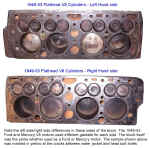
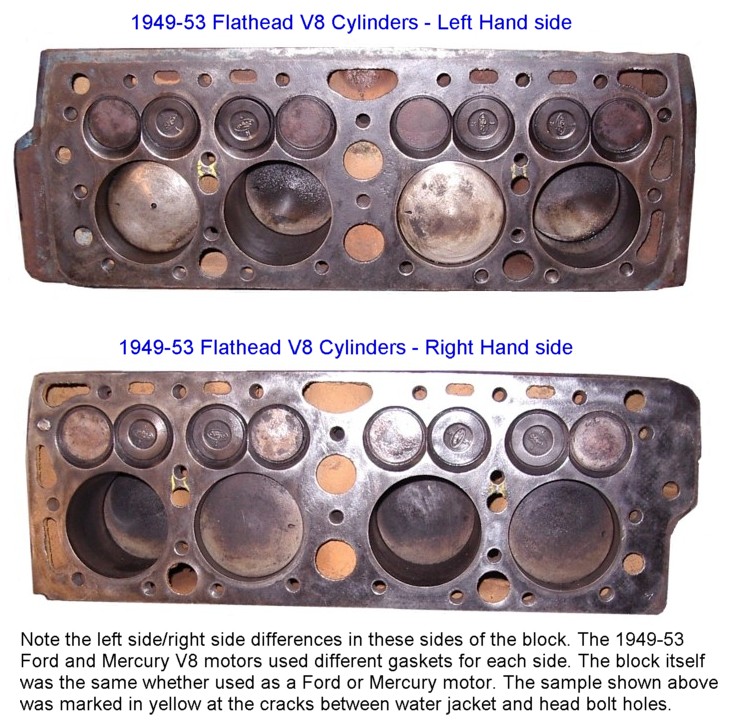
The 1949 to 53 engine blocks were all essentially the same. The primary difference being that Ford installed replaceable hardened valve seat inserts (exhaust side only) on the 1949 to 51 engines. The 1952-53 models did not come from the factory with any hardened valve seat inserts, although they are often found with them now, having had them installed by an engine rebuilder at some time later on. Click on the picture above for an enlarged view of the tops of the cylinders.
</td> </tr> </tbody></table>Tune-up Specs For These Engines
Go Directly to Engine Parts Drawings
Return to Specifications Homepage
Return to Ford Flathead Homepage
<table border="0" cellpadding="3" height="672" width="860"><tbody><tr><td colspan="2" align="center" bgcolor="#0000ff" height="49" valign="middle" width="848">
</td> </tr> <tr> <td colspan="2" height="22" width="848">
</td> </tr> <tr> <td align="left" height="21" valign="top" width="261">
(shown above)
</td> <td height="21" width="577">Major changes occurred to the mid size flathead V8 in 1948 for the new Ford trucks and in 1949 for new Ford and Mercury cars. The new engine incorporated several changes, some obvious and some not. The heads are now bolted to the blocks with 24 bolts (rather than studs and nuts) and the water outlet fittings are moved up to the front corner of the head (rather than the middle of the head). Another major change was the use of the new "Load-A-Matic" distributor, which was driven off the front of the engine, but through a shaft mounted vertically at right angle to the axis of the engine. With this new engine, Ford stopped casting the bell housing integral to the cylinder block, and provided it as a separate component which was bolted on. Internal changes include using a straight stem valve with one-piece valve guide. The belts and pulleys for 1948/49 stayed with the 5/8" wide of previous years, but changed from 1950 on to the narrow belts. In general, the latter year flatheads were commonly referred to as the "8BA" type for Ford and "8CM" for Mercury. The truck version was identified as an "8RT". Later 1952 and '53 Fords and Mercurys were known as "EAB" and "EAC" respectively. These markings are generally cast into the cylinder heads. The truck versions often had different oil pans to accommodate the different suspensions, and some truck V8's were factory "relieved". The EAB's and EAC's did not have the hardened valve seat inserts like the earlier engines.</td> </tr> <tr> <td colspan="2" height="296" valign="top" width="848">
(Cubic Inches)[/COLOR]</td> <td align="center" bgcolor="#0000ff" width="19%">[***************]Bore & Stroke
(Inches)[/COLOR]</td> <td align="center" bgcolor="#0000ff" width="12%">[***************]Maximum
Brake HP[/COLOR]</td> <td align="center" bgcolor="#0000ff" width="14%">[***************]Compression Ratio[/COLOR]</td> <td align="center" bgcolor="#0000ff" width="9%">[***************]Head Bolts[/COLOR]</td> <td align="center" bgcolor="#0000ff" width="15%">[***************]Notes[/COLOR]</td> </tr> <tr> <td width="16%">1949 Ford</td> <td align="center" width="15%">239</td> <td align="center" width="19%">3.1875 x 3.750</td> <td align="center" width="12%">100</td> <td align="center" width="14%">6.80:1</td> <td align="center" width="9%">24</td> <td width="15%">2</td> </tr> <tr> <td width="16%">1949 Mercury</td> <td align="center" width="15%">255</td> <td align="center" width="19%">3.1875 x 4.000</td> <td align="center" width="12%">110</td> <td align="center" width="14%">6.80:1</td> <td align="center" width="9%">24</td> <td width="15%">3,1</td> </tr> <tr> <td width="16%">1950 Ford</td> <td align="center" width="15%">239</td> <td align="center" width="19%">3.1875 x 3.750</td> <td align="center" width="12%">100</td> <td align="center" width="14%">6.80:1</td> <td align="center" width="9%">24</td> <td width="15%">2</td> </tr> <tr> <td width="16%">1950 Mercury</td> <td align="center" width="15%">255</td> <td align="center" width="19%">3.1875 x 4.000</td> <td align="center" width="12%">110</td> <td align="center" width="14%">6.80:1</td> <td align="center" width="9%">24</td> <td width="15%">1,3</td> </tr> <tr> <td width="16%">1951 Ford</td> <td align="center" width="15%">239</td> <td align="center" width="19%">3.1875 x 3.750</td> <td align="center" width="12%">100</td> <td align="center" width="14%">6.80:1</td> <td align="center" width="9%">24</td> <td width="15%">2</td> </tr> <tr> <td width="16%">1951 Mercury</td> <td align="center" width="15%">255</td> <td align="center" width="19%">3.1875 x 4.000</td> <td align="center" width="12%">112</td> <td align="center" width="14%">6.80:1</td> <td align="center" width="9%">24</td> <td width="15%">1,3</td> </tr> <tr> <td width="16%">1952 Ford</td> <td align="center" width="15%">239</td> <td align="center" width="19%">3.1875 x 3.750</td> <td align="center" width="12%">110</td> <td align="center" width="14%">7.20:1</td> <td align="center" width="9%">24</td> <td width="15%">2</td> </tr> <tr> <td width="16%">1952 Mercury</td> <td align="center" width="15%">255</td> <td align="center" width="19%">3.1875 x 4.000</td> <td align="center" width="12%">125</td> <td align="center" width="14%">7.20:1</td> <td align="center" width="9%">24</td> <td width="15%">1,4</td> </tr> <tr> <td width="16%">1953 Ford</td> <td align="center" width="15%">239</td> <td align="center" width="19%">3.1875 x 3.750</td> <td align="center" width="12%">110</td> <td align="center" width="14%">7.20:1</td> <td align="center" width="9%">24</td> <td width="15%">2</td> </tr> <tr> <td width="16%">1953 Mercury</td> <td align="center" width="15%">255</td> <td align="center" width="19%">3.1875 x 4.000</td> <td align="center" width="12%">125</td> <td align="center" width="14%">7.20:1</td> <td align="center" width="9%">24</td> <td width="15%">1,4</td> </tr> </tbody></table> </center>
Notes:
1) Mercury engines of these years had the 4" stroke crankshaft.
2) Used the Ford-Holley two barrel carburetor.
3) Used the Ford-Holley split float, dual downdraft carburetor.
4) Used the Holley Centri-Flo concentric dual carburetor.
Engine Colors:
Ford engines were generally dark blue in 1949 and changed to bronze in late '49 production through 1951. For 1952 and 1953 the Ford engine was either tangerine red or green. The Ford truck engines were red from 1948 through 1951, and then changed to green for 1952-53.
Mercury engines were green in color from 1949 through 1951. From 1952 to 1953 they were either green or tangerine.
For complete crankshaft bearing specs CLICK HERE.
Keep in mind that there were exceptions to these guidelines. Also, remanufactured engines and rebuilt engines of another color could have been installed in your vehicle during its history. Do not depend on the engine color to verify or identify your engine.
</td> </tr> <tr> <td colspan="2" height="259" valign="top" width="848">
</td> </tr> </tbody></table>
Lead Driver
Joined: Dec 2004
Posts: 7,669
Likes: 13
From: San Jose, CA
That looks to be an original set up. There's a guy here locally selling another 52 F1 flatbed. He has lowered the price by $1k recently. He was asking $9750. Click on the link for some reference photos: 1952 Ford F1 Stake Truck
You have a nice looking truck and it appears to be solid. I wish I could find all of the Mercury badging so that I could "convert" my US made Ford into a US made Mercury.
Does your truck have a "FORD" script bed?
You have a nice looking truck and it appears to be solid. I wish I could find all of the Mercury badging so that I could "convert" my US made Ford into a US made Mercury.
Does your truck have a "FORD" script bed?
Thread Starter
|
Hotshot
Joined: Oct 2009
Posts: 16,192
Likes: 4,800
From: Burbank, WA
That looks to be an original set up. There's a guy here locally selling another 52 F1 flatbed. He has lowered the price by $1k recently. He was asking $9750. Click on the link for some reference photos: 1952 Ford F1 Stake Truck
You have a nice looking truck and it appears to be solid. I wish I could find all of the Mercury badging so that I could "convert" my US made Ford into a US made Mercury.
Does your truck have a "FORD" script bed?
You have a nice looking truck and it appears to be solid. I wish I could find all of the Mercury badging so that I could "convert" my US made Ford into a US made Mercury.
Does your truck have a "FORD" script bed?