


teaching Em about mechanics: headers

Thread Starter
|
Senior User
Joined: Mar 2009
Posts: 438
Likes: 2
From: northern cali
teaching Em about mechanics: headers
Welcome to our new one-million part series on Teaching Em Mechanics.
Today's topic: headers
What are headers? What are they for? Do i need new ones? Can I install them (if i need/want them) given that i live in a city and have to work on my truck on the street? Do I have to know how to weld? Can you show me a photo/photos of headers installed on a 300 I6 like mine? Are they something I should look for at a junkyard or buy new? And finally, are they pretty?
As always, y'all rule for helping me learn.
Today's topic: headers
What are headers? What are they for? Do i need new ones? Can I install them (if i need/want them) given that i live in a city and have to work on my truck on the street? Do I have to know how to weld? Can you show me a photo/photos of headers installed on a 300 I6 like mine? Are they something I should look for at a junkyard or buy new? And finally, are they pretty?
As always, y'all rule for helping me learn.

pedant
Joined: Jan 2008
Posts: 23,576
Likes: 40
From: EXTREME southwest CT

Headers replace your cast iron exhaust manifolds.
Generally built from sections of mandrel bent tubing welded to a flat 'flange' that bolts to the cylinder head. Those individual pipes come to a 'collector' where the pipes join and adapt into one before traveling farther downstream to the muffler.
Headers have better flow than the typical cast manifold and most have larger inside diameter reducing back pressure and increasing performance.
Not likely the sort of thing you would install in the street, but you don't have to weld them together or into place.
Some are very attractive.
They can come in polished stainless steel or an aluminum ceramic coating.
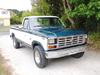
Edit: liking the pics of your dash repair on Flikr. Here's some of my engine swap.
Generally built from sections of mandrel bent tubing welded to a flat 'flange' that bolts to the cylinder head. Those individual pipes come to a 'collector' where the pipes join and adapt into one before traveling farther downstream to the muffler.
Headers have better flow than the typical cast manifold and most have larger inside diameter reducing back pressure and increasing performance.
Not likely the sort of thing you would install in the street, but you don't have to weld them together or into place.
Some are very attractive.
They can come in polished stainless steel or an aluminum ceramic coating.
Edit: liking the pics of your dash repair on Flikr. Here's some of my engine swap.
Cargo Master

Joined: Aug 2007
Posts: 2,561
Likes: 70
From: New Zealand
Em
Like ArdWrknTrk said, headers improve exhaust flow over a normal manifold.
The tubes are sized, both in length & diameter, to suit a specific engine & essentially create a vacuum effect at the end of each tube as the exhaust gases exit it. That vacuum in turn helps extract the exhaust gases from the next tube & so on in sequence of the cylinder firing order. This all gives a performance ( & if you're lucky, economy) boost; different engines & applications respond differently.
"Are they pretty?" - I guess that's an 'X' chromosome thing!
Quality of finish, performance, length of life etc, vary i.e. it's a case of - 'you get what you pay for'
Like ArdWrknTrk said, headers improve exhaust flow over a normal manifold.
The tubes are sized, both in length & diameter, to suit a specific engine & essentially create a vacuum effect at the end of each tube as the exhaust gases exit it. That vacuum in turn helps extract the exhaust gases from the next tube & so on in sequence of the cylinder firing order. This all gives a performance ( & if you're lucky, economy) boost; different engines & applications respond differently.
"Are they pretty?" - I guess that's an 'X' chromosome thing!
Quality of finish, performance, length of life etc, vary i.e. it's a case of - 'you get what you pay for'

Moderator


Joined: Jan 2001
Posts: 57,027
Likes: 2,763
From: Virginia

Yes they do help exhaust flow out of the engine, which helps power. Now I will tell you what the others left out.
1. They are noisy. This can be good or bad, depending on your personal preference.
2. They can be difficult to install, and when you do get them installed, most except the shorties require custom exhaust work to hook the remaining exhaust to the headers.
3. They can give clearance issues. I know on v8s they make starter removal very difficult, and they also hang down low giving less ground clearance, depending on the engine. I believe on your six, there may be issues with mounting the intake with a header. I am not sure, but have seen some sixes that use a common bolt with a spreader bar to mount both the intake and the exhaust manifolds. A header usually messes this configuration up.
1. They are noisy. This can be good or bad, depending on your personal preference.
2. They can be difficult to install, and when you do get them installed, most except the shorties require custom exhaust work to hook the remaining exhaust to the headers.
3. They can give clearance issues. I know on v8s they make starter removal very difficult, and they also hang down low giving less ground clearance, depending on the engine. I believe on your six, there may be issues with mounting the intake with a header. I am not sure, but have seen some sixes that use a common bolt with a spreader bar to mount both the intake and the exhaust manifolds. A header usually messes this configuration up.

Postmaster
Joined: Feb 2008
Posts: 2,658
Likes: 5
From: Out of here
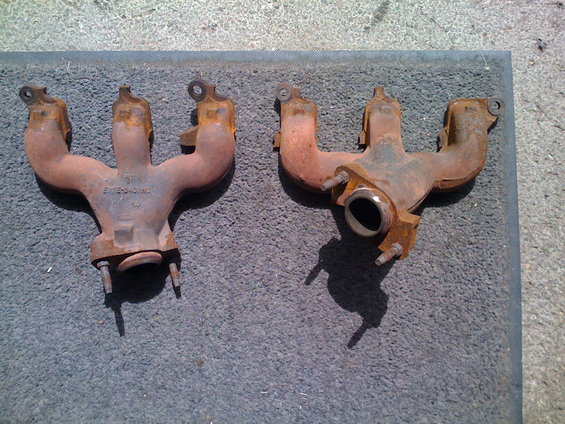
EFI manifolds from later model trucks flow almost as well and would be way cheaper ($8 each here) and IMO would be easier to install then headers.
They would also last a lot longer than headers.
This is one of the most common swaps on an early 4.9L
They would also last a lot longer than headers.
This is one of the most common swaps on an early 4.9L
Thread Starter
|
Senior User
Joined: Mar 2009
Posts: 438
Likes: 2
From: northern cali
thanks guys! so let me ask you this. is it recommended or necessary that you add headers if you want to upgrade your exhaust? do headers have any impact on emissions?
i do love that low rumbly sound you get from things like flowmasters...but it's not something i'd die without...i think my lil I6 sounds pretty dang good for a 30 year old engine but that doenst meant wouldnt love for it to sound more rumbly...
<b>stosh</b> what model years should i look for if i want to grab EFI manifolds?
i do love that low rumbly sound you get from things like flowmasters...but it's not something i'd die without...i think my lil I6 sounds pretty dang good for a 30 year old engine but that doenst meant wouldnt love for it to sound more rumbly...
<b>stosh</b> what model years should i look for if i want to grab EFI manifolds?
Posting Guru
Joined: Jan 2005
Posts: 1,299
Likes: 2
From: The Vieux Ford, Kansas
You will have to have custom exhaust made, your truck has one pipe and with headers it will have two, same goes for the EFI manifold swap. I don't live in an emissions state thank god, but you will have to find a way to retain a catalytic converter, and most of the aftermarket high flow ones are not CA approved so I would try to run a Y pipe and maintain your stock one. By the time you do this I think your exhaust will be so restrictive after the header you won't see much gain. If you can find a good high flow cat it might be worth it if you plan on a carb and intake swap but I don't know if the smog police will allow that. I ran a flow master 44 on my 89 Bronco right out in front of the rear tire and it sounded decent kinda like a cummins diesel crossed with an old grain truck. It had no cat and I didn't see any increase in MPG or a noticeable power gain. Now as for you exhaust system upgrade, no you sure don't have to run a header to upgrade you exhaust, heck you can just stick a high flow muffler on and see gains on some trucks. If you really feel like you want a manifold up grade I would go with the EFI manifolds over headers any day, not as prone to leaking, are really cheap, take up less engine bay room, and are a heck of a lot easier to install.
-Johnboy
-Johnboy
Trending Topics
Elder User
Joined: Apr 2003
Posts: 673
Likes: 0
From: Maryland
Em,
I'm with Stosh and Franklin on this one. The reason I went to EFI manifolds was to rid my truck of the cracked "log" manifold; I would be pissed if I had to deal with leaks (constantly changing header gaskets) after installing expensive tubular headers!
The EFI manifolds do require some minor trimming for clearance and removal of an unused bolt-ear. This is real easy with a 4 1/2" angle grinder.
As for parts: I got a set of dirt-cheap manifolds from the junkyard, the front y-pipe I used is the Walker pipe that you will find listed all over the forums (it was cheap, has a 2 into 1 design with 2 1/2" outlet and fits nice). I went with a new high-flow cat since I did need to pass the tailpipe test. For the rest of the system I ordered a Walker Dynomax cat back system (2 1/2" inlet to (2)x 2" outlet muffler). Both pipes exit on the pass side after the differential. This is a complete bolt-in solution, it's clean, has a nice sound and looks factory. Oh yeah, since I'm still running the factory carb my performance gains are limited, but the motor does spin freely to 3000 RPM while still making torque. I would guess the upgrade bought me about 800 more usable RPM.
Things that may need to be fab'd up:
Choke stove -Tube that runs from the carb to the exhaust and back to the carb (runs it through a passage in the exhaust manifold and up to the choke housing) to pickup heat to aid in opening the choke. My truck is fine with out it (has factory electric choke too as does your truck). This system can be replicated with some brakeline wound around the downpipe.
As for the emissions hookups, you should have air and EGR connectioins. May not be required in your area so do as you see fit. I hooked it all back up by fabricating a combo EGR-out and air-in adapter that threaded into the rear manifold. the adapter was made with steel "black" pipe and consisted of a tube within a tube configuration. The outer tube is the EGR out and the inner tube that extends into the manifold and incorporates a down pointed nozzle is the air injector. An easier way to accomplish this would be to weld a bung in the downpipe for the air connection.
The last thing was to install the O2 sensor in the downpipe bung hole. This will require that you lengthen the wire.
One last tip, the alternator piviot bolt is originaly installed from the rear and cannot be removed with the front manifold installed. You have a few choices including removing the alternator bracket with the alternator attached. I opted to remove the bracket and reverse the bolt orientation by drilling and installing a thread insert (Helicoil) in the rear hole. My alternator change is still a two bolt opperation.
I did the EFI manifold swap to my '85 I6 and it was well worth the effort; got rid of the chronic leaks and made more power, nuff said. If you're thinking of going this route, do a search and you'll find the PN for the Walker downpipe and pics of the required manifold mods (trimming) as well as pics of other members installs. Goodluck and enjoy your I6...
I'm with Stosh and Franklin on this one. The reason I went to EFI manifolds was to rid my truck of the cracked "log" manifold; I would be pissed if I had to deal with leaks (constantly changing header gaskets) after installing expensive tubular headers!
The EFI manifolds do require some minor trimming for clearance and removal of an unused bolt-ear. This is real easy with a 4 1/2" angle grinder.
As for parts: I got a set of dirt-cheap manifolds from the junkyard, the front y-pipe I used is the Walker pipe that you will find listed all over the forums (it was cheap, has a 2 into 1 design with 2 1/2" outlet and fits nice). I went with a new high-flow cat since I did need to pass the tailpipe test. For the rest of the system I ordered a Walker Dynomax cat back system (2 1/2" inlet to (2)x 2" outlet muffler). Both pipes exit on the pass side after the differential. This is a complete bolt-in solution, it's clean, has a nice sound and looks factory. Oh yeah, since I'm still running the factory carb my performance gains are limited, but the motor does spin freely to 3000 RPM while still making torque. I would guess the upgrade bought me about 800 more usable RPM.
Things that may need to be fab'd up:
Choke stove -Tube that runs from the carb to the exhaust and back to the carb (runs it through a passage in the exhaust manifold and up to the choke housing) to pickup heat to aid in opening the choke. My truck is fine with out it (has factory electric choke too as does your truck). This system can be replicated with some brakeline wound around the downpipe.
As for the emissions hookups, you should have air and EGR connectioins. May not be required in your area so do as you see fit. I hooked it all back up by fabricating a combo EGR-out and air-in adapter that threaded into the rear manifold. the adapter was made with steel "black" pipe and consisted of a tube within a tube configuration. The outer tube is the EGR out and the inner tube that extends into the manifold and incorporates a down pointed nozzle is the air injector. An easier way to accomplish this would be to weld a bung in the downpipe for the air connection.
The last thing was to install the O2 sensor in the downpipe bung hole. This will require that you lengthen the wire.
One last tip, the alternator piviot bolt is originaly installed from the rear and cannot be removed with the front manifold installed. You have a few choices including removing the alternator bracket with the alternator attached. I opted to remove the bracket and reverse the bolt orientation by drilling and installing a thread insert (Helicoil) in the rear hole. My alternator change is still a two bolt opperation.
I did the EFI manifold swap to my '85 I6 and it was well worth the effort; got rid of the chronic leaks and made more power, nuff said. If you're thinking of going this route, do a search and you'll find the PN for the Walker downpipe and pics of the required manifold mods (trimming) as well as pics of other members installs. Goodluck and enjoy your I6...
FTE Stories
Ford Trucks for Ford Truck Enthusiasts

3 Best / Worst Features Of The 2025+ Ford Expedition
Brett Foote
10 Ways Ford is LOSING to the Competition
Joe Kucinski
Top 6 Best Deals Available on New Fords & Lincolns Right Now
Brett Foote
This Hennessey Takes the Expedition Tremor's Off-Roading Capability to the Next Level
Verdad Gallardo
Top 10 Fords at 2026 Carlisle Ford Nationals
Joe Kucinski
3 Best / 3 Worst Parts of Modern Ford Ownership
Brett Foote
10 Amazing Upgrades That Solve Common Ford Truck Owner Headaches
Pouria Savadkouei
Every 2026 Ford Engine Explained
Brett Foote
