



Cold Air Intakes

Thread Starter
|
Elder User
Joined: Sep 2004
Posts: 750
Likes: 0
From: Weimar,TX

 Cold Air Intakes
Is anyone running a cold air intake by Xtreme Diesel. I have been looking
at them, but they are a little pricey........just wondering if they are worth
what they cost?
at them, but they are a little pricey........just wondering if they are worth
what they cost?
Thread Starter
|
Elder User
Joined: Sep 2004
Posts: 750
Likes: 0
From: Weimar,TX
That's the one I looked at that seemed a little steep. Think it was around $400.00.
I guess the 6637 like Jim mentioned is probably my best bet, but I was just curious if the AFE was that much better.
I guess the 6637 like Jim mentioned is probably my best bet, but I was just curious if the AFE was that much better.

Hotshot


Joined: Jul 2003
Posts: 12,177
Likes: 40
From: Newport, WA
6637. You can buy a 6637 style filter from AFE that is re-usable now too. Then buy a snazzy cover from Pete.

Snowboard season cometh..
Joined: Jan 2006
Posts: 5,406
Likes: 1
From: Gulf Coast of Florida
6637. You can buy a 6637 style filter from AFE that is re-usable now too. Then buy a snazzy cover from Pete.
Trending Topics
Postmaster
Joined: Jun 2006
Posts: 2,647
Likes: 0
From: Fulltime RVer

Well I figure my reappearance on FTE wouldn't be "official" until I relied to at least one thread on air filters! I've been doing some additional analysis in that area and if there's enough interest I'll do a detailed post on air filters and the mechanisms by which they effect engine HP.
For now I'll just post some graphs and charts along with a few comments. Here's a CFM vs Inches H2O restriction curve for a clean 6637 filter. The blue diamonds are from BP, RPM, MAT, and H2O restriction measurements that Tenn made and I then used his data in my 7.3L computer model.
My speculation is that the Donaldson maximum rating of 470 CFM at 8" H2O restriction for a 6637 filter is to allow for up to 10" H20 of additional restriction due to dirt loading before reaching the 18" H20 restriction where the filter needs to be replaced.

Here's some additional data including the 508 CFM at 10" H2O restriction data point (green circle) for the stock 6.0L filter, but I've seen higher flow rates than this claimed for the stock 6.0L filter at this restriction.

I think the best choice for towing and all around use is to duplicate the "Clux approach" of adapting a 6.0L Donaldson filter to the 7.3L. The problem with the 7.3L AIS version of the Donaldson is that the element is installed perpendicular to the incoming air flow.
I think the best choice for all out drag racing or dyno contests is a filter with a very low H2O restriction, but not because the low restriction increases HP by that much, but rather because the low restriction results in less "collapsing force" on the element at very high CFM flows so there's less danger of it getting sucked into the turbo.
I don't think a very low H2O restriction filter is the best choice or even a good choice as a daily driver because even though these types of filters have an initial low restriction their restriction rapidly increases when they collect only a little dirt while more robust filters can collect and hold a lot of dirt before incurring much additional restriction. Then there's also the issue that very low H2O restriction filters don't filter as well either.
For now I'll just post some graphs and charts along with a few comments. Here's a CFM vs Inches H2O restriction curve for a clean 6637 filter. The blue diamonds are from BP, RPM, MAT, and H2O restriction measurements that Tenn made and I then used his data in my 7.3L computer model.
My speculation is that the Donaldson maximum rating of 470 CFM at 8" H2O restriction for a 6637 filter is to allow for up to 10" H20 of additional restriction due to dirt loading before reaching the 18" H20 restriction where the filter needs to be replaced.
Here's some additional data including the 508 CFM at 10" H2O restriction data point (green circle) for the stock 6.0L filter, but I've seen higher flow rates than this claimed for the stock 6.0L filter at this restriction.
I think the best choice for towing and all around use is to duplicate the "Clux approach" of adapting a 6.0L Donaldson filter to the 7.3L. The problem with the 7.3L AIS version of the Donaldson is that the element is installed perpendicular to the incoming air flow.
I think the best choice for all out drag racing or dyno contests is a filter with a very low H2O restriction, but not because the low restriction increases HP by that much, but rather because the low restriction results in less "collapsing force" on the element at very high CFM flows so there's less danger of it getting sucked into the turbo.
I don't think a very low H2O restriction filter is the best choice or even a good choice as a daily driver because even though these types of filters have an initial low restriction their restriction rapidly increases when they collect only a little dirt while more robust filters can collect and hold a lot of dirt before incurring much additional restriction. Then there's also the issue that very low H2O restriction filters don't filter as well either.
FTE Stories
Ford Trucks for Ford Truck Enthusiasts

10 Fords to Drive Before You Die
Joe Kucinski
3 Best / Worst Features Of The 2025+ Ford Expedition
Brett Foote
10 Ways Ford is LOSING to the Competition
Joe Kucinski
Top 6 Best Deals Available on New Fords & Lincolns Right Now
Brett Foote
This Hennessey Takes the Expedition Tremor's Off-Roading Capability to the Next Level
Verdad Gallardo
Top 10 Fords at 2026 Carlisle Ford Nationals
Joe Kucinski
3 Best / 3 Worst Parts of Modern Ford Ownership
Brett Foote
10 Amazing Upgrades That Solve Common Ford Truck Owner Headaches
Pouria Savadkouei
Every 2026 Ford Engine Explained
Brett Foote
Post Fiend
Joined: Feb 2002
Posts: 10,600
Likes: 3
From: Carhenge

Postmaster
Joined: Jun 2006
Posts: 2,647
Likes: 0
From: Fulltime RVer


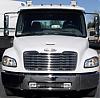
As can be seen below my Freightliner came with a similar setup to yours where the air flow is parallel as it's supposed to be, and it comes from a "cold air" intake on the hood.



Postmaster
Joined: Jun 2006
Posts: 2,647
Likes: 0
From: Fulltime RVer
The best way to tell how well an air filter performs is to monitor the status of the leading edges of the blades on the compressor wheel. When a wheel is new they're razor sharp but over time as the 100,000 rpm blades collide with um size particles they become dull and even rounded.
As shown below the um size particles in the atmosphere consist of windblown dusts, pollens, sea salts, and other natural sources of particles. Particles larger than about 60 um (diameter of a human hair) tend to settle out of the atmosphere so that particles in the 1 um to 60 um range constitute the TSP=Total Suspended Particulate matter in a typical atmosphere.

I did a quick calculation which indicates that for every 1,000 gal of diesel consumed an air filter ingests between 0.015 lb to 0.075 lb of 1 um to 60 um particulate matter depending on the air quality. This is for what's considered to be "clean still air", and driving in windy conditions or through a "dust storm" is another matter altogether!
I've seen claims that some filters allow as much as 7% of 10 um to 20 um particulate matter to pass through their element while others allow only 0.1% or less to pass through! One analysis that I've been meaning to attempt is to estimate to what extent if any you can judge air filtration efficiency from a typical OA report. My gut feeling is that an OA is probably only useful for flagging a fairly serious issue with a truck's air filtration.
When members install a WW or a new turbo I'd like them to take a pic of their compressor wheel when new and again every 10K mi thereafter and compare that to their OA reports and post the results. That way FTE could archive a very useful database on the subject, and if I live long enough to see it and still have a few brain cells remaining I'll analyze the results and post them.
Here's a caution that's quoted from the K&N web site that supports my concern about "cylinder type" or as the Banks web site calls them "filters on a stick" collapsing under load if they're allowed to become too restricted...
"The maximum allowable restriction for a K&N Filtercharger is 15" of vacuum (water). If the restriction is allowed to go higher, the filter media might become so restricted that the element could distort allowing dirty air to bypass the filter and enter the engine."


Post Fiend
Joined: Mar 2007
Posts: 26,966
Likes: 50
From: Texas
Good to see these types of discussions back on here Gene. Clux has been awfully quiet with his 6637 bashing for a while, so I think this would be a great time to start a new thread, or just hijack this one to continue this discussion.
I will disagree with your naked eye assessment, and the possibility of having a clean intake tube with no filter. I bought a truck for my wife a few months ago, and the amount of dust visible on several intake tubes was amazing. Not all were K&N related, some where just a leaking air box.
I know someone who is about to install a wicked wheel behind a 6637, so we might be able to get some 10k interval pictures for you to look at. Joe recently pulled his wicked wheel out, maybe he took pictures of what his looked like when he pulled it and can tell us how many miles were on it.
I will disagree with your naked eye assessment, and the possibility of having a clean intake tube with no filter. I bought a truck for my wife a few months ago, and the amount of dust visible on several intake tubes was amazing. Not all were K&N related, some where just a leaking air box.
I know someone who is about to install a wicked wheel behind a 6637, so we might be able to get some 10k interval pictures for you to look at. Joe recently pulled his wicked wheel out, maybe he took pictures of what his looked like when he pulled it and can tell us how many miles were on it.