


best engin temp.
Thread Starter
|
Fleet Mechanic


Joined: Mar 2007
Posts: 1,532
Likes: 29
From: northeast Ga
best engin temp.
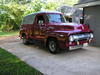
My 54 panel is running a 351W and a C6.The motor temp runs about 180-200 on the road and goes up to 22o while idling.Is this to hot? It has a 160 thermostat,electric fan and uses the stock radiator,I know that you want it to run a certain heat range .But I don't know if this is it.

Post Fiend
Joined: May 2008
Posts: 7,641
Likes: 21
From: Poway, Ca.
My 54 panel is running a 351W and a C6.The motor temp runs about 180-200 on the road and goes up to 22o while idling.Is this to hot? It has a 160 thermostat,electric fan and uses the stock radiator,I know that you want it to run a certain heat range .But I don't know if this is it.
If it goes up above 220, you might want to think about one of the additional cooling avenues - bigger/dual fan, deeper radiator, etc). Where do you have the fluid cooler for the C6 mounted?
Julie
Post Fiend
Joined: May 2008
Posts: 7,641
Likes: 21
From: Poway, Ca.
Uh huh! 
Actually you don't need to worry unless it gets above about 260.
I think you're fine!
J!
PS Very nice drive train BTW!
Actually you don't need to worry unless it gets above about 260.
I think you're fine!
J!
PS Very nice drive train BTW!

Elder User
Joined: Jan 2008
Posts: 658
Likes: 0
From: N.W. Mo.
I also think you are fine with those temps but the temp going up setting or low speed at idle is too little air through the rad.
Electric fans are rated for air flow and many of them are on the low end.
If it gets to be more of a problem look into a fan that will push/pull more air.
Electric fans are rated for air flow and many of them are on the low end.
If it gets to be more of a problem look into a fan that will push/pull more air.

Senior User
Joined: Nov 2008
Posts: 116
Likes: 0
From: SE IA
I would try a 180 degree thermostat. A 160 degree thermostat will remain open to long not slowing the coolant enough to be properly cooled in the radiator. Is your cooling fan thermostatically controled?
Trending Topics
Post Fiend
Joined: May 2008
Posts: 7,641
Likes: 21
From: Poway, Ca.
At 160 degrees the coolant will in fact pass through the radiator at full flow at a lower temperature when it opens completely at 160. Fact of the matter is it will do exactly the same thing with the other thermostat at 180 degrees. And each thermostat will restrict flow until it reaches the design temperture - when full flow will occure. The engine produces enough heat to make this happen with both and th eamount of time the thermostat is in "half deployment" is a matter of minutes. So what you are describing only happens for a few minutes.
When he stops, the truck temp climbs to 200 so either thermostat would be full open and there would be full flow. The only difference is the coolant would start to circulate at full flow 20 degrees lower with the 160 degree thermostat thus providing a greter margin against overheat.
Considering that proper cooling is a function of heat absorbed in the engine vs heat removed in the radiator, slower flow in your scenario will not only allow more time in the radiator to dissapate heat, but also have the coolant in the engine longer to absorb more heat. And at idle when the engine has no circulating flow around the oil pan to cool it, or forced air to excavate the engine compartment of thrown off heat, other than the fan, the engine has less factors helping it cool - thus coolant temp gets hotter faster.
If your radiator/fan is capable of dislodging all that extra heat at idle then you have an exchange surplus. He does not, his temp climbs above the rated temps of both thermostats at idle to 200 and stops (the exchange formula is a curve type of thing of cooling efficiency [excahnge rate at a given temp] Vs temp produced in the engine and at 200 you reach the top of the curve). Make that engine hotter and the curve gets taller and the top may be too high. In other words the fan never quite catches up without the margin.
Therefore it is better to run less refreshed coolant through an engine getting hotter and flow off more heat faster (plus have the extra 20 degrees margin, and the extra time he gets from that to reach 200) than to put in a warmer thermostat that will restrict coolant flow for only a minute or two longer and then inflicts more engine heat on the radiator/fan at full flow than the cooler thermostat.
" If it's not broken, don't fix it."
Keep it as it is - you're fine
J!
FTE Stories
Ford Trucks for Ford Truck Enthusiasts

Top 10 Fords at 2026 Carlisle Ford Nationals
Joe Kucinski
3 Best / 3 Worst Parts of Modern Ford Ownership
Brett Foote
10 Amazing Upgrades That Solve Common Ford Truck Owner Headaches
Pouria Savadkouei
Every 2026 Ford Engine Explained
Brett Foote
10 Ugly Ford Trucks That We Still Kinda Love
Joe Kucinski
10 Things Every Truck Owner NEEDS (2026 Edition)
Michael S. Palmer
Rezvani's Latest Post-Apocalyptic Monster Is a Ford F-150 Raptor Underneath
Verdad Gallardo
Top 10 Most Expensive Ford Trucks Ever Sold on Bring a Trailer
Joe Kucinski
2027 Ford Super Duty Buyer's Guide (Every Model, Engine, & Package)
Brett Foote
Fleet Owner


Joined: Jul 2004
Posts: 27,300
Likes: 1,059
From: NM
I believe it was Earl (George) who put this together; it will dispel many of the myths about thermostat operation:
I had a nice conversation with Paul Miglierina, at Standard-Thomson Corporation, 152 Grove Street, Waltham, MA 02254-9109 (781-894-7310). They are a division of Thomas Industrial and Automotive, and make the automotive thermostats sold under the Stant and Gates brand names. He seems to be a great guy; he has a lot of experience and is very knowledgeable about both the practical and technical aspects of how thermostats work. I actually had two conversations with him - I had to call him back to confirm some information, since I was typing at warp ten during our first conversation. He indicated he would be happy to answer any additional questions that anyone may have.
I specifically asked if I could get some detailed performance curve information – temperature versus thermostat opening position. Paul indicated that each manufacturer uses proprietary design methods, and while he would gladly discuss the general operation of thermostats, he could not provide detailed design data. Fair enough. Here is a condensed version of our conversations in a question/answer format.
George: Our group has had some discussion that thermostats are basically on-off devices. The thermostat is there only to help the engine reach operating temperature quickly. Once it opens, it's no longer a "player" in the system since the engine should reach an ideal operating temp close to 210 degrees. Do we have that correct?
Paul: Well, that's partially true. The thermostat does stay closed until the coolant temperature reaches the nominal thermostat opening temperature. After that, the thermostat also regulates coolant flow to maintain the engine temperature in the optimum range. At Standard-Thomson, we talk about four temperatures when we design and test thermostats - other manufacturers may have other terms or methods of designing and testing their thermostats. In increasing temperature order, our temperatures go like this:
Minimum opening temperature - below this temperature, the thermostat must remain closed.
Nominal temperature - the number you read on the box, or are quoted as the thermostat rated temperature.
Maximum opening temperature - at this temperature, the thermostat must be open at least a minimum amount (0.003”, 0.005”, etc.) specified by the manufacturer.
Full open temperature - the temperature at which the thermostat is at its rated full open position (0.300”, 0.400”, etc.).
The range between the minimum and maximum opening temperature is typically around 5 to 7 degrees F, although specialized thermostats for high-performance applications may have a much narrower range. All of our thermostats must begin to open within this range, or they are rejected for failure to meet quality assurance.
George: So, if we are driving down the road under normal conditions, the thermostat is in the full open position, correct?
Paul: No. We work with the OEMs to ensure that, under normal operating conditions, the thermostat is NOT at its full open position. The thermostat is designed to keep the engine in a narrow temperature range while it is operating. Let’s use an example. If we design a thermostat with a 0.300” full opening stroke, we may want it to operate at about 0.200” open stroke under normal conditions. If you start up a big hill, or start towing a load, the engine puts out more heat. We need to be able to open the thermostat more, say to 0.250”, so there is more coolant flow to remove the extra heat from the engine.
George: So you design thermostats to keep engines in a narrow range of temperatures over their various operating conditions. What engine operating temperature range do you shoot for when designing a typical thermostat?
Paul: You should realize that, when we design a thermostat, we work with a large number of variables including the type of coolant, the ambient temperature and humidity, engine heat generation, radiator capacity, water pump pressure, and at least a dozen more. There is no single temperature curve for all thermostats with a nominal rating of 180 degrees, or any other nominal temperature rating for that matter. Many common thermostats are designed to regulate the coolant in the range of 205 to 215 degrees – although thermostats designed to operate outside that range are certainly not rare. As I said, the precise temperature depends on many factors. Remember that the thermostats are not fully open when they are regulating in their design range, or they wouldn’t be able to regulate the engine temperature.
George: What is the typical full open temperature for a thermostat?
Paul: Again, it varies a great deal. There is no single full open temperature for all thermostats with a given nominal rating like 180 degrees. Full open temperature can range as high as 300 degrees. I’m not saying a common engine will ever run at that temperature, but the thermostat performance curve may end with the full open temperature at 300 degrees in order to get the performance we need at lower temperatures where the engine is actually operating.
George: Sorry to beat this to death, but I want to make sure I understand this clearly. If I change from a 180 degree to a 195 degree thermostat, will my engine run hotter under normal conditions?
Paul: No, that’s fine. Remember that there is no single temperature curve for all thermostats with a nominal rating of 180 or 195 degrees. You could buy a 195 degree thermostat that is designed to regulate at the same temperature as your original 180 degree thermostat. In that case, you would see no difference in the engine temperature under normal operating conditions. You would, however, see that the engine gets warmer before the thermostat initially opens.
George: So, if I have a 180 degree thermostat, and I want to increase my engine operating temperature under normal driving conditions, how do I know which 195 degree thermostat to buy?
Paul: I don’t think you will easily find the information you need to do what you are asking. Performance curves for thermostats are generally proprietary information for manufacturers. Some customers probably have increased their engine operating temperature by trial-and-error, and found a part number that does what they want to do. You may get lucky on your first 195 degree thermostat purchase, and never realize that any old 195 degree thermostat may not provide the same results.
One suggestion is to try different 195 degree thermostats in your engine and monitor the normal operating temperature with an accurate temperature meter. As you mentioned, these thermostats are not expensive parts, so you could pick up a few 195 degree thermostats with different part numbers without a big dollar investment. If you have a temperature gage in your instrument cluster, you can get a very rough sense of any changes with different thermostats, but those gages are not very good for absolute temperature measurements.
The other suggestion I can make is to measure the temperature curve for a few thermostats yourself. The measuring equipment may be a cost issue, unless you have access to a lab that can do it for you. When we test our thermostats, we use carefully stirred fluid baths to make sure we don’t have temperature gradients in the fluid. We also use thermocouples attached directly to the thermostat housing to get very accurate temperature measurements – you can’t be off by five degrees when doing this. You also need to set up a device to measure the opening movement of the thermostat. A dial indicator is accurate enough and works well if you put together some sort of fixture to hold the thermostat and dial indicator in place. One other thing – you can’t use plain water for this type of work since it boils at too low a temperature. We use fluids specifically designed to be environmentally friendly and non-toxic for our employees. I haven’t looked, but an internet search would probably get you in touch with suppliers of fluids for this type of testing.
George: One final question – and this may be something you can’t answer. Some of our folks have found that removing the thermostat actually causes the engine to run hotter. Most of us agree that this seems counter-intuitive, but it certainly appears to be the case. Do you have any comments on this – or should I contact a radiator manufacturer?
Paul: Well, I don’t know why that occurs. Off the top of my head, it might have to do with the coolant bypass passage in the engine not being closed when the thermostat is removed. I really haven’t got any other information for you on that question.
I had a nice conversation with Paul Miglierina, at Standard-Thomson Corporation, 152 Grove Street, Waltham, MA 02254-9109 (781-894-7310). They are a division of Thomas Industrial and Automotive, and make the automotive thermostats sold under the Stant and Gates brand names. He seems to be a great guy; he has a lot of experience and is very knowledgeable about both the practical and technical aspects of how thermostats work. I actually had two conversations with him - I had to call him back to confirm some information, since I was typing at warp ten during our first conversation. He indicated he would be happy to answer any additional questions that anyone may have.
I specifically asked if I could get some detailed performance curve information – temperature versus thermostat opening position. Paul indicated that each manufacturer uses proprietary design methods, and while he would gladly discuss the general operation of thermostats, he could not provide detailed design data. Fair enough. Here is a condensed version of our conversations in a question/answer format.
George: Our group has had some discussion that thermostats are basically on-off devices. The thermostat is there only to help the engine reach operating temperature quickly. Once it opens, it's no longer a "player" in the system since the engine should reach an ideal operating temp close to 210 degrees. Do we have that correct?
Paul: Well, that's partially true. The thermostat does stay closed until the coolant temperature reaches the nominal thermostat opening temperature. After that, the thermostat also regulates coolant flow to maintain the engine temperature in the optimum range. At Standard-Thomson, we talk about four temperatures when we design and test thermostats - other manufacturers may have other terms or methods of designing and testing their thermostats. In increasing temperature order, our temperatures go like this:
Minimum opening temperature - below this temperature, the thermostat must remain closed.
Nominal temperature - the number you read on the box, or are quoted as the thermostat rated temperature.
Maximum opening temperature - at this temperature, the thermostat must be open at least a minimum amount (0.003”, 0.005”, etc.) specified by the manufacturer.
Full open temperature - the temperature at which the thermostat is at its rated full open position (0.300”, 0.400”, etc.).
The range between the minimum and maximum opening temperature is typically around 5 to 7 degrees F, although specialized thermostats for high-performance applications may have a much narrower range. All of our thermostats must begin to open within this range, or they are rejected for failure to meet quality assurance.
George: So, if we are driving down the road under normal conditions, the thermostat is in the full open position, correct?
Paul: No. We work with the OEMs to ensure that, under normal operating conditions, the thermostat is NOT at its full open position. The thermostat is designed to keep the engine in a narrow temperature range while it is operating. Let’s use an example. If we design a thermostat with a 0.300” full opening stroke, we may want it to operate at about 0.200” open stroke under normal conditions. If you start up a big hill, or start towing a load, the engine puts out more heat. We need to be able to open the thermostat more, say to 0.250”, so there is more coolant flow to remove the extra heat from the engine.
George: So you design thermostats to keep engines in a narrow range of temperatures over their various operating conditions. What engine operating temperature range do you shoot for when designing a typical thermostat?
Paul: You should realize that, when we design a thermostat, we work with a large number of variables including the type of coolant, the ambient temperature and humidity, engine heat generation, radiator capacity, water pump pressure, and at least a dozen more. There is no single temperature curve for all thermostats with a nominal rating of 180 degrees, or any other nominal temperature rating for that matter. Many common thermostats are designed to regulate the coolant in the range of 205 to 215 degrees – although thermostats designed to operate outside that range are certainly not rare. As I said, the precise temperature depends on many factors. Remember that the thermostats are not fully open when they are regulating in their design range, or they wouldn’t be able to regulate the engine temperature.
George: What is the typical full open temperature for a thermostat?
Paul: Again, it varies a great deal. There is no single full open temperature for all thermostats with a given nominal rating like 180 degrees. Full open temperature can range as high as 300 degrees. I’m not saying a common engine will ever run at that temperature, but the thermostat performance curve may end with the full open temperature at 300 degrees in order to get the performance we need at lower temperatures where the engine is actually operating.
George: Sorry to beat this to death, but I want to make sure I understand this clearly. If I change from a 180 degree to a 195 degree thermostat, will my engine run hotter under normal conditions?
Paul: No, that’s fine. Remember that there is no single temperature curve for all thermostats with a nominal rating of 180 or 195 degrees. You could buy a 195 degree thermostat that is designed to regulate at the same temperature as your original 180 degree thermostat. In that case, you would see no difference in the engine temperature under normal operating conditions. You would, however, see that the engine gets warmer before the thermostat initially opens.
George: So, if I have a 180 degree thermostat, and I want to increase my engine operating temperature under normal driving conditions, how do I know which 195 degree thermostat to buy?
Paul: I don’t think you will easily find the information you need to do what you are asking. Performance curves for thermostats are generally proprietary information for manufacturers. Some customers probably have increased their engine operating temperature by trial-and-error, and found a part number that does what they want to do. You may get lucky on your first 195 degree thermostat purchase, and never realize that any old 195 degree thermostat may not provide the same results.
One suggestion is to try different 195 degree thermostats in your engine and monitor the normal operating temperature with an accurate temperature meter. As you mentioned, these thermostats are not expensive parts, so you could pick up a few 195 degree thermostats with different part numbers without a big dollar investment. If you have a temperature gage in your instrument cluster, you can get a very rough sense of any changes with different thermostats, but those gages are not very good for absolute temperature measurements.
The other suggestion I can make is to measure the temperature curve for a few thermostats yourself. The measuring equipment may be a cost issue, unless you have access to a lab that can do it for you. When we test our thermostats, we use carefully stirred fluid baths to make sure we don’t have temperature gradients in the fluid. We also use thermocouples attached directly to the thermostat housing to get very accurate temperature measurements – you can’t be off by five degrees when doing this. You also need to set up a device to measure the opening movement of the thermostat. A dial indicator is accurate enough and works well if you put together some sort of fixture to hold the thermostat and dial indicator in place. One other thing – you can’t use plain water for this type of work since it boils at too low a temperature. We use fluids specifically designed to be environmentally friendly and non-toxic for our employees. I haven’t looked, but an internet search would probably get you in touch with suppliers of fluids for this type of testing.
George: One final question – and this may be something you can’t answer. Some of our folks have found that removing the thermostat actually causes the engine to run hotter. Most of us agree that this seems counter-intuitive, but it certainly appears to be the case. Do you have any comments on this – or should I contact a radiator manufacturer?
Paul: Well, I don’t know why that occurs. Off the top of my head, it might have to do with the coolant bypass passage in the engine not being closed when the thermostat is removed. I really haven’t got any other information for you on that question.

Post Fiend
Joined: May 2008
Posts: 7,641
Likes: 21
From: Poway, Ca.
I believe it was Earl (George) who put this together; it will dispel many of the myths about thermostat operation:
No Myths at all. The article is very well written by someone who is very well respected...but there are a few key statements to note.
Paul: No. We work with the OEMs.... The original poster stated that this was not an OEM application he has an electric fan.
Paul: You should realize that, when we design a thermostat, we work with a large number of variables including the type of coolant, the ambient temperature and humidity, engine heat generation, radiator capacity, water pump pressure, and at least a dozen more. There is no single temperature curve for all thermostats with a nominal rating of 180 degrees, or any other nominal temperature rating for that matter. Many common thermostats are designed to regulate the coolant in the range of 205 to 215 degrees – although thermostats designed to operate outside that range are certainly not rare. As I said, the precise temperature depends on many factors. Remember that the thermostats are not fully open when they are regulating in their design range, or they wouldn’t be able to regulate the engine temperature.
The radiators ability to dispell heat is one of these "variables."
George: Sorry to beat this to death, but I want to make sure I understand this clearly. If I change from a 180 degree to a 195 degree thermostat, will my engine run hotter under normal conditions?
Paul: No, that’s fine. Remember that there is no single temperature curve for all thermostats with a nominal rating of 180 or 195 degrees. As previously stated.
George: So, if I have a 180 degree thermostat, and I want to increase my engine operating temperature under normal driving conditions, how do I know which 195 degree thermostat to buy?
Paul: I don’t think you will easily find the information you need to do what you are asking. Pertinent.
George: One final question – and this may be something you can’t answer. Some of our folks have found that removing the thermostat actually causes the engine to run hotter. Most of us agree that this seems counter-intuitive, but it certainly appears to be the case. Do you have any comments on this – or should I contact a radiator manufacturer?
Paul: Well, I don’t know why that occurs. Off the top of my head, it might have to do with the coolant bypass passage in the engine not being closed when the thermostat is removed. I really haven’t got any other information for you on that question.
No Myths at all. The article is very well written by someone who is very well respected...but there are a few key statements to note.
Paul: No. We work with the OEMs.... The original poster stated that this was not an OEM application he has an electric fan.
Paul: You should realize that, when we design a thermostat, we work with a large number of variables including the type of coolant, the ambient temperature and humidity, engine heat generation, radiator capacity, water pump pressure, and at least a dozen more. There is no single temperature curve for all thermostats with a nominal rating of 180 degrees, or any other nominal temperature rating for that matter. Many common thermostats are designed to regulate the coolant in the range of 205 to 215 degrees – although thermostats designed to operate outside that range are certainly not rare. As I said, the precise temperature depends on many factors. Remember that the thermostats are not fully open when they are regulating in their design range, or they wouldn’t be able to regulate the engine temperature.
The radiators ability to dispell heat is one of these "variables."
George: Sorry to beat this to death, but I want to make sure I understand this clearly. If I change from a 180 degree to a 195 degree thermostat, will my engine run hotter under normal conditions?
Paul: No, that’s fine. Remember that there is no single temperature curve for all thermostats with a nominal rating of 180 or 195 degrees. As previously stated.
George: So, if I have a 180 degree thermostat, and I want to increase my engine operating temperature under normal driving conditions, how do I know which 195 degree thermostat to buy?
Paul: I don’t think you will easily find the information you need to do what you are asking. Pertinent.
George: One final question – and this may be something you can’t answer. Some of our folks have found that removing the thermostat actually causes the engine to run hotter. Most of us agree that this seems counter-intuitive, but it certainly appears to be the case. Do you have any comments on this – or should I contact a radiator manufacturer?
Paul: Well, I don’t know why that occurs. Off the top of my head, it might have to do with the coolant bypass passage in the engine not being closed when the thermostat is removed. I really haven’t got any other information for you on that question.
Again, the original question asked was pertaining to the observed temperatures the poster saw in his vehicle, and were they alright.
And the correct answer is: Your operating temperatures are within normal operating parameters. NO ACTION IS REQUIRED!
J!
Senior User
Joined: Nov 2008
Posts: 116
Likes: 0
From: SE IA
Julie Julie Julie. DR Smith states 180 to 200 degrees going down the road and up to 220 degrees idling. I believe that the purpose of the thermostat is to control the rate of heat absorption from the engine block and heat dissipation from the radiator. My reasoning is that the difference of twenty degrees will allow the liquid to cool more/longer in the radiator therefor when the thermostat does open a cooler mixture will close the 180 degree thermostat whereas it doesn't appear the 160 degee is closing. With a stated tempature range of between 180 to 220 degrees which thermostat will close soonest?
Post Fiend
Joined: May 2008
Posts: 7,641
Likes: 21
From: Poway, Ca.
Julie Julie Julie. DR Smith states 180 to 200 degrees going down the road and up to 220 degrees idling. Correct. I believe that the purpose of the thermostat is to control the rate of heat absorption from the engine block and heat dissipation from the radiator. No, the primary purpose of the thermostat is maintain the engine temperature within the correct operating limits and the secondary purpose it to expedite warming the engine up to those optimum operating temperatures. My reasoning is that the difference of twenty degrees will allow the liquid to cool more/longer in the radiator therefor when the thermostat does open a cooler mixture will close the 180 degree thermostat whereas it doesn't appear the 160 degee is closing. With a stated tempature range of between 180 to 220 degrees which thermostat will close soonest? Who cares which one closes soonest? Closing sooner to restrict flow may be appropriate in one vehicle when it is not in another. What you need to care about is does the thremopstate keep the engine in the proper temperature range - and in this case, that was the original question. And the correct answer in this case is: YES it does. The engine with the thermostat he has in it is operating in the exact temperature range it ought to be and there is NO REASON, to change to a higher thermostat - none, nada, zilch.
I understand exactly what you are saying - that a slower rate of circulation with the higher temperature thermostat (at mid temperatures) allows the coolant in the radiator added time there to cool it more. My counter to that is it will need more time because it is 20 degrees hotter to start with, and the coolant in the engine is now hotter as well because the coolant is not flowing through it to draw off heat as quickly. Point is, and the article is very clear about this, the effects are not constant and may or may not apply from vehicle to vehicle.
My 390 did exactly the same thing during break in except it would climb to almost 300. I went round and round with guys about thermostats - including the imbecilic claim that a carburated engine will get vastly improved mileage at hotter engine operating temps. So just to put theory into application, I installed a 20 degree warmer thermostat. And it did exactly as I thought it would - it operated 20 degrees hotter, overheated 3-5 minutes sooner and got even farther beyond the upper limit than it had before. I put the cooler thermostat back in and it runs in the perfect temperature range.
You can argue all day long about theory, you can't argue with results - Councilman, councilman,councilman.
I understand exactly what you are saying - that a slower rate of circulation with the higher temperature thermostat (at mid temperatures) allows the coolant in the radiator added time there to cool it more. My counter to that is it will need more time because it is 20 degrees hotter to start with, and the coolant in the engine is now hotter as well because the coolant is not flowing through it to draw off heat as quickly. Point is, and the article is very clear about this, the effects are not constant and may or may not apply from vehicle to vehicle.
My 390 did exactly the same thing during break in except it would climb to almost 300. I went round and round with guys about thermostats - including the imbecilic claim that a carburated engine will get vastly improved mileage at hotter engine operating temps. So just to put theory into application, I installed a 20 degree warmer thermostat. And it did exactly as I thought it would - it operated 20 degrees hotter, overheated 3-5 minutes sooner and got even farther beyond the upper limit than it had before. I put the cooler thermostat back in and it runs in the perfect temperature range.
You can argue all day long about theory, you can't argue with results - Councilman, councilman,councilman.

Thread Starter
|
Fleet Mechanic
Joined: Mar 2007
Posts: 1,532
Likes: 29
From: northeast Ga
Just to show how dumb I am.I had the hood up and motor running,As I was looking around I noticed the fan belt jumping a little.After shutting off the truck, I adjusted the belt and then drove about thirty miles.The temp never got above 175.Even though the belt was not lose enough to make the power steering slip it must have been lose enough to let the water pump slip.I must learn to pay attention to the little things.