


Ford refuses DPF problem, HELP!
Senior User
Joined: Apr 2004
Posts: 140
Likes: 0
Questions:
Don't most dealerships have EPA emissions test stations?
Would the exhaust emisions test station pick up the additional soot not captured by the DPF?
Can you insist they perform an exhaust emissions test?
If the vehicle fails emissions tests, then by law they have to address it.
Vincent
Don't most dealerships have EPA emissions test stations?
Would the exhaust emisions test station pick up the additional soot not captured by the DPF?
Can you insist they perform an exhaust emissions test?
If the vehicle fails emissions tests, then by law they have to address it.
Vincent

Senior User
Joined: Feb 2007
Posts: 123
Likes: 0
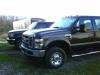
I thought you would all be interested in pics of a Job1 6.4l's exhaust tips that have over 30k miles on them. They are completely clean with no hint of soot. This is what your exhaust should look like.
BTW, I pull a 35' toy hauler, and have a heavy foot.


BTW, I pull a 35' toy hauler, and have a heavy foot.
Freshman User
Joined: Apr 2009
Posts: 25
Likes: 0
A lot of guys are having the same problem
I have an 08 Job 1 F-350 Lariat that I just turned over 29,000 on in 13 months. It has been strictly Dealer Serviced. After this last oil change we took a short trip, to see our son at college, about 400 miles one way. On the way back, I have noticed that I seem to be over full on oil and it appears to be a little "Thin" as well. I have ordered a Blackstone Test Kit. Today, with the windows down and parked between two Containers the when I do a slight rev and let off I have a "Whistle" as the engine RPM's come back down, and the exhaust is more then a little Gray.
Cass
Cass
https://www.ford-trucks.com/forums/8...aking-oil.html

Senior User
Joined: Nov 2005
Posts: 290
Likes: 0
From: Albuquerque
DPF filter is designed to an engineered efficiency level. It filters to a specific micron level to pass EPA particulate matter (soot) size.
It does not matter how heavy your foot is or what you tow, the filter's efficiency is unchanged. The only variable is regen frequency.
If you are seeing black soot build up in your pipe, your dpf media is damaged and allowing some level of bypass.
I would urge anyone having trouble with dealer to "bypass" the dealer and contact Ford's regional office and/or the epa phone number in the emissions warranty booklet.
It does not matter how heavy your foot is or what you tow, the filter's efficiency is unchanged. The only variable is regen frequency.
If you are seeing black soot build up in your pipe, your dpf media is damaged and allowing some level of bypass.
I would urge anyone having trouble with dealer to "bypass" the dealer and contact Ford's regional office and/or the epa phone number in the emissions warranty booklet.

Postmaster
Joined: Feb 2006
Posts: 3,201
Likes: 4
From: waynesville, mo.

I'm curious, how does ceramic filter? And with the relative values that we are given for backpressure readings at a specific speed/load, why aren't they picked up by the sensors if the dpf is broken? KOEO-0 psi....hot idle-0.21 psi.....30 mph-0.66 psi....55 mph-1.18 psi. Please, a little less "internet diagnostics". Just stick with the facts!
Senior User
Joined: Nov 2005
Posts: 290
Likes: 0
From: Albuquerque
Ceramic Filter?
Filter media design=the pore size equal to that needed to trap the PM at the micron level required. How else?
How do HEPA filters work? How about sand filters on pools? How about stainless steel oil filters? The DPF on diesels is a trap set to regenerate itself using heat.
The pressure sensors are simple, measuring values at different points in the exhaust to determine system status and regen times.
I don't get the non-fact part. This is basic info, like the sky is up, GM is a Zombie company, stuff like that.
How do HEPA filters work? How about sand filters on pools? How about stainless steel oil filters? The DPF on diesels is a trap set to regenerate itself using heat.
The pressure sensors are simple, measuring values at different points in the exhaust to determine system status and regen times.
I don't get the non-fact part. This is basic info, like the sky is up, GM is a Zombie company, stuff like that.
Postmaster
Joined: Feb 2006
Posts: 3,201
Likes: 4
From: waynesville, mo.
Filter media design=the pore size equal to that needed to trap the PM at the micron level required. How else?
How do HEPA filters work? How about sand filters on pools? How about stainless steel oil filters? The DPF on diesels is a trap set to regenerate itself using heat.
The pressure sensors are simple, measuring values at different points in the exhaust to determine system status and regen times.
I don't get the non-fact part. This is basic info, like the sky is up, GM is a Zombie company, stuff like that.
How do HEPA filters work? How about sand filters on pools? How about stainless steel oil filters? The DPF on diesels is a trap set to regenerate itself using heat.
The pressure sensors are simple, measuring values at different points in the exhaust to determine system status and regen times.
I don't get the non-fact part. This is basic info, like the sky is up, GM is a Zombie company, stuff like that.
Senior User
Joined: Nov 2005
Posts: 290
Likes: 0
From: Albuquerque
It isn't a solid piece--Here are a few quotes from DPF design companies.
"Ceramic Honeycomb cordierite DPF, which consists of parallel channels, separated by thin walls made of porous cordierite. The channels are open at one end, but plugged at the other. During operation, the exhaust gases are forced to flow through the thin walls and leave particulates trapped in the filter walls. Cordierite DPF is mainly used in the diesel engine automobile to solve the air pollution problem."
"Conventional diesel soot filters usually consist of cylindrical ceramic blocks crisscrossed by numerous channels. A block of this kind cannot be made in one piece. Instead, individual quadratic honeycomb segments are bonded together to form a large block. The bonds act as expansion joints that offset the temperature stresses during operation. This is vital, for a solid ceramic block would break apart."
"Ceramic Honeycomb cordierite DPF, which consists of parallel channels, separated by thin walls made of porous cordierite. The channels are open at one end, but plugged at the other. During operation, the exhaust gases are forced to flow through the thin walls and leave particulates trapped in the filter walls. Cordierite DPF is mainly used in the diesel engine automobile to solve the air pollution problem."
"Conventional diesel soot filters usually consist of cylindrical ceramic blocks crisscrossed by numerous channels. A block of this kind cannot be made in one piece. Instead, individual quadratic honeycomb segments are bonded together to form a large block. The bonds act as expansion joints that offset the temperature stresses during operation. This is vital, for a solid ceramic block would break apart."
FTE Stories
Ford Trucks for Ford Truck Enthusiasts

3 Best / 3 Worst Parts of Modern Ford Ownership
Brett Foote
10 Amazing Upgrades That Solve Common Ford Truck Owner Headaches
Pouria Savadkouei
Every 2026 Ford Engine Explained
Brett Foote
10 Ugly Ford Trucks That We Still Kinda Love
Joe Kucinski
10 Things Every Truck Owner NEEDS (2026 Edition)
Michael S. Palmer
Rezvani's Latest Post-Apocalyptic Monster Is a Ford F-150 Raptor Underneath
Verdad Gallardo
Top 10 Most Expensive Ford Trucks Ever Sold on Bring a Trailer
Joe Kucinski
2027 Ford Super Duty Buyer's Guide (Every Model, Engine, & Package)
Brett Foote
Top 10 Ford Truck Tragedies
Joe Kucinski
Senior User
Joined: Nov 2005
Posts: 290
Likes: 0
From: Albuquerque
There is development of dpf's using gel-cast ceramic foam!!
"Gel-cast ceramic foams potentially offer a more robust configurable alternative filtration medium to monolithic wall flow filters (WFFs) for the reduction in particulate matter (PM) emissions from diesel internal combustion engines. The fundamental back pressure and filtration efficiency characteristics of gel-cast ceramic foam diesel particulate filters (DPFs) have been investigated. Methodology is developed for the first time that allows the calculation of the effect of local PM loading on the pressure drop characteristics from experimental data without problems caused by the non-uniform PM loading in the filter that can be applied to all depth bed filtration media. The back pressure and filtration efficiency relationships were used to develop graphical design spaces to aid development of application-specific DPFs. Effects of PM distribution on the pressure drop of the filter are presented. Filters with a non-even distribution of PM were found to have lower pressure drops than filters with an evenly distributed PM for the same average specific PM loadings. The predictions showed that gel-cast ceramic foams can achieve comparable back pressure, filtration volume, and PM holding capacity with WFFs with a lower filtration efficiency of about 80 per cent. The model demonstrated that greater than 90 per cent filtration efficiency can be achieved with filter volumes of about 0.6 times the volume of a WFF with a lower PM holding capacity."
"Gel-cast ceramic foams potentially offer a more robust configurable alternative filtration medium to monolithic wall flow filters (WFFs) for the reduction in particulate matter (PM) emissions from diesel internal combustion engines. The fundamental back pressure and filtration efficiency characteristics of gel-cast ceramic foam diesel particulate filters (DPFs) have been investigated. Methodology is developed for the first time that allows the calculation of the effect of local PM loading on the pressure drop characteristics from experimental data without problems caused by the non-uniform PM loading in the filter that can be applied to all depth bed filtration media. The back pressure and filtration efficiency relationships were used to develop graphical design spaces to aid development of application-specific DPFs. Effects of PM distribution on the pressure drop of the filter are presented. Filters with a non-even distribution of PM were found to have lower pressure drops than filters with an evenly distributed PM for the same average specific PM loadings. The predictions showed that gel-cast ceramic foams can achieve comparable back pressure, filtration volume, and PM holding capacity with WFFs with a lower filtration efficiency of about 80 per cent. The model demonstrated that greater than 90 per cent filtration efficiency can be achieved with filter volumes of about 0.6 times the volume of a WFF with a lower PM holding capacity."

Elder User
Joined: Mar 2006
Posts: 516
Likes: 1
It probably depends on the amount of cracking. The DPF is designed to have fairly low backpressure to begin with and depending on how much soot is trapped already backpressure might be maintained...and even continue to increase as some soot is still trapped...even with a crack.
Senior User
Joined: Nov 2005
Posts: 290
Likes: 0
From: Albuquerque
That's a great question--There are many variables.
How sensitve is the system--how low does the BP need to be to generate a code?
Does the leak occur all the time, or only when the temp goes up during regen? Or, viceversa?
I can't answer the question, it may well create a low BP condition but it isn't consistent or low enough to set a code.
I am not a Ford Diesel Tech, but I am very familiar with the EPA and environmental law.
If the DPF fails and doesn't set a code that notifies the consumer of the failure, then Ford has an EPA problem.
The OP was about black soot in the pipe. The DPF is fine enough that visible soot should never be apparent in the exhaust. We are assuming a DPF leak, when maybe more possibilites exist?
A DPF leak is the most common cause, but is it the only one? Is the OP describing the problem correctly? I don't know. I am just adding info to the discussion.
How sensitve is the system--how low does the BP need to be to generate a code?
Does the leak occur all the time, or only when the temp goes up during regen? Or, viceversa?
I can't answer the question, it may well create a low BP condition but it isn't consistent or low enough to set a code.
I am not a Ford Diesel Tech, but I am very familiar with the EPA and environmental law.
If the DPF fails and doesn't set a code that notifies the consumer of the failure, then Ford has an EPA problem.
The OP was about black soot in the pipe. The DPF is fine enough that visible soot should never be apparent in the exhaust. We are assuming a DPF leak, when maybe more possibilites exist?
A DPF leak is the most common cause, but is it the only one? Is the OP describing the problem correctly? I don't know. I am just adding info to the discussion.

Tuned
Joined: May 2009
Posts: 435
Likes: 1
dpf removal
anyone removed the dpf and installed a tuner to clear the regeneration codes? I've heard you get incredible mpg gains and power increase but I don't want to damage my truck in any way. Also, does it void the warantee and would it be detectable?
Senior User
Joined: Feb 2007
Posts: 123
Likes: 0
Yes it voids your warranty. DPF delete would be for off-road use only. Spartan Diesel Tech sells an extremely solid product that is pretty much the most popular tuner I've seen. You can get a DPF delete pipe and a stock tune with the Regenerations removed for a good deal. This wouldn't add any power, but just allow you to remove the DPF and get better mileage. Of course that would be for off-road use only. People are seeing MUCH better mileage gains with their higher HP tunes though. Something to think about.
I'm sure there are ways Ford can find out if you've modded your truck, but I have yet to hear or read of anyone being flagged for it.
Tuned
Joined: May 2009
Posts: 435
Likes: 1
Of course it would be for off road use, how dare anybody mess with the all mighty EPA I have actually been doing alot of research on the spartan and have found absolutly nothing bad. I guess from my point of view, how can I be doing damage to my truck by making it breathe easier and run more efficiently. I have read that ford actually makes a dpf removal kit but does not sell it the general public. As far as the warantee issue, that may be a risk I'm willing to take, I have 20,000 miles on my truck and the only problem I've had is with the stupid dpf. Anyone know if there is an advantage to doing a dpf/cat removal as compared to just a dpf removal? Strictly for off road use of course.
I have actually been doing alot of research on the spartan and have found absolutly nothing bad. I guess from my point of view, how can I be doing damage to my truck by making it breathe easier and run more efficiently. I have read that ford actually makes a dpf removal kit but does not sell it the general public. As far as the warantee issue, that may be a risk I'm willing to take, I have 20,000 miles on my truck and the only problem I've had is with the stupid dpf. Anyone know if there is an advantage to doing a dpf/cat removal as compared to just a dpf removal? Strictly for off road use of course.