


FIPL Sensor Off?


Thread Starter
|
Junior User
Joined: Sep 2007
Posts: 94
Likes: 0
From: Versailles, KY
FIPL Sensor Off?
My 1990 F250 4x4, 7.3 is not shifting well. It hesitates to shift up to the next higher gear, then slams into it; this happens throughout the whole range of gears. I can ease up on the accelerator to soften the blow, but it's still fairly attention-getting.
It seems like the most likely culprit is the FIPL sensor; I just replaced the injection pump and the hard shifting became noticable after that. The mounting bracket (which looks like an adjustment to me - even though it's not) was put back 'pretty close' to the original position based on aligning the mounting screw washer imprints. Probably didn't get it close enough.
Another contributing factor, however, could be the external transmission filter (7B155); I got the transmission fluid flushed about 3,000 miles ago and the filter was not removed during the flush. It also appears to have been there for quite a while. (This truck is new to me as of late September.)
I've got the Ford service manual but it's a bit like Greek to me since it's written for mechanics, not map-makers. They keep referring to a key-on-engine-off self-test, but there's no indication of how that's done. It appears that a code reader is involved, but I don't really know.
I think I can figure this one out and get the job done, but need to bridge some sizable gaps in my understanding.
Thanks,
Tom
It seems like the most likely culprit is the FIPL sensor; I just replaced the injection pump and the hard shifting became noticable after that. The mounting bracket (which looks like an adjustment to me - even though it's not) was put back 'pretty close' to the original position based on aligning the mounting screw washer imprints. Probably didn't get it close enough.
Another contributing factor, however, could be the external transmission filter (7B155); I got the transmission fluid flushed about 3,000 miles ago and the filter was not removed during the flush. It also appears to have been there for quite a while. (This truck is new to me as of late September.)
I've got the Ford service manual but it's a bit like Greek to me since it's written for mechanics, not map-makers. They keep referring to a key-on-engine-off self-test, but there's no indication of how that's done. It appears that a code reader is involved, but I don't really know.
I think I can figure this one out and get the job done, but need to bridge some sizable gaps in my understanding.
Thanks,
Tom

Post Fiend
Joined: Nov 2004
Posts: 5,638
Likes: 1
From: Manitoba
To set to specs:
With a warm engine and the idle speed set to your engine specs probably 650 in drive (curb idle).
Now with key on engine off. First connect the negative lead of a volt meter to the negative battery post, then place a paperclip straightened to slide up the side of the center wire for a good contact, touch the positive lead to the paperclip. Electrical connector must beconnected to the FIPL.
If your FIPL requires resetting loosen the small torx screws and attempt to attain the correct setting. You can loosen the large bolts on the bracket if necessary but try to retain the centering on the FIPL/blade.
Your trying to get closed throttle voltage: 1.1 V, wide open throttle voltage: minimum of 3.8 V but not more than 4.3 V.
If you can attain those #s then tighten the screws/bolts and ensure the voltage is at the correct setting after tightening. You can also do a slow sweep of the fuel lever from idle to WOT to see if there are any blanc (dead) spots, much easier with a really $$$ meter with capture mode. If you still find there are hard shifts or very soft slippery shifts you can adjust to suit your driving but be warned slippery shifts will burn the trans up.
With a warm engine and the idle speed set to your engine specs probably 650 in drive (curb idle).
Now with key on engine off. First connect the negative lead of a volt meter to the negative battery post, then place a paperclip straightened to slide up the side of the center wire for a good contact, touch the positive lead to the paperclip. Electrical connector must beconnected to the FIPL.
If your FIPL requires resetting loosen the small torx screws and attempt to attain the correct setting. You can loosen the large bolts on the bracket if necessary but try to retain the centering on the FIPL/blade.
Your trying to get closed throttle voltage: 1.1 V, wide open throttle voltage: minimum of 3.8 V but not more than 4.3 V.
If you can attain those #s then tighten the screws/bolts and ensure the voltage is at the correct setting after tightening. You can also do a slow sweep of the fuel lever from idle to WOT to see if there are any blanc (dead) spots, much easier with a really $$$ meter with capture mode. If you still find there are hard shifts or very soft slippery shifts you can adjust to suit your driving but be warned slippery shifts will burn the trans up.
Thread Starter
|
Junior User
Joined: Sep 2007
Posts: 94
Likes: 0
From: Versailles, KY
Thanks, Manitoba, for the response.
To get curb idle, should I start the warm engine, put it in Drive, and set the parking brake while I adjust the idle speed to 650? It's there in Park, but since there's one of me it's a little hard to tell what's up unless I can set the brake.
I replaced the in-line filter this evening and there's no difference; not that I expected it, but was hoping...
Tomorrow I'll try the test you outlined. Is the WOT setting achieved with the .515-inch block or just a concrete block on the accelerator?
Centering the blade... ...is this done by eye or is there another, more precise methodology?
I've been watching the shifting and trying to baby it.
Thanks again.
T
To get curb idle, should I start the warm engine, put it in Drive, and set the parking brake while I adjust the idle speed to 650? It's there in Park, but since there's one of me it's a little hard to tell what's up unless I can set the brake.
I replaced the in-line filter this evening and there's no difference; not that I expected it, but was hoping...
Tomorrow I'll try the test you outlined. Is the WOT setting achieved with the .515-inch block or just a concrete block on the accelerator?
Centering the blade... ...is this done by eye or is there another, more precise methodology?
I've been watching the shifting and trying to baby it.
Thanks again.
T
Post Fiend
Joined: Nov 2004
Posts: 5,638
Likes: 1
From: Manitoba
Just use the park brake and a chock in front of the wheels. Put trans in drive and screw the idle adjustment to 650rpm. The screw is the forward one pax side reached from over the rad, next to the Fast idle solenoid. Do this adjustment on a warm engine, when you set the FIPL it must also be done on a warm engine KOEO (key on engine off). You will see there is a correct location for the blade, I need a picture so into the garage I go tommorrow..... -17F this week...Note to self "wear parka".
The WOT is just done right at the fuel lever with the meter wires attached to FIPL just ensure it is below maximums.
The WOT is just done right at the fuel lever with the meter wires attached to FIPL just ensure it is below maximums.
Thread Starter
|
Junior User
Joined: Sep 2007
Posts: 94
Likes: 0
From: Versailles, KY
Hey PLC,
I remember those early mornings in NE Montana when it took about five miles of driving before the tires warmed up enough to quit thumping. When propane furnaces quit working because it won't turn from liquid to gas below 40-below; the point at which the Fahrenheit and Celsius scales coincide in value... On the bright side, your neighborhood should warm up to nearly zero in a week or so.
Thanks for the info. I had the idle adjusted in Park but will reset tomorrow evening in Drive. I'll also review the blade into the FIPL sensor more carefully to see how it works. I know there's a spring in the sensor and that it needs to exert some pressure against the blade for positive contact, but beyond that I'll have to learn. I'll also try to figure out where to put the positive meter lead to get the proper readings.
Thanks again,
T
I remember those early mornings in NE Montana when it took about five miles of driving before the tires warmed up enough to quit thumping. When propane furnaces quit working because it won't turn from liquid to gas below 40-below; the point at which the Fahrenheit and Celsius scales coincide in value... On the bright side, your neighborhood should warm up to nearly zero in a week or so.
Thanks for the info. I had the idle adjusted in Park but will reset tomorrow evening in Drive. I'll also review the blade into the FIPL sensor more carefully to see how it works. I know there's a spring in the sensor and that it needs to exert some pressure against the blade for positive contact, but beyond that I'll have to learn. I'll also try to figure out where to put the positive meter lead to get the proper readings.
Thanks again,
T

Posting Guru
Joined: May 2003
Posts: 1,242
Likes: 3
From: Joliet, Illinois
Those older grey FIPL's just aint what they shoud have been, aint what they should---
Those older grey FIPL's fail all the time (assuming yours is original) and if there is any shifting quality issue 99% of the time it will be a bad FIPL!
I just swap the FIPL's out as even testing them will not prove them bad all the time!
And that hard shifting could break either the input shaft to planitary connection, or the output to planitary connection to shear the splines or break the planitary outright if the planitary is aluminum.
Mine had a bad FIPL and a split input planitary when I got it!
They do offer steel upgrades for these planitarys.
I just swap the FIPL's out as even testing them will not prove them bad all the time!
And that hard shifting could break either the input shaft to planitary connection, or the output to planitary connection to shear the splines or break the planitary outright if the planitary is aluminum.
Mine had a bad FIPL and a split input planitary when I got it!
They do offer steel upgrades for these planitarys.

Senior User
Joined: Jun 2006
Posts: 146
Likes: 0
<DT>got this from dieselmann's InDirect Injected Diesel Page<DT> <DT>Fuel Injection Pump Lever sensor--E4OD <DD>The screws holding the FIPL sensor bracket to the injection pump are epoxied, but enough adjustment may be achieved by loosening the screws holding the FIPL sensor to its bracket.
The FIPL should be adjusted using a scan tool. Remove the throttle cable and return spring, reinstall the spring so that the throttle is held to WOT. Enter and retrieve KOEO and Continuous trouble codes. After both fast and slow codes have been retrieved, turn on the scan tool speaker and press and release the OverDrive Cancel switch. Continue to press and release the ODC switch until the scan tool begins to beep repeatedly. A gauge block for the throttle lever can be improvised using the 13mm head of an 8mm bolt. Insert the head of the bolt between the flat boss on the right side of the injection pump and the throttle travel screw. The beeping should become a steady tone. If it doesn't, loosen the FIPL sensor (T-15 torx screws) and adjust to get a steady tone; a faster beeping occurs when the the FIPL is set too low.
If a scan tool is not available, connect an ohm meter to the top and center FIPL terminals and adjust to 1800 ohms +/- 50 ohms. You can check the adjustment of the FIPL by back-probing the center wire of the FIPL sensor connector with a digital volt meter. The voltage should read 1.0-1.1 volts at idle, 1.6-1.9 at 30 MPH, and 2.0-2.5 at 55 MPH.
If these readings can't be achieved, replace the FIPL sensor and re-start this procedure. It may be necessary to remove the epoxy from the bracket screws (T-27 torx screws) to adjust a new FIPL sensor.</DD>
The FIPL should be adjusted using a scan tool. Remove the throttle cable and return spring, reinstall the spring so that the throttle is held to WOT. Enter and retrieve KOEO and Continuous trouble codes. After both fast and slow codes have been retrieved, turn on the scan tool speaker and press and release the OverDrive Cancel switch. Continue to press and release the ODC switch until the scan tool begins to beep repeatedly. A gauge block for the throttle lever can be improvised using the 13mm head of an 8mm bolt. Insert the head of the bolt between the flat boss on the right side of the injection pump and the throttle travel screw.
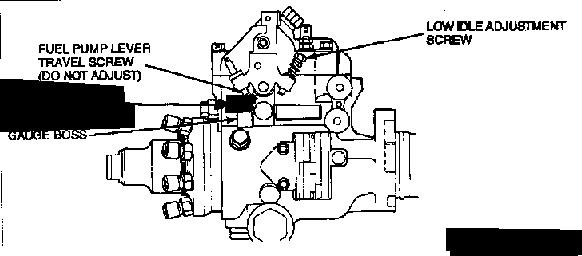 The beeping should become a steady tone. If it doesn't, loosen the FIPL sensor (T-15 torx screws) and adjust to get a steady tone; a faster beeping occurs when the the FIPL is set too low.
 If a scan tool is not available, connect an ohm meter to the top and center FIPL terminals and adjust to 1800 ohms +/- 50 ohms. You can check the adjustment of the FIPL by back-probing the center wire of the FIPL sensor connector with a digital volt meter. The voltage should read 1.0-1.1 volts at idle, 1.6-1.9 at 30 MPH, and 2.0-2.5 at 55 MPH.
If these readings can't be achieved, replace the FIPL sensor and re-start this procedure. It may be necessary to remove the epoxy from the bracket screws (T-27 torx screws) to adjust a new FIPL sensor.</DD>
Last edited by rockcrawlerdude; Nov 29, 2007 at 04:00 PM.

Thread
Thread Starter
Forum
Replies
Last Post
SeminoleSlim
1999 - 2003 7.3L Power Stroke Diesel
25
Jul 15, 2008 10:32 PM
b33cpe
1980 - 1986 Bullnose F100, F150 & Larger F-Series Trucks
3
Feb 4, 2007 12:45 AM


