






SD Towing/Steering issue?
Thread Starter
|
Senior User
Joined: Mar 2003
Posts: 116
Likes: 0
SD Towing/Steering issue?
Went camping this weekend and noticed a couple of odd things. First thing is that my coolant level droped because it appears to have blown out under the cap. It did this before and I replaced the cap. Now I'm not sure what the problem is. The second thing was that after we arrived at our spot I had to make what felt like a seventeen point turn to get backed in to our campsite. After I got parked I noticed that I had shot what looked like P.steering fluid all over the ground at least that's what I think it was. The fluid was reddish in color and felt similar to a light oil. The fluid level did not look low when i checked though. Anyway has anyone heard of issues like this? I recently had the truck serviced, could it be that the they overfilled the p.steering system and cooling system? Any ideas would be appreciated.
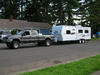
BTW my truck is an 2004 6.0l Crew Cab 4x4 and i'm towing a 7500lb travel trailer.
BTW my truck is an 2004 6.0l Crew Cab 4x4 and i'm towing a 7500lb travel trailer.
Last edited by FourbynFord; Jul 15, 2007 at 11:44 PM.

Sit. Stay.
Joined: Oct 2001
Posts: 18,308
Likes: 20
From: Washington State

The fluid probably didn't look low since it expands when it is heated. Looks at it again when it is cold. I cannot recall if there is a way for the fluid to escape if overfull like a vent of something. Was the reservoir wet? Are all the lines intact and tight?
It coulda been tranny fluid, too since the PS fluid IS tranny fluid. Are you assuming that due to the location of the fluid underneath the truck that it was PS fluid?
As far as coolant...what exactly did they do for this service you speak of?
It coulda been tranny fluid, too since the PS fluid IS tranny fluid. Are you assuming that due to the location of the fluid underneath the truck that it was PS fluid?
As far as coolant...what exactly did they do for this service you speak of?

Elder User
Joined: Jan 2004
Posts: 819
Likes: 0
From: Troy,NY
You could have foamed the heck out of the P/S fluid with that 17 point turn. They could have filled it up a bit too much when it was serviced too. Check the fluid level (hot and cold) and don't keep cranking the wheel against the stops. Ford isn't known for having the best power steering pumps.
Thread Starter
|
Senior User
Joined: Mar 2003
Posts: 116
Likes: 0
Yeah, I thought it might be tranny fluid also so I checked the level of it and it appears to be ok as well. Also the tranny worked flawlessly both going up and coming back, I love not having to waste my brakes coming down the hills with this torqshift. Now that were back in town I'll get under there and really look to see if I can trace it. Also it never leaked any additional fluid either while we drove around while camping and there was no fluid on the ground this morning when I went to work. I know during that parking job I was working the steering very hard since I only had about 18-20 feet to make a 90 degree back in with a 28' trailer which puts me at 53 feet overall length. I tried to minimize putting pressure on the pump unless I was rolling but I 'm sure I didn't the whole time. I'm hoping It was just overfilled
The service I had done was a coolant and power steering flush and fill, I had heard that it's good to keep both fluids fresh in these. I really miss my old 88 F250 which I could turn the wheel with one finger at a dead stop. What was ford thinking on these SD's steering set up?
Any additional ideas of what the problem/s might be?
The service I had done was a coolant and power steering flush and fill, I had heard that it's good to keep both fluids fresh in these. I really miss my old 88 F250 which I could turn the wheel with one finger at a dead stop. What was ford thinking on these SD's steering set up?
Any additional ideas of what the problem/s might be?
Last edited by FourbynFord; Jul 16, 2007 at 09:42 AM.

Senior User
Joined: Apr 2007
Posts: 304
Likes: 0
From: Woodbine, Maryland
To much coolant will cause it to puke until the system levels out to where it will want to be. If it continues to puke and show's really low coolant id give it a chance to see where it levels off at.

Postmaster

Joined: Mar 2001
Posts: 4,968
Likes: 3
From: So Cal
After a long haul especially in hot weather, the metal parts of your engine and tranny have sucked up a lot of heat. When you slow down or stop, the air rushing thru your coolers is no longer there and the heat in the engine and tranny dumps into the fluids. Sometimes this will make them boil over, especially the antifreeze and especially if you stop the engine.
Whenever I come to a stopping place I let the engine idle for a few minutes before shutting off. This helps keep the coolant from boiling over.
Jockeying back and forth with your trailer generates a lot of heat in the tranny and there is nowhere for it to go and very little airflow thru the cooler. Sometimes it will squeeze out from the front main seal and drip out thru the bellhousing. Sometimes it will come out the dipstick tube, this usually also means you had foaming. A powersteering system might also leak and can overheat, but I think it is more likely the red fluid leaked out of your bellhousing.
Just my experience,
Jim Henderson
Whenever I come to a stopping place I let the engine idle for a few minutes before shutting off. This helps keep the coolant from boiling over.
Jockeying back and forth with your trailer generates a lot of heat in the tranny and there is nowhere for it to go and very little airflow thru the cooler. Sometimes it will squeeze out from the front main seal and drip out thru the bellhousing. Sometimes it will come out the dipstick tube, this usually also means you had foaming. A powersteering system might also leak and can overheat, but I think it is more likely the red fluid leaked out of your bellhousing.
Just my experience,
Jim Henderson
Trending Topics
Thread Starter
|
Senior User
Joined: Mar 2003
Posts: 116
Likes: 0
Thought I'd share this as it sounds like it might be more then just an issue on my truck:
TSB
06-21-2 COOLANT DEGAS BOTTLE OVERFLOW - 6.0
ISSUE:
Some 2003-2007 F-Super Duty, 2003-2005 Excursion and 2004-2006 E-Series vehicles, all equipped with a 6.0L engine, may exhibit coolant venting from the degas bottle cap. The condition typically occurs when operating the vehicle under a load such as trailer towing, uphill driving, or both.
ACTION:
Prior to making any repairs verify the coolant level is not overfull. The level should be at the "MIN" line in the degas bottle at operating temperature. Overfilled coolant levels will cause coolant to vent from the degas bottle cap. If the degas bottle is not overfull, and is still venting out coolant, refer to the following Service Procedure.
SERVICE PROCEDURE
Check for cross contamination of engine oil into cooling system by inspecting the coolant condition in the degas bottle. If oil is present in coolant, perform the following repair:
Replace the oil cooler, refer to Workshop Manual, Section 303-01C.
NOTE: ON 2004 E-SERIES 6.0L BUILT BEFORE 05/29/2004, IF THE OIL COOLER IS REPLACED, ALSO REPLACE THE HEATER CORE INLET HOSE, THE REVISED HOSE CONTAINS AN INTERNAL FLOW RESTRICTOR (FIGURE 1). REFER TO TSB 05-2-5 FOR ADDITIONAL INFORMATION.
Clean cooling system with Motorcraft Premium Cooling System Flush (VC-1) following Workshop Manual procedure in Section 303-03, Flushing - Engine and Radiator.
NOTE: IT MAY BE NECESSARY TO FURTHER REMOVE ALL COOLANT HOSES (RADIATOR, DEGAS, AND HEATER) AND CLEAN THEM SEPARATELY. OIL TENDS TO ADHERE TO THE RUBBER AND RESISTS NORMAL FLUSHING.
Check for diagnostic trouble codes (DTCs). Then using WDS datalogger, access the following PIDs and road test the vehicle:
Manifold Gauge Pressure (MGP)
Barometric Pressure (BARO)
Exhaust Gas Recirculation (EGR)
Exhaust Pressure (EP)
Mass Air Flow (MAF)
Manifold Absolute Pressure (MAP)
Engine Coolant Temperature (ECT)
Engine Oil Temperature (EOT)
Verify that MGP, BARO, EGR, EP, MAF and MAP PIDs are within specification, and the EP PID value is within 1.5 psi (10.34 kPa) of the MAP and BARO PID values with key on engine off (KOEO). If PIDs are not within specification, or DTCs are retrieved, refer to PC/ED pinpoint tests. Repair any faults then proceed with the TSB.
NOTE: OVER-BOOST CONDITIONS (HIGHER THAN SPECIFIED MGP) WILL RESULT IN EXCESSIVE CYLINDER PRESSURES, AND MAY BE CAUSED BY ONE (1) OF THE FOLLOWING: IRREGULAR RESPONSE IN VARIABLE GEOMETRY TURBO, BIASED EXHAUST PRESSURE SENSOR, AND/OR IRREGULAR EXHAUST GAS RECIRCULATION.
Verify that ECT and EOT PIDs are within specified ranges (see PC/ED Section 1: Description and Operation of ECT, EOT). EOT should be about 225° F (107° C) when the ECT is 200° F (93° C). If EOT IS NOT within 25° F (14° C) of ECT during the concern, replace the oil cooler. However, first perform all steps through Step 5 before replacing the oil cooler. Refer to Workshop Manual, Section 303-01C.
Check for proper operation of the pressure cap and its seal to the degas bottle. Do not remove the pressure cap. As shown in Figure 2, install the pressure tester to one (1) of the two (2) small ports near the top of the bottle. Then isolate the degas bottle by securely pinching off (or plugging) the other intake deaeration (small) line, and the large hose at the bottom of the bottle between the bottle and the tee fitting. Pressurize the degas bottle by using slow and steady pushes on the tester pump handle (not quick jerking pushes). Pressurize the degas bottle until the gauge pressure levels off, typically between 12-18 psi (83-124 kPa).
Wait 30 seconds, if the gauge holds steady pressure, the pressure cap and degas bottle fill neck lip are good.
If the gauge pressure drops, apply soapy water around the cap to find any leaks. Check the degas bottle fill neck lip for nicks or cracks. Small nicks can be removed by light sanding with fine emery cloth. Re-pressure test, if leaks are still present replace the pressure cap. Re-pressure test again, if leaks are still present replace the degas bottle, refer to Workshop Manual, Section 303-03.
After verifying that the degas bottle and pressure cap are in good condition proceed to Step 4.
EGR COOLER TEST: Install a pressure tester in-line with the degas bottle hose using Rotunda 014-R1068 adapter (Figure 3).
Pressurize the cooling system until the gauge pressure levels off.
Inspect for external leaks especially in the heater core area. Replace the heater core if necessary, refer to Workshop Manual Section 412-02. Also replace the oil cooler at this point if necessary as outlined in Step 2. Refill the system and proceed to Step 4c.
NOTE: ON 2004 E-SERIES 6.0L BUILT BEFORE 05/29/2004, IF THE HEATER CORE OR OIL COOLER ARE REPLACED, ALSO REPLACE THE HEATER CORE INLET HOSE, THE REVISED HOSE CONTAINS AN INTERNAL FLOW RESTRICTOR. REFER TO TSB 05-2-5 FOR ADDITIONAL INFORMATION.
Raise rear of vehicle 2' (61 cm) so front of vehicle is angled down. Pressurize system with pressure tester and remove EGR valve, inspect for coolant in the intake manifold at EGR valve location. Maintain pressure for up to 15 minutes. An EGR cooler gross leak will produce coolant in the intake manifold almost immediately. It will take up to 15 minutes for coolant to be evident in the intake manifold for smallest EGR cooler leak. If coolant is present in intake replace the EGR cooler, refer to Workshop Manual, Section 303-08. (Normally when the EGR cooler has failed, there will be coolant in the exhaust.Hydro locking of the engine is possible.) Refill the system and proceed to Step 5.
NOTE: REPLACE THE OIL COOLER AT THIS POINT IF NECESSARY AS OUTLINED IN STEP 2.
CAUTION: COOLANT ENTERING ANY COMBUSTION CHAMBER MAY CAUSE A HYDRO LOCK CONDITION. EVACUATE INTAKE PASSAGES AND COMBUSTION CHAMBERS OF ALL LIQUIDS. REMOVE GLOW PLUGS (REFER TO WORKSHOP MANUAL, SECTION 303-07B) TO ASSIST IN VENTING LIQUID FROM COMBUSTION CHAMBERS, BEFORE ENGINE IS STARTED.
With the pressure tester still installed as outlined in Step 4, release cooling system pressure, leave tester in place. Seal pressure bleed. Drive the vehicle at WOT / high load / maximum boost, observe whether the cooling system pressure exceeds the holding pressure of 12-18 psi (83-124 kPa) noted in Step 3, and/or if coolant is venting through the degas bottle cap.
If pressure is not greater than the holding pressure noted in Step 3, and no venting from the degas bottle occurs, perform Step 7 (if applicable) and return the vehicle to the customer.
If cooling system pressure is greater than the holding pressure noted in Step 3, and/or the degas bottle cap vents, replace the head gaskets. Refer to Workshop Manual, Section 303-01C for head removal/installation and head flatness specification, check the surface of the heads for flatness and/or imperfections. Refer to Workshop Manual, Section 303-00 for the cylinder head flatness measuring procedures. Use the following revised head bolt torque sequence and specifications (Figure 4).
Ensure the cooling system is thoroughly flushed and new antifreeze installed after all repairs have been completed. Refer to Workshop Manual, Section 303-03. Make certain to follow the cooling system air bleed procedure, or additional failures may result.
For 2004 (built after 9/29/2003) - 2006 F-Super Duty and 2004 (built after 9/29/2003) - 2005 Excursion reprogram the powertrain control module (PCM) to the latest calibration using WDS release B39.12 and higher. Calibration files may also be obtained at Motorcraft Racing.
CYLINDER HEAD HANDLING
Avoid banging, dragging or scratching the cylinder head at all times. When removing the cylinder head, lift the cylinder head straight up off of the dowels so as not to nick the cylinder head
Once the cylinder head is removed, place the cylinder head on a bench with the gasket side up. If the gasket surface must be turned down, use a piece of clean cardboard on the bench surface to protect the cylinder head from damage. Do not allow the cylinder head to slide on the gasket surface, even on cardboard
CLEANING THE CYLINDER HEAD AND DECK SURFACE
The only tools approved by Ford Motor Company for cleaning the cylinder head and deck surface are plastic (Figure 5) and wood scrapers, combined with use of Ford approved cleaners. Ensure that the mating cylinder block deck surface is completely free of solid contamination, corrosion, and fluids. Use cleaners Motorcraft Silicone Gasket Remover (ZC-30) and Motorcraft Metal Surface Prep (ZC-31) to rid the deck surface of any material that could later interfere with the gasket sealing ability
NOTE: STAINING OF THE METAL SURFACE IS CONSIDERED NORMAL AND DOES NOT AFFECT SEALING ABILITY.
CAUTION: DO NOT CLEAN DECK SURFACES UNDER ANY CIRCUMSTANCE WITH STEEL RAZOR BLADES, ROTARY ABRASIVE DEVICES, OR ABRASIVES INCLUDING: ROLOC AND 3M BRANDED SCOTCHBRITE PRODUCTS OR EQUIVALENTS, ROTARY WIRE BRUSHES, SINGLE HANDLED WIRE BRUSHES, HAND ABRASIVES SUCH AS SANDPAPER OR EMERY CLOTH, ANY CARBON STEEL BLADE. THESE PRODUCTS WILL CUT AND DAMAGE DECK SURFACES RESULTING IN LEAKS. ABRASIVE PARTICLES MAY ALSO ENTER THE ENGINE CAVITIES CAUSING INTERNAL ENGINE DAMAGE. USE OF THESE TOOLS CAN ALSO GREATLY AFFECT THE FLATNESS OF THE SURFACE.
PART NUMBER PART NAME
5C3Z-6079-C Head Gasket (All Model Years Universal Kit Includes Both Head Gaskets)
3C3Z-9P456-AE EGR Cooler (Built Before 9/29/2003)
4C3Z-9P456-AF EGR Cooler (Built 9/29/2003 And After)
3C3Z-6A642-AA Oil Cooler
5C2Z-18472-AA Hose - Inlet Heat Core
6C3Z-8A080-B Degas Bottle (F-Series, Excursion)
4C2Z-8A080-AA Degas Bottle (E-Series)
4C2Z-18476-AA Heater Core (E-Series)
4C3Z-18476-BA Heater Core (F-Series, Excursion)
F6DZ-8100-A Cap - Degas Bottle
VC-1 Motorcraft Premium Cooling System Flush
TSB
06-21-2 COOLANT DEGAS BOTTLE OVERFLOW - 6.0
ISSUE:
Some 2003-2007 F-Super Duty, 2003-2005 Excursion and 2004-2006 E-Series vehicles, all equipped with a 6.0L engine, may exhibit coolant venting from the degas bottle cap. The condition typically occurs when operating the vehicle under a load such as trailer towing, uphill driving, or both.
ACTION:
Prior to making any repairs verify the coolant level is not overfull. The level should be at the "MIN" line in the degas bottle at operating temperature. Overfilled coolant levels will cause coolant to vent from the degas bottle cap. If the degas bottle is not overfull, and is still venting out coolant, refer to the following Service Procedure.
SERVICE PROCEDURE
Check for cross contamination of engine oil into cooling system by inspecting the coolant condition in the degas bottle. If oil is present in coolant, perform the following repair:
Replace the oil cooler, refer to Workshop Manual, Section 303-01C.
NOTE: ON 2004 E-SERIES 6.0L BUILT BEFORE 05/29/2004, IF THE OIL COOLER IS REPLACED, ALSO REPLACE THE HEATER CORE INLET HOSE, THE REVISED HOSE CONTAINS AN INTERNAL FLOW RESTRICTOR (FIGURE 1). REFER TO TSB 05-2-5 FOR ADDITIONAL INFORMATION.
Clean cooling system with Motorcraft Premium Cooling System Flush (VC-1) following Workshop Manual procedure in Section 303-03, Flushing - Engine and Radiator.
NOTE: IT MAY BE NECESSARY TO FURTHER REMOVE ALL COOLANT HOSES (RADIATOR, DEGAS, AND HEATER) AND CLEAN THEM SEPARATELY. OIL TENDS TO ADHERE TO THE RUBBER AND RESISTS NORMAL FLUSHING.
Check for diagnostic trouble codes (DTCs). Then using WDS datalogger, access the following PIDs and road test the vehicle:
Manifold Gauge Pressure (MGP)
Barometric Pressure (BARO)
Exhaust Gas Recirculation (EGR)
Exhaust Pressure (EP)
Mass Air Flow (MAF)
Manifold Absolute Pressure (MAP)
Engine Coolant Temperature (ECT)
Engine Oil Temperature (EOT)
Verify that MGP, BARO, EGR, EP, MAF and MAP PIDs are within specification, and the EP PID value is within 1.5 psi (10.34 kPa) of the MAP and BARO PID values with key on engine off (KOEO). If PIDs are not within specification, or DTCs are retrieved, refer to PC/ED pinpoint tests. Repair any faults then proceed with the TSB.
NOTE: OVER-BOOST CONDITIONS (HIGHER THAN SPECIFIED MGP) WILL RESULT IN EXCESSIVE CYLINDER PRESSURES, AND MAY BE CAUSED BY ONE (1) OF THE FOLLOWING: IRREGULAR RESPONSE IN VARIABLE GEOMETRY TURBO, BIASED EXHAUST PRESSURE SENSOR, AND/OR IRREGULAR EXHAUST GAS RECIRCULATION.
Verify that ECT and EOT PIDs are within specified ranges (see PC/ED Section 1: Description and Operation of ECT, EOT). EOT should be about 225° F (107° C) when the ECT is 200° F (93° C). If EOT IS NOT within 25° F (14° C) of ECT during the concern, replace the oil cooler. However, first perform all steps through Step 5 before replacing the oil cooler. Refer to Workshop Manual, Section 303-01C.
Check for proper operation of the pressure cap and its seal to the degas bottle. Do not remove the pressure cap. As shown in Figure 2, install the pressure tester to one (1) of the two (2) small ports near the top of the bottle. Then isolate the degas bottle by securely pinching off (or plugging) the other intake deaeration (small) line, and the large hose at the bottom of the bottle between the bottle and the tee fitting. Pressurize the degas bottle by using slow and steady pushes on the tester pump handle (not quick jerking pushes). Pressurize the degas bottle until the gauge pressure levels off, typically between 12-18 psi (83-124 kPa).
Wait 30 seconds, if the gauge holds steady pressure, the pressure cap and degas bottle fill neck lip are good.
If the gauge pressure drops, apply soapy water around the cap to find any leaks. Check the degas bottle fill neck lip for nicks or cracks. Small nicks can be removed by light sanding with fine emery cloth. Re-pressure test, if leaks are still present replace the pressure cap. Re-pressure test again, if leaks are still present replace the degas bottle, refer to Workshop Manual, Section 303-03.
After verifying that the degas bottle and pressure cap are in good condition proceed to Step 4.
EGR COOLER TEST: Install a pressure tester in-line with the degas bottle hose using Rotunda 014-R1068 adapter (Figure 3).
Pressurize the cooling system until the gauge pressure levels off.
Inspect for external leaks especially in the heater core area. Replace the heater core if necessary, refer to Workshop Manual Section 412-02. Also replace the oil cooler at this point if necessary as outlined in Step 2. Refill the system and proceed to Step 4c.
NOTE: ON 2004 E-SERIES 6.0L BUILT BEFORE 05/29/2004, IF THE HEATER CORE OR OIL COOLER ARE REPLACED, ALSO REPLACE THE HEATER CORE INLET HOSE, THE REVISED HOSE CONTAINS AN INTERNAL FLOW RESTRICTOR. REFER TO TSB 05-2-5 FOR ADDITIONAL INFORMATION.
Raise rear of vehicle 2' (61 cm) so front of vehicle is angled down. Pressurize system with pressure tester and remove EGR valve, inspect for coolant in the intake manifold at EGR valve location. Maintain pressure for up to 15 minutes. An EGR cooler gross leak will produce coolant in the intake manifold almost immediately. It will take up to 15 minutes for coolant to be evident in the intake manifold for smallest EGR cooler leak. If coolant is present in intake replace the EGR cooler, refer to Workshop Manual, Section 303-08. (Normally when the EGR cooler has failed, there will be coolant in the exhaust.Hydro locking of the engine is possible.) Refill the system and proceed to Step 5.
NOTE: REPLACE THE OIL COOLER AT THIS POINT IF NECESSARY AS OUTLINED IN STEP 2.
CAUTION: COOLANT ENTERING ANY COMBUSTION CHAMBER MAY CAUSE A HYDRO LOCK CONDITION. EVACUATE INTAKE PASSAGES AND COMBUSTION CHAMBERS OF ALL LIQUIDS. REMOVE GLOW PLUGS (REFER TO WORKSHOP MANUAL, SECTION 303-07B) TO ASSIST IN VENTING LIQUID FROM COMBUSTION CHAMBERS, BEFORE ENGINE IS STARTED.
With the pressure tester still installed as outlined in Step 4, release cooling system pressure, leave tester in place. Seal pressure bleed. Drive the vehicle at WOT / high load / maximum boost, observe whether the cooling system pressure exceeds the holding pressure of 12-18 psi (83-124 kPa) noted in Step 3, and/or if coolant is venting through the degas bottle cap.
If pressure is not greater than the holding pressure noted in Step 3, and no venting from the degas bottle occurs, perform Step 7 (if applicable) and return the vehicle to the customer.
If cooling system pressure is greater than the holding pressure noted in Step 3, and/or the degas bottle cap vents, replace the head gaskets. Refer to Workshop Manual, Section 303-01C for head removal/installation and head flatness specification, check the surface of the heads for flatness and/or imperfections. Refer to Workshop Manual, Section 303-00 for the cylinder head flatness measuring procedures. Use the following revised head bolt torque sequence and specifications (Figure 4).
Ensure the cooling system is thoroughly flushed and new antifreeze installed after all repairs have been completed. Refer to Workshop Manual, Section 303-03. Make certain to follow the cooling system air bleed procedure, or additional failures may result.
For 2004 (built after 9/29/2003) - 2006 F-Super Duty and 2004 (built after 9/29/2003) - 2005 Excursion reprogram the powertrain control module (PCM) to the latest calibration using WDS release B39.12 and higher. Calibration files may also be obtained at Motorcraft Racing.
CYLINDER HEAD HANDLING
Avoid banging, dragging or scratching the cylinder head at all times. When removing the cylinder head, lift the cylinder head straight up off of the dowels so as not to nick the cylinder head
Once the cylinder head is removed, place the cylinder head on a bench with the gasket side up. If the gasket surface must be turned down, use a piece of clean cardboard on the bench surface to protect the cylinder head from damage. Do not allow the cylinder head to slide on the gasket surface, even on cardboard
CLEANING THE CYLINDER HEAD AND DECK SURFACE
The only tools approved by Ford Motor Company for cleaning the cylinder head and deck surface are plastic (Figure 5) and wood scrapers, combined with use of Ford approved cleaners. Ensure that the mating cylinder block deck surface is completely free of solid contamination, corrosion, and fluids. Use cleaners Motorcraft Silicone Gasket Remover (ZC-30) and Motorcraft Metal Surface Prep (ZC-31) to rid the deck surface of any material that could later interfere with the gasket sealing ability
NOTE: STAINING OF THE METAL SURFACE IS CONSIDERED NORMAL AND DOES NOT AFFECT SEALING ABILITY.
CAUTION: DO NOT CLEAN DECK SURFACES UNDER ANY CIRCUMSTANCE WITH STEEL RAZOR BLADES, ROTARY ABRASIVE DEVICES, OR ABRASIVES INCLUDING: ROLOC AND 3M BRANDED SCOTCHBRITE PRODUCTS OR EQUIVALENTS, ROTARY WIRE BRUSHES, SINGLE HANDLED WIRE BRUSHES, HAND ABRASIVES SUCH AS SANDPAPER OR EMERY CLOTH, ANY CARBON STEEL BLADE. THESE PRODUCTS WILL CUT AND DAMAGE DECK SURFACES RESULTING IN LEAKS. ABRASIVE PARTICLES MAY ALSO ENTER THE ENGINE CAVITIES CAUSING INTERNAL ENGINE DAMAGE. USE OF THESE TOOLS CAN ALSO GREATLY AFFECT THE FLATNESS OF THE SURFACE.
PART NUMBER PART NAME
5C3Z-6079-C Head Gasket (All Model Years Universal Kit Includes Both Head Gaskets)
3C3Z-9P456-AE EGR Cooler (Built Before 9/29/2003)
4C3Z-9P456-AF EGR Cooler (Built 9/29/2003 And After)
3C3Z-6A642-AA Oil Cooler
5C2Z-18472-AA Hose - Inlet Heat Core
6C3Z-8A080-B Degas Bottle (F-Series, Excursion)
4C2Z-8A080-AA Degas Bottle (E-Series)
4C2Z-18476-AA Heater Core (E-Series)
4C3Z-18476-BA Heater Core (F-Series, Excursion)
F6DZ-8100-A Cap - Degas Bottle
VC-1 Motorcraft Premium Cooling System Flush
FTE Stories
Ford Trucks for Ford Truck Enthusiasts

Top 10 Fords at 2026 Carlisle Ford Nationals
Joe Kucinski
3 Best / 3 Worst Parts of Modern Ford Ownership
Brett Foote
10 Amazing Upgrades That Solve Common Ford Truck Owner Headaches
Pouria Savadkouei
Every 2026 Ford Engine Explained
Brett Foote
10 Ugly Ford Trucks That We Still Kinda Love
Joe Kucinski
10 Things Every Truck Owner NEEDS (2026 Edition)
Michael S. Palmer
Rezvani's Latest Post-Apocalyptic Monster Is a Ford F-150 Raptor Underneath
Verdad Gallardo
Top 10 Most Expensive Ford Trucks Ever Sold on Bring a Trailer
Joe Kucinski
2027 Ford Super Duty Buyer's Guide (Every Model, Engine, & Package)
Brett Foote
Elder User
Joined: Oct 2004
Posts: 855
Likes: 5
Originally Posted by FourbynFord
CAUTION: DO NOT CLEAN DECK SURFACES UNDER ANY CIRCUMSTANCE WITH STEEL RAZOR BLADES, ROTARY ABRASIVE DEVICES, OR ABRASIVES INCLUDING: ROLOC AND 3M BRANDED SCOTCHBRITE PRODUCTS OR EQUIVALENTS, ROTARY WIRE BRUSHES, SINGLE HANDLED WIRE BRUSHES, HAND ABRASIVES SUCH AS SANDPAPER OR EMERY CLOTH, ANY CARBON STEEL BLADE. THESE PRODUCTS WILL CUT AND DAMAGE DECK SURFACES RESULTING IN LEAKS. ABRASIVE PARTICLES MAY ALSO ENTER THE ENGINE CAVITIES CAUSING INTERNAL ENGINE DAMAGE. USE OF THESE TOOLS CAN ALSO GREATLY AFFECT THE FLATNESS OF THE SURFACE.