


Towing Question

Thread Starter
|
Freshman User
Joined: Jan 2006
Posts: 27
Likes: 0
Towing Question
Hi Ya'll, I'm new to this forum. I haven't been here because I didn't own a ford (have owned many in the past) but I needed a tow vehicle so I recently bought a 1993 F350-dually-flat bed-7.3L non turbo diesel-standard trans.This was a work truck, called a hot shot truck in the oil fields. It has 387,000 miles on the odometer but a Jasper crate engine was installed about 90,000 miles ago. It is very clean & runs great. I have the receipts that show the previous owner spent over $10,000 on the engine & clutch. I need to tell you that I have never owned a diesel before & know nothing about them. I told you all this because I have a question. I bought this truck to tow a 10,000# RV. At the time that I bought it I was convinced that it would tow anything,after all the previous owner had been towing a big goose neck trailer.I later found out that I was wrong. from what I have learned the engine is 185HP & 400# of torque. A RV dealer in baton rouge told me that it should pull 11,000# another dealer in texas told me that it would only tow about 8,500# so now I don't know what to think. I haven't bought the RV yet because I'm worried that I will not be able to safely tow it. So the question is how much do you think that this truck will tow?

Post Fiend
Joined: Nov 2004
Posts: 5,638
Likes: 1
From: Manitoba
You don't mention a rear axle ratio. With a turbo it could do much better, but here is the Ford info for 93, it shows as a bit under rated they can do better with some tweeking.
This is right from the Recreational vehicle and trailer towing guide 1992-3....
The GCWR of the Fseries trucks towing a frame hitched trailer.
F series with 7.3 and automatic is:
355....12000lbs
410....17000lbs
F series with 7.3 and manual is:
355....12000lbs
410....14000lbs
The CGWR of the Fseries trucks towing a Fifth wheel trailer.
F series with 7.3 automatic is:
355....12000lbs
410....17000lbs
513....18000lbs
Fseries with 7.3 and manual is:
355....12000lbs
410....14000lbs
513....17000lbs
This is right from the Recreational vehicle and trailer towing guide 1992-3....
The GCWR of the Fseries trucks towing a frame hitched trailer.
F series with 7.3 and automatic is:
355....12000lbs
410....17000lbs
F series with 7.3 and manual is:
355....12000lbs
410....14000lbs
The CGWR of the Fseries trucks towing a Fifth wheel trailer.
F series with 7.3 automatic is:
355....12000lbs
410....17000lbs
513....18000lbs
Fseries with 7.3 and manual is:
355....12000lbs
410....14000lbs
513....17000lbs
Thread Starter
|
Freshman User
Joined: Jan 2006
Posts: 27
Likes: 0
Yes, Ishould have told you that it has a 410 rear end, according to the chart it should tow 14,000#. I can also tell you that it is a standard cab with a flatbed.14,000# seems like a lot, if it will tow that I will be well satisfied. where can I find that chart? Thanks
Last edited by DeepDiver; Jan 7, 2006 at 05:37 AM.

Fleet Owner


Joined: Jun 2004
Posts: 25,090
Likes: 1,112
From: Rio Rico, AZ.
If you have some extra to invest in the truck, put a turbocharger on it and a pyrometer. It will lower the EGT with the extra air going through the engine and give you a lot of extra power for pulling the trailer up the hill. Dave Sponaugle (sorry about the spelling Dave) is the expert on the older trucks here in this forum. Lot's of good information. Do a search for his posts.
Lead Driver

Joined: Jan 2005
Posts: 7,782
Likes: 221
From: Huntington Indiana

I have the same truck towing a 9000 lb trailer and you will be ok on the flats but when you get into hills and mountains then you will be working it. it isn't a speed setting truck for towing but a good workhorse. With a manual towing I start out in first gear just to get moving ( do this to save the clutch). You can start in second but it will be hard on the clutch lining.

FTE Leadership Emeritus

Joined: May 2001
Posts: 13,653
Likes: 6
From: Cabot, Arkansas
Most people are pleasantly surprised how well the old IDI's tow in stock form. Those that aren't satisfied come back here and learn all about how to modify it for better towing performance.
My brother-in-law has stock 93 and it runs surprisingly well. I only say surprisingly because I am used to a modified Powerstroke, so I expected it to be a total dog by comparison....but it isn't.
My brother-in-law has stock 93 and it runs surprisingly well. I only say surprisingly because I am used to a modified Powerstroke, so I expected it to be a total dog by comparison....but it isn't.
Fleet Owner
Joined: Jun 2004
Posts: 25,090
Likes: 1,112
From: Rio Rico, AZ.
Originally Posted by cookie88
Most people are pleasantly surprised how well the old IDI's tow in stock form. Those that aren't satisfied come back here and learn all about how to modify it for better towing performance.
My brother-in-law has stock 93 and it runs surprisingly well. I only say surprisingly because I am used to a modified Powerstroke, so I expected it to be a total dog by comparison....but it isn't.
My brother-in-law has stock 93 and it runs surprisingly well. I only say surprisingly because I am used to a modified Powerstroke, so I expected it to be a total dog by comparison....but it isn't.

Trending Topics

New User
Joined: Aug 2003
Posts: 21
Likes: 0
From: Vallejo, Ca

Originally Posted by DeepDiver
Yes, Ishould have told you that it has a 410 rear end, according to the chart it should tow 14,000#. I can also tell you that it is a standard cab with a flatbed.14,000# seems like a lot, if it will tow that I will be well satisfied. where can I find that chart? Thanks
Don't forget. That's 14,000# combined weight, not towed weight.
Ed
FTE Stories
Ford Trucks for Ford Truck Enthusiasts

Top 6 Best Deals Available on New Fords & Lincolns Right Now
Brett Foote
This Hennessey Takes the Expedition Tremor's Off-Roading Capability to the Next Level
Verdad Gallardo
Top 10 Fords at 2026 Carlisle Ford Nationals
Joe Kucinski
3 Best / 3 Worst Parts of Modern Ford Ownership
Brett Foote
10 Amazing Upgrades That Solve Common Ford Truck Owner Headaches
Pouria Savadkouei
Every 2026 Ford Engine Explained
Brett Foote
10 Ugly Ford Trucks That We Still Kinda Love
Joe Kucinski
10 Things Every Truck Owner NEEDS (2026 Edition)
Michael S. Palmer
Rezvani's Latest Post-Apocalyptic Monster Is a Ford F-150 Raptor Underneath
Verdad Gallardo
Post Fiend
Joined: Nov 2003
Posts: 21,285
Likes: 16
From: Nutter Fort, WV


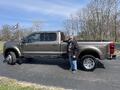
And here is a picture of a 6.9 turbo that is a little over 20,000 gross with a 3.55 rear end and manual tranny.
I have no problems in the mountains with this setup and weight.
The brakes are the weak point in the equation, keep them in top notch condition on both the truck and trailer.
The non turbo motor will pull just as much, it is just not as fast.
Post Fiend
Joined: Nov 2003
Posts: 21,285
Likes: 16
From: Nutter Fort, WV
What is your definition of struggling?
Are you going to tow 10,000 pounds up a 10 percent grade at 70 MPH?
The answer is no you are not.
Can you tow 10,000 pounds up a 10 percent grade?
Yes you can.
How fast will you be going?
The answer to that depends on a lot of things.
Box trailer aerodynamics,
A RV trailer is usually a tall box, it catches a lot of wind so it will be hard to drag.
Aerodynamics very similar to a cement block.
If you are bucking a head wind it will slow you down a lot.
If you are going up a hill and bucking a head wind it will slow you down even more.
The frontal surface area and the large hole in the air behind the trailer you will be pulling will be more of an issue than the weight will as far as speed goes.
What I mean by this is pay attention the next time a big rig pulling a box trailer blows by you running real fast. As he is starting to pass you your vehicle wants to be pushed away from the truck. But as soon as he passes you the vehicle wants to be sucked in behind the trailer.
The air in front of the truck takes horse power to punch through.
Once it is punced through and the air is displaced, once it passes there is a hole in the air left. That hole is actually harder to drag than it is to punch the front through.
If you get in a small car and get close enough to the back of a semi trailer, you can actually put the car in neutral and the truck will pull you along. Even up small hills if you are real close and the truck is going fast enough. Works just like drafting in NASCAR. A pack of cars in line and real close can go faster than one car alone can.
When I used to drive tractor trailer there would be days when the wind was blowing and I would have to drop 3 or 4 gears to keep the EGT's down to a safe level. If you turbo your truck, or if you get a Power Stroke truck you will have the same issues.
Also a head wind is anything blowing from 70 degrees to your left to 70 degrees to your right toward the front of the truck.
Why do I not have any problems dragging over 12,000 pounds of trailer through the mountains?
Because it does not catch much wind even though it weighs a lot.
Also I have done a lot of work to my truck in the power and stopping departments. I did tow the same kinds of loads with the factory set up 6.9 back when it was younger. I was not the fastest thing up the hills. Usually I was the slowest, but I always got to where I was going.
Kwik you were perfect with your spelling.
Expert? Well I am not so sure about that, but I do have a lot of opinions most of which were learned the hard way. (pronounced "EXPENSIVE")
Are you going to tow 10,000 pounds up a 10 percent grade at 70 MPH?
The answer is no you are not.
Can you tow 10,000 pounds up a 10 percent grade?
Yes you can.
How fast will you be going?
The answer to that depends on a lot of things.
Box trailer aerodynamics,
A RV trailer is usually a tall box, it catches a lot of wind so it will be hard to drag.
Aerodynamics very similar to a cement block.
If you are bucking a head wind it will slow you down a lot.
If you are going up a hill and bucking a head wind it will slow you down even more.
The frontal surface area and the large hole in the air behind the trailer you will be pulling will be more of an issue than the weight will as far as speed goes.
What I mean by this is pay attention the next time a big rig pulling a box trailer blows by you running real fast. As he is starting to pass you your vehicle wants to be pushed away from the truck. But as soon as he passes you the vehicle wants to be sucked in behind the trailer.
The air in front of the truck takes horse power to punch through.
Once it is punced through and the air is displaced, once it passes there is a hole in the air left. That hole is actually harder to drag than it is to punch the front through.
If you get in a small car and get close enough to the back of a semi trailer, you can actually put the car in neutral and the truck will pull you along. Even up small hills if you are real close and the truck is going fast enough. Works just like drafting in NASCAR. A pack of cars in line and real close can go faster than one car alone can.
When I used to drive tractor trailer there would be days when the wind was blowing and I would have to drop 3 or 4 gears to keep the EGT's down to a safe level. If you turbo your truck, or if you get a Power Stroke truck you will have the same issues.
Also a head wind is anything blowing from 70 degrees to your left to 70 degrees to your right toward the front of the truck.
Why do I not have any problems dragging over 12,000 pounds of trailer through the mountains?
Because it does not catch much wind even though it weighs a lot.
Also I have done a lot of work to my truck in the power and stopping departments. I did tow the same kinds of loads with the factory set up 6.9 back when it was younger. I was not the fastest thing up the hills. Usually I was the slowest, but I always got to where I was going.
Kwik you were perfect with your spelling.
Expert? Well I am not so sure about that, but I do have a lot of opinions most of which were learned the hard way. (pronounced "EXPENSIVE")
Last edited by Dave Sponaugle; Jan 7, 2006 at 08:24 PM.
Post Fiend
Joined: Nov 2003
Posts: 21,285
Likes: 16
From: Nutter Fort, WV
You are welcome, I realize I probably did not answer your questions well enough for what you want to know.
But you also have to think about all the variables involved.
A natural aspirated diesel is sensitive to elevation also.
Higher altitude, less air pressure, less oxygen into the cylinder, less power.
Trailers come in so many different configurations that there is no fits all answer.
My 20 year old truck will pull about anything I hook to it.
It is paid for many times over just with money it has earned working.
Being able to run 10 MPH faster up a hill is not worth the extra insurance premium or truck payment that goes with it in my book.
I am old enough that I am not in that much of a hurry to get anywhere.
I did more than enough racing around the country at insane speeds in a truck when I was a meat hauler. 46,000 pounds of swinging meat that had to be 1800 miles away tomorrow so someone could eat fresh steak in NYC or Boston or another big town.
But you also have to think about all the variables involved.
A natural aspirated diesel is sensitive to elevation also.
Higher altitude, less air pressure, less oxygen into the cylinder, less power.
Trailers come in so many different configurations that there is no fits all answer.
My 20 year old truck will pull about anything I hook to it.
It is paid for many times over just with money it has earned working.
Being able to run 10 MPH faster up a hill is not worth the extra insurance premium or truck payment that goes with it in my book.
I am old enough that I am not in that much of a hurry to get anywhere.
I did more than enough racing around the country at insane speeds in a truck when I was a meat hauler. 46,000 pounds of swinging meat that had to be 1800 miles away tomorrow so someone could eat fresh steak in NYC or Boston or another big town.
Lead Driver
Joined: Jan 2005
Posts: 7,782
Likes: 221
From: Huntington Indiana
 Dave - at least you wasn't one of the cattle haulers going cross county. Hate the smell.
You sure do have a nice looking truck and I could do some damage on my farm with the hoe.
Last edited by bigredtruckmi; Jan 7, 2006 at 09:08 PM.
Thread Starter
|
Freshman User
Joined: Jan 2006
Posts: 27
Likes: 0
I think I understand, I also did a lot of traveling when I was younger. I am not interested in speed, like you said, I just want to get there and I want to do it safely and without destroying my truck. Another question, my truck turns about 2300 rpm's at 65mph. I would be satisfied to tow at 60 or 65mph. Will the rpm's change when I'm towing? What is a safe range to tow at? The tach shows yellow at 3500 & red at 4000. Where is the power band on this engine?