When you click on links to various merchants on this site and make a purchase, this can result in this site earning a commission. Affiliate programs and affiliations include, but are not limited to, the eBay Partner Network.
Looking into finishing my brake setup and was revisiting the front thunderbird caliper upgrade i have seen people do. I have read a bunch of the threads and some videos, where it essentially requires you to grind down the banjo bolt inlet to accept the brake line. My question is, is this only required to use the original style brake lines or can you just use a different style banjo bolt? I know this is mainly for clearance with the knuckle, But can you just use one like the one below?
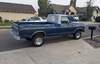
I know James Duffs sells a kit thats meant for broncos, "https://dufftuff.com/product/t-bird-caliper-upgrade/". But that would still work as intended. Please note that the axle under my 66 is a dana 44 from a 77 f150. As such it has front disc brakes.
Bigger banjo bolts (7/16 x 14 if I recall correctly). I had to trim some ears off the brake hose block and drill the hole bigger to accommodate the bigger banjo bolt. The stock banjo bolt and brake hose it wasn't a snug fit so brake fluid can flow. I tried to match the amount of gap when I drilled it out for the larger banjo.
You may need to modify the caliper so there is a flat spot for the brake hose fitting to sit flush and seal properly. My passenger side caliper didn't need to be modified. I discovered the driver's side wasn't sealed and ended up stacking a couple copper washer. Next time I have the calipers off I will do some grinding to make a flat surface that will seal with a single washer.
When I replace the stock rubber brake hoses, I intend to use a round banjo fitting like the james duff image you posted. Banjo to -4AN and braided stainless brake hose and pre-bent stainless line like I used on the rear disc conversion. I have some pre-bent stainless line from in-line tube to use for the front diff.
That round banjo fitting should work fine as long I orient it the same as the factory hose routing.
When I replace the stock rubber brake hoses, I intend to use a round banjo fitting like the james duff image you posted. Banjo to -4AN and braided stainless brake hose and pre-bent stainless line like I used on the rear disc conversion. I have some pre-bent stainless line from in-line tube to use for the front diff.
That round banjo fitting should work fine as long I orient it the same as the factory hose routing.
Hey, I was wondering if it's possible to install this caliper without having to drill or cut anything to make it fit? I found this youtube video and it seems like the guy in the video uses a -4AN "fitting" and doesnt modify anything, but he doesnt really go into detail and I've no idea what a -4AN fitting is. Google shows me pictures of a loop on a threaded stick.
I saw your post about your build and you include part numbers for a different banjo bolt you used but I'm trying to figure out if this can be done without any drilling or cutting anything. Also, in the youtube video the guy uses a braided soft line and I'm not sure what line that is. Please help I have no idea what I'm doing
He's using a universal braided stainless brake hose and a fitting to adapt to the steel line with inverted flare fittings.
-4 is the size. AN = Army/Navy fitting. I recall AN fittings use a 37* angle where an inverted flare uses 45* angle. -4AN is roughly equal to 1/4" I.D. tubing.
Similar to the set up on my rear disc conversion. You use an inverted flare to -4AN conversion fitting that you clip into a bracket. In the rear disc conversion on mine I used a female -4AN with banjo fitting on the other side braided hose to connect the hard line to the caliper. You can get the banjo fitting for brake caliper side without hose already attached. The banjo fitting is sized for the banjo bolt that screws into the caliper. You can get a braided hose with -4AN female fittings on each end and get a separate banjo fittings instead of getting a preassembled hose like I used for my rear disc conversion.
This Hennessey Takes the Expedition Tremor's Off-Roading Capability to the Next Level
Slideshow: The VelociRaptor Expedition gains a lift, upgraded suspension, Brembo brakes, and trail-ready equipment while retaining the stock 440-horsepower EcoBoost V6.
Rezvani's Latest Post-Apocalyptic Monster Is a Ford F-150 Raptor Underneath
Slideshow: Called the Fortress, the 850-horsepower pickup combines Raptor underpinnings with military-inspired features, survival equipment, and a starting price of $285,000.